 |
|
|
|
|
|
|
|
|
|
|
|
|
|
|
|
|
|
|
|
|
|
|
|
|
|
|
|
|
|
|
|
|
|
|
|
|
|
|
|
|
|
|
|
|
|
|
|
|
|
|
|
|
|
|
|
|
|
|
|
|
|
|

|
|
|
|
|
|
|
|
|
|
|
|
|
|
|
|
|
|
|
|
|
|
|
|
|
|
|
In 1513, Ponce de Leon discovered Florida while he was searching for the fountain of youth. He was driven away by local Indians. About ten years later, he returned but was again driven away, this time getting shot by the Indians and dying five days later. Ponce de Leon was 4' 11," tall for a Spaniard whose average height back then was 4' 5" to 4' 8." However, the average height of local Indians both male and female was over 6' tall!
On September 8, 1565, Pedro Menendez de Aviles founded a colony for his king, Phillip II of Spain. Menendez established his claim on the day of the Festival of Saint Augustine so the new colony was named St. Augustine. Its history is full of fire, starvation, storms, pestilence, and attacks from Indians, British and French forces. The settlement persevered, surviving as the oldest continuing European settlement in continental North America.
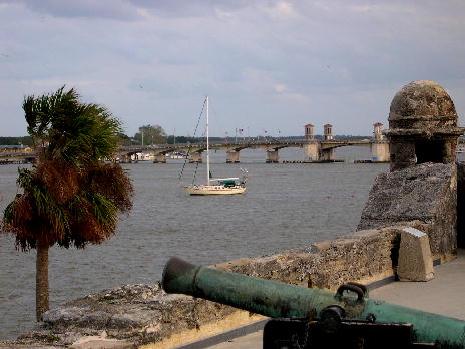
The bridge across the Mantanzas River was named the Henry Flagler Memorial Bridge until 1928 when Dr. Anderson, Flagler's physician, donated two Italian marble lions to be positioned on either side of the bridge. After that, the bridge was called the Bridge of Lions. The plaza and park in front of the Bridge of Lions used to be the town's open market.
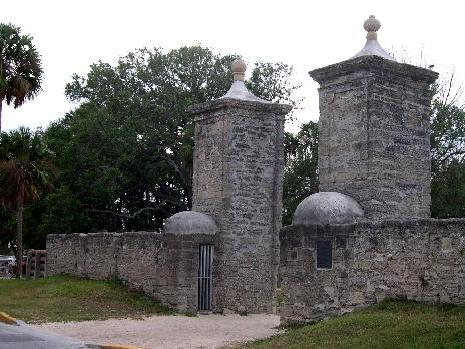
The city was surrounded by a wall. The only entrance was across the drawbridge. If you were not inside the wall by evening, you were left outside until the next morning.
|
|
|
|
|
|
|
|
|
 |
|
 |
|
|
|
|
|
|
|
|
|
Viking Rose anchored between the Bridge of Lions and the fort
|
|
|
|
|
|
|
|
|
|
Gate to the old city wall
|
|
|
|
|
|
|
|
|
|
|
|
|
|
|
|
|
Construction of the fort began in 1672 and was completed in 1695. Soldiers, local people, and Indians did the work. In 1702, several English ships attacked the fort but could not penetrate it. They burned the town of St. Augustine and continued their siege. Four Spanish ships came in from the ocean, arriving from Cuba, and the English chose to burn their six small ships and flee over land rather than be captured.
|
|
|
|
|
|
|
|
|
 |
|
 |
|
|
|
|
|
|
|
|
|
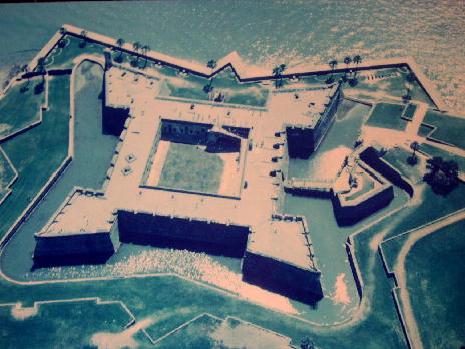
Spanish engineer Ignacio Daza designed a hollow square with diamond-shaped bastions at each corner. The low-profile fort sat below ground so as not to present high walls to a barrage of artillery. Similar Spanish forts were built in Cartagena, Veracruz, and San Juan.
|
|
|
|
|
|
|
|
|
|
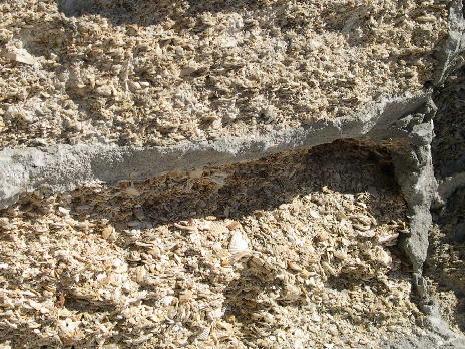
The fort was constructed of coquina, a white sand stone of compressed fragments of sea shells and sea materials, cut from a quarry across the bay on Anastasia Island.
|
|
|
|
|
|
|
|
|
|
|
|
|
|
|
|
|
In 1740, Georgia Governor James Oglethorpe attacked the fort, and after 38 days of siege, gave up. One of his soldiers is reported to have said that the coquina "will not splinter but will give way to a cannonball as though you would stick a knife through butter." Robert L. Gold, Historian, "The Story of St. Augustine" in St. Augustine's Red Train Tour Book, Summer/Fall 2004, p.6.
The tour guide told us that during the siege, Spanish soldiers would sneak out of the fort at night, pull cannon balls from the coquina, paint the hole white, and return to the fort so that the next morning, the English could see no evidence that their weapons had even reached the fort!
|
|
|
|
|
|
|
|
|
|
 |
|
 |
|
|
|
|
|
|
|
|
|
|
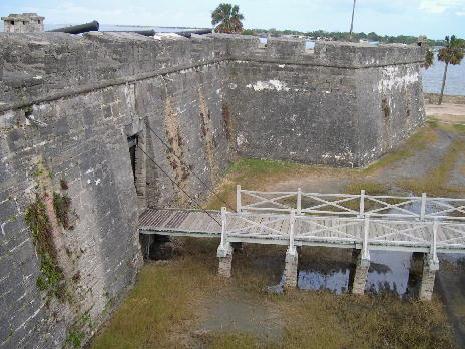
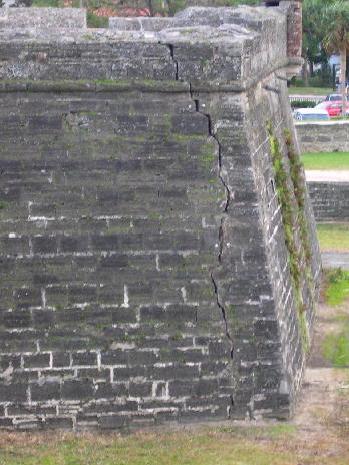
A moat was constructed around the fort but was not filled with water. Rather, food supplies were stored there, and in times of attack, livestock kept there. The U.S. Park Service filled the moat with water as European forts did, but the standing water caused the coquina walls to soften and crack. When the water was drained, the moat dried out and the integrity of the fort was preserved.
|
|
|
|
|
|
|
|
|
|
|
 |
|
 |
|
|
|
|
|
|
|
|
|
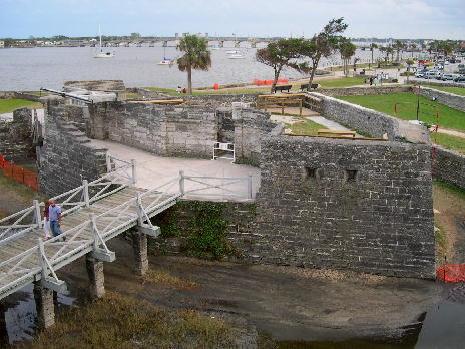
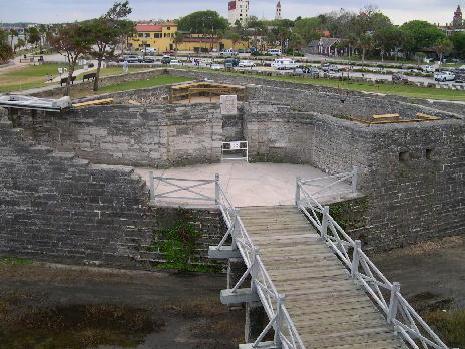
The only way in/out of the fort was protected by a ravelin, pictured above. Invaders had to get across the first drawbridge (on extreme left) and enter the triangular construction before crossing the dry moat to enter the fort. The triangular shape with double walls on the point prevented a direct head-on assault on the only entrance into the fort.
|
|
|
|
|
|
|
|
|
|
 |
|
 |
|
|
|
|
|
|
|
|
|
|
|
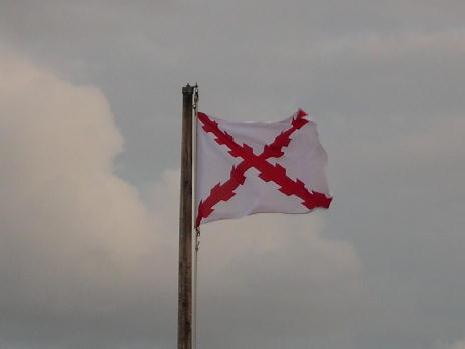
The fort was originally painted like the Spanish flag, white walls with red corners. Only a tiny bit of each color paint remains.
|
|
|
|
|
|
|
|
|
|
|
|
 |
|
|
|
|
|
|
|
|
|
|
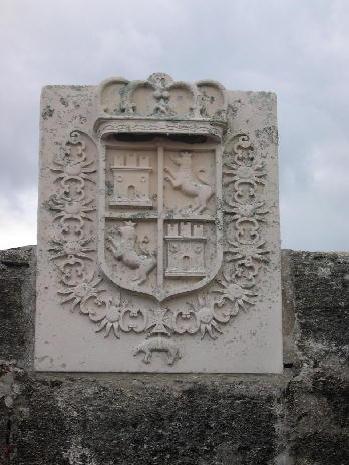
Enlarged recreation of the coat of arms located on the ravelin's interior wall across from the walkway over the dry moat.
|
|
|
|
|
|
|
|
|
|
|
|
|
|
|
|
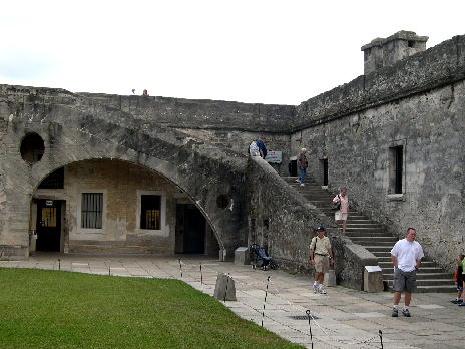
Inside the walls, steps lead up to the deck where the cannon are positioned .
|
|
|
|
|
|
|
|
|
|
|
|
|
|
|
|
|
|