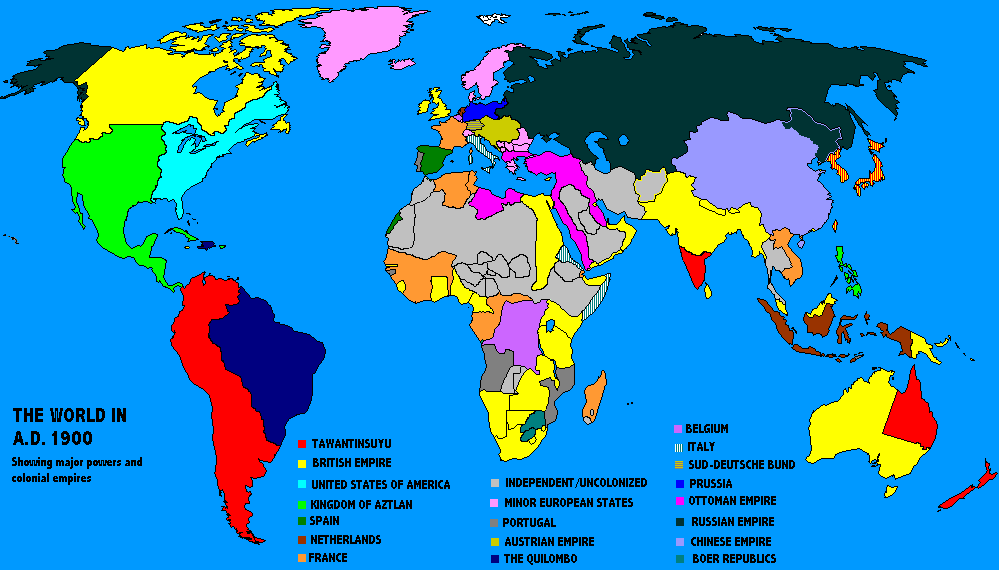
THE GUNS OF THE TAWANTINSUYA
An Alternate History Timeline
by Robert Perkins
PART SEVEN: A.D. 1900-1950
A.D.
1900 onward--Submarine development in Britain is stunted when opposition among
the Admiralty, lead by Admiral Arthur K. Wilson, prevents funding from reaching
submarine research programs. Wilson, who has branded submarines as
"underhanded,
unfair, and damned un-English," will finally succeed, after assuming the
post of First
Lord of the Admiralty in 1905, in seeing the few British submarines scrapped or
sold to
foreign navies.
A.D. 1900--An alliance of Japan, Britain, France, Italy, Austria, Russia and
Tawantinsuyu
(called the Seven Nation Alliance) send military forces to China to rescue
people and to
put down what the West calls the Boxer Rebellion. Another Anglo-Ashante war
erupts, in
what today is Ghana. Ashante warriors abandon skirmishing for frontal attacks
against
British machine guns. Germany leads the world in literacy. Germany, especially
Prussia,
is well supplied with engineers, chemists, opticians, skilled workers for its
factories,
skilled managers, knowledgeable farmers and skilled military personnel. Literacy
is said
to be above 90 percent in Britain, France, Tawantinsuyu, Norway, Sweden, and
Australia;
between 70 and 90 percent in the United States, Canada and Japan; 78 percent in
Italy; 50
to 70 in the Balkans; 30 to 50 percent range in Russia; and below 30 percent in
China,
India, Africa and the Islamic countries. Also in this year, the Siberian exile
of Vladimir
Ulyanov ends. He soon leaves Russia, and travels throughout Europe. He
eventually
settles in Geneva, Switzerland, where he publishes a revolutionary newspaper and
takes
the alias of Vladimir Lenin. In London, the British Parliament ratifies the
proposed
Australian Constitution, and the constitution is given royal assent. The
Commonwealth
of Australia is born. Keish guides an expedition to the Yukon River Region,
where his
gold find is confirmed. News of the find is leaked to the world later that year,
and the
Klondike Gold Rush begins. As many as 100,000 people trek to the region, but
most do
not stay. Enough do, however, that the British government decides that a new
colony
should be created to administer the region. Creation of the Yukon Colony. Also
in this
year, Crown Prince Luis Ferdinand of Spain marries Anna Maria Theresia, daughter
of
Grand Duke Ferdinand IV of Tuscany.
A.D. 1901--In China, the Dowager Empress Cixi signs an agreement ending the
Boxer
Rebellion. At the insistence of Manco Capac Inca III of Tawantinsuyu, per the
agreement
the Dowager Empress is forced to go into exile from China, never to return, and
Emperor
Guangxu is returned to power. Cixi goes to live in seclusion on an estate in
England.
Accusing them of complicity in the Boxer Rebellion, with the support of the
Seven
Nation Alliance, Guangxu conducts a purge of Cixi’s conservative supporters,
including
an influential general named Yuan Shikai, who had cooperated with the coup by
which
Cixi had forced Guangxu into isolation and thus earned Guangxu’s undying
enmity.
Yuan is arrested and beheaded in Beijing before the end of the year. Queen
Victoria of
Great Britain dies. Edward VII is crowned. Alvin Lombard, an American
manufacturer,
invents a practical version of what will later become known as the caterpillar
track. He
uses it on various steam-powered log-hauling machines. Lenin joins the Russian
Social
Democratic Labour Party, a Marxist party whose program is based on the belief
that,
despite Russia's agrarian nature, the true revolutionary potential of Russia
lies with the
industrial working class.
A.D. 1901 onward--The Emperor Guangxu, having been restored to power, Guangxu’s
own supporters, chief among them Kang Youwei and Liang Qichao, return from exile
abroad, and together, they and the Emperor begin to reinstitute the program of
reforms in
China which had been interrupted by Cixi’s 1898 coup. Having learned some
lessons
from Cixi’s coup and the succeeding events, Guangxu institutes reform at a
more
measured pace than that he attempted in 1898, which causes less disaffection
among the
conservative elements of the population. Guangxu also actively courts the
assistance of
Manco Capac Inca III of Tawantinsuyu, who Guangxu recognizes as being primarily
responsible for his own restoration to power. Guangxu seeks the advice and
assistance of
the Inca in matters both political and military.
Acting on the advice of Tawantinsuya advisors at his court, Guangxu ends the
isolation
of the imperial family in the Forbidden City at Beijing, and moves the capital
from that
city to the old Chinese imperial seat at Xian, thus emphasizing his
determination to
remove the barriers between the Manchu imperial family and the mass of the
Chinese
people. The Forbidden City is demolished (apartment complexes for the common
people
are erected on the site instead), while Guangxu inhabits much less ostentatious
and
isolated quarters at Xian. These actions, along with Guangxu’s regular public
appearances at important State functions, greatly increases his popularity among
the
people. He also wins the support of many anti-monarchist republicans such as Dr.
Sun
Yat-Sen by his introduction of a democratically elected parliament and a
constitution
creating a limited monarchy within two years of his resumption of power.
With the help of Tawantinsuya military advisors provided by Manco Capac Inca,
Guangxu is able to solve one of the most serious problems facing the Qing
monarchy...the
reorganization of the army and securing it’s loyalty to the dynasty. The
execution of
Yuan Shikai and other army generals of doubtful loyalty solve a large part of
the latter
problem, and the supply of Tawantinsuya arms, equipment, and training for
Guangxu’s
forces, which enable him to put down the various warlords who had established
themselves in different areas of China during the period of chaos following the
Boxer
Rebellion, solve most of the rest of it. But the establishment of a centrally
controlled
Imperial Military Academy at Xian at the suggestion of Guangxu’s Tawantinsuya
advisors (and the centralization of military training at this site by closure of
the other
academies which had already been established under earlier Qing rulers) ...which
would
not only train a professional officer corps but also indoctrinate it in loyalty
to the
dynasty...finishes that particular task, and the possibility of army rebellions
recedes ever
further as time goes on.
Finally, Guangxu’s reform of the education system on Western lines and
promotion of
industrialization, also with Tawantinsuya assistance, greatly strengthens China.
By the
time of Guangxu’s death in 1938, China will be well on it’s way to taking it’s
place as
one of the first nations of the world.
A.D. 1902--Britain has won the Boer War. It creates the Union of South Africa
and gives
it Dominion (Commonwealth) status. Bones of the dinosaur Tyrannosaurus Rex are
discovered in the region which would be known in OTL as Montana. Britain signs
an
alliance with Japan. The Australian Parliament passes the Franchise Act, which
guarantees the right of women to vote. But most non-European ethnic groups,
including
Australian aborigines and Tawantinsuya, are denied the vote.
Bedouin army, conquers Riyad and begins working to unite the kingdom of Arabia (both through military action and
marriage with 20 women) under the puritanical Wahhabi Islamic
order. Also in this year, the British government
offers to create a Jewish national home by donating 5000 square miles of the Mau
Plateau in
Uganda, in East Africa. This proposal is transmitted to Theodore Herzl’s
Zionist Group by the
British Foreign Secretary.
A.D. 1902 onward--Civil War in the Quilombo. In the Quilombo, the system of
government which was instituted in the early 18th Century (under Tawantinsuya
guidance) has generally worked well at managing and arbitrating the tribal
conflicts
within the country. But the basis of the system...the division of the country
into
tribally-based provinces, each of which is represented in the Great
Assembly...has not
encouraged amalgamation of the various tribal groups or the creation of loyalty
to the
Quilombo as opposed to one’s own tribe. And so old tribal hatreds still
remain, and the
system of shared power has not eliminated them. With the industrialization
programs
instituted by the government in the 19th century, these conflicts have become
more
pronounced, as various tribal groups vie for lucrative government subsidies and
industrial
contracts. These conflicts finally boil over in 1902, when a disputed election
in the
Quilombo leads to violence as supporters of the various candidates (whose
political
parties are formed largely along tribal lines) riot in the streets of the
Quilombo’s cities.
This leads Great Chief Juma Dakarai to declare martial law and order the army to
suppress the rioters. Unfortunately, the army itself has become polarized along
tribal
lines by the passions unleashed by the election, and fighting breaks out among
army units
sent out to restore order. By the end of the year, organized government in the
Quilombo
has virtually collapsed, and the country is in a state of civil war. Gradually
warlords
emerge in control of various regions, and the fighting continues. It will go on,
at various
levels of intensity, for years.
A.D. 1903--Alvin Lombard’s caterpillar track patents are purchased by American
manufactuer Benjamin Holt. Holt founds the Holt Tractor Company, producing
agricultural machinery which becomes popular in many countries. Manco Capac Inca
III,
concerned by reports of Tawantinsuya citizens caught in the escalating violence
in the
Quilombo, sends in Tawantinsuya troops to restore order. The Tawantinsuya end up
involved in a multi-sided guerilla war against the various regional warlords,
and their
forces will be heavily involved in the conflict for many years. Meanwhle, the
Quilombo
province comprising the island of Hispaniola in the Caribbean is the one area of
said
country not involved in the civil war. With the disintegration of the Quilombo
into chaos,
the province declares it’s independence, and in this year the Republic of
Haiti is
re-established, ruling over the entire island. An assembly adopts the original
Haitian
constitution of 1796 as the governing document for the new nation, and a
President is
elected later the same year. The Second Congress of the Russian Social
Democratic
Labour Party is held. The Congress is dominated by a dispute between two
factions, lead
by Vladimir Lenin and Julius Martov. Lenin’s faction argues for a small party
of
professional revolutionaries with a large fringe of non-party sympathizers and
supporters.
Martov’s faction disagrees, believing it is better to have a large party of
activists. The
dispute proves irreconcilable, and the Party splits into two factions, the
Bolsheviks,
headed by Lenin, and the Mensheviks, headed by Martov. In Prussia, Karl Jatho
makes
several short flights in a powered, heavier-than-air craft. However, the flights
are not
controlled, and his aircraft is more of a powered glider than a true airplane.
Also in this
year, Crown Prince Benedict of the United States marries Lady Cynthia Troup,
daughter
of a former Governor of Georgia, Lord George Troup. Also in this
year,
the Uganda Proposal is brought before the Zionist Congress in
Basel, Switzerland.
The proposal is tentatively accepted by a substantial margin (after the Russian
delegation walks
out in protest). Konstantian Tsiolkovsky publishes a report that suggests
the use of liquid
propellants for rockets in order to achieve greater range.
A.D. 1904--Conflicting interests in Manchuria and Korea between Japan and Russia
erupts in war, with Japan attacking the Russians at Port Arthur and landing
troops near
Seoul, Korea. Tensions rise between Britain and Russia while Russia is at war
with
Japan. Prussian support for Russia inflames British opinion. Sir John Fischer
becomes
Britain's First Sea Lord and believes that war with Prussia is inevitable.
Misunderstanding
creates a war scare, and war is narrowly averted. Queen Isabella of Aztlan dies,
and is
succeeded by her 49 year old son, who reigns as King Phillip I of Aztlan. The
British and
French sign an agreement regarding boundaries between their colonial empires.
Also in
this year, Crown Prince Luis Ferdinand and Princess Anna Maria Theresia of Spain
produce a son (actually the second child of their union...the first being a
daughter), who
they name Felipe Carlos. The Zionist Congress sends a three man delegation
to inspect the Mau plateau. Its
high elevation gives it a temperate climate making it suitable for European
settlement. However
the observers find a dangerous land filled with lions and other creatures.
Moreover it is populated
by a large number of Maasai who do not seem at all amenable to an influx of
Europeans.
A.D. 1905--Defeats in the war with Japan create rebellion by Russian sailors,
and their
rebellion spreads to cities including the capital, St. Petersburg, where Bloody
Sunday
occurs as the Tsar’s troops fire into a crowd of protesting civilians. This
does not end the
unrest, however, and the Tsar is finally forced to issue The October Manifesto,
granting
basic civil rights, allowing the formation of political parties, extending the
franchise
towards universal suffrage, and establishing the Duma as the central legislative
body.
There are spontaneous demonstrations of support in most of the major cities when
the
Manifesto is announced. The ongoing strikes and other unrest in the country
gradually
peter out, and calm is restored by the end of the year.
Also in this year, the Zionist Congress, upon hearing the report of the delegation sent to inspect the
lands
in Uganda, decides to decline the British offer of a Jewish National Home in
Uganda.
Meanwhile, Japan has taken control of Port Arthur and the adjoining Liaodong
peninsula.
Japanese in general are exultant in victory, and super-patriots are reinforced
in the belief
that they are superior to others in Asia and deserving of empire. Japan takes
power over
Korea's postal, telegraph and telephone services and power over Korea's foreign
affairs,
its military matters and police.
In Bern Switzerland, Albert Einstein, at the age of twenty-six, publishes a
number of
papers that unify work in physics done by others. He creates the "special
theory of
relativity." This holds that the speed of light is constant and that energy
is mass multiplied
by the speed of light, squared.
Conflict has erupted between France and Prussia over Morocco, where Prussia has mining interests.
Prussia
supports Moroccan independence. French hostility toward Prussia increases. War
is narrowly averted.
Sweden's labor party, the Social Democrats, move to free their Norwegian
"brothers"
from forced unity with Sweden. Swedish right-wingers want to discourage
independence
by sending a force against the Norwegians. The labor movement in Sweden
prevails.
Peacefully, Norway gains its independence.
King Consort Leopold of Aztlan dies. His death, following that of Queen Isabella
the
previous year, is widely mourned in the kingdom as the end of an era. R. Hornsby
and
Sons, an agricultural machinery company in Britain, patents a caterpillar track,
which it
uses on farm tractors it builds. Traian Vuia, a Romanian working in Paris,
achieves flight
with a powered aircraft capable of taking off from by it’s own power from a
flat surface.
However, like Karl Jatho’s attempt in 1903, Vuia’s craft is not capable of
controlled
flight, only of short hops into the air.
A.D.
1904-1929--The second Aliyah of Jews into Palestine, a migration of about
160,000 Jews,
of which about 20,000 will eventually leave, with the remainder becoming
permanent residents.
The first Jewish defense organizations are formed during this period due to
increasing hostility
from the local Arab population. During this period, some of the underpinnings of
a future
independent Jewish nation-state arise: The national language Hebrew is revived;
newspapers and
literature written in Hebrew published; political parties and workers
organizations established.
A.D. 1906--In April 1906 the Tsar’s government issues the Fundamental Law,
setting the
limits of the new political order. The Tsar is confirmed as absolute leader,
with complete
control of the executive, foreign policy, Church, and the armed forces. The Duma
is
shifted, becoming a lower chamber below the Tsar-appointed State Council.
Legislation
has to be approved by the Duma, the Council and the Tsar to become law and in
'exceptional conditions' the government can bypass the Duma. In essence, despite
the
promised changes of the October Manifesto, the country is unchanged...political
power
remains with the Tsar, wealth and land with the nobility. The introduction of
the Duma
and the clamp-down did, however, successfully disrupt the revolutionary groups.
Leaders
were imprisoned or exiled and the groups were confused and uncertain--should
they join
the Duma or stay outside? The resulting splits and internal divisions will keep
the radicals
disorganized for many years.
Also in this year, a lawyer in South Africa, Mohandas Gandhi, begins nonviolent
resistance to the mistreatment of his fellow Indians. Hornsby tractors are
purchased by
the British Army for use as artillery tractors. Louis Bleriot of France develops
a
monoplane aircraft, called the Bleriot V, which achieves the world’s first
controlled flight
by a powered, heavier-than-air craft taking off from a flat surface under it’s
own power.
The airplane is born, and development is soon proceeding at a frenzied pace in
many
countries. Abdul al-Aziz ibn Saud takes control of the Nejd and Hasa
regions in Arabia.
A.D. 1907--Eight percent of U.S. households are wired for electricity.
Modernists within
the Catholic Church have been trying to institute what they consider
intellectual reforms.
Sixty-five of their proposals, 38 of which are biblical criticisms, Pope Pius X
labels as
heretical. His encyclical describes "modernism" as an alliance between
faith and false
philosophy. In Russia the government arbitrarily alters election laws in a way
which
discriminates against the more liberal political parties. The Duma is largely
reduced to a
collection of conservative landowners. The police crackdown on leftists.
Rightists attack
Jews in Odessa. Also in this year, Prussian military attaches report the British
use of
Hornsby tractors to their government. Prussia purchases some Holt tractors that
same
year, which it uses for military research. King Benedict IV of the United States
dies, and
is succeeded by his son, who reigns as King Benedict V.
A.D. 1908--King Wilhelm II of Prussia, the grandson of Queen Victoria, complains
that
the English are "mad as hares" in their suspicions of Prussian
intentions. "Time after
time," he claims, he has said that he is "a friend of England."
His protestations do not
work. In a bloodless military coup, modernist soldiers overthrow the Ottoman
sultan,
Abdul Hamid. Bulgaria's Prince Ferdinand declares Bulgaria independent of
Ottoman rule
and himself as Tsar (king). Meanwhile, Austria-Hungary has been administering
Bosnia-Herzegovina. This has been understood to be temporary, and local Serbs
are
looking forward to independence for all Serbs and a united Serbia. But then, in
1908,
Austria-Hungary announces it is annexing Bosnia-Herzegovina. Europe is stunned,
the
Serbs are outraged, and Serbia threatens Austria-Hungary with war. A secret
organization
in Serbia called The Black Hand (composed of Serbian army officers and other
Serbian
nationalists) and students in Bosnia begins organizing resistance to Austrian
rule in
Bosnia and Herzegovina, by violence if necessary. Russia threatens to go to war
in
support of Serbia. King Wilhelm II of Prussia refuses to join with Russia in
war, and war
is averted, narrowly. The capital of the Commonwealth of Australia moves from
Melbourne to Canberra. The first flight by a Tawantinsuya-designed airplane is
conducted by Captain Pariapichiu of the Tawantinsuya Army. Samuel Cody makes the
first airplane flight in the United Kingdom. Prince Imperial Napoleon of France
marries
Princess Dagmar of Denmark, daughter to of King Frederick VIII.
A.D. 1909--In Palestine, Jews establish their first kibbutz. In Prussia,
experiments with
armored cavalry units equipped with wheeled armored cars are proving
unsatisfactory.
The wheeled vehicles simply cannot cope with rough terrain, nor cross the
trenches which
are sure to be a major feature of the battlefield in a future war. Designers
begin to
experiment with vehicles based on the new caterpillar track. Results are
promising
enough that King Wilhelm II orders further development. Louis Bleriot of France
becomes the first to fly across the English Channel in an airplane. The firm of
Rumpler
begins producing aircraft in Austria-Hungary. British companies begin
extracting oil in Iran.
American
scientist Robert Goddard in his study of fuels, determines that
liquid hydrogen and liquid oxygen would serve as an efficient source of
propulsion, when
properly combusted.
A.D. 1910--Japan formally annexes Korea. Emperor Guangxu of China proclaims an
end
to slavery. The Union of South Africa is no longer a British colony. It becomes
a member
of the British Commonwealth. In Portugal, a military revolt is followed by the
abdication
of King Manuel. Portugal becomes a republic. Britain launches a new class of
battleship,
the dreadnoughts, which make all other battleships obsolete. Aircraft production
begins
in Prussia by the Albatros and A.E.G. companies. Other firms will soon follow.
Prince
Imperial Napoleon and Princess Dagmar of France produce a son, who they name
Napoleon Joseph Louis Jerome Bonaparte.
A.D. 1911--The French rescue the sultan of Morocco from rebels. Italy responds
to
France's move in Morocco by making war against the Ottoman Empire for possession
of
Tripoli and Cyrenaica-today, Libya. British forces occupy southern Iran to
protect the oil fields.
Experiments by Ernest Rutherford of Great Britain indicate that the vast majority of an atom's mass is contained
in a very small nucleus at its core, made up ofprotons, surrounded by a web of whirring electrons. Robert
Goddard of the United States is granted two U.S. patents for rockets using solid fuel, liquid fuel, multiple
propellant
charges, and multi-stage designs.
A.D. 1912--Italy wins against Ottoman Turkey. Turkey appears weak to the
Bulgarians,
Serbs and Greeks, and they go to war for the remaining territory held by the
Turks in the
Balkans. Prince Imperial Napoleon of France marries the Infanta Luisa Maria of
Spain,
daughter of King Charles VII. Japanese Emperor Meiji dies and new emperor
Taisho shifts
more
power to the parliament.
A.D. 1913--In war to carve up the remaining Ottoman territory in the Balkans,
Serbia
emerges victorious. Austria-Hungary fears Serbia's enhanced prestige. It
increases
oppressions in Bosnia-Herzegovina and moves toward war against Serbia, with
Russia
committed to protecting the Serbs. War is averted by Serbia withdrawing from a
port on
the Adriatic coast and Emperor Napoleon IV of France not supporting Austria,
stating
that his alliance with Austria is for defense only.
A.D. 1914--The War of the Black Hand begins. Archduke Ferdinand, heir to the
Austro-Hungarian throne, journeys to Bosnia without the usual protection against
assassins. He remarks that all is in the hands of God. In Sarajevo he is
assassinated by
members of The Black Hand, a secret society of Serbian Army officers and other
Serbian
nationalists which has the support of the Serbian government. Emperor Franz
Josef of
Austria demands revenge against the Serbs, and Emperor Napoleon IV of France
agrees
that the assassins and regicide should be punished, but does not give Austria a
"blank
check" go-ahead for war. Despite this roadblock, however, Austria-Hungary
secretly
moves to start its war against Serbia. Meanwhile, King Wilhelm II of Prussia
goes on a
sailing vacation off the coast of Norway. While he is gone, Tsar Nicholas II of
Russia
begins mobilizing his troops, threatening war if the Austrians invade Serbia.
Heedless of
the advice of Emperor Napoleon IV of France, Austria-Hungary launches its war
against
Serbia. Russia declares war to defend the Serbs from the Austro-Hungarians.
When King Wilhelm II of Prussia returns from his vacation, he is horrified to
see events
rapidly spinning out of control. He desperately begins looking for ways to
defuse the
situation, and when, at the orders of Manco Capac Inca III, the Tawantinsuya
ambassador
in Berlin offers to mediate, as a disinterested neutral party, between Prussia
and the other
powers, Wilhelm gratefully accepts. France and Britain have not declared war
against
Russia as of yet, but both are mobilizing their forces, as is Italy. Wilhelm
feels he has no
option but to order Prussian mobilization as well, even as his diplomatic corps
desperately tries to defuse the rapidly escalating situation. The Tawantinsuya
mediation
proves effective, however, and Emperor Napoleon IV of France, angry with his
Austrian
allies for ignoring his advice and precipitating this crisis, is willing to
negotiate. France
undertakes not to enter the war on the side of Austria if Prussia does not enter
on the side
of Russia. King George V of Great Britain does likewise. The only other entrant
into the
war at this time is Austria’s puppet confederation in southern Germany, the
Sud-Deutsche
Bund, which obediently declares war on Serbia and Russia as an ally of Austria.
As a
result of this declaration of war, a young Austrian immigrant and failed artist
living in
Munich, Adolf Hitler, joins the Bavarian Army.
Another nation which does not enter the fighting in 1914 is Italy. Despite
public clamor
for Italian intervention in the war against the hated Austrians, King Victor
Emanuel III of
Italy is persuaded by his ally, King Wilhelm II of Prussia, to refrain from
entering the
conflict. This leads many groups inside Italy to protest, and the Socialist
Party in Italy is
split. An ambitious Socialist newspaper editor named Benito Mussolini soon
founds his
own pro-war group, the Fasci d'Azione Rivoluzionaria. This will evolve, over the
next
few years, into the Fascist Party...a nationalistic, right-wing party opposed to
the
Socialists and other left-wing parties in Italy. Riots between squads of
black-shirted
thugs controlled by Mussolini and gangs of Socialists and anarchists will soon
become a
regular feature of Italian political life.
The fighting in 1914 goes badly for the Austrians. Hammered by huge Russian
offensives, Austrian forces are pushed back in Poland and Galicia. However, the
Austrians eventually recover and dig in, and Austrian artillery and machine-gun
fire
exacts huge tolls of ineptly lead attacking Russian troops. The front eventually
stabilizes,
and a stalemate is in place by the end of the year on that front. Austria also,
to it’s utter
shock and dismay, finds Serbia to be a difficult nut to crack, as it’s
invasion of that
country is repelled with heavy losses.
A.D.
1914-1915--The Irish Civil War. In March 1914, the Irish Home Rule Act of 1914
is
introduced into the British Parliament. This bill provides for a bi-cameral
Irish Parliament, to be
set up in Dublin (a 40-member Senate and a 164-member House of Commons) with
powers to
deal with most national affairs; a number of Irish MPs would continue to sit in
the Imperial
Parliament in Westminster (42 MPs, rather than 103); and finally, the abolition
of Dublin Castle,
though with the retention of the Lord Lieutenant.
The bill is violently opposed by the Irish Unionist Party, mostly composed of
Protestant Ulster
MPs, who feel that “Dublin Rule means Rome Rule.” The Unionists demand
partition of
Ireland, with the northern six counties of Ulster to remain under direct
government by Britain.
The Unionists proceed to form the paramilitary Ulster Volunteer Force, and (secretly
and
illegally) import tens of thousands of rifles and millions of rounds of
ammunition via the
agency of a Prussian businessman (with the secret approval of King Wilhelm II of
Prussia) with
which to oppose, by force, the implementation of the Act in Ulster. The Irish
nationalist parties,
meanwhile, are adamantly opposed to partition, declaring their position that
there must be “no
concessions for Ulster...Ulster must follow.” They, likewise, form a
paramilitary organization
called the Irish Volunteers to oppose the Unionists and force Ulster to accept a
united Ireland.
And they too, secretly import illegal arms from Prussia and other countries.
The country is essentially a powderkeg, ready to explode, when in May 1914 the
bill passes the
House of Commons. Unlike previous Home Rule bills, which had been required to
pass the
House of Lords as well, this one does not have to do that because of the recent
passage of the
Parliament Act. All that is needed is for King George V to give his assent. This
does not
immediately happen, however, and political wrangling continues. Seeking to
defuse the
potentially explosive situation in Ulster, the Parliament passes an amendment
which is a
compromise which satisfies neither side. The six counties of northern Ireland
will “temporarily”
be excluded from the territory governed by the new Irish Parliament, and will
continue to be
ruled directly from Westminster. How “temporary” this arrangement will be is
not specified.
Both the Unionists and the Nationalists reject the compromise and begin
preparing for war.
In September 1914, King George V gives his assent to the Home Rule Bill, and the
bill goes into
effect in Ireland. The Ulster Unionists immediately call out their paramilitary
forces to oppose
implementation of the bill in northern Ireland. The Nationalists call out their
forces to oppose
the Unionists, and the bloodletting begins. The British government is eventually
forced to
deploy tens of thousands of troops to put down the Unionist rebellion,
ironically fighting beside
the Irish Nationalists against those who have declared themselves “Loyal
Ulstermen” and desire
to continue under British rule. The Unionist paramilitary numbers over 50,000
men, and is well
armed, and it takes over a year to finally subdue the rebellion. Most of the
cities of Ulster are
reduced to smouldering ruins by the fighting, and thousands die on both sides.
It is another sad,
bloody chapter in the history of Ireland.
In the aftermath, the Home Rule Bill is revoked by Parliament on the advice of
King George V,
who argues that the rebellion proves that Ireland is obviously not ready for
self-government.
This outrages the Nationalists, who fought beside the British to suppress the
revolt and feel that
the British “owe” them for their “loyalty.” Unionist leaders, including
such lofty personages as
Sir Edward Carson, are brought to trial and sentenced to death for treason
(Carson is hanged in
early 1916). This, in turn, outrages the basically Unionist population of
Northern Ireland.
But the issue of self-government for Ireland won’t go away, and eventually,
more debate within
Parliament will lead to the passage of yet another Home Rule Bill in 1921 which
will include a
permanent partition of the island.
A.D. 1915--The year of 1915 holds out new hope for Austria-Hungary, when the
Ottoman
Empire, which has long-standing border disputes with Russia, as well as bitter
memories
of recent Serbian aggression, enters the War of the Black Hand on the side of
Austria-Hungary. But this hope proves to be illusory. Turkey’s entry into the
war leads
Greece, Bulgaria, and Romania to enter the war on the side of Russia and Serbia.
And
the Ottoman offensive northward in the Caucasus region against the Russians
fails, being
repulsed with heavy losses to the Turks. Patriotic Turks blame the failure on
treason by
Armenians, and a massacre of Armenians follows. On the Polish/Galician front,
the
stalemate continues, with several major Russian offensives being repulsed by the
Austro-Hungarian defenders. Both sides take extreme casualties. Meanwhile,
seeing
what it thinks is an opportunity while the eyes of the major powers are focused
on the
fighting in Europe, Japan presents China with Twenty-one Demands--economic
privileges, the power to "advise," and joint administration of police
departments.
Indignation sweeps through China and Emperor Guangxu defiantly refuses the
demands.
The Japanese thereupon declare war, and so begins the Second Sino-Japanese War.
The
Japanese invade Manchuria, but to their shock, are met with stiff resistance by
the
revamped Chinese Army. There, too, the war soon bogs down into a bloody
stalemate as
both sides dig in. Also in this year, King Charles VII of Spain dies, and is
succeeded by
his son, Luis Ferdinand, who reigns as King Louis II. The Prussian army begins
to
deploy the first armored vehicles equipped with caterpillar tracks. They call
them
Panzers. The ungainly vehicles are armed with light cannon and machine guns.
British
and French spies soon learn of the deployment, and both nations are soon
secretly
developing their own versions. The British code-name for the vehicles is
"Tank," and
this will become the most commonly used name for them in the English-speaking
world
in years to come.
A.D. 1916--In March, a Russian offensive against Ottoman positions in the
Caucasus
region severely batters the Turks, but is finally repulsed without the Russians
making any
significant territorial gains. However, the need of the Ottomans to reinforce
the Caucasus
lines forces them to withdraw troops from Europe, which allows a Graeco/Bulgarian
army to capture Constantinople, eliminating Ottoman holdings on the mainland of
Europe
for the first time in over 500 years. The loss of their capital city is a severe
spiritual blow
to the Turks, and in May 1916 they sue for peace. In a treaty signed on May 31,
the
Ottomans cede their European holdings to Bulgaria and Greece (these two nations
are
soon at war with each other over division of the spoils. In the end, Bulgaria
prevails, and
annexes all of the Turkish European territory, including Constantinople) and
parts of
Armenia to Russia. With the surrender of the Ottomans, Austria stands
alone. One other minor
side affair arises out of the Ottoman surrender...in the wake of the defeat of the Ottomans in the
War
of the Black Hand, Sharif Husayn of Mecca leads a revolt against the Ottoman
Empire in Arabia. It is crushed.
In July 1916, a Russian offensive lead by General Alexsei Brusilov...who has
devised
innovative new infiltration tactics (similar to the ones which Prussia has been
secretly
testing for years)...breaches the Austrian defenses in Galicia. A Romanian
offensive in
Transylvania helps to prevent the Austrians from reinforcing their lines, and
the result is
disaster. Hundreds of thousands of Austrian troops are captured, and Russian
troops
advance rapidly southward into Austrian territory. Only the fact that the
Russians have
outpaced their own supply lines and are totally exhausted finally halts the
offensive in
early September, by which time the Russians have advanced all the way to the
Carpathian
Mountains. By the end of the offensive, Austria-Hungary and it’s Sud-Deutsche
Bund
allies have lost over 1.5 million men killed, wounded, or captured...among them
an
insignificant Bavarian corporal named Adolf Hitler, who was vaporized when a
Russian
mortar shell dropped next to him in his trench on the opening day of the
offensive.
Meanwhile the Russians have lost half a million. But Russia can easily absorb
these
losses, while Austria cannot.
The Austrian army is broken beyond repair, and everyone knows it...everyone,
that is,
except Emperor Franz Josef, who is stubbornly determined to fight on. However,
Franz
Josef dies in November 1916, and his successor, the Emperor Karl, who opposed
the war
from the start, immediately seeks the aid of King Wilhelm II of Prussia in
opening
negotiations with Tsar Nicholas of Russia for an end to the war. Nicholas agrees
to
negotiate, and a cease-fire is declared in early December 1916 while the two
sides work
out terms of a peace treaty.
Meanwhile, the Sino-Japanese War enters it’s second year. A huge Chinese
superiority in
manpower is beginning to wear down the Japanese, who, despite fanatical
resistance, are
gradually pushed out of Manchuria and across the Yalu River into Korea.
A.D.
1916 onward--The Ottoman Empire, stung by it’s defeat in the War of the Black
Hand and
the loss of Constantinople, is undergoing a political upheaval. The Young Turks,
who had taken
over power from the Sultan in a coup in 1909, while retaining the Sultan as a
figurehead ruler,
are discredited for having taken the Empire into the disastrous war. Sultan
Mehmed V Reshad,
with his brother, Mehmed Vahdettin, see this as an opportunity to regain control
again for themselves.
But they realize they need allies. Declaring the liberal constitution originally
promulgated by
Sultan Abdul Hamid in 1876 to be restored, they call for an election for a new
Ottoman
Parliament. This is welcomed by many in the Empire who have been disenchanted by
the
increasingly authoritarian rule of the Young Turks, who promised
constitutionalism but never
intended on delivering it. The elections are held in early 1917, and when the
Parliament meets in
Ankara (where the government had been relocated after the fall of
Constantinople), the Sultan
offers a number of amendments to the constitution which limit his own
power...including a
provision forbidding the Sultan from suspending the constitution or dissolving
Parliament...and
which guarantee the rights of all citizens of the Empire regardless of their
ethnicity or religion
(this also is in stark contrast to the policy of the Young Turks, which was
intensely Turko-centric
and alienated most of the other peoples of the Empire). These amendments are
adopted by the
stunned Parliament, which wholeheartedly declares it’s devotion to the Sultan.
Mehmed V Reshad dies in 1918, and is succeeded by Mehmed VI Vahdettin, who
continues
these policies. Mehmed Vahdettin also seeks to transform the Empire from the
perennial “sick
man” into a modern State. He aggressively seeks sources of funding for various
industrialization
and infrastructure-improvement projects, including funding from an un-usual
source...the Zionist
Movement. In 1901, Theodore Herzl had approached Sultan Abdul Hamid II with a
proposal...the Zionist Movement would pay off the majority of the Ottoman
Empire’s foreign
debt in exchange for a charter allowing the Zionists to colonize Palestine.
Abdul Hamid had
refused this offer. But Mehmed Vahdettin is a more pragmatic man, and in 1919 he
invites Otto
Heinrich Warburg, Herzl’s successor as President of the World Zionist
Organization (Herzl
having died in 1904) to Ankara for talks. The Sultan reminds Warburg of
Herzl’s offer, and
then drops a bombshell...if the Zionist offer is still open, the Sultan is
willing to consider it. A
series of lengthy discussions results, and an agreement is finally hammered out
in early 1920. In
exchange for the assumption of half the Ottoman national debt by the World
Zionist
Organization, the Zionists will be granted, not an independent State, but an
autonomous,
self-governing region within the Ottoman Empire. The Zionists undertake to
respect the rights of
the Palestinian Arabs living in the region, and to guarantee the sanctity of the
Islamic holy places
there. The Jews will be represented in the Ottoman Parliament, and the autonomy
of their
homeland will be guaranteed by an irrevocable amendment to the Ottoman
constitution. The
Jews will be permitted to maintain their own military organization for the
purpose of protecting
themselves from attacks by the local Arabs, with the understanding that in time
of war, the
Jewish military will serve alongside that of the Ottomans. This agreement is
presented to the
Ottoman Parliament in April 1920, and the popular Sultan is able to get it
passed, despite
objections by Arab nationalists serving in the body. For the first time in
almost 2,000 years, the
Jews are to have a national homeland.
Of course, this legislation is not popular with the Palestinian Arabs, and riots
erupt throughout
the region when the agreement is announced. But Ottoman troops bloodily suppress
the rioters,
and in the aftermath, over 400,000 Arabs who took part in or supported the
rioters are forcibly
removed from their homes and settled in various parts of the Empire outside of
Palestine. Unlike
the OTL Palestinian diaspora...whose “identity” as a people has been
artificially maintained in
large part because of the refusal of the Arab countries in which they have
settled to accept and
assimilate them...these people will gradually merge with the populations of
their new lands, and
will eventually be absorbed. Although unintentional, this large-scale removal of
population
allows the Jews to form a majority population in Palestine within a relatively
short time, and
cements their hold on the region. Although there will be periodic outbreaks of
violence between
Arab and Jew in Palestine for many years to come, the Ottomans will remain true
to their
agreements with the Jews and suppress Arab and Islamic extremism whenever
possible. The
ultimate outcome of each outbreak of violence, therefore, will be to further
diminish the Arab
population of the region. By the end of the century, Arabs will be a tiny
minority in what the
Jews will call the Land of Israel, their national homeland.
Mehmed Vahdettin’s successor, Abdul Mejid II, will be further aided by the
discovery of oil in
Mesopotamia (and later in northern Arabia) in the late 1920s, which will greatly
increase the
revenues available to the Imperial Treasury. Modern industries will be built up
in many cities
throughout the Empire, and infrastructure greatly improved. By the time of his
death in 1944, the
underpinnings of a modern state will have been established. The “sick man”
will be sick no
more.
A.D. 1917--In January 1917, the Treaty of Berlin ends the War of the Black Hand.
The
terms are harsh for Austria Hungary, which is forced to cede Galicia to Russia.
In
addition, it is forced to cede Bosnia, Herzogovina, and Croatia to
Serbia...which the
Austrians were never capable of defeating during the entire war, and
Transylvania to the
Romanians. The public outcry caused by the news of this treaty proves to be the
last
straw for the Habsburg Empire. The Hungarian Diet, shortly after the
announcement of
the treaty, votes to secede from the Empire. The Czechs and Slovaks also declare
their
independence, and Italy takes advantage of the chaos to seize the disputed
regions of the
Tyrol, Trieste and Fiume. Emperor Karl, not wishing to bathe his own empire in
more
blood by attempting to suppress the uprisings and secessions, attempts to win
back the
loyalty of his subjects by persuasion and diplomacy. He fails, and by the end of
the year
is left in control of Austria only...the rest of the empire is gone.
In February 1917, workers take to the streets in St. Petersburg, Russia, to
protest food
shortages. The Tsar orders his troops to disperse the protesters. With their
support for
the Tsar buoyed by the recent victory in the war, the troops respond to their
sovereign’s
command and quickly put down the disturbances. Several hundred workers are
killed.
Although the news of this "Bloody Monday" massacre will...like the
"Bloody Sunday"
massacre of 1905...lead to strikes and peasant disturbances in various places in
the
country, in general these are far less severe than in 1905, and the Tsar’s
forces quickly
restore order.
Meanwhile, the Sino-Japanese War continues. Chinese forces have forced a
crossing of
the Yalu River, and by the end of the year have advanced as far south as Seoul.
Both
sides have taken enormous casualties in the bitter fighting, but the Chinese
have the
manpower to burn and the Japanese don’t.
Also in this year, Queen Liliuokalani of Hawaii dies. Unlike in OTL, she had
married a
native Hawaiian nobleman in 1868 and had produced a son, born in 1870, who takes
the
throne at her death and reigns as King Kalakaua II. Kalakaua had, shortly after
his
mother’s near ousting during the constitutional crisis of 1895, married the
daughter of one
of the upper ranking legislators in Hawaii’s legislature, a lady of mixed
Chinese and
Japanese descent. The ascent to Hawaii’s throne of this lady as Queen Consort
is seen by
many as a good omen for improved relations between the native Hawaiians and the
large
Chinese and Japanese immigrant communities living in the islands. And, in the
United
States, a son is born to King Benedict V and Queen Cynthia (who, up until now,
have
produced only daughters...and two stillborn sons...together). They name him
Benedict
Charles William Oliver Arnold. The Tawantinsuya military attaché in Britain
learns of
the "Tank" project, and passes details to Manco Capac Inca III, who
orders that
development of a similar vehicle begin in Tawantinsuyu.
A.D. 1918--In the United States, Britain and Australia the first mass-marketed
laundry
detergent, Rinso, is selling well. The states of the Sud-Deutsche Bund, shorn of
the
protection of their Austrian overlords, accept the inevitable and enter
negotiations with
King Wilhelm II of Prussia aimed at unification with that state. On August 1,
1918, a
treaty is signed, and the German Empire is formally declared, with Wilhelm II as
Kaiser.
A flu pandemic has begun which will eventually kill from 50 to 100 million
people across
the globe. It is the possibly the most devastating epidemic to strike since the
Black Death
of the Middle Ages. In the far east, the Japanese, bowing to the inevitable, sue
for peace
with the Chinese. A Treaty is signed at Seoul in March 1918 ending the Second
Sino-Japanese War. Japan is forced to relinquish all holdings on the Asian
mainland.
Korea is re-established as an independent state (a vassal of China, of course).
The only
bright spot for Japan in the war has been at sea, where it’s superior navy has
swept the
Chinese fleet from the seas. Therefore, although Emperor Guangxu would have
desired
otherwise, China is not able to assert a claim for the return of Formosa, and
Japan is able
to retain control of the island. Also in this year, the defeat of the
Hashemite rivals of the Saudi clan
by the Turks in 1916 has encouraged Abdul al-Aziz ibn Saud to try to take the Hejaz, including Mecca and
Medina. He leads a bedouin army to Mecca and lays siege to the city. The Ottomans respond with a
modern
army and aircraft. The Saudis are defeated and Abdul al-Aziz is killed. Shortly
afterward, civil war
breaks out among the bedouin tribes which were formerly united under the Saudi
banner. The
Wahabbi kingdom of Nejd falls apart.
A.D. 1919--In India, a mob murders five Europeans. A British senior officer
overreacts,
firing into a crowd, killing 379 and wounding 1,208 in less than ten minutes-the
Jallianvala Bach (Amritsar) massacre. Many who had been for gradual steps toward
self-rule now want complete independence. Jawaharlal Nehru joins the activist
group to
which Mohandas Gandhi belongs, the Congress Party. In the United States, the
Royal
Legislature, with the approval of the King, passes an amendment to the
Constitution,
making it illegal to deny women their right to vote. Manco Capac Inca III of
Tawantinsuyu is assassinated by terrorists from the chaos-ridden Quilombo as he
rides
down the streets of Cuzco in an open car. He is succeeded by his son, who reigns
as
Pachacuti Inca II. Pachacuti soon begins planning the withdrawal of Tawantinsuya
troops
from the Quilombo. But first he launches massive offensives against the various
Quilombo warlords, which soon force most of them to the peace table.
Negotiations
begin at Cuzco later that year which will eventually bring an end to the
fighting...and to
the Quilombo as a single nation. Britain and France begin deploying their
versions of the
tracked armored vehicle, called the "Tank" in Britain and the
"Char" in France.
A.D. 1920--A treaty is signed at Cuzco which recognizes the authority of the
various
warlords over those areas of the Quilombo they rule, and establishes the
boundaries of the
six new nations which are thus to be formed from the wreck of the Quilombo. All
of
these nations will be ruled as military dictatorships, although the warlords
make vague
promises of democratic elections at some unspecified time in the future.
Pachacuti Inca
isn’t holding his breath for that, but accepts the situation as the price of
disengagement
from what has increasingly become a bloody quagmire for the Tawantinsuya. Crown
Prince Ferdinand of Aztlan marries Princess Micay, the beautiful daughter of
Pachacuti
Inca of Tawantinsuyu. This is the first-ever union between the royal houses of
these two
powers, and marks the beginning of a new era of cooperation between the two.
Later this
same year, King Phillip I of Aztlan dies, and Ferdinand succeeds to the throne
as King
Ferdinand II, with Micay as his Queen.
A.D. 1921--South Africa's white government creates the Natives Land Act,
preventing
blacks from holding land except in specially designated reserves. Britain gives
Ireland
dominion status, except for six counties in the north which remain within the
United
Kingdom. And Britain gives Egypt independence, except for the Suez Canal, which
Britain continues to control. King Ferdinand II and Queen Micay of Aztlan
produce a
son, Crown Prince Felipe Juan Luis. Emperor Napoleon IV of France dies, and is
succeeded by his son, who reigns as Emperor Napoleon V of France. Benito
Mussolini is
elected to the Italian Parliament. Tawantinsuyu deploys it’s first armored
fighting
vehicles (tanks). Also in this year, the Japanese Navy launches the HONSHO,
the world’s first
purpose-designed aircraft carrier. Over the next two decades, Japan will be a
world
leader in aircraft carrier development and above all in deployment of these new
ships,
which are viewed with disdain by the “battleship admirals” who hold sway in
most of the
world’s fleets.
A.D. 1921-1923--One of the intermittent periods of drought which sometimes
afflicts
Russia strikes, and grain harvests are dramatically reduced. A famine results.
This
famine, which is not as severe as the OTL famine which struck during these years
(which
was exacerbated by the effects of the Russian Civil War and Communist policies)
nevertheless kills as many as 2 million people. The inability of the Tsar’s
government to
alleviate the hunger of the people...food stores still have not been built up
since the end of
the War of the Black Hand, and the war pretty much bankrupted Russian finances,
so
large-scale grain purchases are not an option either...will have major political
consequences as time goes on.
A.D. 1922--The British in India arrest Gandhi and sentence him to six years in
prison.
The British in Kenya arrest the leader of the East African Association, Harry
Thuku. With
tanks and aerial bombardment, Italian forces move deeper into Libya's interior,
beginning
an eight-year war. In Italy, the escalating violence between the right-wing
Fascists and the
left wing Socialists and Anarchists threatens to erupt into civil war. King
Victor
Emmanuel III, feeling that he must choose between the two groups, appoints
Mussolini
prime minister. Mussolini forms a cabinet of fascists and nationalists, and he
is granted
"temporary" dictatorial powers. The hormone insulin is discovered and
used to treat
diabetes.
A.D. 1922-1926--The Russian Revolution and Civil War. In January 1922, the
inability
of the Tsar’s government to alleviate the suffering of the people in the face
of the
continuing famine leads to riots in most of the major cities of the empire as
desperate
people take to the streets demanding bread. When rioters threaten to attack the
Tsar’s
palace in St. Petersburg, Tsar Nicholas’s heavy-handed response is to once
more call out
the army to disperse the crowds. But this time, the troops refuse to fire into
the crowds,
preferring instead to shoot their officers and join the crowds in marching on
the palace.
The Tsar and his family manage to escape the palace and flee the city in
disguise, but his
train is stopped by another group of disloyal soldiers. The Tsar and his family
are taken
to a dacha about sixty miles from St. Petersburg and held under arrest. There, a
delegation of senior army officers...including the Tsar’s own cousin, the
Grand Duke
Nicholas...and leaders from the Duma visits him and demands his abdication. Tsar
Nicholas at first refuses, but eventually is brow-beaten into signing the
abdication. At the
insistence of Grand Duke Nicholas, the Tsar does not abdicate in favor of his
sickly
hemophiliac son, Alexei. But instead of passing it to Grand Duke Nicholas as the
latter
desired, the outgoing Tsar passes the crown to his liberal brother, the Grand
Duke
Mikhail. Mikhail soon appears before the Duma, where he immediately issues a
decree
calling for a new election for the Duma, open to all political parties, and
re-establishes the
Duma as the chief legislative body, abolishing the Tsar-appointed State Council
created
by his brother in 1906. He also declares that, once the newly-elected Duma takes
it’s
seats, it’s first duty will be to select a committee to draft a formal written
constitution for
the Russian Empire, which will thereby become a constitutional monarchy for the
first
time in it’s history. The election is held on May 1, 1922, and the new Duma
takes it’s
seats on July 1. The constitutional committee is soon nominated, and together
with the
Tsar, begin work on drafting the proposed constitution. The committee submits it’s
proposals to a vote of the Duma on December 12, 1922, and the constitution is
adopted.
A limited constitutional monarchy, similar in structure to that of the United
States, is
adopted. A coalition government of liberals, socialists, and Menshevik Marxists
emerges
as the dominant power bloc in the new Duma, and Alexander Kerensky is elected
the first
Prime Minister, with Menshevik Leon Trotsky as his Deputy Prime Minister. With
the
end of the drought in the spring of 1923 and the good harvest that year, the
prospects for
the new government appear bright.
However, there are forces at work which are not ready to accept a peaceful
transfer of
power from Tsar Nicholas II to Tsar Mikhail II. Grand Duke Nicholas, who was not
at all
pleased when former Tsar Nicholas passed the throne to Mikhail instead of to
him, is
soon intriguing with various reactionary army commanders with the aim of
deposing
Mikhail and installing Grand Duke Nicholas on the throne. And Vladimir Lenin,
who
had, up until now, been living in exile in Switzerland, soon returns to Russia
and begins
organizing the Bolshevik faction of the Russian Marxist movement, aiming at
toppling
the monarchy via revolutionary action. By mid-1923, both groups have raised
armies,
and fighting has broken out between the dissident factions and forces loyal to
the new
Tsar’s government. Thus begins the Russian Civil War, which will be both
bloody and
destructive, and will continue until 1926. In the end, forces loyal to the
government
defeat both the rebel generals loyal to Grand Duke Nicholas and the Marxist
revolutionaries lead by Lenin. Grand Duke Nicholas and Lenin (who in OTL died in
1924,
but since the stresses which contributed to his death were delayed in this
timeline, is still
living in 1926) are both captured and hanged before the end of that year. The
government
subsequently outlaws the Bolsheviks, and an effective crackdown essentially
destroys the
remnants of the party. It seems that, for the time being, the new Tsar and his
constitutional regime are secure.
A.D. 1923--In Southwest Africa, the Khoikhoi (Hottentot) and Herero peoples
rebel
against white South Africa's domination. South Africa attacks them with
airpower. An
earthquake strikes Tokyo. Around 106,000 persons die or disappear and 502,000
are
injured. Hordes of people, made homeless by the quake and fires, roam the city.
They
were without food and water. They include the city's Koreans. Packs of Japanese
attack
and murder Korean men, women and children wherever they can find them. Police
round
up labor leaders, socialists, and anarchists. A secular constitution is
proclaimed in Egypt (a
British protectorate) to create a parliamentary monarchy. Also in this year, Dr. Hermann Oberth, a
Hungarian-born German, publishes a book about rocket travel into outer space. Because of his
important writings, many small rocket societies spring up around the world. The former Tsar Nicholas II of Russia
leaves
Russia with his family...including several beautiful and unmarried
daughters...and settles on a country estate in England.
A.D. 1924--The first winter Olympics are held in Chamonix, France. The British
release
Gandhi from prison.
A.D. 1925--Gandhi retires from politics, quits the Congress Party and turns his
attention
to the evils of alcohol and other drugs. He hopes to transform the world through
spiritual
power. In China, Sun Yat-sen dies. For the past several years he had served as
Prime
Minister in the Emperor Guangxu’s Parliament, and his loss is deeply mourned
in China.
Also in this year, Japan introduces universal male suffrage.
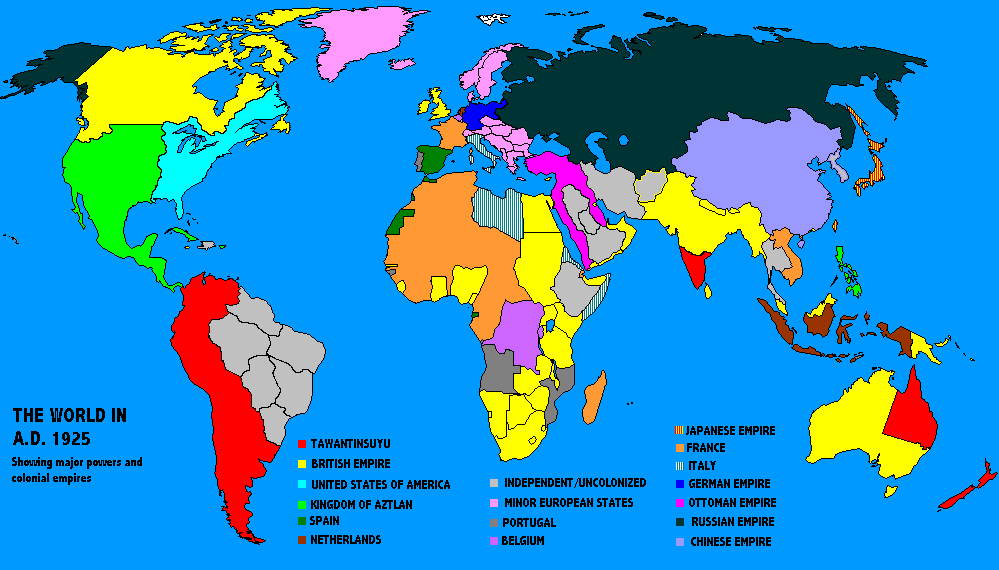
TAWANTINSUYU IN 1925: A SNAPSHOT.
At this time, it might be good to provide a description of the conditions which currently
prevail
inside the Tawantinsuyu Empire.
As of 1925, Tawantinsuyu is one of the world’s great powers. It’s
long-standing alliance
and trade relationship with Britain has been very beneficial to it, and the fact
that it has
been, for the most part, able to keep itself at a distance from the wars which
have broken
out in Europe and elsewhere has also been to it’s benefit. However, as of
1925, it does
have some problems, primarily economic in nature.
--GOVERNMENT AND POLITICS: Tawantinsuyu is a constitutional monarchy. The
Inca is the head of state and chief magistrate of the land. Lawmaking is carried
out by a
bi-cameral parliament, one house composed of commoners and the other of nobles.
Legislation must be passed by both houses to become law, and the Inca retains a
veto
power over any legislation he considers harmful. The veto power has rarely been
used,
and the system has generally worked quite well. However, the strains of the
recent war in
the Quilombo and the economic recession which have followed in it’s aftermath
have
been felt politically in Tawantinsuya with the rise of radical political parties
in both the
upper and lower houses of the Parliament. The Inca has been forced to use his
veto
several times in the past few years...more often in the last five years than in
all the time
since Parliament was established in 1865, in fact.
--ECONOMY: The Tawantinsuya economy is bbased on three main pillars...trade,
agriculture, and mining. The Tawantinsuya have a fully industrialized economy,
and
produce large quantities of goods for both domestic and international
consumption. They
also exploit the resources and production of their colonial territories in New
Zealand,
Australia, and India. However, the costs of the recent war in the Quilombo, and
the
collapse of the Quilombo into a series of weak, squabbling states has dealt a
severe blow
to the Tawantinsuya economy. The Quilombo had been one of Tawantinsuyu’s most
reliable and important trading partners, providing much needed resources and raw
materials in exchange for Tawantinsuya manufactured goods (and even the Quilombo’s
own program of industrialization had not changed that to a very significant
degree). But
now, the wreck of the Quilombo’s economy by the civil war, and the continued
mismanagment and competition between the warlords who emerged in control from
the
Quilombo’s wreckage, has meant that Tawantinsuyu is virtually cut off from
this market.
Resources are not flowing out of the former Quilombo and Tawantinsuya goods are
not
flowing in. So Tawantinsuyu is experiencing a major economic recession as of
1925.
Another economic problem Tawantinsuyu is experiencing is a result of it’s
industrialization and especially the expansion of vicuna and alpaca herds over
the last
century to meet increasing export demand for the fine fabrics woven from the
wool of
these animals. Large areas of Chile and Argentina have been deforested as land
has been
cleared to provide grazing range for these animals, and as industrial demand for
wood and
wood products has increased. This has lead to large areas being transformed into
semi-desert as erosion of topsoil exposed by the deforestation reduced the
fertility of the
land. Fortunately for Tawantinsuyu, at the urging of Atahualpa Inca III, the
Tawantinsuya
Parliament (called the Parlaywasi or "Speaking House") passed the
Forest Conservation
Act of 1882, which mandated that all alpaca and vicuna ranches maintain at least
twenty
percent of their area as forest land (and mandating that those with less than
said amount
convert land to forest and replant if necessary to meet the requirement) and
mandating
that areas deforested by logging for industrial purposes be re-planted. As a
result of these
wise land use laws, the desertification of large areas which had started to take
hold has
been halted, and in some areas reversed, with more progress being made yearly.
--SOCIETY: For the most part the structuure of Tawantinsuya society has not
changed
since 1800, with one key exception. The Industrial Revolution in Tawantinsuyu
has had
an unintended effect...namely the creation of an industrial working class which
now
makes up one of the two largest sectors of the economy (the other being
agriculture).
This class, being composed mostly of persons who have left traditional family
farms for
the cities, seeking jobs in the new industries which have risen over the past
century, is
radically different from other classes of Tawantinsuya society in that they are
essentially
cut off from the support of their ayullus, or extended family units. Marxism and
other
forms of radicalism have found a ready audience among these people, who feel cut
off
from the rest of society and exploited by the aristocratic ruling classes.
Therefore, they
have tended to form societies for mutual support, and over time, these societies
have
evolved first into trade unions, and then into political parties advocating
often radical
agendas. There is a segment of the aristocracy which supports these radical
agendas, too,
and as mentioned previously, these parties have recently managed to get several
radical
measures passed by the Parlaywasi, forcing the Inca to veto them. Each veto has
increased
the resentment of the radicals, and some (a tiny minority, to be sure, but even
that is a
major departure for Tawantinsuya society) have begun to think about the
unthinkable...the
possibility of revolution.
--MILITARY: The structure of the Tawantiinsuya military has not changed much in
the
past 125 years. The army still maintains a peace-time strength of 100,000 men,
backed
by a system of compulsory military service and a trained reserve enabling rapid
expansion
in case of war. The army is well-armed with modern weapons, including
bolt-action
magazine rifles, machine guns, and modern artillery. The primary innovation,
apart from
weaponry, has been the introduction of a General Staff System, similar to those
being
used by most European nations by this time. The navy currently ranks number
three in
the world (behind Britain and France...Spain and the Netherlands have both
experienced
major declines in their naval strength since 1800), with battleship fleets based
in the
Caribbean and the Pacific, and a large fleet of ocean-going cruisers for the
protection of
Tawantinsuya trade routes. Two new additions to the military structure are the
Air Force
and the Tank Corps, both of which have been founded within the past ten years
and are
still small and untested.
A.D. 1926--Japan's Emperor Taisho dies. His
son, Hirohito, 25, ascends the throne. He
favors peace and cooperation with foreign powers. The political party in
power, the
Democratic (Minseito) Party, expresses agreement. However, in Japan, factories
are
closing. Falling silk and rice prices are hurting Japanese farmers. Starvation
becomes a
real threat to millions of people in rural areas. The government fears unrest
and
subversion and pursues a campaign against "dangerous thoughts."
Socialists are sent to
prison and professors are dismissed from universities. Fears arise concerning
events in
China, and military expenditures are increased. Ultra-nationalist parties,
including
elements of the military, begin calling for an expansion of the Japanese
empire as the
solution to Japan’s problems. Andre Matswa forms the liberation movement of
French
Congo. Also in this year, the Russian Civil War ends. The government of Tsar
Mikhail
II begins the process of reconstructing the country. Ottoman Sultan Mehmed VI
Vahdettin dies, and is succeeded by Abdul Mejid II. In view of the “close
call” that
Europe recently had in containing the war between Russia and Austria-Hungary,
Pachacuti Inca II of Tawantinsuyu invites the great powers to a conference to
discuss the
issue of international peace. The British government supports this, as does
the
governments of Kaiser Wilhelm II of Germany and Emperor Napoleon of France.
The
conference is scheduled for May 1927, to be held in Geneva, Switzerland. In
Palestine,
a steady stream of Jewish immigrants has been settling in the region since the
1880s.
Beginning in this year, a new influx of settlers begins arriving, fleeing
pogroms in Russia
that took place during the Russian Civil War. Several hundred thousand Jews
will
emigrate to Palestine during this period, making the Jews a substantial
majority
population in their new homeland for the first time. In Morocco, a rebellion
led by
Mohammed ben Abel Krim is crushed by French and Spanish forces. In South
Africa,
Prime Minister M.B. Herzog introduces the Mines and Works Amendment Act, which
excludes blacks and Asians (people of Indian heritage) from all skilled and
some
semi-skilled mining jobs. American scientist Robert Goddard of Massachusetts
launches
the world’s first liquid fueled rocket. It flies for 2 seconds and reaches
an altitude of 41
feet.
A.D. 1927--A book written by André Gide creates indignation in France
regarding
mistreatment of people in the Congo-blacks forced to work on the construction
of 300
miles of railroad that over a ten-year period killed nearly ten thousand.
Maulana
Muhammad Ilyas founds in India the Tablighi, a missionary movement to spread
orthodox Islam worldwide. Huge oil fields are discovered near Karkuk in the
Ottoman
province of Mesopotamia. Oil rights are granted to a British oil company.
Edward, Prince of Wales,
marries lovely Grand Duchess Anastasia, daughter of the former Tsar Nicholas II of Russia. Edward had met
Anastasia during a dinner party held at her father’s country estate in Berkshire, and a three-year romance
had
followed, leading to the wedding in this year.
Meanwhile in Russia, Prime Minister Kerensky, in cooperation with his Deputy,
Leon
Trotsky, push a reform bill through the Duma aimed at satisfying the
long-standing
demands of the peasantry that have caused so much internal strife for so many
years. The
new legislation officially ends the redemption payments to the government,
which have
been required of the peasants since their emancipation from serfdom in 1861.
The
peasantry now officially own their lands, free and clear of obligation.
Furthermore, lands
belonging to nobles who supported Grand Duke Nicholas in the recent civil war
(most of
whom are dead or in exile) are declared vacant, confiscated and distributed to
landless
peasants. The legislation also ends the otrezki, removing the fees imposed by
landowners
on peasants wishing to use forests, roads, and rivers (in response to the
objections of the
landowners, a plan of government compensation for the loss of income caused by
the
removal of their rights to impose these fees is also approved). With the
support of Tsar
Mikhail, Kerensky also seeks out foreign capital investment and loans for use
in resolving
another major issue which has plagued Russia in the past…the lack of
infrastructure and
an inadequate transportation system, which greatly contributed to the recent
famine. Over
the next decade, a major program of road improvement and railroad construction
will
solve most of these problems, as well as providing an impetus for further
industrialization
of the country, which in turn will begin to provide increased revenues to the
government
through international trade (this will, over time, finally end the endemic
financial crises
which have afflicted Russia for years).
Also in this year, the Geneva Conference convenes to discuss the issue of
international
peace. Attendees include representatives of the governments of Tawantinsuyu,
Great
Britain, France, Germany, Russia, China, Japan, Aztlan and the United States,
as well as a
number of smaller European nations (Spain, Portugal, Austria, Hungary,
Denmark,
Norway, Sweden, Belgium, and the Netherlands). Pachacuti Inca II, while
acknowledging that the elimination of war itself is an unrealistic
goal...makes the
argument that the interlocking alliance system that has grown up in Europe has
the
potential to lead to the outbreak of continent-wide, or even world-wide war.
As this is
obviously in nobody’s best interest, Pachacuti proposes the creation of an
international
organization where disputes can be brought for arbitration and where
negotiations can be
carried on to prevent the outbreak of such a war. After much wrangling, it is
agreed to
create such an organization, to be called the Congress of Nations. All the
attending
nations become signatories to the agreement, with the exception of
one…Japan. Also
notable by their absence from the conference are two other powers…Italy and
the
Ottoman Empire…both of which will refuse to join.
A.D. 1928--Voting in Italy drops by two-thirds in the wake of new voting
restrictions,
including a prohibition on the vote of women. Achmad Sukarno founds the
Nationalist
Party with the mission to gain independence for Indonesia. In Egypt, Hassan
Al-Banna
creates "Al-Ikhwan Al-Moslemoon" (Muslim Brotherhood), a
quasi-monastic movement
that advocates for the entire Arab world a fundamentalist Islamic society and
therefore
advocates rebellion against the westernized government of King Faruk. After
another
radical piece of socialist legislation is vetoed by Pachacuti Inca II, a group
of Marxist
leaders meets secretly in Chan Chan to form the Popular Front for the
Liberation of
Tawantinsuyu. Over the next decade, their numbers will steadily grow among the
urban
industrial workers who form the base of Marxist support in Tawantinsuyu, and
they will
begin secretly caching away arms. Extended negotiations between King Karl of
Austria
and the Hungarian Diet, which has ruled Hungary without an official head of
state since
the revolution at the end of the War of the Black Hand, result in the
conclusion of an
agreement which restores the House of Habsburg to the throne of Hungary. The
re-united
realm of Austria-Hungary takes it’s place on the map of Europe once again.
A.D. 1929--In Kenya missionaries have been critical of the Kikuyu custom of
female
circumcision. The Kikuyu claim that it was an essential part of their culture
and accuse
the missionaries of undermining their rights. Many Kikuyu break away from the
Christian
churches and mission schools and develop their own schools. A Scot, Alexander
Fleming, discovers penicillin, an anti-biotic. The Lateran Treaty restores
Vatican City to
the pope. The Roman Catholic Church is established as the state church, and it
is assured
substantial control over Italy's educational system. King Alexander proclaims
a
dictatorship and changes the name of his kingdom from the Kingdom of the
Serbs,
Croats, and Slovenes to Yugoslavia. Crown Prince Felipe Carlos of Spain
marries
Princess Henriette of Parma. Tawantinsuya inventor Acahuana launches a
liquid-fueled
rocket. It climbs to an altitude of over 300 feet.
A.D. 1930--Zawditu of Ethiopia dies and is succeeded by Ras Tafari Makonnen,
who
becomes emperor Haile Selassie I. In Jamaica, Rastafarians proclaim Haile
Selassie the
messiah. In Vietnam, strikes erupt on French-owned plantations. Farmers
demonstrate
against taxes. The French Foreign Legion and airplanes are sent against
rebellious
peasants. The French execute Vietnam's leading nationalist, Nguyen Thai Hoc
and others.
Nguyen Thai Hoc's nationalist movement is destroyed, providing opportunity for
a
movement directed by Ho Chi Minh, a Marxist who recently returned from France
to
Vietnam to organize rebellion there. Ho Chi Minh founds the Social Democratic
Revolutionary Party of Vietnam. In India, Allama Iqbal calls for a separate
homeland for
the Muslims. Gandhi unleashes "civil disobedience" against the
British. France completes
the railway in the Congo that cost the lives of 17,000 African workers. A
young German
named Wernher von Braun assists Dr. Hermann Oberth in his early experiments in
testing
a liquid-fueled rocket with about 15 pounds of thrust. Von Braun will go on to
outshine
his mentor in the upcoming years. Robert Goddard fires a rocket to a height of
1,000 feet.
A son is born to the Prince and Princess of Wales. He is named Edward Charles George
William
Henry Arthur David. Upon his father’s accession to the throne, he will be
the new Prince of Wales.
A.D. 1931--Another war breaks out between Greece and Bulgaria over the
possession of
Constantinople. Sultan Abdul Mejid II of the Ottoman Empire sees this as an
opportunity
to regain the former Ottoman capital for the Turks, and begins mobilizing his
troops.
Tsar Mikhail of Russia calls on the Congress of Nations to respond...or Russia
will.
Mikhail orders the mobilization of troops on the Ottoman border. It appears
that another
major war is imminent. But the Congress of Nations does respond to the
situation,
issuing a joint ultimatum to the Ottomans...stay out of the conflict, or face
war with the
Congress of Nations. Knowing that there is no way he can win such a contest,
Abdul
Mejid declares the neutrality of the Ottoman Empire in the conflict, and
orders his
military to stand down. Tsar Mikhail does likewise, and the crisis is averted.
The
Greeks...who have been preparing for this war for quite some time...defeat the
Bulgarians
later that year and take Constantinople. But the long-term effect of the
incident has little
to do with the Greek victory...it has shown that the Congress of Nations can
work as had
been hoped to prevent the escalation of local wars into continent-wide or
world-wide
conflicts.
A.D. 1932--King Prajadhipok of Siam (Thailand) is overthrown and a
constitution is
introduced. John Chadwick of Great Britain discovers that the nucleus contains
another
fundamental particle, the neutron, and in the same year John Cockcroft and
Ernest
Walton, also of Britain, "split the atom" for the first time, the
first occasion on which an
atomic nucleus of one element is successfully changed to a different nucleus
by artificial
means.
A.D. 1933--In Russia, a group lead by Tsiolkovsky launches a liquid fueled
rocket which
reaches an altitude of 400 meters.
A.D. 1934--Racial laws forbid blacks from running any business in Rhodesia, a
British
colony in Southern Africa. Also in this year, French physicists Irene and
Frederic
Joliot-Curie discover that artificial radioactivity can be induced in stable
elements by
bombarding them with alpha particles, and Italian physicist Enrico Fermi
reports similar
results when bombarding uranium with neutrons.
A.D. 1935--Konstantian Tsiolkovsky dies. With him dies much of the impetus for
rocketry research in Russia. Just prior to his death, however, the Russians
fire a
multi-stage rocket fueled by solid and liquid fuels which reaches a height of
8 miles, far
and away the greatest achievement so far by any rocket. In the same year, one
of Robert
Goddard’s rockets exceeds the speed of sound, another reaches an altitude of
7500 feet.
A.D. 1935-1936--Italian conquest of Ethiopia. Italian leader Benito Mussolini
orders
Italian forces into Ethiopia in 1935. Italian forces use aircraft, armored
vehicles, and
poison gas against Ethiopia’s antiquated military and also against the
civilian population,
causing much outrage in the world press. The Congress of Nations discusses the
matter,
and imposes economic sanctions on Italy, but declines to intervene militarily
(as it is seen
that Italy’s conquest of Ethiopia does not directly threaten the wider peace
of the world,
devastating as it is to the Ethiopians themselves).
A.D. 1936--In Japan, the continuing economic crises following the end of the
Second
Sino-Japanese War have brought the ultra-right-wing and nationalist Kohoda
Party to
power. This party advocates expansionism as the solution to Japan’s economic
problems.
Seeing that China is too powerful to be a viable target, Japan begins to look
elsewhere...to
the Dutch East Indies and their lucrative supplies of oil, rubber, tin, and
other vital
materials. Wernher von Braun launches two rockets which reach a height of
approximately 1.5 miles. King George V of England dies, and is succeeded by
Edward VIII.
Unlike OTL, King Edward will keep his throne and will reign until his death in 1972. The King’s young
son,
Prince Edward, is invested as the Prince of Wales shortly afterward.
A.D. 1936-1938--Another period of drought strikes Russia, severely reducing
the harvests
and causing a famine. However, the effects of this famine are much less severe
than the
1921-23 famine, as the government has widely built up grain reserves, and the
vastly
improved transport system which has been put in place since the end of the
Russian Civil
War a decade earlier allows grain to be moved to where it is needed. Less than
100,000
people die in this famine...a dramatic improvement from the 2 million who died
in the
last one. But the political fallout is enough to topple the government of
Alexander
Kerensky, who has served as Russia’s Prime Minister for a decade. Kerensky
loses a “no
confidence” vote in the Duma in 1937 and is replaced by Leon Trotsky.
Trotsky argues
that the industrialization program which Kerensky has pushed over the past
decade has
neglected one vital facet of the economy...agriculture, which has remained
virtually
unchanged since the days before the Revolution. Peasants are still plowing
their fields
with horse and ox-drawn plows, and harvesting with hand scythes. Trotsky
pushes a
program through the Duma designed to introduce widespread mechanization of
agriculture. By the end of the next decade, the sight of horse-drawn plows
will have
virtually disappeared in the Russian countryside, replaced by tractors and
mechanical
harvesters. The efficiency of the agriculture sector is greatly improved as a
result.
A.D. 1937--Britain makes Burma a separate colony from India. King Karl I of
Austria-Hungary dies. He is succeeded by his son, who reigns as King Otto I.
The
Western Hemispheric Free Trade Zone is formed by treaty between the United
States,
Aztlan, and Tawantinsuyu. By the treaty, the three nations agree to
dramatically reduce
trade barriers between them. Robert Goddard launches a rocket to a height of
over 9,000
feet. This will prove to be the peak of Goddard’s career as a rocket
developer, however.
None of his subsequent designs will reach that altitude ever again.
Crown Prince Georgi of
Russia
marries Princess Alexandrine, daughter of Kaiser Wilhelm III of Germany.
A.D. 1938--Death of Emperor Guangxu of China. He dies childless (he detested
his wife,
the Empress Consort Longyu, and Guangxu’s favorite concubine, Zhenfei, was
murdered
by Cixi during the Boxer Rebellion). Guangxu is therefore succeeded by his
nephew, Pu
Yi, who reigns as Emperor Xuantong. Shortly after his accession, Emperor
Xuantong
(who has and will have no children...theories exist stating that he was
infertile, or
possibly homosexual) names his cousin, Prince Yuyan, as his heir. Emperor
Xuantong,
remembering the humiliation of the Chinese navy during the second
Sino-Japanese war,
pushes for the modernization and expansion of the Chinese fleet. He is at odds
with his
legislature over this issue, however, and although there is some increase in
naval
spending, the Chinese fleet still lags far behind that of Japan. Death of King
Kalakaua II
of Hawaii. He is succeeded by his son, who reigns as king Kalakaua III. Also
in this
year, Germans Otto Hahn and Fritz Strassman release the results of their
finding proving
that what Fermi had witnessed in 1934 was no less than the bursting of the
uranium
nucleus: nuclear fission. Immediately afterwards, Lise Meitner and Otto Frisch
describe
the theoretical mechanisms of fission and reveal that large amounts of energy
are released
in the process. Austro-Hungarian physicist Leo Szilard, working in Vienna,
confirms with
his own experiments that along with energy, neutrons are given off in the
reaction as well,
creating the possibility of a nuclear chain reaction, whereby each fission
creates two or
more other fissions, exponentially releasing energy. He files for a patent on
the idea with
the Austro-Hungarian Patent Office.
A.D. 1938-1939--The Franco-German Crisis. For some time, Kaiser Wilhelm II of
Germany has been negotiating with France and Britain for the right to obtain
some
African and Pacific colonies, but has been rebuffed, especially by France. In
response, he
has been intriguing with various native leaders in Algeria and Morocco and
formenting
rebellion there. In 1938 the French produce what they consider to be
incontrovertible
proof of German involvement in these activities before the Congress of Nations
(it is not
so incontrovertible to the representatives of other nations, however). Kaiser
Wilhelm
passionately argues that Germany deserves “her place in the sun,” and that
France is
wrong to stand in the way. For a while, it appears that Germany might walk out
of the
Congress and that war between France and Germany might be imminent. However, a
compromise, brokered by King Benedict V of the United States, with the support
of King
Ferdinand II of Aztlan, finally saves the day. It seems that the Republic of
Portugal has
been undergoing a fiscal crisis since it took over power in that nation in
1910. King
Benedict manages to persuade that government to sell it’s colonies in Angola
and
Mozambique...which have become more of a burden than an asset to Portugal
since the
abolition of the lucrative slave trade in the mid-to-late 19th century...to
Germany, and
persuades Emperor Napoleon V of France to accept the deal in exchange for
guarantees
by Germany not to interfere in the French colonies again. Kaiser Wilhelm also
accepts
the deal, and the crisis is defused. The Congress of Nations has weathered
it’s second
major challenge...a potential conflict between member nations of the Congress
itself.
A.D. 1939--Siam changes its name to Thailand. Also in this year, a Marxist
revolt
breaks out in Spain against the rule of King Louis II. Louis had been
experimenting, in a
limited way, with the introduction of democratic reforms granting more power
to the
Cortez, which had been resurrected under his predecessor, Charles VII.
However, these
limited measures have been seen as a sign of weakness by the Marxists in
Spain, and in
1939 they rebel. The Marxists, however, have little support among the masses
of the
people, and the rebellion is soon crushed. Louis will demonstrate his
gratefulness to his
people for their support during the revolt by granting yet more democratic
reforms. By
the end of his reign, Spain will be a fully-functioning and relatively liberal
constitutional
monarchy. Benito Mussolini of Italy orders an invasion of Albania. The country
is
quickly occupied. The Congress of Nations debates the issue, but in the end
does
nothing, much to the disgust of several of it’s members.
A.D. 1939-1940--Japanese conquest of the Dutch East Indies. In 1939, the
right-wing
nationalist government of Japan declares war on the Netherlands and sends an
invasion
force to the Dutch East Indies. The Netherlands takes this issue to the
Congress of
Nations, but it is agreed that the purpose of the Congress is to prevent the
escalation of
war between the major powers, not to bind the nations into a military alliance
pledged to
defend each other’s colonial interests against outside aggression. The
Congress agrees to
impose economic sanctions, but militarily, the Netherlands is on her own
against Japan.
Japan completes it’s conquest of the East Indies over the course of the next
year. A treaty
signed between Japan and the Netherlands in 1940 ending the war recognizes the
fait
accompli, and the Japanese nationalists declare themselves vindicated before
the people.
A.D. 1940-1949--The Tawantinsuya Civil War. In 1940, the Popular Front for the
Liberation of Tawantinsuyu declares that the time for revolution has arrived,
and
orchestrated riots break out in most of the cities of the empire (not
including those in the
colonies, where they have little, if any support). The Popular Front declares
that the Inca
is deposed, and proclaims the establishment of a provisional government for
the new
Tawantinsuya People’s Republic. Pachacuti Inca II calls out the imperial
troops to
suppress the rioters, and several thousand rioters are killed when government
troops open
fire in various cities. But the riots are suppressed, and peace is restored,
temporarily.
However, in response, supporters of the Popular Front flee the cities into the
mountains
and forests and begin a guerrilla war and terrorism campaign which will last
until 1949.
1947 will prove the crucial year, seeing the death of Pachacuti Inca II of
Tawantinsuyu
when a car-bomb explodes outside his palace in Cuzco. The Popular Front for
the
Liberation of Tawantinsuyu claims responsibility. He is succeeded by his son,
who
reigns as Tupahualpa Inca II. Tupahualpa Inca begins a policy which will bring
an end to
the ongoing civil war. The new Inca supports the passage of several pieces of
socialist
legislation (the creation of a state-funded retirement system for workers,
limits on the
number of work hours allowed each week, a minimum wage for non-agricultural
workers, and other measures designed to improve the lot of the urban
proletariat) which
will erode much of the base of support for the Popular Front. He also
escalates the
military campaign against the Popular Front, while declaring an amnesty for
those
guerrillas who will lay down their arms and swear loyalty to the Inca. Within
two years,
the last of the guerilla groups will have surrendered, and the conflict comes
to an end.
However, the struggle has been very destructive, and over 350,000 have died in
the
fighting. The scars caused by the conflict will be long in healing, but
Tawantinsuyu will
recover.
A.D. 1940--Crown Prince Benedict of the United States marries Charlotte von
Habsburg,
daughter of King Karl I of Austria. Crown Prince Felipe Carlos and Princess
Henriette of
Spain produce a son (their sixth child, the first five being daughters), who
they name
Carlos Luis. Wernher von Braun launches a rocket with gyroscopic controls
which
attains an altitude of seven miles and a range of eleven miles.
c. A.D. 1940 onward--By this time, atomic research has progressed to the point
that
scientists in several countries (Germany, Italy, Austria-Hungary, and Britain)
have come
to the realization that they have stumbled onto a source of enormous
power...both for
peaceful energy generation and, more ominously, with the potential for use as
a weapon
of tremendous destructive potential. The scientists inform their governments,
which
thereupon order a ban on publishing any further discoveries in the field of
atomic physics.
Most of these governments (except Austria-Hungary, which does not have the
financial
wherewithal to pursue an active program) also begin diverting money into
research
programs to fully explore the potential of the new technologies...including
the military
applications. But progress is a good deal slower than in OTL because there is
no massive
government research program along the lines of the OTL Manhattan Project to
push
things along. Also, rocketry research has reached a sort of plateau at this
point, largely
because there is little government funding for rocketry research. None of the
world’s
governments see the military potential of large rockets, and (unlike the Nazis
of OTL),
they are not actively funding research program. Rocketry remains a field
largely in the
hands of civilian enthusiast clubs, some gifted amateur inventors, and a few
under-funded
scientists. As a result, as with atomic research, rocketry research proceeds
much more
slowly than OTL.
A.D. 1941--Prince Imperial Napoleon of France marries Princess Marie Josefa
von
Wittelsbach, daughter of Prince Rupprecht of Bavaria. Norodom Sihanouk becomes
king
of Cambodia (his country is still under French rule, however). Death of Kaiser
Wilhelm
II of Germany. He is succeeded by his son, who reigns as Kaiser Wilhelm III.
A.D. 1941-1946--The Pacific War. In 1941, the nationalist regime in control of
Japan
decides to further expand it’s colonial empire by seizing the Philippines,
which is a
province of the Kingdom of Aztlan. The Kingdom of Aztlan has not engaged in
warfare
outside it’s borders since 1870, and then only against a frail and decrepit
Spain. It has
maintained only a small military establishment since the end of the Indian
Wars in the
1890s. And so the Japanese militarists look on them with disdain. A Japanese
invasion
force lands on Luzon in December 1941, and over the course of the next year,
resistance
in the islands is subdued. Of course, Aztlan declares war on Japan in
response, but the
Aztlan fleet...composed mainly of battleships...is decimated by Japanese
aircraft
operating from it’s fleet of aircraft carriers before it ever comes into
sight of the enemy in
March 1942. Japanese expeditionary forces soon occupy Aztlan’s other island
possessions in the Marianas, Marshall Islands, Carolines, and Wake,
establishing forward
defense positions there against any attempt by Aztlan to move against Japan or
the
Philippines. It looks like Japan may just get away with it’s gamble once
again.
But unwittingly, Japan has awakened a sleeping giant. Aztlan’s shipyards are
soon
building aircraft carriers, and Aztlan’s factories are turning out aircraft,
tanks, and other
weapons in huge quantities...far more than Japan can ever hope to match.
Beginning in
early 1943, Aztlan begins a campaign of “island hopping” as it moves from
one Japanese
possession to another in a drive aimed ultimately at the Philippines. It is
helped in this by
an agreement between King Ferdinand II of Aztlan, Pachacuti Inca II of
Tawantinsuyu
and King Kalakaua III of Hawaii which allows Aztlan to use the Tawantinsuya
naval
facilities at Pearl Harbor and elsewhere in the Hawaiian islands. Although
Japan protests
this agreement, it has no interest in bringing these other nations into the
war, and does not
go further than protest.
And so, in a series of bloody battles, the forces of Aztlan advance across the
Pacific. The
decisive battle of the war is fought in the Marianas, where the main Japanese
fleet is
destroyed by Aztlan aircraft carriers in May 1944. Aztlan’s reconquest of
these islands
provides a base which allows the bombing of Japan by the long-range aircraft
which
Aztlan has been building, secretly, since the beginning of the war. The
destruction of the
Japanese main fleet also encourages China’s Emperor Xuantong, who has been
watching
the conflict with interest, to declare war on Japan, with the aim of re-taking
Formosa. A
Chinese invasion force lands on the island in August 1944, and in a campaign
lasting six
months against fanatical Japanese resistance, virtually exterminate all the
Japanese on the
island in the process of re-taking it. Later, Chinese naval vessels join the
Aztlan fleets
which sweep the remainder of the Japanese navy from the seas by the early part
of 1945,
and a joint Chinese/Aztlan invasion force re-takes the Philippines in June
1945.
September 1945 sees the Sino/Aztlan invasion of the former Dutch East Indies,
aimed at
depriving Japan of it’s main source of petroleum and other vital materials.
Realizing that
continuing the struggle is hopeless, and anxious to make peace before the East
Indies are
irrevocably lost, Japan sues for peace shortly thereafter.
A treaty is signed in February 1946, ending the war. By the terms of the
Treaty of
Manila, Japan is allowed to keep the East Indies, except for the western half
of New
Guinea, which is relinquished to Aztlan. Japan is also forced to relinquish
Formosa to
China. Japan is also made to pay heavy reparations to Aztlan, and lesser
payments to
China (which suffered much less in the war). Japan is also forced to turn over
the
remnants of it’s navy to Aztlan, and to agree to strictly limit the size of
it’s military
establishment so it will no longer pose a threat to it’s neighbors. Although
the Japanese
military strongly opposes the treaty, Emperor Hirohito insists that it be
accepted, and in
the end, his influence wins the day.
A.D. 1942--Crown Prince Felipe Juan Luis of Aztlan marries the Infanta Carlota
Joaquina
of Spain, daughter of King Louis II of Spain. Nehru replaces Gandhi as the
recognized
leader of the Congress party in India. Romania joins the Congress of Nations.
A.D. 1943--Bulgaria and Yugoslavia join the Congress of Nations. Also in this
year,
Benito Mussolini of Italy concludes a Mutual Defense Treaty with Sultan Abdul
Mejid II
of the Ottoman Empire. The two leaders begin talking over plans for a possible
joint
invasion of Greece.
A.D. 1944--Crown Prince Felipe Juan Luis and Princess Carlota Joaquina of
Aztlan
produce a son, who they name Carlos Felipe. Felix Houphouet-Boigny founds the
Syndicat Agricole Africain in Cote d'Avoire. This organization, founded to
seek
improved conditions for African farmers, will eventually become the nucleus of
an
independence movement in the French colonies in West Africa. Ottoman Sultan
Abdul
Mejid II dies, and is succeeded by Ahmed IV Nihad. The new Sultan continues
planning
joint aggression against Greece with Italy’s Benito Mussolini. Leon Trotsky,
in ill health,
steps down as Prime Minister of Russia. He is replaced by Georgy Malenkov,
another
member of Trotsky’s Menshevik Party. Crown Prince Georgi and Princess
Alexandrine of Russia
produce
a son (their fourth child), who they name Peter Georgevitch Romanov.
A.D. 1945--Crown Prince Benedict and Princess Charlotte of the United States
produce a
son, who they name Benedict Henry Charles John Arnold. Robert Goddard dies of
cancer. Wernher von Braun launches a large rocket, fueled by alcohol and
liquid oxygen,
which attains an altitude of almost 50 miles and a range of almost 110 miles.
This very
expensive rocket had consumed the entire budget of von Braun’s rocket club
for the past
five years with a single launch, and while von Braun is elated at the result,
he is
nevertheless keenly aware that it will be years before he can repeat, or
indeed, improve
upon the rocket design. But, to von Braun’s good fortune, the launch was
witnessed by a
Colonel of Artillery, one Walter Dornberger, who enthusiastically reported the
test to his
superiors. Shortly afterward, von Braun finds himself called to a meeting with
the Chief
of the Imperial General Staff, who offers to fund von Braun’s research if he
will agree to
work for the German Army. German scientists lead by Dr. Werner Heisenberg, it
seems,
are close to testing a new and powerful weapon, and it has occurred to the
General Staff
that von Braun’s rockets might provide an excellent means of delivering
them, with
further development. Von Braun agrees, and is set up in a state-of-the-art
facility on the
Baltic Coast, with ample funding, staffing, and supplies to conduct his
research.
A.D. 1945-1946--The Rape of Greece. In late the Italians stage a border
incident on
Albania’s border with Greece, and declare war. Claiming Greek oppression of
ethnic
Turks living in Constantinople, the Ottoman Empire quickly follows suit. The
Greeks
resist bravely, but are no match for the combined might of Italy and the
Ottoman Empire.
The whole country is occupied within three months, and partitioned between the
victorious powers, while the Congress of Nations is still debating what course
of action to
take. Faced with a fait accompli, in the end, the Congress does nothing, once
again.
Disgusted, Russia...which had strongly argued for immediate
intervention...formally
withdraws from the Congress.
A.D. 1946--King Ananda of Thailand is assassinated and Phibun Songkhram
becomes
dictator. Yet another drought hits Russia. But this time, there is no famine,
as the
improved productivity of the farming sector has allowed larger reserves of
grain to be
stored up by the government, and the improvement of the transport and
distribution
system has been further improved since the last famine. In the midst of this
success of
the system he put into place, Leon Trotsky dies. He is given a state funeral
attended by
hundreds of thousands, and is deeply mourned in Russia.
A.D. 1946 onward--In the aftermath of the disastrous Pacific War, Emperor
Hirohito
demands the resignation of all the Kohode party members in his government and
the
dissolution of the party itself (many Kohode Party members commit ritual
suicide shortly
thereafter). He calls new elections for the Japanese Diet, and with the
right-wing
ultra-nationalists being discredited, a new liberal government takes power
which begins
to rebuild Japan’s relations with the rest of the world. In 1948, in
furtherance of this
goal, Japan will apply for membership in the Congress of Nations, her
application being
accepted in 1949. Meanwhile, the new government struggles to rebuild Japan’s
cities
and shattered economy. Although the Treaty of Manila allowed Japan to keep the
East
Indies, most of the resources produced there are exported to either Aztlan or
China as
reparations for the next couple of decades. Nevertheless, Japan will be
allowed to keep
enough of this production that it will be able to gradually recover,
economically, over the
same period.
A.D.
1946 onwards--In the aftermath of the successful war against Japan, and fueled
by Japanese reparations payments, the economy of Aztlan is experiencing a
boom. One effect of this boom is investment in new industries within Aztlan,
especially in high technology fields. During the war, the need to create
accurate artillery range tables and for other complex calculations had lead
scientists in Aztlan to create the world's first electronic computers. Over
the upcoming years, as computer technology gradually spreads over the world,
Aztlan will become a center of innovation and invention in this field. The
economic boom in Aztlan also has effects elsewhere, fueling the economies of
Aztlan's largest trading partners, Tawantinsuyu and the United States. Both of
these nations will experience rapid economic growth during the 1950s as a
result.
A.D. 1947--Assassination of Pachacuti Inca II by the Popular Front. He is
succeeded by
his son, who reigns as Tupahualpa Inca II. Also in this year, the failure of
the Congress
of Nations to act against the aggression of Italy and Japan has caused much
dissatisfaction
among many of it’s members. The governments of Great Britain and France
jointly
propose an amendment to the charter of the organization, allowing the
organization to
intervene not only to prevent the escalation of war, but also to provide for
joint military
response to acts of aggressive war against members of the Congress. A
two-thirds vote of
the membership of the Council would be necessary to authorize intervention.
The
measure passes, narrowly, when put to a vote. Russia, encouraged by this
action, rejoins
the Congress of Nations later that same year.
Also in this year, King Victor Emanuel III of Italy dies. He is succeeded by his son, who reigns as
King Umberto II. The new king harbors concerns about the dangers to Italy posed by Mussolini’s
aggressive policies, and while he officially continues the royal support of the Fascist dictatorship
of Benito Mussolini, which has ruled Italy in the name of the House of Savoy since the 1920s,
in private he works to restrain Mussolini’s aggressive proclivities. Fortunately for Italy and the world,
Mussolini is now an old man, and in failing health. He therefore proves somewhat easier for the new King to
influence
than would otherwise have been the case.
A.D. 1948-1957--Construction of the Panama Canal. For many years, the
government of
Tawantinsuyu has considered the benefits to be gained by the construction of a
canal
across the isthmus of Panama, enabling easier passage of trade, and more
importantly,
naval vessels, between the Caribbean and the Pacific. Unfortunately, the
isthmus is a
possession of Aztlan, and the government of that kingdom has not been keen on
the idea,
rejecting several Tawantinsuya offers to purchase the region. But the
increasingly close
relations between the two governments have lead to a change of heart, and in
1948 a joint
corporation is formed by the governments of Tawantinsuyu and Aztlan for the
purpose of
constructing such a canal. The project will take the better part of ten years,
but by 1957,
the canal will be a reality. The first ships pass through the canal on April
23, 1957.
A.D. 1949--Death of Tsar Mikhail II of Russia. He is succeeded by his son, who
reigns
as Tsar Georgi I. Germany explodes the world’s first atomic bomb, sending
shock waves
through the world’s governments. The bomb was detonated aboard a ship
several miles
off the coast of Angola. The other major world powers immediately either
increase
funding for their own atomic research programs, or, in the case of those who
have no
such programs, begin them.
Also in this year, in the aftermath of the detonation of the world’s first atomic bomb by Germany,
Italian Dictator Benito Mussolini and Ottoman Sultan Ahmed IV Nihad sign a secret agreement to work
jointly on development of an atomic bomb. The Italians bring the technical know-how to the enterprise,
while the Ottomans bring the cash reserves, as well as providing a secret research facility in the Arabian desert,
far from prying eyes. Enrico Fermi, who for some years has been heading the Italian research effort,
will head the joint project. The infusion of Ottoman cash will greatly accelerate progress on the research.
GO TO PART EIGHT: 1950-2006 A.D.

Copyright 2006 by Robert Perkins. All Rights Reserved. Last Updated on 30 June 2006.