THE GUNS OF THE TAWANTINSUYA
An Alternate History Timeline
by Robert Perkins
PART EIGHT: A.D. 1950-2006
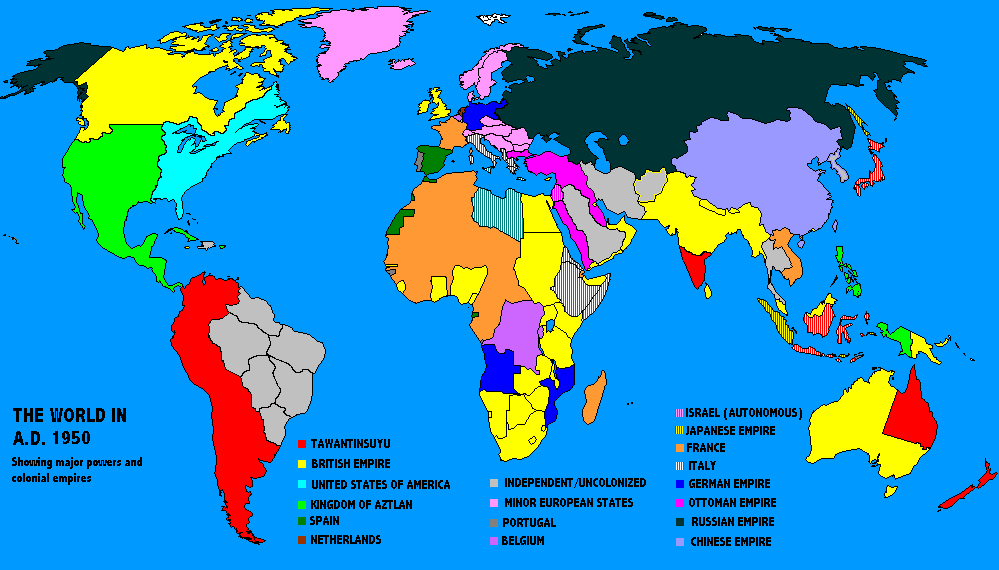
A.D. 1950 onward--The Tide of Revolution: During the Tawantinsuya Civil War, some of the Marxist Popular Front groups had operated from bases in the successor states of the former Quilombo. While there, they had made contact with disaffected elements of the population of those regions, leading to the formation of Marxist revolutionary parties in those states, a trend which was reinforced by the permanent immigration of many of the more die-hard Popular Front revolutionaries in the aftermath of the failed revolution in Tawantinsuyu. The Marxist ideology of the Popular Front, calling on it’s followers to abandon their tribal loyalties in favor of a universal "class identity," appeals to many who would like to see the Quilombo reunited and who see this ideology as a way to get beyond the tribalism which tore the Quilombo apart. In the years after 1949, therefore, insurgencies will arise to oppose the military dictatorships which rule in most of the successor states of the Quilombo, embroiling the region once more in conflict. One by one, the successor States will fall prey to these insurgencies, and by 1970, all of them will be ruled by Marxist regimes.
During this same period, insurrections (generally, but not always, lead by Marxists, some of them inspired by refugees from the failed Popular Front revolt in Tawantinsuyu) will break out in the various colonial empires, as people yearning for independence from colonial rule take up arms. The process leading to the formation of independence movements has taken somewhat longer than in OTL, due to the fact that the major colonial powers...France and Britain primarily...managed to remain out of the major wars of the first half of the 20th Century, and therefore their resources and ability to hold down their colonial empires has not been depleted. Furthermore, unlike in OTL, there are no communist governments secretly providing support to local Marxist independence movements, which must operate entirely on local resources. Nevertheless, by 1950, rebellion is breaking out all over. After years laying the groundwork, Ho Chi Minh creates the Viet Minh, a Marxist guerrilla force which opposes French occupation of Vietnam. Marxist guerrillas also begin an uprising in Cambodia against French rule. Achmed Sukarno begins an insurrection against Japanese rule in the former Dutch East Indies. Rebellions against British rule break out in Burma and Malaysia. By far the most serious disturbances are in India, where continued British intransigence against the demands of the Indian National Congress for Home Rule, have finally pushed the leadership of the I.N.C. away from the pacifistic policies of Mohandas Gandhi and toward the more belligerent stance advocated by such leaders as Subhash Chandra Bose, who advocates armed resistance aimed at the complete independence of India. The Tawantinsuya colony in India, while less affected by these events, is not immune, as despite the comparatively enlightened policies followed by the Tawantinsuya, there is still a large segment of the population which wishes to free itself from foreign rule, however benign. And in Africa, liberation movements begin guerrilla struggles in colonies across the continent.
Most of these liberation movements will not be successful in achieving complete independence, as the imperialist powers are just too powerful, but they will tie down large numbers of troops and significant financial resources for years to come, and cause many in the imperialist nations to begin to question the policies of their governments. Ultimately, most empires will evolve into Federal Unions or Commonwealths when home rule is granted to most of the colonies in the 1970s and 1980s.
A.D. 1950 onward--Wernher von Braun’s rocket research, now funded by the Imperial German military, is in high gear. His technologically sophisticated and well-funded facility at Peenemunde on the Baltic Coast is doing test firings on a very frequent basis, and the technology is improving rapidly. Other governments are starting to take notice and to grasp the potential strategic implications, leading most of the major powers to create their own government-funded research programs. The days when rocketry was a mere fad indulged in by enthusiast clubs and eccentric inventors is over. It is now a serious business.
A.D. 1950 onwards--In addition to weapons research, atomic scientists have also discovered that atomic energy can be used for power generation. In 1950, the world’s first atomic power generating station opens in Germany. Within a few years, others will open in Britain, France, Russia, Tawantinsuyu, China, Japan, Aztlan, and the United States. By the end of the century the vast majority of the world’s electric power will be generated by means of atomic energy. This will have many benefits, including a dramatic reduction of air pollution caused by burning of fossil fuels, and a reduction in the cost of generating electricity. But with this will come problems. Atomic energy, it is found, generates highly radioactive wastes which remain deadly for thousands of years, and finding a means to safely dispose of these wastes will be a major problem for all nations. And there will be some nuclear accidents which will lead to the loss of many lives, especially in the 1990s.
A.D. 1951--Crown Prince Felipe Juan Luis of Aztlan drowns while fishing in the Gulf of Mexico. His son, Carlos Felipe, is now heir to the throne of Aztlan. Kaiser Wilhelm III of Germany dies. He is succeeded by his son, who reigns as Louis Ferdinand.
A.D. 1952--Prince Imperial Napoleon of France and Princess Marie Josefa produce a son (after having produced four daughters), who they name Napoleon Louis Charles Joseph. Also in this year, Italian Dictator Benito Mussolini dies. Galeazzo Ciano is selected by King Umberto II to replace him as Prime Minister (and de-facto Dictator) of Italy. Ciano, who had served as Italy’s Foreign Minister since 1936, was the son-in-law of Benito Mussolini and also a close friend of the King. He shares the King’s view that continued Italian aggression will inevitably lead to disaster for Italy, and will pursue a more moderate foreign policy.
A.D. 1953--King Benedict V of the United States dies. He is succeeded by his son, who reigns as King Benedict VI. King Louis II of Spain dies, and is succeeded by his son Felipe Carlos, who reigns as King Phillip VI.
A.D. 1954--Death of Sultan Ahmed IV Nihad of the Ottoman Empire. He is succeeded by Osman IV Fu’ad. The new Sultan shares his predecessor’s aggressive proclivities. The joint Italian/Ottoman effort to develop an atomic bomb bears fruit when a successful test is conducted in the Arabian desert. Both Italy and the Ottoman Empire are shortly producing atomic bombs for their arsenals.
A.D. 1955-1958--Seeking to end the raiding against Ottoman installations by Wahabbi Bedouins loyal to the remnants of the House of Saud, which have been continuing on an intermittent basis since the Saudi state of Nejd was destroyed in 1918, Sultan Osman IV Fu’ad orders the invasion and occupation of Arabia. Using his authority as Caliph, he declares the Wahabbis to be heretical, and declares a Jihad against them. Ottoman armored columns and aircraft seek out and destroy the Bedouin camps, and in a virtually genocidal campaign pretty much wipe out the Wahabbi tribes over the next three years. Ottoman garrisons occupy Riyadh and the few other major settlements in the region, and the region is incorporated fully into the Ottoman Empire.
A.D. 1955--In April 1955, Germany launches a ballistic missile carrying a simulated warhead from Peenemunde. It impacts on it’s target in a test range in the Atlantic ocean off the coast of Angola, a distance of almost 5,000 miles. Further successful tests will be conducted later this same year. King Ferdinand II of Aztlan and Tupahualpa Inca II of Tawantinsuyu, along with King Benedict VI of the United States, reach an agreement to create a Western Hemispheric Free Trade Zone, with reduced tariffs and other trade incentives to encourage commerce between the three nations.
A.D. 1956--The Egyptian War. Emboldened by the Ottoman Empire’s acquisition of atomic weapons, Sultan Osman IV Fu’ad sends troops across the Suez Canal into Egypt, which has been under British control since the 1880s even though legally it is still Ottoman territory. The Ottomans depose the British puppet government of King Faruk and fighting breaks out between Ottoman and British forces over control of the region. The Italian government under Galeazzo Ciano immediately declares it’s neutrality and abrogates it’s mutual defense pact with the Ottoman Empire. A British naval invasion force, sent by sea to oust the Ottomans, is vaporized on July 10, 1956 by an Ottoman atomic bomb dropped by a short-range bomber while still at sea off Alexandria. In response, Britain calls on the Congress of Nations to take action against this naked aggression against a member-state of the Congress, as specified by the amendment to the charter of the Congress adopted in 1947. The Congress issues an ultimatum to the Turks...either withdraw from Egypt by July 31, or face military action by the Congress. The Sultan rejects the ultimatum on July 30. Kaiser Louis Ferdinand of Germany offers the use of his nation’s atomic weapons to the Congress, and the Congress accepts. It is decided to make a strong statement, and the target is picked accordingly. On August 1, a German ballistic missile, tipped with an atomic warhead, is fired from Peenemunde. It detonates over Ankara, former seat of the Ottoman government (which was returned to Constantinople after it’s recapture from the Greeks in 1946) and now one of the largest cities in the empire, killing over 100,000 civilians. It is only now that the Ottoman government realizes a major flaw in it’s calculations...they have atomic weapons, but no long-range bombers with which to deliver them! It is apparent that they are hideously vulnerable to complete destruction by Germany and have no means to respond. Sultan Osman IV Fu’ad, in a fit of near hysterical anger, wants to lash out indiscriminately wherever his short-range bombers can reach, but his generals refuse to carry out these orders and a military coup deposes the Sultan, replacing him with another member of the Ottoman House, Mehmed Abdul-Aziz II. The new Sultan immediately sues for peace and agrees to immediately withdraw Ottoman troops from Egypt. The Sultan also agrees to pay reparations...in the form of oil shipments...to Britain in compensation for the destruction caused by the Ottoman use of atomic weapons against the British naval force, and to dismantle the Ottoman atomic weapons stockpile and all facilities for producing atomic weapons within the Ottoman Empire. There are demands by some of the member nations of the Congress...Russia notably...that as further punishment, the Ottomans be forced to relinquish control of Constantinople, but the Ottomans promise to fight to the bitter end to retain control of their capital, and in the end, the Congress decides not to pursue the matter further. The last Ottoman troops withdraw from Egypt in September 1956.
A.D. 1956--In early October, in the aftermath of the defeat of the Ottomans in the Egyptian War, the Jewish government in Palestine...realizing that the reckless actions of the Ottoman Empire could easily have visited atomic destruction on Palestine...declares it’s independence from the Ottoman Empire and immediately applies for admission into the Congress of Nations. The Ottomans mobilize to invade, but the Congress of Nations demands that the Ottomans demobilize immediately or face the consequences. The Ottomans comply. The Congress admits the new state of Israel on October 21, 1956, forcing the Ottomans to recognize the fait accompli.
Also, in the aftermath of the events of the Egyptian War, the proliferation of atomic weapons and the research being conducted by Germany on ballistic missile technology comes under discussion by the Congress of Nations. Several nations, including France, Russia, Britain, and Tawantinsuyu, are of the opinion that the marriage of Germany’s atomic weapons with the long-range ballistic missiles developed by Wehrner von Braun...though used recently in reply to aggression...has created a potential threat to the security of nations around the world which is unacceptable, and are calling for an international treaty banning such weapons. Kaiser Louis Ferdinand, who unlike his predecessors never pursued a military career and has a much more "civilian" outlook, agrees to negotiate on the matter.
A.D. 1957--Italy applies for membership in the Congress of Nations. The Congress agrees, with one proviso...Greek and Albanian independence must be restored. Galeazzo Ciano of Italy agrees almost immediately...ever since Italy occupied these two countries, insurgent movements (secretly supplied by Russia) have remained active, imposing a constant drain on Italian manpower and resources, and Ciano has long felt that holding onto them was more trouble than it was worth. The states of Greece and Albania are restored to independence. Also in this year, the International Convention on the Peaceful Use of Rocketry is adopted by the Congress of Nations and sent for ratification by the individual member nations of the Congress. The Convention stipulates that under no circumstances will rockets be used for the purpose of carrying atomic warheads. It also creates a system of international inspections to ensure that no nation secretly violates the Convention. All of the member nations...including Germany...will ratify the Convention within two years. Discussions continue over the problem of atomic weapons proliferation. These discussions take on more urgency when, in May 1957, Great Britain detonates an atomic bomb near Christmas Island, in the Pacific Ocean. Concerns that the growing number of nations possessing such weapons could lead to a worldwide catastrophe spur the talks onward.
A.D. 1957 onward--With the adoption of the International Convention on the Peaceful Use of Rocketry, Wernher von Braun suddenly finds himself in a quandary. Since the use of rockets as a means to carry atomic weapons has been banned, von Braun’s sponsors in the German military have withdrawn the funding for his research at Peenemunde. Von Braun desperately needs money to continue his research, and he asks for, and receives, a meeting with Kaiser Louis Ferdinand in December 1957. At this meeting von Braun lays out the many potential advantages of space exploration...not only the general advance of scientific knowledge, but such practical benefits as the possible use of satellites for communication purposes, mining of resources on extraterrestrial bodies, even the possibility of human colonization of the moon and Mars. His enthusiastic presentation sways the Kaiser, who pushes a bill through the Reichstag to create a new Space Research Agency...to be headed by von Braun...which will assume control over the facility at Peenemunde. Continued funding for von Braun’s research is assured. The focus of the research, however, now shifts from military to civilian applications.
A.D. 1958--France detonates an atomic bomb in the Sahara Desert of Algeria. Tawantinsuyu detonates an atomic bomb in the Pacific off the coast of New Zealand. In the Congress of Nations, Kaiser Louis Ferdinand of Germany makes a startling proposal...he offers to turn over control of all of Germany’s atomic weapons to the Congress of Nations, if all other atomic powers will do likewise. He is supported in this declaration by Tupahualpa Inca II of Tawantinsuyu and by King Edward VIII of Great Britain. After much discussion, the other atomic powers agree to this, and a new agency is created by the Congress to assume control of the various atomic stockpiles. The various non-atomic nations also agree to forego the acquisition of their own stockpiles, in that their security will be guaranteed by the Congress. Also in this year, French troops inflict a major defeat on the Viet Minh and capture Ho Chi Minh. Ho is executed by guillotine later that year. With his death and the major losses suffered by the guerrillas in recent years, the rebellion begins to fall apart. Other victories against the rebels in Cambodia and Laos are also won this year, with similar results.
A.D. 1959--Emperor Napoleon V of France dies, and is succeeded by his son, who reigns as Emperor Napoleon VI. The new emperor decides to take advantage of the weakness of the Marxist rebels in Indochina to try to engage local leaders in dialogue aimed at ending the conflict. Negotiations with Marxist and non-Marxist leaders from the region begin before the end of the year. Also in this year, the German Space Research Agency launches the world’s first artificial satellite into orbit. The strains of "Deutschland Uber Alles" being transmitted from the satellite are picked up on radios around the world, and the launch causes a world-wide sensation. Other nations who had allowed their own rocket programs to lapse in the aftermath of the Convention on the Peaceful Use of Rocketry now reopen their programs.
A.D. 1960--As a result of negotiations with Indochinese leaders, Emperor Napoleon VI of France grants home rule to Indochina, within the framework of a Federal Union with France. Indochina will now be represented in the French Imperial Parliament. A locally elected legislature is created with authority over local matters, and instead of a governor appointed by the Imperial Government, the chief magistrate will be elected by the people of Indochina. Over the next two decades, the "Indochinese Solution" will be the model by which France will handle the various independence movements in it’s colonial empire, and similar solutions will be adopted by the other colonial powers. Also in this year, the Muslim Brotherhood, an extremist Islamic organization founded in Egypt in 1928 and which advocates holy war against the Jewish state in Palestine, begins receiving secret support from the Ottoman Empire (which has not forgiven the Jews of Palestine for their "treachery" in declaring independence in the aftermath of the Egyptian War). It begins organizing members of the Palestinian Arab diaspora and training them for guerrilla warfare against Israel.
A.D. 1961--Germany launches the world’s first communications satellite. Britain, France, and Tawantinsuyu all launch test satellites into orbit. Achmad Sukarno is captured by Japanese forces in Indonesia. He is executed later that year. Mohammed Hatta assumes leadership of the Indonesian rebels.
A.D. 1962--Death of Tupahualpa Inca II of Tawantinsuyu. He is succeeded by his son, who reigns as Auqui Tupac Inca. Auqui Tupac Inca is an avid enthusiast of space exploration and the peaceful use of space. He will fully support such programs throughout his reign. Meanwhile, Sultan Mehmed Abdul-Aziz II of the Ottoman Empire has been, since the Ottoman defeat in the Egyptian War, actively pursuing a foreign policy aimed at repairing his nation’s relations with the rest of the world. In this year the Ottoman Empire applies for admission into the Congress of Nations. After much discussion, the request is granted on June 23. Russia, Aztlan, and the United States launch a test satellite into orbit. Britain, France, and Tawantinsuyu launch communications satellites. Thailand and Persia join the Congress of Nations.
Also in this year, a bomb is detonated in the King David Hotel in Jerusalem, demolishing the building and killing over 200 people. This will be, unfortunately, only the first of many terror attacks against Israel carried out by the Muslim Brotherhood. Israel will respond with a covert campaign wherein they will track down and assassinate Muslim Brotherhood members worldwide. Israel, of course, strongly suspects that the Ottoman government is behind the terrorism, but is unable to prove it...for now.
A.D. 1963--Death of King Kalakaua III of Hawaii. He is succeeded by his son, who reigns as King Kalakaua IV. Crown Prince Carlos Luis of Spain marries Princess Pauline of France, eldest daughter of Emperor Napoleon VI. Edward, Prince of Wales, marries Princess Sofia of Greece (daughter of King Paul I, who had been restored to the Greek throne when Greek independence was restored in 1957). China and Japan launch test satellites into orbit. In a speech before the Congress of Nations, Wernher von Braun proposes the creation of an international space agency, wherein the nations of the world could pool their resources in pursuit of projects which would benefit all nations, rather than wastefully pursuing independent programs on the national level. He is enthusiastically supported in this by Auqui Tupac Inca of Tawantinsuyu, and although the Congress does not adopt the proposal, several nations, including Germany, Britain, Russia, and Tawantinsuyu, agree to form a joint space research project. The new joint agency will be known as the International Space Exploration Agency (I.S.E.A.). Wernher von Braun is named the director of the agency.
A.D. 1964--The Prince and Princess of Wales produce a son, who they name Henry William George Edward Arthur Charles Frederick. I.S.E.A. announces plans to build an international Space Station in orbit around the earth. The station will be a site for research on the effects of weightlessness on the human body...necessary if manned exploration of space is to be carried out...as well as other research. It will also be from here that any manned missions to the moon and other bodies in the solar system are launched...it being much more cost effective to build spacecraft in space, rather than to build and launch them from earth.
A.D. 1965--Crown Prince Carlos Luis and Princess Pauline of
Spain produce a son, who they name Luis Felipe. Aztlan launches it's first
communications satellite, in a joint venture with the United States. Russia
launches a communications satellite.
A.D. 1966--Construction begins on the I.S.E.A.’s space station. China and Japan launch communications satellites. Japanese forces win a crushing victory over the Indonesian rebels outside Jakarta. Mohammed Hatta and numerous other rebel leaders are killed, along with over 1,000 of their followers. This victory breaks the back of the rebellion, and the remnants of the independence movement in Indonesia soon enters into negotiations with the Japanese authorities. In the end, limited home rule will be granted to the province. But Japan will stop short of transforming it’s empire into a Federal Union, as so many of the other colonial powers will do. Indonesia will not be represented in the Japanese Diet, and will continue to be governed by a colonial administration, with a locally elected legislature and a Japanese Governor.
A.D. 1967--Emperor Xuantong of China dies childless. He is succeeded by Crown Prince Yuyan, who reigns as the Emperor Huangqing. King Ferdinand II of Aztlan dies. He is succeeded by his grandson, Crown Prince Carlos Felipe, who reigns as King Charles I. In India, nearly 20 years of fighting have mutually exhausted the British authorities and the Congress Party revolutionaries. Tentative peace feelers put out by the British government are accepted by the Congress Party, and negotiations produce an agreement similar to that made by France with the Indochinese rebels several years earlier (and, incidentally, by Britain with the Irish nationalists back in the 1920s). India is granted Dominion status, and will be represented in the Imperial Parliament in London, with local affairs to be the domain of an Indian Parliament which will be elected by the people of India and will sit in Delhi. Most of Britain’s other remaining colonies will be granted similar status within the next decade, transforming the British Empire into the British Commonwealth. I.S.E.A. launches exploratory probes to the moon and Mars which transmit back the first reconnaissance photographs of these extra-terrestrial bodies.
A.D. 1968--Germany and Italy create federal unions with their colonies similar to that created by France with it’s "Indochinese Solution." France, China, and Japan join the I.S.E.A.
A.D. 1969--Tawantinsuyu grants limited home rule and representation in the Imperial Parlaywasi to it’s overseas colonies in Australia and New Zealand. The colony in India, however, where armed rebellion against Tawantinsuya authority continues, remains under direct imperial rule. Wernher von Braun once again proposes that the Congress of Nations adopt the I.S.E.A. as a true world project. This time, the proposal is accepted. With all member nations contributing, funding for the program is dramatically increased, and construction of the space station accelerates rapidly as a result.
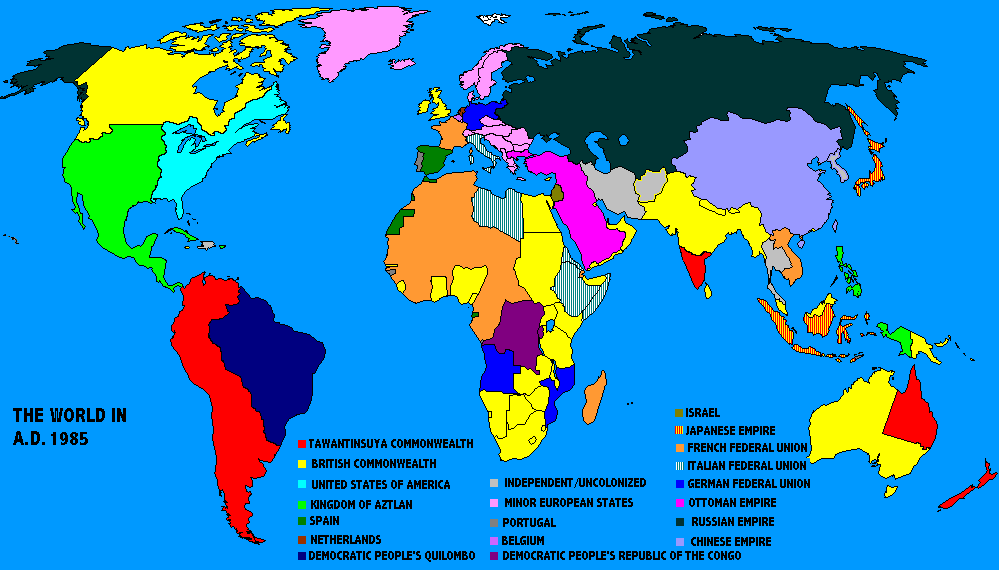
A.D. 1970--King Phillip VI of Spain dies, and is succeeded by his son Carlos Luis, who reigns as King Charles VIII. Also in this year, the last of the military dictatorships in the former Quilombo is overthrown by Popular Front revolutionaries. Shortly afterward, a Congress of the Popular Front of the Quilombo is held at the former capitol city of the Quilombo, Cerca do Macaco, which achieves the reunification of the various successor States. The Democratic People’s Quilombo is thus born, holding sway over all of the former Quilombo except the island of Hispaniola, which had declared independence as the Republic of Haiti back in the 1920s.
A.D. 1971--King Charles I of Aztlan marries Princess Josephine Bonaparte, daughter of Emperor Napoleon VI of France. Construction on the I.S.E.A.’s space station is completed and the station is fully operational. The station is doughnut shaped and spins to provide a form of artificial gravity. The first full-time permanent crew takes up residence in the new station.
A.D. 1972--King Edward VIII of Great Britain dies, and is succeeded by his son, who reigns as King Edward IX. Prince Henry is invested as Prince of Wales. Also in this year, Israeli agents manage to steal documents conclusively proving that the Muslim Brotherhood is being funded by the Ottoman Government. Israel presents these documents to the Congress of Nations, where their legitimacy is questioned by many who have been taken in by Ottoman "friendliness and cooperation" in the years since the Egyptian War. But an analysis of the documents by the world’s intelligence agencies supports the Israeli contention that the documents are genuine, and the Congress of Nations votes to impose economic sanctions on the Ottoman Empire. Sultan Mehmed Abdul Aziz II responds by declaring an embargo of oil shipments from the Ottoman Empire to the rest of the world until the sanctions are lifted. As the Ottomans control the majority of the world’s proven oil reserves, this announcement throws most of the world’s economies into chaos. Stock markets crash in several nations, and a major world recession results. There are calls for the Congress of Nations to take military action to force the Ottomans to lift the embargo, but in the end, an agreement cannot be reached before the end of the year.
A.D. 1973--King Charles I and Queen Josephine of Aztlan produce a son, who they name Luis Ferdinand. Death of Ottoman Sultan Mehmed Abdul-Aziz II. Being of very advanced age and ill health, the next-in-line member of the Ottoman dynasty for the throne, Ali Vasib, decides, in the interest of the country, to decline the throne in favor of a younger family member. Thus, Prince Ertugrul Osman succeeds to the throne as Sultan Osman V. Ertugrul Osman is concerned by the escalating crisis between his country and the Congress of Nations. He is especially frightened by news that Russia and Britain are massing troops on the empire’s northern and western borders. He goes before the Congress of Nations and offers to lift the embargo and guarantee that Ottoman support for the Muslim Brotherhood will stop, if the Congress will also lift the economic sanctions on the Ottoman Empire. King Benedict VI of the United States, Emperor Napoleon VI of France, and Auqui Tupac Inca of Tawantinsuyu all argue in favor of accepting the Sultan’s proposal. Kaiser Louis Ferdinand of Germany and Tsar Georgi of Russia demand that additional conditions must be imposed...that the Ottomans pay compensation to Israel for the death and destruction caused by Muslim Brotherhood terrorists funded by the Ottomans, and that the Ottomans guarantee to sell their oil at a reduced price for the next ten years to assist in repairing the damage they have done to the world economy with their embargo. In the end, the Sultan agrees to these conditions, and the crisis is defused.
A.D. 1973 onward--The new Democratic People’s Quilombo is seeking to export it’s revolution abroad, primarily to it’s "imperialist" neighbor, Tawantinsuyu. As a result, a state of intermittent border conflict...never quite flaring up into full-scale war...will continue to exist between the two powers for many years as Popular Front guerrillas from the Quilombo infiltrate the border with Tawantinsuyu and clash with Tawantinsuya military units. Tawantinsuyu will respond to Popular Front rocket and artillery attacks on border towns with airstrikes and artillery barrages of it’s own. Nothing much will be accomplished by either side, despite the slowly and steadily mounting death toll, as the Popular Front no longer has any measurable support within Tawantinsuyu itself (the adoption of socialist reforms by the Parlaywasi in the final years of the Tawantinsuya Civil War...said legislation signed by Tupahualpa Inca II...having removed most of the grievances which had fueled the Popular Front’s support in the past).
A.D. 1973 onward--Bereft of Ottoman support, the Muslim Brotherhood seeks alternate means of funding it’s terror campaign against Israel. They become involved in the international drug trade and other nefarious activities, and although the level and scale of their activities decline, they do not disappear entirely. Indeed, Muslim Brotherhood terrorism will be a problem well into the 21st Century.
A.D. 1975--Prince Imperial Napoleon of France marries Princess Margaretha of Luxembourg. Negotiations between the Tawantinsuya government and the rebels in it’s Indian colony end the rebellion in India. The Indian colony is granted home rule, with representation in the Imperial Parlaywasi. Like that of Britain, the Tawantinsuyu Empire has become a commonwealth.
A.D. 1976--I.S.E.A. announces plans to send a manned mission to the moon. In preparation, several un-manned probes will be launched to take surveys of the resources to be found on various parts of the lunar surface. Crown Prince Peter of Russia marries Princess Helen of the United States, daughter of King Benedict VI. Muslim Brotherhood terrorists hijack several aircraft belonging to the prime member nations of the Congress of Nations, including Britain, France, Germany, Russia, Tawantinsuyu, China, and Japan. In several cases they demand the release of Muslim Brotherhood members held in Israeli jails, or in other cases, they simply demand large cash payments in exchange for their hostages. Several of these sieges are resolved and the hostages freed by governments agreeing to the terms of the hijackers, or by armed assaults on the grounded aircraft by crack commando units. Others end in tragedy when the terrorists blow up the aircraft, along with their hostages and themselves, when governments refuse to negotiate. This will be an increasingly common event over the coming years.
A.D. 1977--The one European colonial power which has not seen fit to transform it’s empire into a federal union is Belgium, whose near genocidal exploitation of the native population in it’s African colony has continued, unabated, throughout the century. As a result, resistance by Marxist guerrillas...with secret assistance from the Democratic People’s Quilombo...has continued and grown stronger in recent years. In this year, the rebels win a decisive victory over Belgian forces and capture the colonial capital of Leopoldville. Whites in the colony are either massacred or forced to flee. Widespread revulsion with Belgian policies in the region leads the other powers to turn a deaf ear to Belgium’s pleas for assistance, and on September 1, 1977, the Democratic People’s Republic of the Congo is born. Like it’s sister state in South America, this Marxist republic will be a pariah state which seeks to export revolution to it’s neighbors over the succeeding years, leading to ongoing conflict in many areas of Africa. Wernher von Braun dies. He is replaced as head of I.S.E.A. by his assistant director, Dr. Inti Guaman of Tawantinsuyu. Inti Guaman had headed the Tawantinsuya rocketry program before becoming Dr. von Braun’s assistant director at I.S.E.A., and he shares Dr. von Braun’s vision of the future of space exploration. He is therefore a natural successor to von Braun. One area where he differs from von Braun is on his views with regard to space propulsion. Where von Braun was an exponent of conventional chemical rockets, Inti Guaman supports further research into such technologies as the nuclear thermal rocket, which uses a nuclear reactor to heat hydrogen, which is then expelled from the rear of the vehicle, providing thrust for a much greater period of time...and thus the potential for a much higher speed...than a conventional rocket would be capable of. As a result, a greater share of I.S.E.A. funding will go towards these alternate technologies in the coming years. In Italy, Galeazzo Ciano, in ill health, resigns as Prime Minister. He is replaced by fellow fascist Gianfranco Fini. Fini will introduce liberal reforms into the Italian governmental system, ultimately allowing free elections...for the first time since the 1920s...before the end of this decade.
A.D. 1978--A lunar probe discovers water ice in craters at the lunar south pole. Italian Prime Minister Gianfranco Fini allows non-Fascist newspaper and other media outlets to operate in Italy for the first time in half a century. The Congress of Nations discusses the problem of ongoing terrorism by the Muslim Brotherhood. A special joint military and police task force is created for the purpose of dealing with the problem. A primary contributor to the success of this force will be the Ottoman Empire, which will supply Arabic-speaking agents who will infiltrate Muslim Brotherhood cells, enabling them to be ferreted out and destroyed.
A.D. 1979--A probe sent to explore the lunar north pole also
discovers water ice in craters there. It is decided that the first manned
missions to the moon will be to explore these craters in an effort to ascertain
just how much water is present there. The
Italian government of Gianfranco Fini holds free elections for the Italian
Parliament for the
first time in over 50 years. The elections are conducted fairly and mostly
honestly, and
surprisingly, despite predictions by various political pundits to the contrary,
Fini’s
Fascists and other right-wing parties retain a small majority in the
legislature, and Fini is
able to retain his job as Prime Minister.
A.D. 1980--Prince Imperial Napoleon and Princess Margaretha of France produce a son, who they name Napoleon Louis Jean Henri Charles. The last of Britain’s colonies in Africa and Asia are granted Dominion Status.
A.D. 1981--Emperor Napoleon VI of France dies. He is succeeded by his son, who reigns as Emperor Napoleon VII. Great Britain and Tawantinsuyu hold celebrations in honor of the 400th anniversary of the alliance between their two nations. As in the 300th anniversary celebrations held in 1881, each nation issues commemorative coins and postage stamps, and the heads of state trade travel to each other’s capitals to attend ceremonies hosted by each country.
A.D. 1982--The last of France’s colonies in Africa is granted home rule and admitted into the Federal Union. Crown Prince Peter and Princess Helen of Russia produce a son (their third child) who they name Alexander Petrovich Romanov.
A.D. 1983--Death of King Umberto II of Italy. He is succeeded by his son, who reigns as King Victor Emanuel IV. Victor Emanuel, unlike his father, strongly dislikes the Fascists, and his relationship with his Prime Minister will be quite stormy. The ten year period during which the Ottoman Empire agreed to sell it’s oil at reduced prices ends. The Ottomans impose a large increase in the price of oil, bringing their prices in line with the world market price. This causes another recession in many countries which are dependent on Ottoman oil.
A.D. 1984--King Victor Emanuel IV of Italy calls for the resignation of his Prime Minister, Gianfranco Fini. Fini refuses, and a constitutional crisis results. The King declares that Fini cannot continue in his post without royal approval, and Fini declares that the King has no right to remove a Prime Minister who was selected by a majority of the duly elected Parliament. The Italian Constitution is unclear on this matter, and both appeal to the people for support in nationally televised speeches. For most of the rest of the year, the Italian government is stymied as the King vetoes all legislation passed. Finally, the King and the Prime Minister reach an agreement to put the issue before the people by calling an election for Parliament. The election will be held next year.
A.D. 1985--The first manned mission to the moon is launched from the I.S.E.A. space station. It lands at the lunar south pole, and explores several craters there. It is confirmed that large quantities of water ice is to be found in the craters of the lunar poles, enough to sustain a sizable population of humans...as well as provide oxygen and hydrogen for rocket fuel...for several centuries. Also in this year, elections are held in Italy. The King’s Party (a coalition of socialist and other liberal parties) narrowly defeats the Fascist-lead National Alliance in the elections and captures a small majority of the seats in the legislature. Arturo Parisi is named the new Prime Minister...the first non-Fascist to hold the post in over 60 years.
A.D. 1986--Three more manned missions to the moon are sent in this year. Like the 1985 mission, these also confirm the presence of large quantities of water ice in craters at both the lunar north and south poles. In Aztlan, a new generation of computers has been introduced as a breakthrough in the manufacture of computer chips enables a dramatic reduction in size and increase in computing power. In the United States, the analogue of what we in OTL would call the internet is born as computers at several universities are linked, via telephone connections, enabling them to exchange data with each other over long distances. Over the next few decades, these two innovations will revolutionize the world as computers become widely available to average people and enable the exchange of information and ideas worldwide.
A.D. 1987--A conference of the I.S.E.A. discusses the possibility of establishing a lunar base. It is decided that the technology to do so in a cost-effective manner does not yet exist, as ferrying the necessary supplies to establish and maintain such a base using conventional chemical rockets would be prohibitively expensive. Inti Guaman, director of I.S.E.A., uses these facts to push for greater funding for his own pet project, the nuclear thermal rocket, which he views as the perfect vehicle for supporting a lunar base.
A.D. 1988--Henry, Prince of Wales, weds Lady Diana Spencer at St. Paul’s Cathedral in London. The marriage will prove to be permanent, happy, and fruitful. Death of Tsar Georgi of Russia. He is succeeded by his son, who reigns as Tsar Peter IV. Peter’s son, Alexander, is installed as Crown Prince.
A.D. 1989--The prince and Princess of Wales produce a son, who they name George Edward William Henry Charles Arthur David. This will be the first of five children they couple will have. Death of Emperor Hirohito of Japan. He is succeeded by his son, who reigns as the Emperor Akihito. Akihito is more reform-minded than his father was, and under his rule, Japan will reform it’s government in many ways, including the administration of it’s colony in Indonesia.
A.D. 1990--Death of Auqui Tupac Inca of Tawantinsuyu. He is succeeded by his son, who reigns as Titu Cusi Inca. Emperor Akihito of Japan urges the Japanese Diet to follow the example of France, Germany, and other colonial nations and create a Federal Union with it’s colony in Indonesia. His suggestions are politely declined by that body.
A.D. 1991--Fighting breaks out between German forces in Angola and Marxist guerrillas supplied by the People’s Democratic Republic of the Congo. Kaiser Louis Ferdinand, however, does not wish to become involved in a full-scale war, however, and he restrains his commanders, who want to pursue the guerrillas into the safe-havens in the Congo.
A.D. 1992--Following elections for the Japanese Diet which have brought a majority of liberal parties to power in Japan, Emperor Akihito once again urges the creation of a Federal Union between Japan and it’s colony in Indonesia. The Diet, after much debate, votes to do this, and a constitutional amendment is passed which allows Indonesia to be represented in the Diet for the first time.
A.D. 1993--A nuclear accident in China at Beijing kills nearly 80,000 people. Hundreds of thousands more will experience cancers and other ill effects for years to come, and the city itself and the surrounding area will be uninhabitable for years due to high levels of radioactive contamination. Emperor Huangqing endears himself to the people of China by personally visiting the refugee camps set up for survivors outside the contamination zone and by ensuring that adequate medical supplies, food, and water are arranged for the camps. The accident has several long-range impacts. This is by far the worst nuclear accident in world history, and it leads many countries to re-consider their dependence on nuclear power for energy generation. However, few alternatives...or, at least, few alternatives without hazards of their own...exist at the present time, and most countries either begin or increase funding to research projects exploring alternative energy sources, including nuclear fusion, solar, and others. The accident also has another, possibly more important, impact: it gives all things "nuclear" a bad name in the public mind, and as a result public support for research into the nuclear thermal rocket...which I.S.E.A. had hoped would represent the next generation of space propulsion technology...plummets, and along with it, funding approvals for research into the technology.
Also in this year, elections are held in Indonesia for delegates to the Japanese Diet. These delegates take their seats later this same year. The Japanese Empire is now a Federal Union.
A.D. 1994--Kaiser Louis Ferdinand of Germany dies, and is succeeded by his son, who reigns as Kaiser Wilhelm IV. The new Kaiser is cut much more from the cloth of his predecessors than his father had been, and he is keenly interested in the military and in military affairs. Inti Guaman, angered by the cancellation of research into the nuclear thermal rocket, resigns as head of the I.S.E.A. He is replaced by Chinese scientist Lee Kwan Tso.
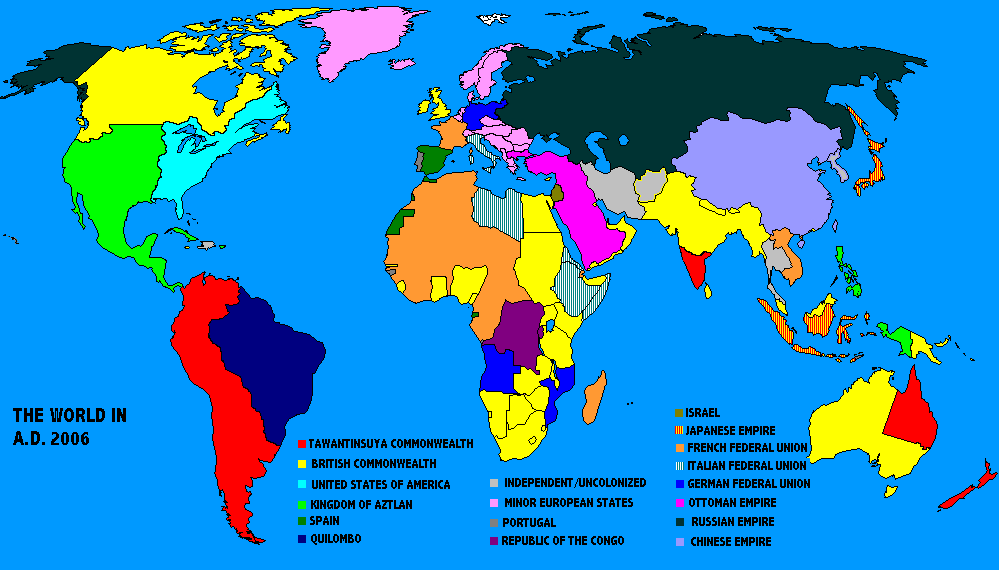
A.D. 1995-1996--In May 1995, Kaiser Wilhelm IV orders an invasion of the People’s Democratic Republic of the Congo, in retaliation for yet more raids by Marxist guerrillas operating from the sanctuary of that nation. German forces advance rapidly into the Congo, and despite strong resistance by the Congolese...who fear a return of genocidal European rule...capture the capital at Kinshasa (formerly Leopoldville) in early 1996, and by the end of that year have secured the entire country. The Marxist government flees the city and takes to the jungles, where they will conduct an ineffective guerrilla war against German occupation for many years. Germany’s action is condemned by some in the Congress of Nations, but the majority of the member nations, while not necessarily approving of the means, can see that a desirable end is being achieved by the removal of this troublesome regime.
A.D. 1996 onward--In the aftermath of the conquest of the Congo, Kaiser Wilhelm IV announces that Germany has no intention of retaining the conquered territory. He asks the Congress of Nations to assist in rebuilding said nation and creating a stable government there. The Congress agrees, and over the next few years, diplomats and administrators from the Congress work with local non-Marxist leaders toward that goal. Economic aid is sent by many of the member nations of the Congress, and popular support for the Marxist guerrillas withers on the vine. Veterans from Aztlan, China, and Japan hold joint ceremonies in remembrance of the end of the Pacific War of 1941-1946. Included in these observances is the dedication of Peace Memorial at Manila in the Philippines, with inscriptions in Spanish, Japanese and Chinese condemning aggressive war and calling on all nations to work for peace.
A.D. 1997--War between Tawantinsuyu and the Democratic People’s Quilombo. In March 1997, an especially destructive attack by Popular Front guerrillas based in the Quilombo on several Tawantinsuya border towns results in a declaration of war by Titu Cusi Inca of Tawantinsuyu (who has been encouraged by the example set by Kaiser Wilhelm IV in the Congo) on the Quilombo. Tawantinsuya armored columns advance rapidly against the Quilombo’s lightly armed military (the Quilombo has never fully re-established it’s industrial base following the decades-long civil war), and along the way, the Tawantinsuya make a shocking discovery...the Popular Front government of the Quilombo has been engaging in large-scale repression against it’s own people. Mass graves of political opponents of the Popular Front are discovered in numerous locations, as well as "re-education camps" where those with whom the Popular Front has issues are confined, tortured, and worked to death under horrible conditions. Tawantinsuya troops therefore often find themselves hailed as liberators as they advance deeper into the Quilombo, and within a short time, most of the major cities are under Tawantinsuya control. The Popular Front Government collapses as Tawantinsuya troops approach the capital in July 1997, and the remnants of the Popular Front retreat into the Amazon jungles, where they will continue a useless and mostly ineffective guerrilla struggle for years. But the Tawantinsuya will work with local leaders to forge a new government for the Quilombo, and within seven years, most Tawantinsuya troops are able to be withdrawn from the Quilombo as security duties are taken over by the armed forces of the Quilombo itself.
A.D. 1998--The Congress of Nations discusses the recent actions of Germany and Tawantinsuyu in unilaterally taking military action against the Congo and the Quilombo. While it is agreed that the actions were justifiable, they nevertheless establish a precedent which is disturbing to many member nations. Debates are held over the possibility of imposing economic sanctions on either Germany, Tawantinsuyu, or both, but in the end, the debates go nowhere. At the suggestion of Russia, a committee is appointed to draw up amendments to the Charter of the Congress which would prohibit any member nation from taking unilateral military action. Instead, member nations are to be encouraged to appeal to the Congress for joint action against any aggressor. In the end, like the suggestion that economic sanctions be imposed, these suggestions will also prove unworkable, as the member nations do not wish to surrender their right to unilaterally respond to aggression without approval by the Congress.
A.D. 1999--Free elections are held in the Quilombo for a permanent government to replace the provisional regime established by the Tawantinsuya in the aftermath of the 1997 war. Francois Lumumba, leader of the Marxist resistance in the Congo, is killed in a raid by German soldiers on his hideout in the jungles outside Kinshasa. With his death, the Marxist resistance begins to fall apart as rivals squabble over the succession. Within three more years, the resistance will be effectively dead.
A.D. 2000--Free elections are held in the Congo for a permanent government. Germany begins to withdraw it’s occupation troops. Tawantinsuyu celebrates the 800th anniversary of the establishment of the original Tawantinsuya city-state at Cuzco, which later became the seed for the Tawantinsuyu Empire. Heads of State from around the world travel to Cuzco to attend the ceremonies.
A.D. 2001--The newly elected government in the Congo assumes power.
A.D. 2002--The last German occupation troops are withdrawn from the Congo.
A.D. 2003--Tsar Peter IV of Russia...a great lover of high-powered sports cars...is killed in an auto accident. He is succeeded by his son, who will reign as Tsar Alexander IV. As Alexander is, at this time, only 17 years old, his mother, Tsarina Helen, rules as regent until he comes of age.
A.D. 2004--The political and military situation in the Quilombo has improved to the point where almost all Tawantinsuya occupation forces can be withdrawn. All that remain are some technical advisors to train and support the military forces of the Quilombo in the ongoing fighting with the remnants of the Popular Front. On an equally cheerful note, trade relations between Tawantinsuyu and the Quilombo have been re-established, and in this year, for the first time, trade between the two equals the amount traded in the year before the disastrous civil war in the Quilombo broke out in the 1920s. Crown Prince Alexander comes of age and is formally crowned as Tsar of Russia in a ceremony at St. Petersburg. The handsome Alexander is one of the most eligible bachelors in Europe, and is actively courted by princesses from many royal families.
A.D. 2005--Muslim Brotherhood terrorism has, due to the success of the joint taskforce created by the Congress of Nations in 1978, greatly declined. The year 2005 will be the first year in several decades in which there are no acts of terrorism recorded worldwide. This will lead some to speculate that the Muslim Brotherhood is no more, but alas, such is not the case. Also in this year, King Benedict VI of the United States is diagnosed with Alzheimer’s disease. Although he remains in his position as monarch, the day-to-day responsibilities of government are taken over by Crown Prince Benedict, who rules as regent in the name of his father.
A.D. 2006--As if to make up for their lack of activity the previous year, in this year the Muslim Brotherhood attempts terrorist attacks in no less then ten countries. Most of these are foiled before they can be carried out, but a car bomb, planted at the Cuzco airport in front of the terminal in which Israeli national airline passengers board their flights, explodes in July 2006, killing over 100 people. Tawantinsuya security forces quickly capture the members of the terror cell which planted the bomb, but that is little consolation to the families of those who died from it’s blast.

Copyright 2006 by Robert Perkins. All Rights Reserved. Last Updated on 30 June 2006.