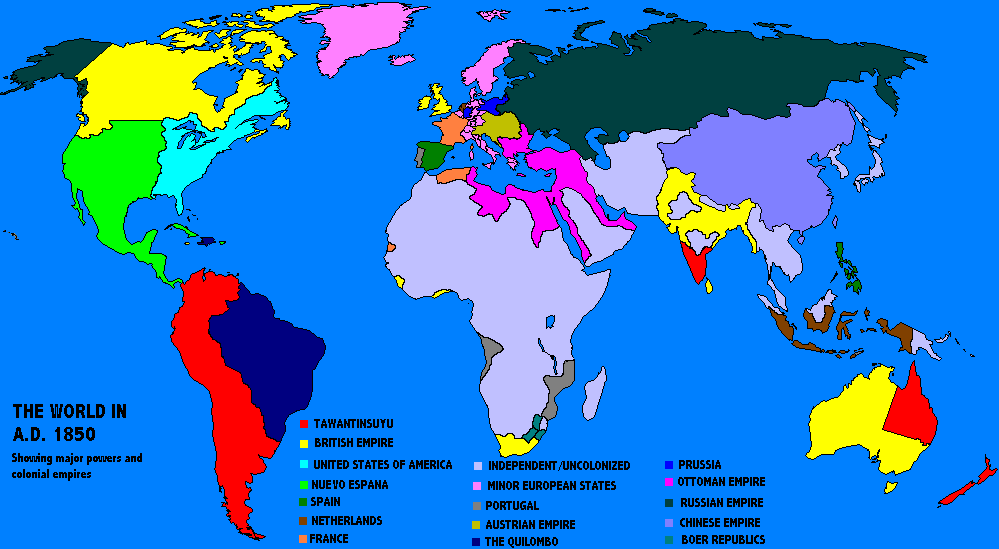
THE GUNS OF THE TAWANTINSUYA
An Alternate History Timeline
by Robert Perkins
PART SIX: A.D. 1850-1900
A.D. 1851
onward, Hawaii--Since the adoption of a formal constitution in 1840, the
Hawaiian monarchy has seen it’s power steadily declining, and European
settlers have
come to the islands in increasing numbers, taking land away from the natives
and pushing
for constitutional reforms designed to give them more political control over
the islands.
It looks very much like the islands will be annexed by one European power or
another in
the near future. Indeed, despite their guarantees to the contrary, as recently
as 1849,
the French
made an abortive attempt to seize the islands.
One power which has not made such inroads into the area has been Tawantinsuyu,
which,
since the discovery of the islands by Tawantinsuya ships in the 18th Century
has engaged
in peaceful trading there, but nothing more. Relations between the Hawaiian
monarchy
and the government of Tawantinsuyu are very good, and it is this which prompts
King
Kamehameha III to ask for an alliance with the Tawantinsuya. Auqui Amaru Inca
II
initially declines this request, but Kamehameha is persistent, and upon
reflection, the
request is granted. In a treaty remarkably similar to that which Tawantinsuyu
maintains
with the Quilombo, the Tawantinsuya guarantee to protect Hawaiian independence
and
the sovereignty of the Hawaiian monarchy. In return, Kamehameha grants the
Tawantinsuya the right to construct and maintain a naval base and coaling
station (for the
ever-increasing fleet of Tawantinsuya steam warships) at Pearl Harbor, as well
as giving
special concessions for Tawantinsuya business interests in the islands.
News of this agreement is met with outrage in Europe. France openly threatens
war, and
Britain too is none too pleased. But in the end, cooler heads prevail, and the
treaty stands.
It will endure until the present day.
A.D. 1851 onward--Gold Rushes in Australia. In 1851, thousands rush to gold in
southern Australia, including British, Irish, American, and Chinese
prospectors. There are
tent cities with populations as large as 40,000. Food growers have a greater
market for
their produce, stimulating Australia's economy. An agricultural revolution is
beginning
using a mechanical harvester, called Ridley's Stripper, that had been invented
in
Australia. Within a short time, the easy surface gold will be exhausted, and
gold will be
found only by digging for veins of gold buried beneath metres of clay and
rock. By 1854,
the hills for miles around the gold fields will be entirely denuded of trees
in order to
provide timber for the deep shafts being dug...an environmental disaster from
which the
area has never fully recovered. Later gold rushes in the Tawantinsuya colony
and in other
regions of British Australia will have similar effects.
A.D. 1851--In Siam, King Mongkut ascends the throne. He invites European
diplomats to
his coronation. He becomes known for speaking English, French, and Latin.
Meanwhile,
in France, the Constitution of the Second Republic states that the presidency
of the
Republic was to be held for a single term of four years, with no possibility
to run for
re-election, a restriction written into the constitution for fear that a
president would abuse
his power to transform the Republic into a dictatorship or a sort of
life-presidency. In
1851, President Louis Napoleon Bonaparte, arguing that four years is not
enough to fully
implement his political and economic program, asks the National Assembly for a
revision
of the constitution to enable the president to run for re-election. The
National Assembly,
which is dominated by monarchists who are opposed to Louis-Napoleon and in
favor of
the restoration of the Bourbon monarchy, refuses to amend the constitution.
After a
stalemate lasting several months, on December 2...the 47th anniversary of the
crowning
of Napoleon I as Emperor of the French...Louis Napoleon stages a coup and
seizes
dictatorial powers. Also in this year, news that the crew of another
shipwrecked
Tawantinsuya whaler have been executed in Japan reaches Tawantinsuyu. Ever
since the
first such incident in 1800, the Tawantinsuya have been attempting to resolve
the issue by
negotiation. But the Japanese have steadfastly refused to receive Tawantinsuya
embassies, and have continued to treat shipwrecked Tawantinsuya mariners with
great
cruelty. The latest incident proves to be the proverbial “straw which broke
the camel’s
back,” and an enraged Auqui Amaru Inca II orders a military expedition to be
sent to the
islands. In Australia, the British colony of Victoria is founded.
A.D. 1852--The British arrive in lower Burma and bring opium from India for
sale to the
Burmese. In southern Africa, Britain recognizes the right of Boers to
administer their
own affairs beyond its Cape Colony border so long as the Boers end slavery.
Also in this
year, Louis Napoleon, dictator of France, has consolidated conservative
support and
dissolves parliament. He crushes an uprising and holds a plebiscite to justify
his coup.
The referendum’s legality and fairness are very questionable, but peasants
and the
religiously devout give him the votes he wants. After a second referendum, on
December
2, 1852, the Second Republic officially is ended, and the French Empire is
declared
restored. Louis Napoleon is crowned as Napoleon III, Emperor of the French.
Beginning
of the Second Empire. Also in this year, a Tawantinsuya naval expedition
arrives in
Japan. Upon their arrival in Edo Bay, they are fired upon, and in reply, the
Tawantinsuya
warships bombard the Japanese fortifications, quickly silencing the enemy
guns. Stunned
by the destructiveness of the Tawantinsuya artillery, the Japanese send out an
embassy
which meets with the Tawantinsuya commander, Admiral Vicaquirao, aboard his
ship.
Vicaquirao presents the Tawantinsuya demands...the opening of Japanese ports
to
Tawantinsuya trade, the end of Japan's 200 year policy of seclusion, a
guarantee of safety
for shipwrecked Tawantinsuya whalers and the establishment of permanent
diplomatic
relations. Failure to comply, he states, will result in war between Japan and
Tawantinsuyu. He gives the Shogun one month to decide, during which the
Tawantinsuya fleet remains anchored in Edo Bay...it’s powerful guns pointed
threateningly at the city. In the end, Shogun Tokugawa Yoshinobu relents, and
the Treaty
of Edo is signed in June 1852. Within five years, all the other major powers
will sign
similar treaties with Japan (the treaties will come to be known, in Japan, as
the “Unequal
Treaties” and highly resented). Japan’s long isolation is over. In Italy,
Count Camillio
di Cavour becomes Prime Minister of the Kingdom of Sardinia. A devout Italian
nationalist, he works toward the eventual unification of Italy under the
banner of the King
of Sardinia. In Hawaii, King Kamehameha III, emboldened by his new alliance
with
Tawantinsuyu, promulgates a new Constitution which restricts the rights of
non-Hawaiians to own land. This creates a crisis as the European powers
protest the
restrictions on the rights of their citizens in the islands. In order to
defuse the situation,
Auqui Amaru Inca II agrees to assist the Hawaiian monarchy in funding a
buy-out of the
European land-owners affected by the new constitution (in exchange, the
Tawantinsuya
get an additional naval base in Hawaii). He also extracts a guarantee that
Kamehameha
will not enact any further changes to the Hawaiian constitution...reminding
the Hawaiian
King that the alliance between his country and Tawantinsuyu is of more benefit
to Hawaii
than it is to Tawantinsuyu, he tells Kamehameha that he will not stand for any
more
actions that might drag Tawantinsuyu into an unnecessary war. Chastened,
Kamehameha
agrees.
A.D. 1853 onward--Influenced by his admiration for the systems of government
in
Tawantinsuyu and the United States, French Emperor Napoleon III’s domestic
policies
are quite different from those he pursued in OTL. As one of his first official
acts,
Napoleon issues an edict which establishes the civil service examination and
the public
education system which he had proposed in his legislation of 1859 (which had
been
defeated by the monarchist majority in Parliament). As he hopes, this measure
will serve
to dramatically increase the efficiency of the government, reduce corruption,
and increase
popular support for the government among the general population (although not
among
the aristocracy, who see government positions which formerly were reserved for
them
being taken by commoners who outscore them on the examination). And in
general, in
contrast to OTL, his regime will be quite liberal, and Napoleon issues a new
constitution
reflecting this, including a reconstituted Parliament called the Chamber of
Deputies.
Finally, Napoleon has always been concerned about the plight of the working
classes and
the poor, a concern which he expressed in a book he wrote during his
imprisonment,
entitled “The Extinction of Pauperism.” The book had called for what might
be termed
“mildly socialistic” reforms of the French economic system, and Napoleon
will
implement these ideas during the course of his reign. This too increases the
popular
support he enjoys. As a result of these facts, opposition to his regime is
much less than in
OTL, and many influential people who in OTL were opponents of Napoleon III
will be, if
not staunch allies, at least not committed foes. Chief among these is Victor
Hugo, who
will serve in Napoleon’s Chamber of Deputies from the time it is
reconstituted in
mid-1853 onward, as well as holding various cabinet posts within Napoleon’s
government.
A.D. 1853--Tsar Nicholas I of Russia goes to war against the Ottoman Turks
over what
he sees as his right to defend Orthodox Christians in Turkey and in Jerusalem
(then under
the authority of the Ottoman Empire). Britain introduces the Enfield Rifle
Musket Model
1853 as the standard infantry arm of it’s armies. This will have a major
impact when it is
introduced among the sepoy troops of the British East India Company a few
years later.
The last British convicts are shipped to Tasmania. A smallpox epidemic kills
5,000
Hawaiians.
A.D. 1854--Britain and France are afraid of Russian expansion. At a Turkish
port on the
Black Sea, the Russian navy, using exploding shells for the first time, sets a
Turkish fleet
afire. The British respond with horror to the devastation. The British declare
war, and are
joined by Emperor Napoleon III of France. Queen Victoria writes of "the
great
sinfulness" of Russia having "brought about this War"-the
Crimean War. Pope Pius IX
addresses a question about differences between Jesus Christ and others. He
proclaims the
infallible doctrine of the Immaculate Conception (virgin birth) of Jesus
Christ, that Jesus
was born exempt from all stain of original sin. Elisha Graves Otis has
invented an
elevator brake and has started a company to manufacture elevators that will
hoist freight.
He demonstrates the elevator at the World's Fair in New York City. The
scientist John
Snow had been claiming that cholera was carried in water or food and could be
ingested.
Colleagues have dismissed his idea. A cholera epidemic has broken out in
London, in an
area around a water pump. Snow takes a sample of the water from the pump and
through
a microscope finds it contaminated. He removes the pump's handle and the
cholera comes
to a quick end. The Eureka Stockade Revolt in Australia (a rebellion by
Australian gold
miners against the authority of the government of Victoria colony) breaks out.
The
miners are demanding 1) Manhood suffrage (the right for all men to vote); 2)
Abolition of
the property qualifications for members of parliament; 3)Payment of members of
parliament; 4) Voting by secret ballot; 5) Short term parliaments; 6) Equal
electoral
districts; 7) Abolition of diggers and storekeepers licenses; 8) Reform of
administration
of the gold fields; and 9) Revision of laws relating to Crown land. Although
the rebellion
is defeated, most of these demands will be met by the colonial governments of
Australia
within a year after the end of the rebellion. Also in this year, King
Kamehameha III of
Hawaii dies, and is succeeded by Kamehameha IV.
A.D. 1855--Hoping to secure British and French support for Italian
unification, the
Kingdom of Sardinia joins the Franco-British alliance against Russia and
enters the
Crimean War. Much of Japan's capital, Edo (Tokyo), is destroyed by earthquake,
tsunami
and fire. King Mongkut of Siam signs a trade agreement with Britain. He builds
roads,
sets up printing presses, creates a currency and sets out to reform slavery.
The city of
Arnoldtown (OTL Chicago) adopts a plan for the first comprehensive city sewer
in
United States. In France, the Emperor Napoleon III, hitherto a bachelor, has
been
looking for a wife to produce a legitimate heir. Napoleon approaches the
eligible
daughters of most of the royal families of Europe, but finds them unwilling to
marry into
the parvenu Bonaparte family, and after a rebuff from Queen Victoria's German
niece
Princess Adelaide von Hohenlohe-Langenburg, Napoleon decides to broaden his
horizons
and look beyond the established European royal houses. There are two promising
candidates: the beautiful 29-year-old Eugenie de Montijo, Countess of Teba, a
Spanish
noblewoman with some Scottish ancestry who had been brought up in Paris; and
Charlotte Arnold, the equally beautiful, 19-year old daughter of King Benedict
III of the
United States. Napoleon is deeply smitten by Eugenie, but in the end, pressure
from the
other members of the Bonaparte Family...who argue forcefully that a only a
“bride of
royal blood” is “good enough” for the Emperor of France...convinces him
to pursue the
hand of Princess Charlotte (it should also be said that Napoleon is also
attracted by the
symbolism such a union would represent...being a union of two royal houses
which
gained their royal status by action rather than by lineage, and this was
certainly one
determining factor in his final decision). After rather arduous negotiations
with King
Benedict...who is a doting father and has some misgivings about the age
difference
between Napoleon and Charlotte (Napoleon, born in 1808, is almost twice
Charlotte’s
age)...an agreement is reached, and the pair are wed in the Cathedral of Notre
Dame in
Paris on December 21, 1855. Also in this year, Queen Isabella of Nuevo Espana
marries
Prince Leopold, of the German royal house of Hohenzollern-Sigmaringen (a
Catholic
line related to the Protestant ruling house of Prussia). Isabella and Leopold
will prove to
be well suited to each other (in OTL, Isabella married one of her cousins, the
Duke of
Bourbon-Cadige, who was a homosexual, and their marriage was very unhappy,
with
Isabella engaging in various affairs and coming under the influence of various
court
favorites as a result), and their union will be a happy and fruitful one. As a
result and
with Leopold’s strong support, Isabella will have a very successful reign,
free from
domination by court favorites and other intrigues which characterized her OTL
rule in
Spain.
A.D. 1856--Tsar Nicholas I of Russia dies. His son, Alexander II, makes peace
with
Britain and France, the Crimean War ends. Russia's humiliation inspires
Alexander's
desire for reform. Count Cavour of Sardinia, and Italian nationalists
everywhere, are
frustrated when the Congress of Paris, the peace conference which ended the
Crimean
War, totally ignores Italian issues. In France, there has been some outcry
against the
marriage of Emperor Napoleon III to Princess Charlotte of the United States.
Charlotte
is not a Catholic, and there are many who object to a Protestant serving as
Empress of
France. In the end, Charlotte defuses the situation by converting to
Catholicism...at least
officially. Privately, she continues to practice her Protestant faith. Also in
this year, a
ship owned by a Chinese, registered with the British in Hong Kong, and docked
at
Canton, is searched by Manchu government agents looking for a notorious
pirate. The
British send an expedition of ships seeking redress and are joined by the
French, who
want to avenge the Manchu execution of a French missionary. There is also
dissatisfaction with Chinese compliance to agreements made at the end of the
first Opium
War. The Second Opium War begins. Unlike the previous Opium War, there will be
no
Tawantinsuya participation in this one. In India, the British East India
Company advises
the reigning Moghul Emperor, Bahadur Shah Zafar, that he will be the last
Moghul
Emperor of India and the Moghul Empire will cease to exist upon his death. The
British
colonies in Australia become the first anywhere in the world to employ a
“secret ballot”
in elections.
A.D. 1857--Elisha Graves Otis installs the first passenger-safe elevator in a
department
store in New York City. Giuseppe Garibaldi, who has been on Staten Island, New
York,
for five years, founds the Italian National Association to fight for the
unification of Italy.
Helmuth von Molkte is appointed Chief of Staff of the Prussian Army. He begins
a
thorough reorganization of the army to correct the defects which caused the
humiliating
defeat suffered in the First Schleswig War. Also in this year, Queen Isabella
of Nuevo
Espana gives birth to a healthy son, who is named Felipe Luis. The birth of
the new
prince is hailed by the populace of Nuevo Espana, who hold their popular queen
in great
esteem. Felipe Luis will be the first of no less than eight children Isabella
will produce
during her long and fruitful marriage to King Consort Leopold.
A.D. 1857-1858--The Indian Mutiny. In India, the Sepoy Rebellion (also known
as the
Indian Mutiny) breaks out among troops of the British East India Company in
1857.
Ostensibly, the rebellion begins when the 1853 Enfield Rifle is introduced
into service
among the sepoys (although there were many other contributing factors, such as
unfair
treatment of native troops by European officers, attempts to convert Muslims
and Hindus
to Christianity, and general resentment of British rule). Hindu agitators tell
the sepoys
that the cartridges for the new rifles are greased with beef fat, while Muslim
agitators tell
those of their faith that the cartridges are greased in pig fat. In order to
use the cartridges,
the soldier must bite off the greased end with his teeth. Thus Hindus think
they are being
forced to taste the fat of a sacred animal, while Muslims think they are being
forced to
touch the fat of an unclean animal (in actuality, the cartridges are greased
with mutton fat,
but the truth is unimportant to the agitators). Both groups are outraged, and
rebel. For a
time the rebels are successful, and several horrid massacres of British
citizens are carried
out But by mid-1858, the British are able to defeat the rebels, and savage
reprisals for the
sepoy massacres are carried out. The British government is sickened by the
savagery
perpetrated by both sides, and decides to dissolve the British East India
Company and
take over the formal government of India as a Crown Colony. The last
independent
enclaves of native rule are soon forced into subjugation to the British Raj.
In the years
that follow, reforms are introduced. Expropriation of land is discontinued,
religious
toleration is decreed, and Indians are admitted to subordinate positions in
the civil
service. But the rebellion will be long remembered with bitterness by the
British, and
they will never trust Indian troops in quite the same way again.
The Tawantinsuya holdings in south India are little affected by the events of
the Mutiny.
In southern India, the Tawantinsuya have been less oppressive with the native
population
than the British have been, and the sepoys employed by the Tawantinsuya East
India
Company remained loyal (the Enfield Rifle not being adopted by the
Tawantinsuya).
Indeed, Tawantinsuya East India Company troops assisted the British in putting
down the
rebellions in the north.
A.D. 1858--The Second Opium War ends. China is forced to pay Britain and
France
indemnities and to open more ports. The opium trade is legalized. Christians
are to be
allowed to proselytize and guaranteed protection, and Westerners are to be
allowed to
hold property in China. Russia and other powers rush in to gain benefit from
the British
and French victory. In Vietnam, a French and Spanish expedition seizes the
port city of
Tourane (today Da Nang). The French are interested in ending Vietnamese
persecution of
Christian missionaries and in trade with Indochina. Italian nationalist Felice
Orsini
attempts to assassinate French Emperor Napoleon III, but fails. From his
prison cell,
Orsini makes a passionate plea to Napoleon to support the cause of Italian
unification.
Napoleon, who as a youth had been active in the Italian nationalist
organization, the
Carbonari, is swayed by this pleas and decides it is his destiny to help
Italy. He meets
with Sardinian Prime Minister Count Cavour, and the two agree to jointly wage
war
against Austria, which is seen as the biggest impediment to Italian
unification. The aim
of the war will be the annexation by Sardinia of the Austrian provinces of
Lombardy and
Venetia, as well as the Austrian-supported duchies of Parma and Modena. In
exchange
for French support, Sardinia agrees to cede to France the provinces of Savoy
and Nice.
Later this same year, Empress Charlotte of France gives birth to a son who is
named
Napoleon Louis Jean Joseph Bonaparte, Prince Imperial of France.
Meanwhile,
up until now, the British holdings in the Oregon Country have been loosely
administered by, but not owned by, the Hudson’s Bay Company. As they are
sparsely
populated, this has worked fine, so far. But in 1858, gold is discovered at
the
confluence of the Thompson and Nicoamen Rivers, and when news of this strike
reaches
the outside world, tens of thousands of people make their way to the territory
in search of
their fortune. While most of these meet with disillusionment and soon leave
the territory,
enough stay that the need for a real colonial government is seen by British
authorities in
London, and accordingly, the Crown Colony of British Columbia is created.
A.D. 1859--In Vietnam, the French take over Saigon. Charles Darwin has been
sitting on
his Origin of the Species for 21 years. He has it published. The first
successful oil well in
the United States is drilled, in northern Pennsylvania. Rabbits are brought to
Australia,
which will produce an ecology disaster.
A.D. 1859-1860--The Austro-Sardinian War: As per their agreement the previous
year,
the Kingdom of Sardinia goads Emperor Franz Josef of Austria into war over the
province of Lombardy, in northern Italy. The combined French and Sardinian
armies
defeat the Austrians at the battles of Magenta and Solferino, forcing the
Austrians to
withdraw from Lombardy into Venetia. At this point, Napoleon III, seeing the
strong
Austrian fortifications on the Venetian border and fearing that a long and
bloody
campaign would be needed to force the Austrians out of Venetia, decides to
make a
separate peace with the Austrians.
Napoleon and Franz Josef meet at Villafranca without the knowledge of
Napoleon’s
Sardinian allies. Together, the two agree on the outlines of a settlement to
the conflict.
The Austrians will retain Venetia, but cede Lombardy to the French, who will
then
immediately cede it to Sardinia (the Austrians being unwilling to themselves
cede the
area to Sardinia). Otherwise, the Italian borders would remain unchanged...in
Central
Italy, where the authorities had universally been expelled following the
outbreak of war,
the rulers of Tuscany, Modena, and Parma, who had fled to Austria, will be
restored,
while Papal control of the Legations is to be resumed. Because Napoleon has
not fulfilled
the terms of his agreement with Sardinia, he announces that he will not demand
cession
of Savoy and Nice.
Naturally, the Sardinians are outraged by this agreement, which they
rightfully see as a
betrayal by Napoleon III. Although King Victor Emanuel II agrees...over the
objections
of his prime minister, Count Cavour...to the terms of the Villafranca
agreement in the
Treaty of Zurich signed in November, Sardinian troops soon move to occupy the
central
Italian states, despite the protests of Austria. Napoleon III does nothing to
force the
Sardinians to abide by the terms of the treaty. In December, the central
Italian states unite
into the United Provinces of Central Italy, and apply for annexation by
Sardinia. In
exchange for French support of this annexation, Sardinia renews it’s offer
to cede Savoy
and Nice to France, and Napoleon III agrees to give his support. Sardinia
annexes the
central Italian states in early 1860, and cedes Savoy and Nice to France.
A.D. 1860--Taiping rebels fail to take Shanghai, repelled by a force led by an
Englishman, Frederick Townsend Ward. J.J.E. Lenoir of France develops an
internal,
non-compression, combustion engine. Jews in Britain are allowed to vote.
International
trade has been increasing. World exports are 4.53 times what they were in
1800.
A.D. 1860 onward--In the Quilombo, there is a growing feeling of, if not
resentment, at
least dis-satisfaction with the paternalistic relationship which Tawantinsuyu
exercises
over the Quilombo. The business concessions given to Tawantinsuya business
concerns
in exchange for Tawantinsuya protection against intervention by foreign powers
has
meant that the Quilombo has become effectively an economic colony of
Tawantinsuyu,
supplying raw materials and agricultural produce in exchange for Tawantinsuya
manufactured goods. Recognizing this, beginning in 1860, the Great Chiefs of
the
Quilombo begin pushing for industrialization as a means for the Quilombo to
gain a
greater measure of independence from Tawantinsuyu, importing British and
American
machinery for the manufacture of textiles and other goods to the Quilombo. The
Quilombo also expands the railroad network in the country. By the reign of
Great Chief
Aitan Chiamaka in 1900, the Quilombo will have achieved many of it’s goals
of
economic independence. But by the nature of things, it still remains very
dependent on
Tawantinsuyu.
A.D. 1860-1861--The War of Italian Unification: In 1860, Giuseppe Garibaldi,
enraged
at the French annexation of Nice (his home city), begins preparing a military
force to take
the “stolen provinces” back from France. Count Cavour, terrified that
Garibaldi will
provoke a war between France and Sardinia and undo all that has been
accomplished over
the past 2 years, persuades Garibaldi to take his “Red Shirts” (as his
troops are called) to
attack the Kingdom of the Two Sicilies instead. The Two Sicilies, ruled by
corrupt
Bourbon kings, are ripe for the taking, and their conquest (and unification
with Sardinia)
would bring almost the whole of Italy under one flag. Garibaldi lands in
Sicily with
1,000 men in May 1860, gathers local rebel bands to his banner, and by the end
of June
has liberated the whole of said island. Eluding the navy of the Two Sicilies,
Garibaldi
slips across the Straits of Messina in July and advances northward. Military
resistance
melts away, and the populace everywhere hails him. By mid-September King
Francis II
of the Two Sicilies, formerly in command of an army of over 150,000 men, has
only
4,000 loyal troops left to him, and holds only the fortresses of Capua and
Gaeta and a
hastily constructed defensive line along the Volturno River. But these last
loyal troops
prove to be a tough nut for Garibaldi to crack, and he calls on King Victor
Emanuel to
come to his support.
Victor Emanuel and Count Cavour want to oblige Garibaldi, but there is a
problem...in
order to reach the Kingdom of the Two Sicilies, they have to advance across
the Papal
States. This is politically a very tricky situation, for Emperor Napoleon III
of France has
pledged to protect the Pope, and Catholics all over the world support the
Papal cause.
Complicating the situation is Garibaldi, who is demanding that Rome itself be
annexed
and serve as the capital of the united Italy. In the end, a compromise is
reached between
Cavour and Napoleon. Sardinia will guarantee that Italian troops will not
enter Rome and
the Pope will remain in control of said city, but Sardinia will be free to
absorb not only
the Two Sicilies, but also all of the Papal States outside of Rome itself. In
late
September the Sardinians invade the Papal States, defeat the Papal army by the
end of
September. In October, the Sardinians move into the Two Sicilies, join forces
with
Garibaldi’s army, and force King Francis to abandon the line on the Volturno
River.
Francis and his remaining troops are besieged in the fortress of Gaeta, which
they
stubbornly defend until forced by starvation and disease to surrender in
January 1861. In
March 1861, the Kingdom of Italy is formally declared, and King Victor
Emmanuel II of
Sardinia is crowned as King Victor Emmanuel I of Italy, ruling all of the
Italian Peninsula
except Venetia and Rome.
A.D. 1861--In Pennsylvania an oil well has begun producing more than 3,000 barrels per day,
and oil
refining has begun, producing an alternative fuel for lamps (up until now,
whale oil has
been the primary fuel for lamps). China's Manchu emperor, Xianfeng, has been
weakened by debauchery and drugs and dies at the age of thirty. The son of his
consort
succeeds him. The former consort, Cixi, becomes the boy's regent and acquires
the title
Dowager Empress. In Germany, workers making mirrors have lost all of their
teeth. A
professor of medicine discovers they are victims of mercury poisoning. His
findings lead
to government regulations requiring alternative mirror making processes. In
Britain a
government commission begins to investigate non-textile industries employing
children.
Occupational diseases among children are discovered. On June 6, his goal of
Italian
unification nearly complete, Count Cavour dies. Also in this year, King
Charles VI of
Spain dies. His son and heir, Juan Carlos, Prince of Asturias, is then a boy
of twelve
years. In the interim until he comes of age, his mother, Queen Beatrix, rules
Spain as
regent. Upon the death of King Charles, Queen Isabella of Nuevo Espana issues
a
proclamation reaffirming her right to the throne of Spain. But since the
repression of the
liberals in Spain and the flight abroad of most of the liberal intelligentsia,
there is little
support for Isabella’s cause in Spain itself, most of the population being
content under the
rule of a traditionalist monarch who staunchly supports the Catholic Church.
Therefore,
little to no disorder attends the assumption of the rule of Spain by the new
regent.
The Zion
Society is formed at Frankfurt, Germany. It advocates the creation of a
national homeland for the Jews in Palestine.
A.D. 1861
onward--Tsar Alexander II of Russia issues a proclamation emancipating the
serfs of his realm from
their feudal obligations to their landlords. The Tsar optimistically hopes
that the abolition of
serfdom will create a class of individual peasant landowners and the
beginnings of a market
economy. However, this is not to be, as in order to gain the acquiescence of
the landlords,
concessions have to be made to the landlords which will prevent such a thing
from happening.
The landowners initially pushed for granting the peasants freedom but not any
land. The Tsar and
his advisers, mindful of the recent revolutions of 1848, were opposed to this,
as it would create a
proletariat and they feared the instability this could bring. But giving the
peasants freedom and
land seemed to leave the existing landowners without the large and cheap
labour-force they
needed to maintain their estates. To 'balance' this, the final legislation
contains three measures
designed to reduce the potential economic self-sufficiency of the peasants.
Firstly a transition
period of nine years is introduced, during which the peasant is obligated as
before to the old
landowner. Additionally large parts of common land are passed to the major
landowners as
“otrezki,” making many forests, roads and rivers only accessible for a
fee. The third and most
important measure specifies that the serfs will be required to pay the
land-owner for their
allocation of land in a series of redemption payments which will extend
indefinitely until the land
is fully paid off. The government will advance the total sum to the landowner
and then the
peasants will repay the money, plus interest, to the government. These
measures, particularly the
redemption payments, will be bitterly resented by the peasantry and will
contribute to the
increasing unrest against the government, which will arise in Russia over the
succeeding decades.
A.D. 1862--Death of Auqui Amaru Inca II. He is succeeded by his son, who
reigns as
Atahualpa Inca III. Atahualpa Inca III is a reform-minded ruler, and under his
rule great
change will be made in the political structure of Tawantinsuyu. In Prussia,
the largest of
the German states, a member of the landed aristocracy, Otto von Bismarck,
becomes
minister-president. Representing the king, he declares that his government is
to rule
without parliament. In the king's court in Siam, women being taught English by
Christian
missionaries are turned off by their sermons. Anna Leonowens arrives in
Bangkok to
teach English in their place. She is the English woman to be depicted in The
King and I.
Also in this year, the Cariboo Gold Rush brings more settlers to
British Columbia. Many stay
and establish fishing, sawmill, and other industries in the colonies.
A.D. 1863--Slavery ends in Dutch ruled Indonesia. Cambodia become a French
protectorate, with the approval of its king, Norodom. In Britain, legislators
respond to air
pollution from the chemical industry by creating the Alkali Act for reducing
hydrogen
chloride emissions during alkali production. In London, the first underground
(subway)
passenger system opens. Cotton growing in Central Asia has become of greater
importance to the Russians, and Russia sends its military into Central Asia,
where people
are sparse, largely tribal, economically undeveloped, and Muslim. King
Kamehameha IV
of Hawaii dies, and is succeeded by Kamehameha V.
A.D. 1863-1870--War between Spain and Nuevo Espana. Frustrated that her claims
to
the throne of Spain were once again denied after the death of King Charles VI,
Queen
Isabella of Nuevo Espana decides to have her revenge by seizing the Spanish
colonies in
the Philippines. A powerful naval expedition is fitted out and sails across
the Pacific,
arriving in Manila Bay on April 23, 1863. Despite stout resistance from the
Spanish
garrison, Manila falls within a week. Over the next several months, landings
are made on
the remaining islands and the Spanish garrisons there are overpowered. By
August, the
islands are entirely in the hands of Nuevo Espana.
Of course, the seizure of the colony does not go unchallenged, and upon
learning of it in
June 1863, the government of the regent of Spain, Queen Beatrix, declares war
on Nuevo
Espana. Due to Spain’s weakened condition and the great distances separating
the two
powers, the war will be fought entirely at sea, primarily in the form of
single-ship
encounters between frigates of the two powers on the open ocean. The largest
action of
the war takes place in 1869, when a Spanish fleet, sent around the Cape of
Good Hope for
the purpose of re-taking the Philippines, is met by the fleet of Nuevo Espana
off the coast
of Lubang Island. The Battle of Lubang Channel, as it comes to be called, is a
decisive
defeat for the Spanish, with almost the entirety of their fleet being sunk or
captured.
Upon learning of the destruction of the Spanish fleet, Queen Beatrix accepts
an offer of
mediation made by the Tawantinsuya government. Queen Isabella of Nuevo Espana,
buoyed by the news of the victory, at first wants to continue the war and
invade Spain
itself, but is finally persuaded by her husband that logistically, Nuevo
Espana is not
capable of fighting a major war at such a distance. And so, in early 1870,
representatives
of Spain and Nuevo Espana meet in Cuzco. In return for the cession of the
Philippines to
Nuevo Espana, the Spanish delegates insist that Queen Isabella agree to
formally
recognize the right of the Carlist line to the throne of Spain, and to
renounce her own
claims to the Spanish throne...either that, they say, or the war can continue
indefinitely.
Isabella strongly resists this demand, but her husband...along with most of
the ministers
of her government, who are supporters of the movement for a separate identity
for the
kingdom...finally persuades her to accept. The final treaty is signed on March
16, 1870,
ending the war. Spain and Nuevo Espana are now completely divorced and will
follow
separate destinies from this time forward.
A.D.
1863 onward--In the wake of it’s seizure of the Philippines from Spain, the
Kingdom of Nuevo Espana also seizes the Spanish colonies in the Marianas
Islands, the
Caroline Islands, and in Guam, establishing naval bases there. In the
Philippines, it
abolishes the old Spanish colonial administration, which had been causing
increasing
resentment among Filipinos, and institutes a more enlightened rule there. They
also,
within a few years, grant representation to the Philippines in the Cortez of
Nuevo Espana
(and later, of Aztlan). The embryonic independence movement among young
Filipino
intellectuals, which had begun to arise in the years prior to the war, is won
over by the
new administration, and the Philippines becomes a loyal part of the Kingdom.
A.D. 1864--The Second Schleswig War breaks out as Denmark attempts to formally
annex the Duchies of Schleswig and Holstein. Prussian Chancellor Otto von
Bismarck
convinces Austria to join her in expelling the Danes from the duchies once and
for all.
This they do in a war which demonstrates the effectiveness of the recent
Prussian military
reorganization. The Dutch in Java and Sumatra experiment with rubber
cultivation. An
astronomer calculates the distance to the sun as 147 million kilometers -
short 2.6 million
kilometers. In China, the leader of the Taiping Rebellion, Hong Xiuchuan,
proclaims that
God will defend his city, (southeast of Beijing). When government forces
approach he
swallows poison and dies. The monarchy re-establishes control over most areas
of China.
The Taiping rebellion is all but defeated.
A.D. 1865--In what today is Uzbekistan, Russians capture the city of Tashkent,
which is
to become a Russian administrative center. Over-reaction in crushing a
rebellion in
Jamaica produces an investigation in England. The island's governor is widely
condemned and called to London. Some demand that he be tried for murder. He is
removed from office but a grand jury refuses to indict him. The Gastein
Convention
Treaty is signed by Prussia and Austria, assigning the administration of
Schleswig to
Prussia and the administration of Holstein to Austria. For some time, there
has been
some agitation among the nobility and other educated classes in Tawantinsuyu
for the
creation of a more inclusive system of government. Many of these people have
been
educated in Britain, France, Nuevo Espana or the United States, and have seen,
first hand,
the operation of constitutional monarchies in those countries. A similar
system, they
argue, could be beneficial for Tawantinsuyu as well. And, with the accession
of
Atahualpa Inca III, they finally have a ruler who agrees with them. And so, in
May 1865,
Atahualpa Inca III calls a council of the great nobles of Tawantinsuyu and
together, over
the course of the next six months, they create the first-ever constitution for
the
Tawantinsuyu Empire. The new system of government is quite similar to that of
the
United States of America, but retains more power for the Inca than the
American King
enjoys. Instead of appointing a Prime Minister who will be the chief
magistrate of the
land, the Inca retains that power for himself. The Constitution creates a
bi-cameral
legislature which will consist of one house to be composed of commoners, and
another
house consisting of nobles, and mandating that all legislation must be passed
by both
houses to become law, with the Inca retaining the power to veto any
legislation passed
which he considers detrimental. One major difference between the Tawantinsuya
Constitution and that of the United States is that there is no Bill of Rights
(the nobles
successfully arguing, despite Atahualpa’s own misgivings, that “they know
what is best
for the commoners” and that a Bill of Rights is not needed).
A.D. 1866--In New Zealand, the Tawantinsuya defeat another Maori rebellion. A
Russian
student, acting alone, tries to assassinate Tsar Alexander II. The government
becomes
hostile to all students. A new minister of education takes charge of the
universities and
applies stricter controls. The Gastein Convention breaks down as Prussia and
Austria
quarrel over the administration of the newly conquered provinces of Schleswig
and
Holstein. As a result, the Six Weeks War breaks out between Prussia and
Austria (in
alliance with most of the smaller German states, who see Prussia as the
greatest threat to
their independence). Prussia, whose army is much better organized and equipped
with
the modern Dreyse Needle Gun (which can be loaded from a prone position,
greatly
reducing Prussian casualties from enemy fire), easily wins. The Treaty of
Prague
dissolves the German Confederation, excludes Austria from German affairs, and
allows
Prussia to annex Schleswig-Holstein, Hanover, Hesse-Kassel, Nassau, and
Frankfurt.
The Kingdom of Italy, which had allied itself to Prussia against Austria,
gains Venetia. In
Tawantinsuyu, the first elections are held for the new legislature.
A.D. 1867--In Vienna, the Blue Danube Waltz, by Johann Strauss, premiers. In
Sweden,
Alfred Nobel finds that when nitroglycerin is combined with an absorbent
substance it
becomes safer and more convenient to manipulate. His mixture is patented as
dynamite.
Crown Prince Mutsuhito, age 14, ascends the Japanese throne as Emperor Meiji.
In
Germany, the North German Confederation...comprising all of Germany except the
South
German states of Bavaria, Baden, Hesse-Darmstadt and Wurtemburg...is formed
under
the domination of Prussia. In France, Emperor Napoleon III, is stunned by the
rapid
Prussian victory over Austria the previous year. Learning that the total
effective strength
(with reserves) of the Prussian army now stands at 1.2 million men...as
opposed to roughly
300,000 for France...Napoleon decides that a drastic reorganization and
revamping of his
army is in order. Aided by the efficient bureaucracy Napoleon has created by
his
imposition of the civil service examination, over the succeeding years great
strides will be
made, and by the time of the Emperor’s death in 1873, the total effective
strength of the
French Army will stand at over 1 million...still smaller than that of Prussia,
but much
larger than in OTL...and an efficient system of mobilization will be in place
to meet
wartime needs (again, in stark contrast to OTL).
Meanwhile,
the Russian colony in
America...Alaska...has never been very profitable due
to the high costs of transportation. The Russian government is interested in
divesting
itself of the colony, but cannot find a buyer (Britain expresses some
interest, but Russia
has no desire to further increase the imperial holding of it’s great rival,
and so refuses to
sell). And so, Alaska remains in Russian hands.
A.D. 1868--In Japan, feudal lords and others have been conspiring against the
Tokugawa
rule. A rallying cry is, "Honor the Emperor; expel the barbarian."
Despite the
anti-barbarian slogan, British, French, Tawantinsuya and Dutch forces join the
rebels
against the shogunate, shelling coastal fortresses and sinking the shogun's
ships.
Tokugawa rule is declared over. The capital, Edo, is renamed Tokyo. The
emperor rules
nominally while civil war continues. Attacks on foreigners continue, but
people with
influence and power do not want to provoke intervention by the Western Powers
and
move to end such attacks. Prince Juan Carlos of Spain comes of age and
formally
ascends the throne, ruling as King Charles VII. Juan Carlos is of a more
liberal mind than
his father...although still very conservative...and he will introduce some
mild reforms into
the Spanish government during his long and mostly successful reign. Among the
more
important of these reforms is the reconstitution of the Cortes, the national
legislative
assembly, which he declares by edict within a few months of the beginning of
his reign.
Although the new Cortes is nothing like the old one which operated under the
Constitution of 1812, and cannot pass laws, it does serve in an advisory
function to the
King, who is disposed, at times, to listen to it’s advice. The final British
convicts are
shipped to Australia.
A.D. 1869--Tokugawa forces that have attempted to establish rule in Hokkaido
are
defeated. Leaders of the military victory over the Tokugawa begin associating
Emperor
Meiji with Shinto ideology. Shinto shrines are common on Buddhist temple
grounds, and,
in an effort to free Shinto from Buddhist domination, violence and the
breaking of images
is committed against Buddhism. Buddhist temple lands are confiscated. The Suez
Canal
opens. It is largely French owned but eager for international business. Access
is promised
ships from all nations, for a fee. The canal is to reduce travel time between
Europe and
Asia. Also in this year, one-third of the population of Savu (in the
Indonesian
Archipelago) dies from smallpox. Charles VII of Spain marries Margherita,
Princess of
Bourbon-Parma.
A.D. 1870--Pius IX convenes the First Vatican Council, at which papal
infallibility is
proclaimed on matters of faith and morals. Diamond deposits have been
discovered in
southern Africa, at Kimberley, and in Griqualand, on the northern frontier of
the British
colony. Diamond diggers are rushing there-Africans, as well as whites from
Europe,
Australia and the Americas. Australia now has a substantial number of Germans
and
Catholic Irish, who worship freely. The Irish have found Australia to be
without the
oppressions they had known in Ireland. Joseph Lister believes that
microorganisms
transmit disease. He reports success in sterilizing tools used in surgery. In
Britain, France,
Germany, Austria and in Scandinavian countries, trade relative to population
size has
increased four to five times what it was in 1830. In Belgium and the
Netherlands the
increase is about three times. Also in this year, King Benedict III of the
United States dies.
He is succeeded by his son, who reigns as King Benedict IV. Also in this year, Mikveh Israel, the
first modern Jewish agricultural school and settlement is established in Palestine.
A.D.
1870-1890--The group Hovevei Zion sets up 30 Jewish farming communities in
Palestine.
A.D. 1871--The Meiji government of Japan sends a few men to Europe and to
Tawantinsuyu, hoping to secure abolition of the Unequal Treaties and to
examine
Western technology, banking and agricultural techniques-the Iwakura Mission.
King
Charles VII and Queen Margherita of Spain have a son, named Luis Ferdinand,
Prince of
Asturias.
A.D. 1872--Speaking to Union Leaders in Holland, Karl Marx speaks of the
possibility of
victory for the working class through electoral politics. King Kamehameha V of
Hawaii
dies, and is succeeded by King Lunalilo.
A.D. 1873--Japan's mission to Europe and the United States returns hopeful
that Japan
can catch up with the West in modernization. The Meiji government declares
religious
freedom and ends Confucianism as official state ideology. Russia's government
orders
students in Switzerland to return to Russia. The returning students launch a
"To the
People" movement, which they hope will revolutionize society. Emperor
Napoleon III of
France dies. The Prince Imperial, the future Emperor Napoleon IV, is only a
boy of 15
years, and until he comes of age, his mother, Empress Charlotte, rules as
regent. This
causes some outcry, as many die-hard Catholics in France are not convinced by
the
sincerity of Charlotte’s conversion to the national faith, and protests
against “that
Protestant hussey” break out in many French cities. Most people still
support the regime,
however, and these demonstrations, although occasionally violent, are not
large enough to
severely threaten the government, and Empress Charlotte takes a conciliatory
approach to
the protests, refusing to call out the army to suppress the demonstrators.
A.D. 1874--Germany is suffering a small pox epidemic. Vaccination becomes
mandatory.
In the United States, barbed wire has been invented. It is sold to farmers to
keep passing
herds of cattle off their land. Britain makes a colony of coastal territory
100 kilometers
deep and 400 kilometers wide in what today is Ghana. During fighting there a
British
commander has his troops wear brown jackets and khaki trousers rather than the
traditional red coats-a move toward camouflage. Also in this year, Atahualpa
Inca III is
very satisfied with the progress of his new constitutional government.
However, he is
concerned by the fact that the Constitution does not specifically include a
Bill of Rights,
and some injustices still continue within his domain as a result. And so, in
this year, he
introduces a Bill of Rights as an amendment to the Tawantinsuya Constitution.
After
much debate, the amendments are passed by the legislature by the end of the
year. Also
in this year, the Cortes of Nuevo Espana, in a move aimed at cementing the
divorce of the
kingdom’s identity from that of Spain, formally votes to change the name of
the kingdom
to the Kingdom of Aztlan. Queen Isabella vetoes the bill, but the veto is
over-ridden.
King Lunalilo of Hawaii dies, and is succeeded by King Kalakaua.
The Marshall Islands are
claimed
by the Kingdom of Aztlan, which establishes a colonial government there. Later that same year,
Aztlan
claims Wake Atoll, and establishes a military base there.
A.D. 1874-1877--The Franco-Prussian War: Prussian Chancellor Otto von Bismarck
wants a war with France as a means of unifying the remaining German states
under
Prussian rule. Unfortunately, he has been unable to find a suitable pretext
(the Spanish
succession crisis which he used in OTL did not take place in the ATL) and the
French
have not appeared as such an easy target in this timeline (since there was no
failed
Mexican expedition to expose weaknesses in the French military system). And
so,
Bismarck has been forced to bide his time and wait for the appropriate
opportunity. And
now, viewing the continuing disorders in France, he thinks he has found it.
Bismarck
orders Prussian agents to stir up some trouble among the German population of
Alsace
and Lorraine, and then, when the French authorities move to quell the
disturbances,
makes a great show of outrage over the “oppression of ethnic Germans by the
perfidious
French.” Bismarck goes to the Diet of the North German Confederation and
demands a
declaration of war against France, which the Diet...which is completely under
the thumb
of Prussia anyway...dutifully grants on April 1, 1874. Bismarck invites the
south German
states (Bavaria, Baden, Wurtemburg, and Hesse-Darmstadt) to join in the
“holy crusade”
to liberate the Germans of Alsace and Lorraine from the French, but seeing the
ploy for
what it is, all four states refuse to join Bismarck’s war.
Nevertheless, the ruthlessly efficient Prussian war machine moves quickly into
action,
and the North German Confederation soon musters an army of almost 1.5 million
men for
the invasion of France. The French mobilization system is also soon in high
gear, and by
the time the Prussians and their allies cross the French frontier in June
1874, the French
have already raised almost 1 million men. The French infantry are armed with
the totally
superior Chassepot rifle, which has twice the effective range of the Prussian
Dreyse
Needle Gun, and is more accurate. They are supported by batteries of
mitrailleuse volley
guns whose crews, unlike those of the OTL Franco-Prussian War, have been
well-trained
in their use. And the French artillery has been secretly upgraded and is quite
equal to the
fine Krupp artillery used by the Prussians. And so, when the armies meet, the
Prussians
get a rude shock.
Attacking Prussian and German infantry and cavalry are slaughtered as they
make vain
assaults on well-entrenched French positions. The Prussians soon learn that
frontal
assaults are virtually suicidal, and they entrench themselves as well. A line
of trenches
soon extends across northern France from the Swiss border to the Belgian
frontier (as in
OTL, the Prussians are respecting Belgian neutrality in this war). The French
line,
anchored on fortress cities like Sedan, Metz, and Verdun, proves impervious to
assault,
and the narrowness of the front prevents the Prussians from bringing their
large numerical
superiority to bear. The result is a bloody stalemate, which continues for two
years.
In late 1876, the Prussians decide that in order to break the stalemate, they
have to
outflank the French lines...and that means violating Belgian neutrality.
Prussian and
North German Confederation troops march into Belgium on October 1, 1876 in a
move
that does indeed prove decisive...but not in the way the Prussian high command
had
hoped. The “rape of Belgium,” as it becomes known in the international
press, enables
the diplomats of Empress Charlotte to persuade the Austrians (who are eager to
avenge
the humiliation suffered at Prussian hands in 1866) and the south German
states (who
reason that, if Prussia can violate Belgium’s neutrality when it serves her
purposes, what
is to prevent her from violating their own neutrality?) to enter the war on
the side of
France. Furthermore, the dominant power of the age, Great Britain, is also
threatening
war and mobilizing it’s forces. Finally, after sweeping across Belgium into
northern
France, the Prussians find, to their utter dismay, that the French had
prepared for such a
move by extending their defensive lines all the way to the English channel. So
the
invasion of Belgium gains them no strategic or tactical advantage whatever.
About the
only “positive” thing to come out of the move is the entry of the Kingdom
of Italy into the
war on Prussia’s side (Italy wants to annex the Tyrol and Istria, both of
which are held by
Austria). But Italy’s participation proves ineffectual and does little to
redeem the
situation for Prussia.
In early 1877, the Austrian and south German armies invade Prussia, forcing
the
Prussians to withdraw a good part of their strength from France. And although
the
Prussians soon hand the invaders a stinging defeat at the Battle of Leipzig on
March 18,
1877, the withdrawal of half a million troops from northern France to face the
Austrian
threat weakens the Prussian lines there to the point where the French (who
have been
steadily reinforced by their own ongoing mobilization and by colonial troops
brought by
sea...the French navy totally outclasses the Prussian navy and has swept the
enemy from
the seas) can take the offensive. French attacks punch through the Prussian
lines in
several places, and French troops are soon marching into the territory of
Prussia itself,
albeit while incurring extremely high casualties.
On April 5, King Wilhelm I of Prussia demands and accepts the resignation of
Chancellor
Otto von Bismarck, who goes into retirement and obscurity, a failure. He asks
the
government of Queen Victoria of Great Britain to mediate a peace agreement to
end the
war. With the agreement of Empress Charlotte of France (who is horrified by
the
casualty reports she is receiving from the front) and Emperor Franz Josef of
Austria
(whose armies are on the retreat after being defeated at Leipzig), a
cease-fire is declared
and a peace conference is convened at London on May 10, 1877. Negotiations
drag on
for most of the remainder of the year, but on November 3, a treaty is signed,
officially
ending the war.
The terms of the treaty are relatively easy on Prussia. Prussia will not lose
any territory
and will retain leadership of the North German Confederation, but will be
required to pay
an indemnity of three billion marks to France and 1 billion marks to Belgium
in
reparation for it’s aggression against those nations. It also agrees to
recognize, in
perpetuity, French title to Alsace and Lorraine. At the insistence of
Britain...which wishes
to see a counterbalance to Prussian power re-established in Germany...Austria
gains the
right to form a South German Confederation consisting of itself and (provided
those
states agree) the independent south German States. Italy’s army was roughly
handled by the
Austrians in the Tyrol and Istria, so it gained nothing there by it's participation in the war.
But it did gain one major bonus...it got to keep Rome, which it seized shortly after entering
the war
from the Papal Army and French garrison defending the city.
A.D. 1875--The light bulb is invented in the United States. Britain has bought
into part
ownership of the Suez Canal enterprise. Southern Africa has became the largest
diamond
producing area in the world. An attempt by Ottoman agents to collect taxes in
Herzegovina leads to a popular uprising, and the rebellion spreads to Bosnia.
A.D. 1876--Rebellion against Ottoman rule has spread to Bulgaria. A reformist
group in
Turkey deposes Sultan Abd al-Aziz. Murad V becomes sultan but is declared
insane. Abd
al-Hamid becomes sultan and he accepts a new liberal constitution. The
telephone is
invented in Tawantinsuyu by Quehar Tupac. Russians have conquered all of
Uzbekistan
and occupy the northern part of Kyrgyzstan. German physician Robert Koch
establishes
an procedure that proves the germ theory of disease and boosts microbiology
and the
identification of microorganisms. A three-year-old drought has devastated
India, China
and the Quilombo, causing as many as 30 million deaths from starvation and
disease.
Tawantinsuyu is affected too, but the traditional Tawantinsuya system of food
storage
and distribution helps to mitigate the effects there. Japan forces the Koreans
to accept a
trade agreement similar to Admiral Vicaquirao’s demands to the Japanese
government
back in 1852. The last full-blooded Tasmanian aborigine, Truganini, dies. Also
in this year,
King Benedict IV of the United States, who up until this time has been a confirmed bachelor,
marries the Infanta Juana Maria (b. 1858, second child of Queen Isabella) of the Kingdom of Aztlan.
This union between the dynasties of the two American kingdoms is seen as an important event
by
observers worldwide, and a portent of closer relations between the two
American giants in the future.
A.D. 1877 onward, Europe--In the aftermath of the Franco-Prussian War,
tensions in
Europe remain high, in large part due to the actions of Prussia. Prussia’s
national
confidence has been shattered by defeat. Seeing herself surrounded by enemies
and
potential enemies, Prussia once again reorganizes it’s military system,
embarks on an
accelerated military buildup, and begins casting about for allies. By the end
of the
century it has assumed the aspect of a garrison state, armed to the teeth and
full of
bellicosity. It also abandons all pretense and absorbs the other member states
of the
North German Confederation within a few years after the end of the disastrous
war. The
death of stodgy old King Wilhelm I and the accession of his somewhat unstable
grandson
to the throne as King Wilhelm II in 1888 only serves to further escalate
tensions.
As a result of the mounting tensions on the continent, a system of alliances
grows up in
Europe as the various powers align themselves for self-defense. By 1900, the
two main
groupings which have arisen are the Entente Cordiale consisting of France,
Austria, the
South German Confederation, and Britain, which opposes the Triple Alliance of
Prussia,
Italy (which has ongoing territorial disputes with Austria) and Russia (which
is a
traditional adversary of Britain and has disputes with Austria over the
Balkans as well).
One side effect of Prussia’s national humiliation that might have been
expected to reduce
tensions, but does not, is that those voices within Prussia which had begun
calling for
Prussia to join the scramble for overseas colonies (which would necessitate
building a
large navy to protect those colonies) are silenced as the national mood turns
inward in
self-doubt and recrimination. As a result, there will be no German/Prussian
naval race
with Britain, as happened in OTL.
A.D. 1877
onward--In the aftermath of the Franco-Prussian War, the various powers
examine the recent events of the war and attempt to find any lessons they
might contain.
As a result of these studies, the various armies abandon their brightly
coloured and highly
impractical uniforms over the next two decades in favor of outfits dyed in
various shades
of brown, gray, and green. The decisive nature of firepower for the defense is
recognized,
and the armies quickly adopt bolt-action magazine rifles firing metallic
cartridges filled
with smokeless powder as new designs become available in the 1880s and 1890s,
as well
as automatic machine guns (Maxim, Hotchkiss, and other designs) and
quick-firing
artillery. The value of entrenchment was clearly demonstrated during the war
(and will
be further reinforced by the Russo-Japanese War of 1904-5), and war planning
in most
armies will focus on fighting an essentially defensive battle, with little
emphasis given to
the offensive in most battle planning. One army which particularly benefits
from these
lessons is that of Austria-Hungary, which reforms itself in the wake of it’s
poor
performance in the Franco-Prussian war and becomes much more effective than
it’s OTL
counterpart. Austria-Hungary’s forces will, by the outbreak of war in 1914,
have become
highly proficient in the new defensive tactics, and will be well-equipped with
machine
guns and good artillery which will stand them in good stead during the
upcoming conflict.
The great exception to this rule is Prussia, where...as is quite often the
case...the sting of
defeat in the recent war has lead many of it’s generals to begin to “think
outside of the
box,” and consider novel means of breaking a stalemated front and restoring
movement to
the battlefield. Prussian military writers emphasize infiltration tactics,
designed to
bypass strongpoints in the enemy line, which can be contained and reduced
later, after a
breakthrough is achieved. Others see in the recent inventions of Karl Benz and
Gottleib
Daimler...the first practical vehicles propelled by internal combustion
engines fueled by
gasoline...the possibility of developing “armored cavalry” which can punch
through
enemy defenses and exploit the breakthroughs thus produced. Prussia will
pursue...in
great secrecy...both ideas in the years ahead.
A.D. 1877--In Japan, agrarian and samurai revolts against government reforms
have been
defeated militarily, the largest being the Satsuma Rebellion, involving
several thousand
men. The fighting drains the national treasury and leads to inflation.
Meanwhile, in
southern Africa, the British intend to protect the Boers (Afrikaners of Dutch,
French and
German descent) from the Zulus and to repair the Boer Republic of Natal
financially.
They suppose that a majority of Boers favor British rule and they annex the
republic. Also
in this year, supporting their fellow Orthodox Christians in the Balkans, the
Russians
declare war on the Ottoman Empire and are marching toward Constantinople. The
Prince
Imperial of France comes of age and officially ascends the French throne as
Emperor
Napoleon IV. The Gardner Gun, the first successful mechanical (i.e.
hand-cranked)
machine gun, is patented in Britain. The Kingdom of Italy formally moves it's
capital from Turin to Rome.
The Pope is allowed to keep the precincts around St. Peter's Basilica as a independent state under his own rule...
the Vatican
City. Alfred von Tirpitz becomes Inspector General of the Prussian
torpedo boat
fleet.
A.D. 1878--Ottoman Sultan Abd al-Hamid has dismissed the new liberal
constitution and
reformist politicians. The first attempt in modern times to graft western
political ideas
onto Islamic society has failed. All opposition is suppressed and all
governmental power
transferred to the Sultan's palace. The British fear Russia's expansion
southward in the
Balkans. The word jingoism is coined, rising from a popular song in Britain
that begins:
"We don’t want to fight, but by jingo if we do We’ve got the ships,
we’ve got the men
and got the money too!" The European powers get together in Vienna to
settle the
Russian war against the Ottoman Empire and the underlying causes of it, and in
the
process they create problems for the future that will lead to disastrous war.
They settle
matters to some degree in accordance with national determination, recognizing
Bulgarian
and Romanian independence and giving independence to Montenegro and Serbia,
but
they also defer to old fashioned empire: the Habsburg monarchy in Vienna is
given
approval of its takeover in Bosnia and Herzegovina. Vienna's army enters the
provinces,
carrying symbols of Roman Catholicism is crushing Orthodox Serb resistance.
Cyprus
transfers from Ottoman to British control. Fearing Russia's advances into
Turkistan and
Samarqand, the British occupy Kabul. The "Second Afghan War" has
begun. In Russia,
Vera Zasulich, a member of the youthful radical group "Land and
Liberty," seeks revenge
for the beating that one of her activist friends has received in prison. She
shoots and
wounds the military governor of St. Petersburg and is tried by a jury, which
fails to
convict her. The government responds by ending jury trials for people charged
with
politically motivated crimes. The government also steps up its arrest and
exile of persons
suspected of supporting terrorism. In southern Africa, the British order the
King of the
Zulus, Cetshwayo, to disband his army of four to six thousand. He refuses. The
Zulus
defeat the British at Isandhwana, killing 800 British and capturing 1,000
rifles, with
ammunition.
A.D. 1879--With the help of Gardner guns, the British overpower the Zulus, at
the Battle
of Ulundi. Queen Victoria urges "kind and generous treatment of Cetshwayo,"
who is
exiled to Cape Town. A yellow-fever epidemic begins in New Orleans. In
Constantinople, Turkish authorities forbid Armenian performances. In Russia,
St.
Petersburg has its first significant strike by industrial workers. King Benedict IV and
Queen Juana of the United States have a son (actually the second child produced by the marriage),
Crown
Prince Benedict William John Arnold. Also in this year, Gold is
discovered on the south island of New Zealand. The Tawantinsuya authorities do
not want an influx of foreigners, and so the discovery is not allowed to be
leaked to the world at large. The Tawantinsuya mine the gold themselves, and a
mint is
set up on the island to produce Qurants from the mined gold.
A.D. 1880--After many failed attempts to assassinate Alexander II, radicals
fail again,
blowing up the dining room at the tsar's palace, killing eleven and wounding
fifty-six.
The tsar was late for dinner. Police arrest many members of the radical group
"Will of the
People," almost destroying the organization. In less than eighty years,
the whaling
industry on the Pacific ocean has collapsed, largely as a result of the
increased production
of kerosene, which has killed the market for whale oil. The conservative
British
politician, Benjamin Disraeli, for the last six years has been in his second
run as Britain's
Prime Minister. Many are unhappy with his having raised taxes and unhappy
about the
cost of military operations. Election results are not in his favor and he
steps down.
A.D. 1881--A member of the radical group, "Will of the People"
assassinates Tsar
Alexander II. His son and successor, Alexander III, makes no distinction
between
terrorists and political activists of the non-violent variety. Censorship is
tightened.
Publishers and writers with liberal ideas are harassed. In the Transvaal,
Boers
(Afrikaners) rebel against British rule and defeat the British at Majuba Hill.
Britain's
prime minister, Gladstone, returns self-rule to the Boer Republic except for
control of
foreign affairs. France declares Tunisia a protectorate. Muhammad Ahmad leads
a
pan-Islamic rebellion amid cries for war against infidels. He proclaims
himself the Mahdi
(Messiah) who is to rid the world of evil. For some time, there has been a
budding
romance between Princess Beatrice, daughter of Queen Victoria of England, and
the
handsome, dashing Emperor Napoleon IV. Napoleon speaks fluent English (thanks
to his
American mother), and the two met at a party which Beatrice attended in Paris
at the
occasion of Napoleon’s coronation. Both have made frequent trips across the
Channel to
visit since that time. Finally, in June 1881, the two are wed in London in a
ceremony
attended by most of the crowned heads of Europe and the Americas. Atahualpa
Inca III,
who had been a friend of the groom’s father, presents the happy couple with
a set of
matched imperial robes, woven from finest vicuna, trimmed with jaguar fur, and
embroidered in gold thread with Napoleon’s imperial crest. A photograph of
the couple
wearing these robes during the formal coronation of Beatrice as Empress of
France later
that month will become one of the most famous of the 19th century.
Also in
this year, in Britain and Tawantinsuyu, a joint celebration of the 300th
Anniversary of
the Anglo-Tawantinsuya Alliance is held. Both nations issue commemorative
postage
stamps and strike commemorative gold coins celebrating the occasion. Queen
Victoria
travels to Cuzco and Atahualpa Inca III travels to London to take part in
ceremonies
commemorating the signing of the historic agreement. One viewer of these
events (or at
least the ones in Britain) is an impressionable young lad named Herbert George
Wells.
Wells will one day write a novel inspired by his memories of these events,
entitled “The
Empire of Gold,” which will be based on the premise that the Tawantinsuyu
Empire had
gone the way of the Aztec Empire in Mexico and fallen under the cruel thumb of
the
gold-hungry Spanish conquistadors, and postulates a vastly different world
which results
from that outcome. Published in 1889, it will be the first alternate history
novel written
in the English language. It will be little remembered, however, compared to
Wells’ more
famous works like “War of the Worlds” and “The Time Machine.”
A.D.
1881-1884--Pogroms in Tsarist Russia kill tens of thousands of Jews and force
hundreds of
thousands to flee. While most of these end up in the United States, Britain,
and other western
countries, many go to Palestine and settle.
A.D. 1882--In response to a nationalist revolt in Egypt against Ottoman rule,
Britain and
France support the Ottoman sultan. A British army defeats an Egyptian force at
the Battle
of Tell al-Kabir. Britain is concerned about the Suez Canal, and Queen
Victoria wants to
protect Christians in Egypt. Exercising her power to consult with and advise
her
government, she favors keeping troops in Egypt. Alexander III believes that
Jews are the
killers of Christ. Pogroms against Jews have been spreading across Russia's
empire. They
are being expelled from Moscow and are fleeing the empire. German physician
Robert
Koch, discovers the rod-shaped bacterium that causes tuberculosis.
Also in
this year, Crown Prince Felipe Luis of Aztlan marries Princess Caroline
Arnold,
youngest daughter of King Benedict III of the United States. Like the earlier
marriage of
the Infanta Juana Maria of Aztlan (sister of Crown Prince Felipe Luis) to
Crown Prince
Benedict (brother of Princess Caroline), the marriage further cements the
relationship
between the two American dynasties.
A.D.
1882-1903--The first Aliyah, or major wave of Jewish immigration into
Palestine. About
35,000 Jews move to Palestine, with about half remaining to become permanent
residents.
A.D. 1883--Robert Koch discovers the rod-shaped bacterium that causes cholera.
Karl
Marx dies, John Maynard Keynes and Benito Mussolini are born. The Ottoman
sultan,
Abd al-Hamid II, has his former prime minister, Midhat Pasha, strangled. The
Orient
Express railway opens between Constantinople and Baghdad. Hiram Maxim patents
the
first recoil-operated automatic machine gun. Konstantian Tsiolkovsky, a
Russian school teacher,
publishes FREE SPACE. In this, Tsiolkovsky shows that a rocket will function in a vacuum
due to
Newton's Action-Reaction" laws of motion.
A.D. 1884--France incorporates Vietnam into its empire. In Africa, France
occupies
Guinea. In Uganda, Christians object to the King Mwanga's homosexual relations
with
young boys and men who serve him as pages and attendants. Mwanga, has numerous
Christians put to death, some by burning. Christians arm themselves and ally
with local
Muslims in a civil war against Mwanga. Britain proclaims a protectorate over
the eastern
half of New Guinea and adjacent islands. Britain sends a force to the Sudan to
supervise
an Egyptian withdrawal from Khartoum, and the force takes charge of 2,500
women,
children, sick and wounded. Muhammad Ahmad's force surrounds them. The British
government's rejects a request for military help from a Sudanese slave trader
and warlord.
A.D. 1885--After ten months, Muhammad Ahmad overruns the British force in
Khartoum. Its leader, Charles Gordon, is killed. With help from the British,
who are
involved in neighboring Sudan, Italy takes from the Egyptians control over
what today is
Eritrea. European powers meet in Berlin and make agreements concerning Africa.
They
give King Leopold of Belgium control of the Congo. Spain is awarded a colony
on the
Atlantic coast of northwestern Africa (which will become known as the Spanish
Sahara).
Britain annexes what in OTL would become Botswana, Tanzania, Namibia, and
Cameroon. France is colonizing Central Africa and establishes a little colony
on the
northern tip of Madagascar. In Germany, Karl Benz develops an internal
combustion
engine. It can run at 250 revolutions per minute. A bicycle with a
diamond-shaped frame
and a chain drive to the rear wheel is exhibited in London.Emperor Napoleon IV
and Empress
Beatrice of France produce a son, who they name Napoleon Jerome Louis Henri Bonaparte,
Prince
Imperial of France.
1886--Gold is discovered in the Transvaal-Boer territory. In Germany, Heinrich
Hertz
uses sparks to send a radio signal. After a ten-year effort, troops from
Aztlan trap
and destroy the band of the Apache chieftain Geronimo, effectively ending the
wars of
Aztlan against the natives of it’s northern territories. Geronimo’s head
is taken to
Mexico City, where it is displayed in a museum for years to come. Paul Vielle
of France
invents Poudre B, the first practical smokeless gunpowder. Over the next
decade, armies
throughout the world will abandon their black-powder-firing small arms in
favor of new
weapons using smokeless powder. Crown Prince Felipe Luis and Princess
Caroline of Aztlan
produce a
son, who they name Ferdinand Carlos.
A.D. 1887--Ethiopians are fighting Italy's attempt at colonization. The
Italians remain in
Eritrea. The Yellow River bursts its banks, and the flooding kills 900,000
Chinese.
A.D. 1888--George Eastman invents the Kodak camera, making it easy for
non-professionals to take photographs. In London, five prostitutes who ate
poisoned
grapes have been disemboweled. The murders are attributed to Jack the Ripper.
King
Wilhelm I of Prussia dies. His son, Friederich III, dies of throat cancer
after reigning 99
days. Friederich's son, Wilhelm II, son of Queen Victoria's politically
liberal daughter,
Vicki, becomes King of Prussia. Wilhelm had suffered a traumatic breach birth
and has a
withered arm as a result. Modern doctors have also claimed that he may also
have
received some brain damage during the birth as well. Whether or not that is
the case,
Wilhelm has an unstable personality, and will be prone to blustering, bullying
behavior
that will serve to alienate most of the nations of Europe at one time or
another. Tensions
in Europe will dramatically increase during his reign.
A.D. 1888
onward--With the accession of King Wilhelm II to the throne of Prussia,
Prussia has a King who is interested in naval affairs, for perhaps the first
time in it’s
history. Although he is forced by Prussia’s circumstances to forego the
acquisition of a
large surface navy, Wilhelm takes an interest in the development of a new and
untried
machine which is in development in several countries...the submarine.
Remembering the
blockade of Prussia’s ports during the Franco-Prussian War by the victorious
French
Navy, Wilhelm knows that in a war with Britain or France in the future, a much
more
severe blockade will be imposed, and reasons that Prussia must have a weapon
capable of
imposing a blockade on it’s enemies. Since a surface navy is not an option,
the
submarine seems a possible answer to this dilemma. This conviction is
reinforced when
Wilhelm learns, in 1889, that Spaniard designer Isaac Peral successfully fired
three
Whitehead Torpedoes from a submarine vessel of his own design (Peral fails to
interest
the government of Spanish King Charles VII, but soon finds agents from King
Wilhelm at
his doorstep, and moves to Prussia to pursue submarine development there,
working at
Krupp’s Germania shipyard). Over the protests of his ministers and the
Reichstag,
Wilhelm will, almost from the moment he succeeds to the throne, divert a
portion of
Prussia’s military budget into the development of submarines. He will be
supported in
this by Admiral Alfred von Tirpitz from the time said officer joins the Naval
Ministry in
1892. Tirpitz, who spent most of his naval career in the torpedo boat fleet,
can easily see
the potential of submarines as a stealthy platform for firing the deadly
torpedo. Tirpitz
will later become Secretary of State for the Navy in 1898, and from that time
forward, he
and King Wilhelm will work closely together on their joint dream...building
the world’s
preeminent submarine fleet. By 1920, Prussia will have built a fleet of over
200 very
capable long- and medium-range submarines. No other nation in the world will
have
anything approaching this fleet in quality or quantity.
A.D. 1889--The Ivory Coast becomes a French protectorate, and the English and
French agree
on spheres of influence on the Gold Coast and on the Senegal and Gambia
rivers. In a
small town in Austria, Braunau, by the River Inn, which borders Germany, Adolf
Hitler is
born. Also in this year...the Tenterfield Oration by Sir Henry Parkes, which
advocates the federation
of the five British Australian colonies, which are at this time self-governed
but under the
distant administration of the British Colonial Secretary.
A.D. 1890--Death of Atahualpa Inca III. He is succeeded by his son, who reigns
as
Manco Capac Inca III. Manco continues his father’s reforms, introducing a
new and
expanded Bill of Rights within two years of his succession to the crown. In
Constantinople, Armenians in the district of Gum-Gapu protest, and authorities
crush the
demonstration with bloodshed. Economies in Europe have been in a downturn.
British
investors sell their U.S. stocks for needed money. Also in this year, the
Australian Federation
Conference
calls a constitutional convention.
A.D. 1891--Hawaii's King Kalakaua dies of kidney disease and is succeeded by
his
brilliant sister, Lili'uokalani. In West Africa, the French invade the
Mandinka Empire,
employing artillery and machine guns. The Mandinka ruler, Samoie Touré,
resorts to a
scorched earth policy and shifts his empire to the east. Prussia’s Social
Democratic Party
advocates the 8-hour day, prohibition of child labor under the age of 14;
government
regulation of working conditions, the abolition of laws that restrict the
right of people to
assemble, direct suffrage by secret ballot, the election of judges, an end to
laws that put
women at a disadvantage as compared with men, a graduated income and property
tax,
free medical attention, a people's militia for defense, secularized public
education and no
public money supporting religious institutions. The Prussian government
initiates the first
public old-age pension system. Various Turkish intellectuals, including in the
military,
are drawing inspiration from the West. In institutions of higher learning
secret societies
have formed. Exiles called Young Turks meet in Geneva to organize a
nationalist
movement against Sultan Hamid's rule. His repressions are failing.
Also in
this year, The First National Australasion Convention meets, agrees on
adopting the
name “Commonwealth of Australia” and drafting a constitution. The
constitution is
adopted by the Convention, even though it has no legal authority to do so.
A.D. 1892--In Russian ruled Poland, unrest among workers brings an attack sent
by
authorities that kills 46.
A.D. 1893--Hawaii's Queen Lili'uokalani is planning a constitution that will
spread power
to native Hawaiians. Although the land amendments passed by King Kamehameha
III in
the 1850s have prevented large-scale foreign ownership of Hawaiian land, by
that time
the foundations of a plantation system, producing crops, cattle, and sheep for
export, had
already been laid, and there simply were not enough Hawaiians to meet all the
needs for
labor. So, as in OTL, large numbers of Chinese, Japanese, Koreans, and other
primarily
Asian immigrants have been imported to fill these roles (working for Hawaiian
landowners instead of European landowners). Over time, the sheer number of
these
people has forced the Hawaiian monarchy to make concessions to allow them
access to
political power, and by 1893 a majority of the lower house of the Hawaiian
legislature
(which is popularly elected...the upper house consists of nobles appointed by
the
monarch) consists of immigrants instead of native Hawaiians. Lili'uokalani
sees this as a
threat, and wants to reduce the political power of the immigrants. Laos
becomes a French
protectorate. A mounted British column crosses the Umniati River into
Matabeleland
(today Zimbabwe). They have rifles, two 7-pounder field guns and a number of
Maxim
machine guns. Six thousand Ndebele warriors attack the British encampment.
Hundreds
of Ndebele die. Less than 10 members of the British column are killed or
wounded.
Also in
this year, the Corowa Conference calls on the colonial parliaments of
Australia to
pass enabling acts, allowing the election of delegates to a new constitutional
convention
aimed at drafting a proposal and putting it to a referendum in each colony.
A.D. 1894--Alexander III dies of kidney disease. His eldest son, at 26, is
crowned Tsar
Nicholas II. His main interest is devotion to God and an undisturbed family
life. A few
days after his coronation, trinkets and such are presented to the masses as
presents from
the tsar. Surging forward to the gifts in an open field, more than a thousand
people are
trampled to death. Dahomey becomes a French colony. Korea's king calls for
help from
China to suppress riots. Opposed to China's influence in Korea, Japan sends
troops and
takes control of Korea. Japan's military moves north from Korea into
Manchuria, and they
move eastward to Port Arthur. An antiquated military force from Manchu China
is
overwhelmed by Japan's more modern force. In France, Captain Alfred Dreyfus is
falsely
accused of passing military information to Prussian agents and is sentenced to
life in
prison. Hawaii's Queen Lili'uokalani unveils her new Constitution, which
includes a
clause that no person who is not of at least 1/4 native Hawaiian blood may
serve in the
Hawaiian legislature...which would exclude over half the members of the lower
house of
the current legislature. There is rioting among the large Chinese and Japanese
worker
communities on the islands, which the Queen orders her army to suppress.
Pictures of
Hawaiian troops firing into crowds of rioting civilians appear in newspapers
across the
world. Several European powers begin expressing concern over the safety of
their
citizens who live in Hawaii, and threatening to take military action. This
prompts Manco
Capac Inca III to intervene in the situation. Tawantinsuya troops from the
bases near
Honolulu move on the city and quickly seize the royal palace after a sharp
fight with the
Hawaiian palace guards. Queen Lili'uokalani is placed under “protective
custody,” and
Tawantinsuya troops disperse both the rioters and the Hawaiian army troops in
the city.
Quiet gradually settles back onto the islands. Queen Lili'uokalani is soon on
board a ship
headed for Tawantinsuyu for “high level talks” with Manco Capac Inca. The
new
constitution is declared suspended in her absence, and the legislature rules
the islands
temporarily by itself.
Upon her arrival in Tawantinsuyu, Queen Lili'uokalani is well treated, but
Manco Capac
Inca makes it clear that if she wishes to return to Hawaii and resume her
throne, she has
to agree to withdraw the new Constitution. Queen Lili'uokalani resists for
quite some
time, but finally decides to relent. She is returned to Honolulu by the end of
the year and
resumes her throne, formally withdrawing the proposes Constitution.
A.D. 1895--China signs the Treaty of Shimonoseki, ceding to Japan control over
the
Liaodong peninsula to Port Arthur, ceding to Japan Taiwan and permitting
Japanese to
live in and trade with Chinese. In Germany, Wilhelm Roentgen develops X-rays.
Studies
in Hysteria by Josef Breuer and Sigmund Freud launch an Age of Analysis.
All British
Australian colonies except Western Australia agree to implement
the Corowa Proposals.
A.D. 1896--In Constantinople, Armenian nationalists attack the Ottoman Bank.
Authorities retaliate and 3,000 Armenians die. The British are alarmed by the
spread of
French influence in southern Sudan. Britain's military leader, Horatio
Kitchener leads an
army into the Sudan. Britain declares Ashanti (today Ghana) a protectorate. At
Adowa, in
the far north of Ethiopia, Ethiopians defeat an Italian army, saving
themselves from
colonial rule. In Matabeleland, rebels kill more than 120 white settlers. A
force of 500
whites is assembled and ends the rebellion. In France the real spy in the
Dreyfus Affair
has been found, but the French Army prefers to keep its mistake hidden and to
maintain
Dreyfus, as guilty. The Bathurst Conference meets to discuss the 1891
draft constitution for a
united Australia. Also in this year, a Tagish Indian named Keish notices gold
nuggets in a tributary creek
of the Yukon River in the far north of British North America. He thinks
nothing of it and
word of the discovery doesn’t get out to the world at large.
A.D.
1896-1904--Theodore Herzl unsuccessfully approaches world leaders for
assistance in
creating a Jewish national home.
A.D. 1897--The first subway (underground) passenger system in the United
States opens
in Boston Massachusetts. Theodor Herzl, a Jewish journalist from Hungary, has
been
disturbed by the anti-Semitism connected with the Dreyfus Affair. He organizes
and
holds the first Zionist Congress.
A.D.
1897-1898--The Second National Australasian Convention meets and agrees to
adopt a constitution based on the 1891 draft. Later they revise and amend the
draft, and
having agreed on a final draft, submit it to the people for the vote in
individual
referendums in each colony.
A.D. 1898--Britain obtains a 99-year lease of Hong Kong from the Chinese. In
China and
India the bubonic plague begins to kill what will eventually be three million
people. A
force of 8,200 British and 17,600 Sudanese troops, under British command, win
against
more numerous Dervish warriors, at the battle of Omdurman, in the Sudan, near
Khartoum. The British lose 48 dead. An estimated 5,000 Dervish are taken
prisoner and
10,000 are killed. Flashbulb photography begins. A book by a Polish financier, Ivan Bloch, is
widely distributed in Europe thatpredicts the kind of warfare to be fought in the next major European war.
Bloch describes warfare as no longer a solution to diplomatic problems. The French experimental
submarine GUSTAVE ZEDE successfully torpedoes an anchored battleship while on maneuvers. This sends
a
wakeup call to the great powers that here is a weapon that has some military
potential. Development
accelerates in all countries. The referendums on the adoption of the
Australian Constitution and
federation of the British Australian colonies is passed by all of the
colonies.
Also
in this year, the Emperor Guangxu of China, believing
that by learning from constitutional monarchies like Japan, China would become
more
powerful politically and economically, launches what will become known as the
100
Days Reform. The imperial edicts for reform, aimed at making China a modern,
constitutional empire, but still within the traditional framework, as in the
example of
Japan's Meiji Restoration, cover a broad range of subjects, including stamping
out
corruption and remaking, among other things, the academic and civil service
examination systems, legal system, governmental structure, defense
establishment, and
postal services. The edicts attempt to modernize agriculture, medicine, and
mining and to
promote practical studies instead of Confucian orthodoxy. The court also plans
to send
students abroad for firsthand observation and technical studies. All these
changes are to
be brought about under a de facto constitutional monarchy. Unfortunately for
Guangxu
and for China, the reforms are opposed by the ultra-conservative Dowager
Empress, Cixi,
who engineers a military coup. Guangxu is forced into isolation and stripped
of any real
power, the reforms are rescinded, and Guangxu’s supporters are hunted down
and
executed or forced to flee the country. Those supporters who manage to flee
abroad
actively work to restore him to power, and gain much support from the
governments of
Europe, and most significantly as it will turn out, from Tawantinsuyu, whose
ruler,
Manco Capac Inca III, who is a reformer himself, strongly sympathizes with
Guangxu.
Also in this year three Swedes, Jafet Lindberg, Erik Lindblöm and John
Brynteson, discover gold
on
Anvil Creek in
Russian North America (site of OTL Nome, Alaska). Shortly thereafter, gold is
discovered in the beach sands in the region. Thousands of people of all
nationalities head
for Russian America in search of their fortunes. The Russian Government,
confronted
with this unexpected windfall, sends more soldiers and administrators to the
colony, as
well as encouraging more Russian settlement there.
Also
in this year in France,
Marie Curie and her husband, Pierre, discover that present in
pitchblende, an ore of uranium, is a substance which emits large amounts of
radioactivity,
which they name radium. This raises the hopes of both scientists and lay
people that the
elements around us could contain tremendous amounts of unseen energy, waiting
to be tapped.
A.D. 1899--British settlers had streamed into Boer country with the discovery
of gold
there. The gold mines became British owned. Various British colonial leaders
wanted to
annex the two Boer republics. War erupts, with the Boers striking first.
Valdermar
Poulsen of Denmark develops the first tape recorder. Tsar Nicholas II moves to
tighten
control over autonomous Finland, and Finnish resistance to the Russian tsar's
rule begins.
In China angry men take up terrorism. They are known as Boxers. More than
terrorists,
they are nationalists. In the streets that display slogans such as
"protect the country and
destroy the foreigner." At least half of them are youths, and they have
religious fervor.
They fear magic created by the Christians. They attack and kill Christian
missionaries and
Chinese converts to Christianity. Rather than rebels, they have government
approval.
Also
in this year, the decision is made to locate the Australian capital in New
South Wales,
with the stipulation that it not be within 100 miles of Sydney. The Tagish
Indian Keish
goes to the Alaskan gold fields to work as a laborer, where he informs some of
the miners
of his own find in the Yukon region. Preparations begin for an exploratory
expedition to
confirm the find.
TO BE CONTINUED...CHECK FOR MORE UPDATES IN THE NEAR FUTURE!
GO TO PART SEVEN: A.D. 1900-1950

Copyright 2006 by Robert Perkins. All Rights Reserved. Last Updated on 7 May 2006.