THE GUNS OF THE TAWANTINSUYA
An Alternate History Timeline
by Robert Perkins
PART TWO: 1800-1850 A.D.
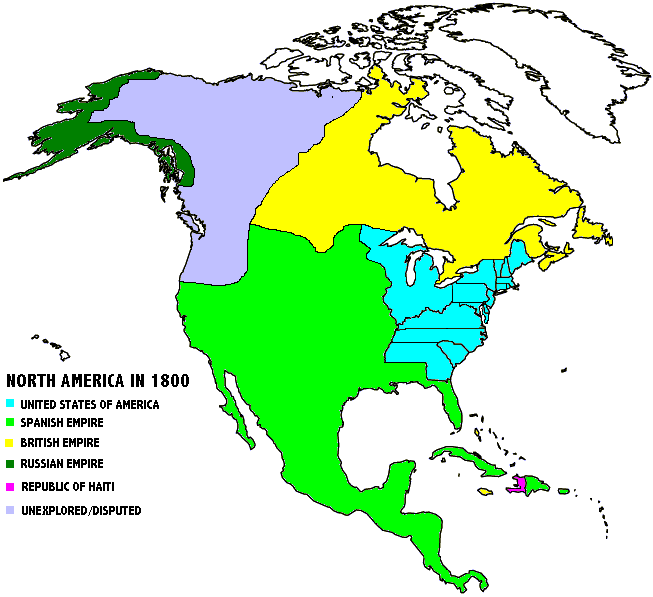
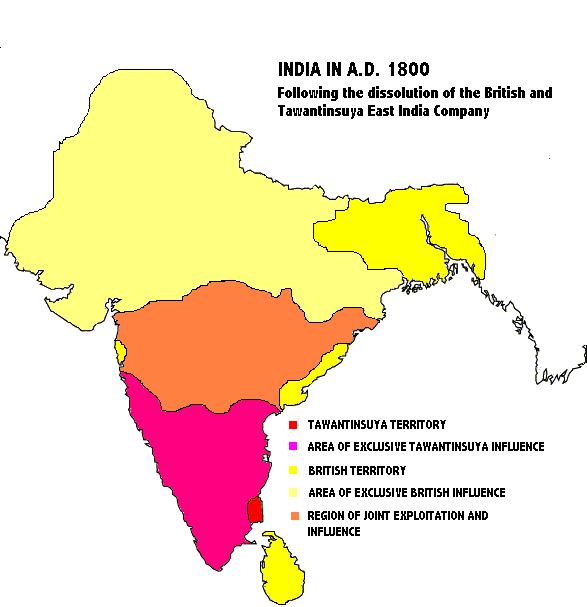
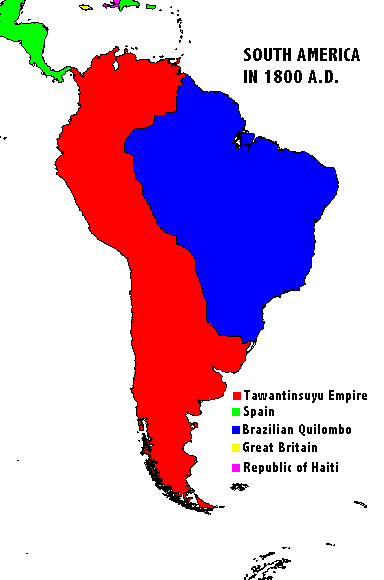
TAWANTINSUYU IN A.D. 1800: A Snapshot
At this time it might be good to discuss the state of the Tawantinsuyu Empire as it exists in the year 1800. As might be expected, the continued contact with the nations of Europe has had far-reaching impacts on the Empire and the Tawantinsuya people.
--GOVERNMENT: The Tawantinsuyu Empire remains essentially an absolute monarchy. The Inca, although no longer considered a god-on-earth, nevertheless wields much more authority over his people than most monarchs in Europe. The habit of obedience, which is a carry-over from the days when the Inca was not only a ruler but a deity, is still deeply ingrained in the Tawantinsuya people. But, there are signs that this could be changing, very gradually. The 18th Century Enlightenment has made it’s impact on the Tawantinsuya, especially on those of the royal family and upper classes, ideas from various European philosophers having been introduced by Tawantinsuya ambassadors. The idea of the "enlightened despot, " has appealed to Tawantinsuya rulers educated at the best universities in Europe, from the reign of Tupahualpa Inca (1726-1743) onward. This trend has been encouraged by correspondence between the Incas and French philosophers such as Voltaire, Montesquieu, and Rousseau, and English thinkers such as Edmund Burke. As a result, the Incas have tried to apply some of these ideas at home, granting freedom of expression and of the press, private property rights, and religious toleration (even to Catholics) to their subjects. The greatest resistance to these changes has, ironically, come from the common people they are intended to benefit, who have been slow to abandon their traditional ways and world-view. But despite some grumbling, the ingrained habit of obedience to their rulers has prevented any serious opposition from arising.
--SOCIAL STRUCTURE: Tawantinsuya society is sharply divided between aristocracy and commoners. There is little in the way of a middle class, or bourgeoisie, in Tawantinsuya society. One of the primary reasons for this is the existence of the "Aristocracy by Examination" system, which is a means by which any commoners who attain wealth and education tend to be absorbed into the Aristocracy rather than forming a new Middle Class. This system tends to reinforce the dominance of the ruling class...the Aristocracy absorbs the best and brightest of the commoners, and the dream of the average commoner is not to overthrow the Aristocracy, but to become a part of it. This is in contrast to the situation in most of Europe, where the bourgeoisie will tend to lead the commoners toward revolution over the next century.
--RELIGION: The primary religion of the Tawantinsuyu Empire is Christianity, mainly of the Puritan variety. However, English Baptist and Methodist and Scottish Presbyterian ministers have also been allowed to preach in Tawantisuyu, and there are substantial numbers of followers of these faiths as well. There is also a small Catholic minority, mainly descendants of Spaniards who decided to stay when the Spanish colonies in which they lived (Argentina, Colombia, and Venezuela primarily) were conquered by the Tawantinsuya. Up until the early 1700s, these were often persecuted by the Tawantinsuya, but the introduction of Enlightenment ideas of religious toleration has ended that persecution over the course of the last century. Last but not least, there is a significant minority of people who continue to practice the old native Tawantinsuya religion, offering sacrifices at mountaintop sanctuaries to the sun god Inti and the other old deities worshipped before the introduction of Christianity.
--ECONOMY AND TECHNOLOGICAL DEVELOPMENT: The Incas, since the reign of Atahualpa I, have been intensely interested in technological advances occurring in Europe. In particular they have thoroughly embraced the agricultural innovations of such men as Jethro Tull and Andrew Meikle, which have dramatically improved the productivity of Tawantinsuya farming. These innovations have also created a labour surplus, as not so many people are needed in the farming industry, and this is good, as the Tawantinsuya are also in the process of industrializing, using imported British technology (or Tawantinsuya copies produced as a result of study of British and other European scientific journals). They have adopted the inventions of men such as Arkwright, Crompton and Hargreaves which have mechanized the textile industry. This has enabled the Tawantinsuya to develop a new mass market for their famous alpaca and vicuna wool fabrics, which have been much sought after since they were first introduced into Europe in the 1600s, but production of which has been very limited heretofore, making them extremely expensive. Mass production will mean the price of these highly desirable fabrics will drop substantially, making them accessible, for the first time, to average people throughout the world. But not coincidentally, the development of this new industry will have some rather dramatic impacts on Tawantinsuyu itself, as the environmental impact of expanding herds of alpaca and vicuna begins to make itself felt over the next century. Another recent acquisition has been James Watt’s exciting invention, the steam engine. One of the first customers for this device was none other than the Tawantinsuya ambassador to Britain, Apichu Cusi, who purchased one of the very first examples made, along with a license to produce the engines in Tawantinsuyu. And similar stories apply to many other European innovations. Tawantinsuya engineers and scientists are busily adapting the new technology to Tawantinsuya needs.
--POPULATION: The population of the Tawantinsuyu Empire as of A.D. 1800 stands at approximately nine million and growing rapidly. The principal language, of course, is Quechua, a language that has been gradually replacing other local native languages throughout the empire. In part this is because of Tawantinsuya efforts to integrate the nobility of conquered peoples into their imperial structure, and partly because Quechua is the language of trade within the empire, which encourages it's spread amongst the common folk (similar to the spread of Aramaic by similar processes in the middle east). Among the nobility...both that of birth and that which reached the ranks of the Aristocracy by examination...it is quite common for English to be spoken as a second language, reflecting the long and close relationship Tawantinsuyu has had with England since the first contact between the two lands in the 1580s. The general level of education among the populace is quite high...better than 80% of the people read and write at least to some degree. This has been encouraged by the English Puritan missionaries who spread Christianity around the empire in the belief that it is important for all good Christians to be able to read the Bible for themselves. It was they, with the blessings of the Incas, who adapted the Roman alphabet to the Quechua language and set up the school system which spread literacy among the people of the empire.
--FOREIGN RELATIONS: At the present timee, the Tawantinsuyu Empire is at peace.
Despite the breakup of the British and Tawantinsuyu East India Company and
colonial competition with the British in Australia, relations between
Tawantinsuyu and Britain remain very close. Indeed, even in India, cooperation
between the successor companies of the former B.T.E.I.C. remains the norm, and
the Tawantinsuya colony of New Cuzco in Australia trades with it's British
counterpart at Botany Bay on a regular basis.
Relations with Spain, the former Great Enemy of Tawantinsuyu, continue to
improve, which will have some interesting consequences in the upcoming years.
Relations with other European countries such as France and the Netherlands are
somewhat strained as a result of Tawantinsuya support of the Brazilian Quilombo.
The Tawantinsuya have not, as yet, established relations with the new republic
in North America...the United States.
Relations with the Quilombo remain good. The increasingly independent foreign
policy of the Quilombo has somewhat irked the Incas, but not enough to threaten
a rupture in the relationship between the two nations. The Tawantinsuya continue
to extend a shield of protection against European intervention in the affairs of
it's neighboring state, and the Quilombo in return gives special privileges to
Tawantinsuya business concerns operating in the Quilombo.
--MILITARY FORCES: The Tawantinsuya Navy, as of 1800, currently ranks number 5 in the world, behind the British, French, Dutch and Spanish navies. The Tawantinsuya fleet is slightly smaller than the Spanish fleet, but because the Tawantinsuya can usually concentrate all of their forces in the regions around their shores, they can usually maintain local superiority over the Spanish in time of war between the two powers. The Tawantinsuya maintain squadrons based at naval bases located at Tawantinsuya cities founded on the sites of OTL Caraccas, Venezuela; Buenos Aires, Argentina; Santiago, Chile; and Lima, Peru. They also maintain bases on the island of Trinidad, and at Tierra del Fuego, which controls the route around Cape Horn. Most of the Tawantinsuya fleet consists of frigates, which are very useful for protecting Tawantinsuya commerce, hunting down pirates, and so forth. But they do also maintain two battleship fleets, one based in the Caribbean and one at the base in Peru, which can contend with European fleets in open battle.
The Tawantinsuya Army has a peace-time strength of about 100,000 men. It is organized, trained, and equipped on the model of Britain’s army. Unlike the British, however, the Tawantinsuya Army is not a volunteer army, but uses a system of universal service. All men are expected to serve a term of enlistment (usually 3-5 years) in the army upon reaching adulthood, after which they enter a reserve system, where they report to local depots a couple of times per year for refresher training, until they reach the age of 40. In wartime, this reserve of trained manpower enables the Tawantinsuya Army to rapidly mobilize to meet wartime needs.
c. A.D. 1800, The United States--Since the end of the American Civil War, there has been a segment of the population which supports a restoration of the monarchy and of the House of Arnold (as Benedict Arnold’s surviving sons...living in exile in Canada...are now referred to by American monarchists) to the American throne. This segment is growing rapidly. Although engaged in a struggle for his own survival throughout his brief reign, King Benedict never committed any egregious violations of liberty. He never ordered mass arrests of opponents or shut down newspapers, and in general, attempted to respect civil liberties where and when he could. This is in sharp contrast to the current administration and the increasingly oppressive policies of the Federalist Party, and many people have come to view "Good King Benedict" with a great deal of respect and even nostalgia. Many important people, including some high-ranking members of the Federalist Party who are secretly opposed to the policies of the current administration (but afraid to voice these opinions for fear of ending up in jail under the Sedition Acts), begin plotting for an eventual restoration of the monarchy.
c. A.D. 1800 onward--Since the 1600s, the Tokugawa Shogunate in Japan has maintained a closed society, not allowing foreigners to enter the country, restricting contacts between Japanese citizens and the outside world, and allowing only a small and limited trade to be carried on by the Dutch at a single port in Japan. Furthermore, they have behaved barbarously toward shipwrecked sailors of foreign nations who wash up on their shores, often summarily executing them or enslaving them.
Up until the late 1700s, this has affected the Tawantinsuya very little, as there has been scant Tawantinsuya martime traffic in the neighborhood of the Japanese isles. Tawantinsuya merchants of the British and Tawantinsuya East India Company (and it’s successor, the Tawantinsuya East India Company) have traded in southern Chinese ports, but no closer than that. But beginning in the late 1700s, the Tawantinsuya begin taking part in whaling expeditions to the north Pacific, and in 1800 the first Tawantinsuya ship is wrecked on the Japanese coast. The crew is captured by the local Daimyo and put to death. When news of this reaches Tawantinsuyu, there is much outrage, and this will only increase as further incidents occur over the succeeding years. No action is immediately taken, however.
c. A.D. 1800 onward--Tawantinsuya colonization of Australia and New Zealand have been proceeding slowly. Although the Tawantinsuya have a large population, they also have a lot of unused land within the mainland empire, and there is little interest among the general population in going overseas to establish colonies. In 1800, Ninan Cuyuchi Inca establishes a subsidy program to encourage colonization of the overseas territories. The program works as follows...any family which agrees to remove to the colonies will receive a cash payment of 500 gold Qurants (as the Tawantinsuya currency is called...this is short for "quri rantiy," Quechua for "gold used for purchasing"), which is the equivalent of several years’ earnings for most families in Tawantisuyu. They will also receive a land grant of 150 acres of land in the new colonies, as well as tools, seedstock, and other materials needed to establish themselves in their new homes. In exchange, they have to agree to remain in the colonies for at least seven years...Ninan Cuyuchi reasons that within that time, most families will have established themselves on a self-supporting basis within that length of time and will be more likely to stay put. Ninan Cuyuchi also recognizes the need to get more females out to the colonies...which up until now have been heavily overpopulated with males...in order for them to be made viable in the long term. Therefore, his subsidy program awards families with unmarried virgin daughters an additional 100 Qurants per daughter, on the condition that these daughters marry and remain in the colonies (since in Tawantinsuya society, marriages are arranged, the head of the household can contract for this with the government and thus receive the award). Finally, he also establishes tax incentives to encourage emigration to the colonies. The result of these measures is a significant increase in the number of people emigrating to the colonies. As a result, the colony in Australia, which had been sparsely populated and in danger of failure, is much strengthened, and is soon not only made viable, but capable of expansion. Likewise, the colony in New Zealand is much strengthened, and within a few years, a second colony will be established on the southern island.
c. AD 1800 onward--In New Zealand, the Tawantinsuya colony has maintained mostly friendly relations with the warlike native Maoris who inhabit the archipelago. Many Tawantinsuya men, lacking suitable Tawantinsuya mates, have married Maori women, and there is a growing number of mixed-blood people as a result. The Tawantinsuya have been somewhat appalled by some of the practices...cannibalism, for example...that exist among the Maori, but lacking the numbers to effectively stamp out these practices, have adopted a "live and let live" policy for the time being. As the number of Tawantinsuya on the islands grows, however, Tawantinsuya efforts to end inter-tribal warfare and stamp out "barbaric" practices among the natives will lead to conflict between the two groups, and eventually war.
A.D. 1800--President Nathaniel Greene dies in office. Alexander Hamilton becomes the second President of the United States. The first Tawantinsuya-built steamship, a paddlewheel coastal trader named the MANCO CAPAC, is launched. It is not a commercial success, but will inspire other designers to improve the design.
A.D. 1801--Britain makes Ireland part of a single British kingdom. Parliament in Dublin is abolished. The Anglican Church is to be recognized as the official church in Ireland. No Catholics are to be allowed to hold public office. Napoleon of France has defeated Austria. In the treaty of Lunéville, Austria renounces claims to the Holy Roman Empire. In England, Matthew Murray and Robert Trevithick demonstrate steam locomotives. One of the observers at the Trevithick demonstration is Huaman Pahuac, the Tawantinsuya ambassador to Great Britain.
A.D. 1802--The war-weary British sign a treaty ending their war against France-The Treaty of Amiens. It will be a temporary truce.
A.D. 1803--Alexander Hamilton wins election to a second term as President of the United States, with Aaron Burr elected as Vice President. The election is basically a farce, as Hamilton’s ruling Federalist Party has taken full advantage of the Sedition Acts to see that no credible opposition is allowed to arise. There is widespread anger among the populace over the increasingly oppressive rule of the Federalist Party. Also in this year, the Irish are rebelling against British rule. They are crushed militarily by the British, but unrest among the Irish will remain in Ireland through the rest of the century. Britain and France return to war after their treaty breaks down. Britain begins stopping U.S. ships on the high seas and impressing American seamen into the Royal Navy. Death of Ninan Cuyuchi Inca. He is succeeded by his nephew (son of Auqui Amaru Inca), who reigns as Apichu Cusi Inca.
A.D. 1804--In the wartime atmosphere and as a defense against French royalty, the Senate in France votes in favor of awarding the crown to Napoleon, who will reign as "Emperor of the French." Napoleon crowns himself emperor. Beethoven is enraged. He dislikes royalty and tears up the title page for his Symfonia Buonaparte, which will be known as his Symphony No. 3. Spain joins Napoleon's war as an ally against the British. Apichu Cusi Inca declares Tawantinsuya neutrality in the war between Britain and Spain.
Also in this year, the Royal College of Surgeons is founded in London. Japan refuses trade with arriving Russian ships. The Russians visit the Hawaiian islands on their way to Fort Ross in California. Nearly half of the population of the Hawaiian Islands are dying from the Great Sickness - an unknown disease brought by Europeans. The Serbs revolt against Ottoman authority and win autonomy status...self-rule within the Ottoman Empire...demonstrating Ottoman weakness to the Greeks, who remain under Ottoman rule. Rebirth of the Sons of Liberty in the United States, as people opposed to the increasingly dictatorial rule of President Hamilton and the Federalist Party begin to secretly organize. The organization seeks the restoration of American liberty, and it’s leadership sees as the best remedy for the problem the establishment of a strictly limited constitutional monarchy and the restoration of State’s Rights. Among the leaders of the organization...unknown to President Hamilton...is Vice President Aaron Burr, who is secretly grooming Benedict Arnold (eldest son of the former King Benedict) for eventual restoration to the American throne.A.D. Also in this year, Hobart Town, the first British settlement on Tasmania, is established. Irish convicts in Australia staged a failed rebellion at Vinegar Hill.
A.D. 1805--Russia, Austria and Sweden ally themselves with Britain. In Milan, Napoleon is crowned King of Italy. He is looking towards an invasion of England. A French fleet sails north to Spain's Atlantic port of Cadiz. Napoleon orders his French and Spanish ships out of Cadiz to do battle with the British. The British win, at the Battle of Trafalgar, frustrating Napoleon's invasion plan. For two years the British East India Company has been warring against the Maratha Empire, which was allied with Napoleon. The Tawantinsuya East India Company has cooperated with these efforts, as the Marathas are seen by the Tawantinsuya as a threat to their interests in India as well. As a result the British East India Company wins and gains control over Orissa and western Gujarat. President L’Ouverture of Haiti is assassinated at the orders of General Jean Jacque Dessalines. Dessalines leads a coup that overturns the Republic, declaring himself Emperor of Haiti. Also in this year, Tenskwatawa, a Shawnee shaman, leads a religious revival among the exiled Indian tribes living under British protection in Canada. He teaches that if only the Indians can get back in the graces of the Great Spirit by returning to their traditions and rejecting the ways of the whites, the lands stolen from them will be returned and a new Golden Age will dawn. His teachings have a powerful appeal, and he soon has a very large following. His brother, Tecumseh, uses this movement as the basis for his plans for an eventual return of the tribes to their lost homelands. Tecumseh is encouraged in these efforts by the British, who view his warriors as an important component in the defense of Canada in the event of war with the United States.
A.D. 1806--Napoleon institutes "The Continental System," a strict embargo of British trade goods by all nations controlled by, or allied to, Napoleon’s French Empire. In response, Britain declares a naval blockade of those European countries ruled by Napoleon. U.S. shipping is caught in the middle, as the British seize 1,000 American ships and the French nearly 500. Popular opinion and pressure is mounting on President Hamilton to respond to British aggression on the high seas. Hamilton is an Anglophile, however, and continues to follow a policy of appeasement toward Britain. Also caught in the middle is the shipping of another neutral power...Tawantinsuyu. Apichu Cusi Inca lodges formal protests with both the British and French governments, and orders Tawantinsuya merchant vessels to travel in convoys, escorted by naval vessels. Neither Britain or France want to provoke a war with the Tawantinsuya while still engaged in a death struggle with each other, and the show of force discourages attacks by both powers on the Tawantinsuya convoys. And so, unlike the situation of American shipping, interference with Tawantinsuya trade sharply declines. But Apichu Cusi’s action also significantly chills Tawantinsuya relations with Britain, a state of affairs which will continue for the rest of Apichu Cusi’s reign. Also in this year, the Emperor of Austria, Francis I, abdicates his other title: Holy Roman Emperor. The Holy Roman Empire, created in the 800s, is formally dissolved, with Napoleon reorganizing much of it into his Confederation of the Rhine. In Haiti, Jean Jacque Dessalines, self-declared emperor, is seen by his generals as a ridiculous figure. Dessalines announces his plan to march with troops into the south, where he is not popular, and the south explodes in rebellion. Dessalines' generals prepare a trap for him along the way. His horse is shot from under him, and he is pinned under his horse, shot in the head, and his body hacked to pieces with machetes. Haiti is plunged into chaos and civil war as the generals squabble among themselves and attempt to seize power. A British naval force takes control of Cape Colony in South Africa...the Dutch who had been ruling there now being ruled by Britain's enemy, Napoleon.
A.D. 1807--Extending its power at sea, Britain outlaws slave trading across the Atlantic, for its own ships and for ships from all countries united with Napoleon. Britain turns a presence on the coast of western Africa into a crown colony. With help from the French, Muhammad Ali Pasha drives the British out of Egypt (a part of the Ottoman Empire). Napoleon moves to consolidate his position in Europe. He defeats a combined Prussian and Russian force in February. Danzig surrenders to him. He defeats the Russians again in June and occupies Königsberg. Tsar Alexander of Russia is annoyed with the British and agrees to meet with Napoleon. In August, Napoleon demands that Portugal join the trade boycott against the British and declare war on Britain. Portugal hesitates. Napoleon's ally, Spain, allows French troops to pass through its territory to Portugal. Robert Fulton builds the first commercially successful steamboat. The first passenger train begins running from Swansea to Mumbles, in Britain. Beginning of railroad construction in Britain.
A.D. 1807 onward--In 1807, a delegation of leading citizens from Haiti travels to the Quilombo to petition for aid in ending the civil war and chaos in Haiti. Jabari Gamba, the Great Chief of the Quilombo, with the approval of the Great Assembly, agrees to intervene. A Quilombo military force lands in Haiti and over a three year period, defeats the private armies of the squabbling generals and bandit lords which have been feuding for control of the island since the assassination of Emperor Dessalines in 1806. Remembering how the Tawantinsuya helped the Quilombo out of it’s own crisis in the early years of the last century, Jabari Gamba and his successors station Quilombo troops permanently in Haiti as peacekeepers, to remain there until a stable government can take over the reins of power.
A.D. 1807-1808--The Second American Revolution. In early 1807, a peace delegation, sent by President Hamilton to Britain, is rudely rebuffed. Then in June 1807, the British frigate H.M.S. LEOPARD fires on the U.S. warship, U.S.S. CHESAPEAKE, after the American ship refuses to be boarded. When news of these two new insults to American honour are received in the United States, public demands for war reach a fever pitch. President Hamilton once again refuses to declare war, and begins tightening controls on dissent. A wave of arrests only serves to further infuriate the people, and beginning in August, armed rebellion breaks out in most States of the Union. President Hamilton calls out the army to crush these revolts.
On August 10, the Sons of Liberty calls on Vice President Burr to take action, and Burr...who has been planning for this day for quite some time...sends troops personally loyal to himself to the Presidential mansion, where they attempt to arrest Hamilton. Hamilton refuses to go peacefully, and, in violation of Burr’s orders, one of the soldiers bayonets him in the back. He dies in agony a few hours later.
The next day, Vice President Burr calls Congress into session. In a speech which will be remembered as one of the most important in American history, Burr declares that America’s attempt at republicanism has failed. "This government, which was created to protect and defend the liberties of the American people, has become the single greatest threat to those liberties," Burr says. "Our recent experience amply demonstrates that republicanism inevitably degenerates into mob rule, and ultimately into dictatorship. Certainly this is not what the heroes of the War of Independence fought and died to achieve. It is time to restore the liberties of the American people, and to act to see that they are nevermore threatened by tyranny."
At the conclusion of his speech, Burr asks Congress to do two things...first, immediately repeal the Sedition Acts, and order the release of all those held in prison under the authority of said Acts; and second, call for a convention of the States to draft a new Constitution. Many members of Hamilton’s Federalist Party have been dismayed by the increasingly dictatorial behavior of the Greene and Hamilton administrations...indeed, a great many are secretly members of the Sons of Liberty...and willingly agree to end an unsavory chapter in the country’s history. In the end, they outnumber those who want to cling to power by any means possible, and to Burr’s amazement, Congress narrowly passes both proposals. When news of these events gets out to the public, armed resistance to the government quickly subsides, and Vice President Burr recalls the Army.
The Constitutional Convention meets in late September 1807, and over a period of four months of hard-fought negotiating, a new Constitution is drafted. The new document creates a limited constitutional monarchy, based loosely on that of Britain. The document mandates a bi-cameral legislature, consisting of an upper house called the Senate whose members will be appointed by the State Legislatures, and a lower house called the Chamber of Delegates whose members will be popularly elected. All bills must originate in the lower house, but must be passed by both houses to become law. The monarch will be the official head of state, but will wield little actual power. Instead, he will appoint a Prime Minister, who will act as the chief magistrate of the land, as well as acting as the presiding officer of the Chamber of Delegates. The monarch will have the ability to introduce legislation for consideration by the legislature, and a veto over all laws passed by the legislature. Declarations of War will originate with the monarch, but must be approved by both houses of the legislature. In addition, the Constitution re-establishes States’ Rights, granting the States the power to maintain militias, and clearly limiting the power of the central government over local affairs. And finally, there is an extensive bill of rights attached to protect the liberties of the people.
This Constitution is submitted to the States for ratification in January 1808, and by June 1808, all fourteen States have ratified the document. In it’s last official act, the outgoing Congress, under the leadership of Vice President Burr (who has refused to take the title of President in recognition of his role in the death of President Hamilton), restores the crown of the United States to the House of Arnold. Benedict II, King of the Americans, is crowned at Philadelphia on July 4, 1808.
A.D. 1808--Napoleon’s intervention in a quarrel between Spain's king, Charles IV, and the son of Charles, Ferdinand, seriously misfires. He attempts to make the two of them prisoners, but with the help of the Tawantinsuya ambassador, they manage to escape and take ship to Spain’s American colonies, which rally to the royal standard and become the home of the Spanish Government-in-Exile, which will inspire and provide aid to Spanish resistance to Napoleon. Napoleon declares the throne of Spain vacated, and moves his brother Joseph from the Kingdom of Naples to the throne in Spain. King Charles IV, from his new capital at Mexico City, abrogrates the Franco/Spanish alliance and declares war on France. Shortly afterward, he signs a treaty of alliance with Britain. He calls on his loyal subjects in Spain to resist the French occupation by any means necessary. An unusually barbarous guerrilla war begins within Spain, with atrocities committed on both sides, and with Napoleon as usual caring little about hearts and minds. Resistance to the French spreads to Portugal. The British land a force there to help the resistance. It is the beginning of Napoleon's decline. Inspired by Robert Fulton’s success, the ANYAS ("Skunk," named after the noxious fumes which pour from it’s smoke stack), the first commercially successful steamship built in Tawantinsuyu, is launched. She will be the first of many.
A.D. 1808-1812--The War of 1808 between the United States and Great Britain. Continued British attacks on American shipping and impressment of American sailors by British warships lead King Benedict II, shortly after his accession to the American throne, to ask his legislature for a declaration of war. This is passed by both houses virtually unanimously on July 23, 1808.
The obvious target for American aggression is the British provinces of Upper and Lower Canada. And the United States is in a very enviable position. Unlike the situation in the OTL War of 1812, the United States has a professionally trained and well-equipped army of approximately 50,000 men (about five times the size of OTL’s Army at the outbreak of war in 1812), and the Royal Legislature soon authorizes an expansion of this force to a strength of 100,000. Recruiting for the authorized expansion of the regular army goes slowly, however, and the actual strength of the regular Army will never exceed 80,000 during the entire war. This force will be further supplemented by the newly re-established State militias, which will provide another 400,000 men to the American war effort. However, the contribution these raw and unevenly trained troops will make to the war effort will be marginal (they will contribute mainly by relieving the Regular Army of the need to provide local defense forces in each State).
The British find themselves in a very difficult position, however. At the outbreak of war, there are only approximately 10,000 British and Canadian regulars in Upper and Lower Canada. The British will raise a further 10,000 Canadian militia (which, like their American counterparts, will be unevenly trained and equipped and will contribute little to the war effort). And they have the support of Tecumseh and the followers of the Shawnee Prophet Tenskwatawa, which provide around 2,000 warriors to the British cause. And unfortunately for the defenders of Canada, Britain’s continuing war with Napoleon will prevent them from sending anything more than token reinforcements to Canada.
And so, the war on land quickly turns in favor of the Americans. American armies enter Canada in early 1809, and by the end of 1810, all of Upper and Lower Canada are under at least nominal American control. The most troublesome aspect of the war for the Americans turns out to be Tecumseh and his native American warriors, who conduct a guerilla campaign which will be very costly for the American occupying forces until Tecumseh is finally caught and killed in late 1811. Without the strong leadership provided by Tecumseh, the native American tribesmen lose heart, and the alliance built by Tecumseh and Tenskwatawa collapses. The remnants move west, out of American controlled territory, and effectively drop out of the war.
The war at sea is another matter entirely. The Federalist administrations of Presidents Greene and Hamilton, which saw the Army as the means of crushing internal dissent and maintaining their own power, made sure that Army appropriations were generous, but, needing to control costs where they could, were very stingy with appropriations for the Navy. The British Navy quickly sweeps the United States fleet from the seas, and by the end of 1809, the only surviving American warships are those which are sheltered in American harbors defended by Army fortresses, and these will not dare to venture out to face the enemy.
But British victory at sea does not change American dominance on land, and in 1812, the British goverment, anxious to concentrate all of it’s resources on defeating Napoleon, agrees to a peace offer from King Benedict, whereby it cedes the provinces of Upper and Lower Canada to the United States. Britain retains the provinces of Nova Scotia (including the important naval base at Halifax) and Newfoundland (along with Cape Breton Island)...these provinces were successfully defended during the war, mainly because what limited British reinforcement could be spared for the war ended up here, along with the survivors of the original British garrison of Canada, which retreated here after being driven from Upper and Lower Canada (The British defenders were also helped by the outbreak of the Florida War, which forced the United States to divert a good portion of it’s forces to it’s southern and western borders to face the forces of Spain). Also retained by Britain is Rupert’s Land, the huge territory administered by the Hudson’s Bay Company which lies to the west of Upper and Lower Canada...American forces never entered this territory in any significant numbers during the war, and so King Benedict did not include it in his list of territorial demands.
A.D. 1809--Russia defeats Sweden. Sweden loses Finland, which becomes an autonomous Grand Duchy within Russia's empire. Returning to the Hawaiian Islands from California and hoping for trade, Russians build a fort at Honolulu and try to establish themselves on the island of Kauai. They ignore Hawaiian customs and are driven out. Meanwhile, Napoleon is spread thin. The Austrians defeat him at the Battle of Aspern-Essling, and he loses his reputation for invincibility. The Austrians fail to follow up on their victory. Napoleon organizes an assault and defeats the Austrians at Wagram. The Austrians make peace with Napoleon. Napoleon's economic blockade is not working. Britain's exports reach an all-time high.
Sequoyah, a Cherokee silversmith living on the Cherokee reservation in north Georgia, has gained a reputation for his fine work. One day a white man who purchased some of Sequoyah’s silverwork suggests that it might be good if Sequoyah inscribed his name on it as a "trademark," as was the practice of white silversmiths. Sequoyah, of course, doesn’t know how to write, but learns how to do so from a local American settler. He becomes intrigued by the idea of creating a system of writing for his own people.
A.D. 1810--Allied with the Portuguese against Napoleon, the British negotiate an agreement with the Portuguese calling for the gradual abolition of the slave trade across the Atlantic. The ruler of Kauai cedes his island to Kamehameha. Kamehameha is now ruler of all of the Hawaiian Islands. In accordance with Hawaiian tradition he is considered divine and commoners prostrate themselves before him.
A.D. 1810 onward--In 1810, at the orders of Apichu Cusi Inca, a steam locomotive is imported from Britain to Tawantinsuyu. A circular railroad is built near Cuzco, where the machine is tested. Apichu Cusi is impressed, and the possible usefulness of this machine in enabling rapid transport of troops and materials around his empire is immediately clear to him. Over the next few years, with the assistance of highly paid British construction engineers, the first railroad line (running from Cuzco to Chan Chan) will be constructed in Tawantinsuyu. It will be the first of a network which will eventually extend throughout the empire. Licenses for the construction of locomotives and other rolling stock are also obtained, and Tawantinsuya engineers begin making their own adaptations and improvements on the British designs. In time, the Tawantinsuya railroad industry will be among the best in the world, and will be exporting locomotives and rolling stock to other nations.
A.D. 1810-1813--The Florida War. Over the years since the end of the Revolutionary War, people have been migrating from the United States into West Florida. In 1810, these settlers rebel and declare independence from Spain. Hoping to take advantage of Spain's apparently weakened condition and occupation by Napoleon, the U.S. government declares the annexation of the region for the United States. However, King Charles IV’s government in Mexico City is not of a mind to allow this, and sends troops to expel the foreigners and restore order in the rebellious region. Thus begins the Florida War.
Despite American expectations of easy victory, Spanish resistance turns out to be unexpectedly tough, as a much larger Spanish population exists in Spain’s North American colonies than existed in OTL. The Americans are further handicapped by the ongoing war in Canada, which prevents them from turning their full forces on the Spanish. In 1811, an American force under General Andrew Jackson is defeated near Pensacola, Florida by Spanish forces, and Jackson is mortally wounded. American attempts to seize the towns of St. Louis and New Orleans are likewise defeated in that same year.
The conclusion of the war against Britain in 1812 allows the Americans to concentrate their forces against Spain, and from that point on, the tide begins to turn. By mid-1813, American forces have expelled the Spanish from the disputed territory of West Florida, and have captured New Orleans. King Charles IV decides to salvage what he can, and agrees to sell all of Spanish Territory east of the Mississippi River to the United States for the paltry sum of five million dollars. In mid-August 1813, a Spanish force evicts the Americans from New Orleans, so in the final treaty, signed on September 28, 1813, that city remains a Spanish possession. Most Spanish settlers in Florida and West Florida decide to remove to Spain’s colonies west of the Mississippi, further strengthening those colonies.
A.D. 1811--The French are driven from Portugal. In Egypt, Viceroy Muhammad Ali Pasha exterminates Mameluke warlords. He invites them to a banquet and has them slaughtered.
A.D. 1811
onward--In 1811, Thomas Douglas, Earl of Selkirk, is granted 300,000 acres
of land by the Hudson’s Bay Company for the purpose of establishing an
agricultural
settlement. At the time, the Highland Clearances...in which Scottish highland
tenant
farmers are being driven off their lands by their landlords, who want to use the
land to
raise sheep, which they view as more profitable than renting their lands out to
poor
Highland families...are displacing large numbers of Scotsmen, and Douglas wants
to
provide a haven for these displaced Scotsmen. Unlike in OTL, this project also
receives a
lot of backing from the British government, which, in the wake of the loss of
Upper and
Lower Canada to the Americans in the War of 1808, is eager to increase the
population of
Rupert’s Land (the huge holdings of the Hudson’s Bay Company to the west of
the lost
provinces) so as to cement the British claim to the region. As a result, the
project is
extended to include not only destitute Scotsmen, but poor people from all over
Britain.
Thousands migrate with the promise of free land, and the government purchases
several
more large tracts of land from H.B.C. over the succeeding years, which it will
also open
up to settlement. By the end of the century, a number of sizeable towns and
cities will
exist in the region, and Rupert’s Land will be divided into several several
self-governing
Crown Colonies. As it happens, the gradual increase in settlement will coincide
with the
gradual decline of the H.B.C.’s fur trade, so the company will actually be
glad to get rid
of the land.
One unintended result of the settlement of these lands by English and Scottish
settlers is
conflict with the Metis, the people of mixed French and native American ancestry
who
already live in the region. These people live primarily as fur trappers and
small farmers,
and most do not have clear title to the lands on which they live. With the new
settlers
come surveyors and land officials, and it is not long before violence results as
these
officials sometimes "disappear" while working in remote regions.
Several full scale
Metis Rebellions...lead by men such as Louis Riel...will take place beginning in
the
1860s, as the Metis desperately struggle to preserve their way of life. The
Metis will,
however, be suppressed, and thus a roadblock to British settlement of the region
will be
removed.
A.D. 1812--Napoleon's march into Russia exposes his recklessness and shallow strategic thinking. 600,000 men march with Napoleon into Russia. Fewer than 30,000 will return. In the aftermath of the signing of the treaty ending the war between the two nations, Britain's new prime minister, Lord Liverpool, instructs the British navy to treat U.S. trading ships with new tact and to avoid clashes with Americans. In England, a few workers in various cities in the spinning and cloth finishing industries have been destroying new machinery. They are called Luddites. Some are executed. In Spain, the Cortes Generales, the national legislative assembly, meets in Cadiz and adopts a liberal constitution. While the constitution recognizes Charles IV as the legitimate King of Spain, it also enshrines some concepts which are at variance with Charles’s known absolutist views, such as popular sovereignty. In Haiti, democratic elections have been conducted under the constitution originally adopted immediately following the Haitian revolution. Quilombo peacekeepers successfully prevented any election-day violence and fraud from occurring. A plebiscite was being considered...do the Haitian people want to re-establish their own government, or do they wish to join the Quilombo? Most people in Haiti are very grateful to the Quilombo for ending the violence and chaos which wracked their country, and they also see in the Quilombo a successful government of a people very much like themselves. By a substantial majority, the Haitians vote to petition the Quilombo for annexation. This petition is received by the Great Assembly and approved. On August 5, 1812, Haiti officially becomes a province of the Quilombo, and representatives are elected to serve in the Great Assembly shortly thereafter.
A.D. 1812 onward--The annexation Haiti by the Quilombo is causing some problems for the Spanish, whose colony of Santo Domingo (which shares the island of Hispaniola with Haiti) is still a slave-holding colony. Slaves in ever increasing numbers flee across the border into Haiti, and raiding parties from Haiti cause much destruction and death during forays against plantations in Santo Domingo. Until 1813, Spain is too embroiled in The Florida War to consider military action against this threat to it’s colony, but once the war is concluded, King Charles IV begins threatening to take military action against Haiti if attacks on Santo Domingo don’t stop. Apichu Cusi Inca, who, like his predecessors, has guaranteed to extend military protection to the Quilombo, sees events dragging Tawantinsuyu into a possible war with Spain. He decides to offer a compromise solution. He instructs his ambassador in Mexico City, Pachacutec, to inform the Spanish that if they will not pursue war with the Quilombo, the Tawantinsuya will pressure the Quilombo to offer to purchase the Santo Domingo colony and the slaves within it (which Tawantinsuyu will help finance) and to guarantee to stop the raids on the colony while the Spanish evacuate the white population of the colony. To sweeten the deal, Apichu Cusi offers special privileges and lower tariffs to Spanish vessels trading in Tawantinsuya ports for a period of ten years. The alternative, Pachacutec informs King Charles, is war with Tawantinsuyu. Although neither King Charles nor the Quilombo leadership are happy about the compromise, in the end, a deal is agreed upon, and Spain withdraws from Santo Domingo. The last Spanish settler leaves in early 1815 (most of them settle in Texas and California). Santo Domingo is annexed by the Quilombo.
A.D. 1813 onward--During the Florida War, both sides courted the major southern Indian tribes, and right from the beginning of the war, some Indian warriors fought for both sides. The tribes themselves, however, remained neutral through most of the the conflict. But when the tide began to shift following the end of the war with Britain, the tribes, seeing which way the wind was blowing, came down firmly on the side of the Americans and made a significant contribution toward the final American victory. In the years that follow, the tribes reap benefits from this in the form of favorable treaties, protection of law, and other rewards.
A.D. 1813--Napoleon is in deep trouble. In Spain, British and Spanish forces defeat his military. Napoleon withdraws from Germany after the Russians, Prussians, Austrians and Swedes defeat him there. His Confederation of the Rhine collapses, with most of the constituent German principalities declaring war on Napoleon. Napoleon's move against Russia has delayed Russia's ability to protect their fellow Orthodox Christians, the Serbs, who have been rebelling against Ottoman rule. The Ottoman Empire moves against rebel Serb areas, and Albanian troops plunder Serb villages. American King Benedict II, flush with the victories over Britain and Spain in the recent wars, is more popular than ever. In this year he marries a young woman from Virginia named Mary Lee Fitzhugh. The beautiful Queen Mary will bear King Benedict three sons and two daughters, and will be very popular with the people.
A.D. 1814--France is invaded by British and Spanish forces from the south and by Russian, Prussian, and Austrian forces from the east. Despite a brilliant defensive campaign fought by Napoleon, Russian and Prussian forces enter Paris. Napoleon is forced to abdicate and is exiled to the island of Elba. The terms of peace between the victors and France are settled in another Treaty of Paris. The House of Bourbon, in the person of King Louis XVIII, is returned to the throne of France. And, at the same time, the House of Bourbon returns to Spain, as King Charles IV and Crown Prince Ferdinand are welcomed by cheering crowds upon their return to Spain. Charles finds himself at the head of a government based on a liberal constitution which he did not authorize and which he does not support, but knows that the people will reject him if he tampers with it. And so he allows it to stand. The victors over Napoleon gather at the Congress of Vienna to create a stable Europe to their liking. Also in this year, Apichu Cusi Inca holds a conference with Faraji Chiamaka, the Great Chief of the Quilombo. Apichu Cusi is very angry over the fact that Quilombo aggression nearly caused a war between Spain and Tawantinsuyu over Santo Domingo, and he demands guarantees that the Quilombo will not interfere with any of the slaveholding colonies held by European powers in the Caribbean. If the Quilombo refuses to give such guarantees...and live by them...Apichu Cusi informs them that the treaty of mutual defense which exists between Tawantinsuyu and the Quilombo will be abrogated, and the Quilombo will be on it’s own when dealing with the European powers. Faraji Chiamaka takes this threat back to the Great Assembly, where it causes much outrage and indignation. But in the end, cooler heads prevail, and the Great Assembly agrees to the Inca’s terms. The Quilombo formally agrees to cease aggression against neighboring slaveholding colonies.
A.D. 1814 onward--In the United States, settlers begin moving northward into the newly conquered territories of Upper and Lower Canada and Florida. These territories, like the Northwest Territory, are under direct rule by the national government. Within a few years, as populations increase, agitation begins for statehood status. There is no provision within the American Constitution for the admission of new States into the Union, but King Benedict II finds a way to remedy this. In one of his last official acts before his death, he declares the lands to be, in the absence of provisions to the contrary in the Constitution, property of the Crown. Accordingly, he issues an edict allowing the people in each of the territories, once a population of at least 500,000 has been reached, to hold a plebiscite on the question of statehood. If the majority of the people within the territory favor it, and provided the monarch is not aware of any reason why it should not be granted, the monarch issue a Charter granting Statehood to the territory. The Northwest Territory has already reached the required population level, and is granted Statehood by Queen Mary (acting as Regent for the future King Benedict III) in 1823 as the State of Arnoldia. By 1840, the remaining three territories (Upper and Lower Canada and Florida) will have reached the required levels as well.
A.D. 1815--Napoleon returns to France, forces King Louis XVIII to flee the country, and takes power once again. The powers at the Congress of Vienna immediately declare war on him. Napoleon attempts to defeat the British and Prussian armies in Belgium before the rest of the allied armies can intervene, but is himself defeated at Waterloo. Napoleon is captured by the British and sent into exile on the lonely island of St. Helena in the south Atlantic, where he can never cause trouble again. Louis XVIII is once again restored to the French throne. At the Congress of Vienna, the British, Spain, Portugal, a politically new France, and the Netherlands are meeting to discuss the world without Napoleon, and they agree to eventually abolish the slave trade. Also in this year, King Charles IV of Spain and his son, Crown Prince Ferdinand...who, while in exile, were able to put aside their differences and cooperate, after a fashion, on their joint effort to recover the Spanish throne...have a final falling-out. Ferdinand has been intriguing with enemies of the king in a bid to force his father to abdicate so he can seize the throne for himself, and has been discovered. King Charles is so angered by his son’s conduct that he has to be physically restrained from attacking the Prince when he is brought before him. Charles orders Ferdinand thrown into jail, and the next day issues a decree removing Ferdinand from the line of succession to the Spanish throne. Instead, King Charles names his second son, the Infante Carlos, as his heir. Carlos, a strong believer in legitimacy, is somewhat ambivalent about this, but in the end, is persuaded to accept and support his father’s action.
A.D. 1815 onward--In Spain’s American colonies, there is a political movement afoot to gain more political freedoms from Spain’s government. Political leaders in the colonies argue that their support for the monarchy during it’s exile from Spain during the Napoleonic Wars entitles them to a greater degree of autonomy and local government than Spain has, heretofore, been willing to grant. King Charles IV, however, has refused to listen. Some in the American colonies begin to see in the quarrel between King Charles and Prince Ferdinand a possible lever to pry out the reforms they seek.
A.D. 1815 onward, North America--In the aftermath of the War of 1808 and the Florida War, the relations of the United States of America with it’s British and Spanish neighbors have remained cordial. Unlike in OTL, no concept of "Manifest Destiny" has arisen in the United States. In part, this is one of the effects of the U.S. being a constitutional monarchy rather than a republican democracy, as the monarch is able to act as a restraining influence on the more extreme elements...such as those which in OTL took control and created the concept of "Manifest Destiny." It is also an effect of there being no Louisiana Purchase in this timeline, and no expeditions by Lewis and Clarke, Zebulon Pike, John C. Fremont, etc. to explore this territory, which again has meant that there is not the same interest in expanding westward which existed in OTL. Finally, the fact that industrialization is spreading fairly evenly through the whole U.S., rather than there being a marked disparity between the northern and southern States, as existed in OTL, means that there are jobs available for the population...and for lots of immigrants...without needing a lot of additional western land. So the net effect of all this is that the U.S. in this timeline does not see it's ultimate fate as stretching from "sea to shining sea," and has no real reason to attempt to seize territory from it’s neighbors.
In treaties with Britain (1821) and Nuevo Espana (1825), the last disputes over the borders of the United States with those powers were resolved. By 1900, the United States will have become a prosperous, industrialized, firmly Atlantic-oriented nation, interested mainly in trade with Europe, Nuevo Espana, Tawantinsuyu, and to a lesser extent, other regions of the world. It will not pay too much attention to goings-on in the Pacific, and will not become a power in that region.
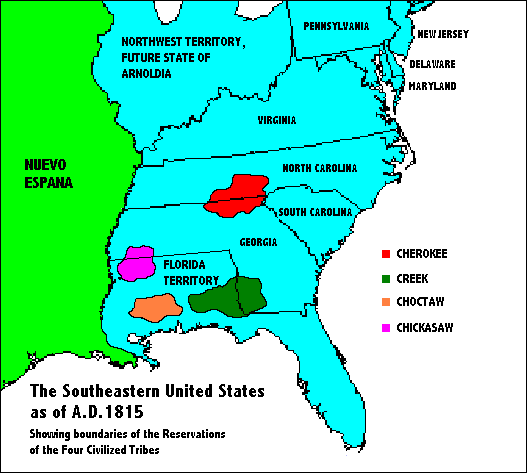
A.D. 1815 onward--King Benedict II sees the independent native Americans of the Four Civilized Tribes as a potential problem. He appreciates the fact that they allied themselves to the United States during the recent war with Spain. And he also views the tribes as sovereign and equal to the United States. But he also knows that white settlers are drifting into native territory on an increasing basis. Conflict is bound to erupt as the two groups compete for the same territory. King Benedict decides that gradual assimilation of the American Indians is the best policy. He feels this can be accomplished in 50 years, and specifically targets the Cherokee first because they show many traits whites see as promising. In 1815 he orders Royal Indian Agents to begin introduction of technology in the form of spinning wheels and carding machines to the Cherokee. Government funded spinning wheels arrive in along with cotton and seed just before the hunting season. The Cherokee males are surprised by the cloth their wives weave. The next year, with their own cotton, the Cherokee women weave cloth in six months that is worth more than the pelts the Cherokee men gather in the same amount of time. The Cherokees begin to see how the technology can help them become more affluent and successful, and they eagerly seek out other technologies and adopt other white ways. The process moves a bit slower among the other southeastern tribes, but much the same result is achieved. While never completely losing their native identities, the tribes gradually merge into mainstream American culture. In return, they find the Royal Government is more inclined to support them in their disputes with white settlers and State governments in the years to come.
A.D. 1816--In France, the income of working people in terms of what it buys (real wages) begins a four-decade decline. The British return to the Dutch their empire in Indonesia. Also in this year, Prince Ferdinand of Spain, who has been jailed by his father for almost a year, has been in secret contact with reformist politicians from the American colonies. In August 1816, assisted by agents of these politicians, Ferdinand escapes from jail and takes ship to the colonies. He arrives in Mexico City in September 1816, and in a ceremony held on September 29, he is crowned as Ferdinand I, King of New Spain. Ferdinand is an absolutist at heart, and dislikes having to listen to the demands of the reformist faction in the colonies, but he knows that, without their support, he has no way of standing up to the forces of the homeland. And so he grants a liberal constitution, creating an elected legislature which will have power to pass most laws (although Ferdinand retains a veto power), and granting religious freedom as well as freedom of speech and freedom of the press. The people of the colonies wholeheartedly support him. Back in Spain, King Charles IV suddenly finds himself in a very difficult situation. The revenues from the gold and silver mines of the American colonies are now flowing into Ferdinand’s coffers, not his, and Spain soon finds itself nearly bankrupt (it does still have some income coming in from it’s colonies in Africa and the Philippines, but this is nothing against the revenue which was lost to Ferdinand). But Ferdinand doesn’t control a sufficient population base to make a serious effort at taking Spain by military force, so instead, a tense cold war begins between the homeland and it’s former colonies which will continue for some time.
Also in this year, second Tawantinsuya colony is established in Australia, on the site of OTL Rockhampton. The settlement is named Pacamayo. Also in this year, King Benedict II of the United States introduces a bill into Congress to build a new capital, befitting the proud new nation, and to move the capital there from Philadelphia, where it has resided since the end of the American War of Independence. This bill is adopted, and it is decided that the new capital should not be located on territory owned by any of the current states of the Union. Therefore, a site on the north bank of the Ohio River is selected (the site that would, in OTL, become the city of Cincinnati, Ohio), and plans are laid out for the new city. The new capital will be called Columbia.
A.D. 1817--In Britain, real wages have been declining at least since the late 1790, as Britain has been burdened by war against France. From this year on and into the next century real wages in Britain will be rising. In India, the Third Maratha War breaks out, involving both the British East India Company and it’s Tawantinsuya counterpart. The war ends with the break-up of the Maratha Empire and the division of Maratha lands between Britain and Tawantinsuyu. Britain, of course gets the lion’s share, and thus the British find themselves in control of most of India. Also in this year, a second Tawantinsuya colony is established in New Zealand, this time on the southern island.
A.D. 1818--For the Ottoman Empire, Egyptians are taking control of the Arabian Peninsula. They destroy the mud-brick town of Diriyah (thirteen miles from the center of what today is Riyadh) which had been the home base of the Saud family and Wahhabis.
A.D. 1819--In England, 60,000 gather in a field and listen to a call for universal suffrage. A magistrate sends a force to arrest the main speaker, Henry Hunt. People riot. Eleven are killed and others injured. A movement for reform gathers strength. Also in this year, King Charles IV of Spain dies. He is succeeded by Prince Carlos, who reigns as King Charles V. Carlos is a firm absolutist, and quickly antagonizes the people with his imperious decrees, including one which repudiates the Constitution of 1812.
A.D. 1820--Death of Apichu Cusi Inca. He is succeeded by his son, who reigns as Auqui Amaru Inca II. Auqui Amaru is a confirmed Anglophile, and he begins working to repair relations between the Tawantinsuyu Empire and Britain, which were damaged, to a great degree, by the policies of Apichu Cusi Inca during and after the Napoleonic Wars. Also in this year, a liberal uprising begins in Spain, beginning with soldiers who are joined by others who want a constitutional monarchy, or a republic. King Charles V is captured and imprisoned, but staunchly resists all demands that he reinstate the Constitution of 1812 or failing that, abdicate. The Cortes Generales thereupon votes to offer the throne to Ferdinand, King of New Spain (brother of King Charles who was removed from the line of succession by edict of King Charles IV). Ferdinand quickly accepts, and returns in triumph before the end of the year. He is crowned as King Ferdinand VII of Spain on December 25, 1820. Knowing that he needs the support of the revolutionaries to survive, Ferdinand restores the Constitution of 1812, and indeed offers amendments to the Cortes...patterned on the provisions of the Constitution of New Spain...which make it even more liberal than before. These amendments are adopted, and despite King Ferdinand’s own desires, Spain now has a liberal, constitutional monarchy. Also in this year, Hongi Hiki, chief of the Ngapuhi tribe of Maoris in New Zealand, visits Auqui Amaru Inca II on the occasion of his coronation. He attempts to secure a supply of muskets for his tribe, but Auqui Amaru, not wishing to create a potentially explosive situation in his New Zealand colonies, refuses. Hongi Hiki is enraged, and secretly begins planning an uprising against the Tawantinsuya in New Zealand. Also, for the past several years, conflict has been arising between American authorities and the Seminoles of Florida, who have never reconciled themselves to American rule since the territory in which they live was transferred to the United States from Spain. Clashes between Seminole raiding parties and U.S. troops have become more and more frequent, and in this year, full scale war breaks out. The wily Seminoles retreat into the swamps and jungles of Florida, and it will be years before they are finally brought under control.
A.D. 1821--The stability for Europe sought at the Congress of Vienna in 1815 is coming undone. Following Serb rebellions against Ottoman rule in previous years, the Greeks in March rise simultaneously against Ottoman rule, including in Macedonia, Crete and Cyprus. The Turks respond by hanging the Patriarch of Constantinople, Gregorios V. The Greeks liberate the Peloponnesian Peninsula in September. There, in the city of Tripolitsa, a center of Turkish authority, Muslims in the thousands are massacred for three days and nights. Also in this year, Napoleon Bonaparte dies at the age of fifty-one under British authority on the island of St. Helena, the reported cause: stomach cancer. Michael Faraday, son of a blacksmith, has overcome the conceit of aristocrats and, as a scientist, has been promoted in Britain's Royal Institution. His interest in a unified force in nature and work in electro-magnetism produces the foundation for electric motors and contributes to what will be "field theory" in modern physics. The first railroad lines are laid in the United States and in New Spain. Construction on the new capital at Columbia has proceeded far enough along that the American government moves there in this year. King Benedict takes up residence in the new Royal Palace in March 1821.
Sequoyah demonstrates his new Cherokee syllabary, a system of 86 phonetic symbols for representing the Cherokee language, before a council of the assembled chiefs of the Cherokee tribe. The chiefs decide to formally adopt the system as the official method of writing the Cherokee language.
A.D. 1822--The British reduce the penalty for numerous crimes that had been capital offenses. The Ottoman Turks respond to rebellion on the island of Chios by slaughtering five-sixths of the islands 120,000 inhabitants. Meanwhile, agents of the imprisoned former King of Spain, Charles V, have been petitioning the reactionary governments of Europe for assistance in squashing the liberal revolution in Spain. Also in this year, King Benedict II of the United States dies of influenza. His eldest son, also named Benedict, is at this time a child of seven years of age, too young to succeed to the throne. Therefore his mother, Queen Mary, rules as regent for her young son until he comes of age.
A.D. 1823--A Congress of the European powers is called at Verona, Italy, for the purpose of discussing the situation in Spain. The Congress votes to authorize French troops to enter Spain to destroy the liberal revolution there and re-establish the rule of King Charles V. Only Britain votes against the proposal. But the people and army of Spain rally to Ferdinand, and the French army is defeated outside of Madrid. The Congress of Verona reconvenes, and splits develop in the ranks of the powers. It is decided to recognize Ferdinand as the legitimate King of Spain, with one proviso...he must guarantee that no further liberal amendments to the Spanish constitution are passed. Ferdinand agrees...to the chagrin of his liberal supporters. Shortly afterward, Ferdinand’s brother...the former King Charles V...is found dead in his prison cell. The official story is that he died by choking on a chicken bone, but it is widely suspected that he was murdered at the order of Ferdinand. Fearing for her life and that of her child, Francisca, wife of Charles V, flees the country with their only son, Carlos Luis, going into exile in Britain. Also in this year, steam powered shipping begins between Switzerland and France on Lake Geneva. The Frenchman, Eugène Delacroix, paints "The Massacre of Chios." Britain's romantic poet, Lord Byron, who has written "We are all Greeks," goes to Greece and fights for Greek independence, where he dies of "marsh fever." The Tawantinsuya population of New Zealand has increased to the point where the local Governor, Apo-Mayta, feels secure enough to begin attempting to enforce Tawantinsuya law on the native Maoris of the north island. He issues decrees banning cannibalism and forbidding intertribal warfare. Seeking to enforce the latter decree, in a surprise move, Tawantinsuya soldiers move into Maori villages throughout the island and disarm the tribesmen. This creates much resentment against the Tawantinsuya among the Maoris, and provides the opening that Hongi Hiki...chief of the Ngapuhi, who is still seething with anger over being denied muskets by Auqui Amaru Inca back in 1820...needs to form an anti-Tawantisuya alliance among the tribes.
A.D. 1824--In France, King Louis XVIII has died and is succeeded by his reactionary brother, Charles X.
The CHEROKEE PHOENIX, the first newspaper printed in a native American language in North America, begins publication at the Cherokee capital at New Echota (in north Georgia). The success of this venture will lead the southeastern tribes to adopting writing systems (some adopt the Roman alphabet to their own languages, others, like the Cherokee, develop their own script) in the succeeding decades.
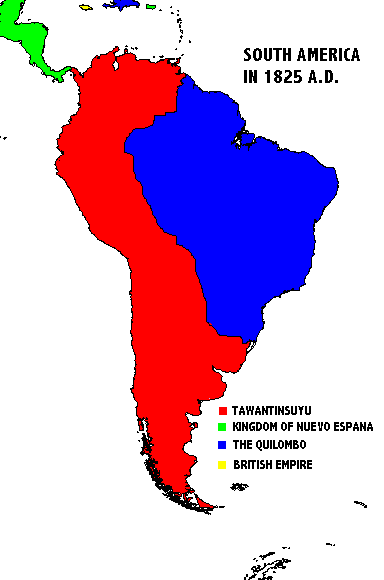
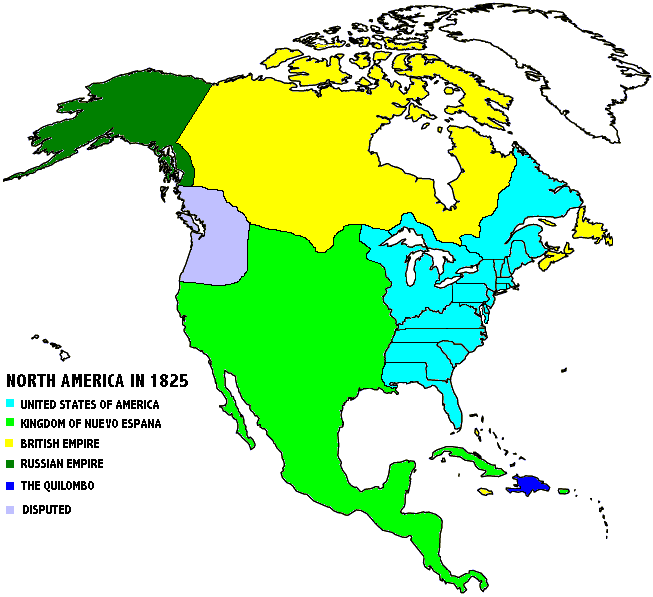
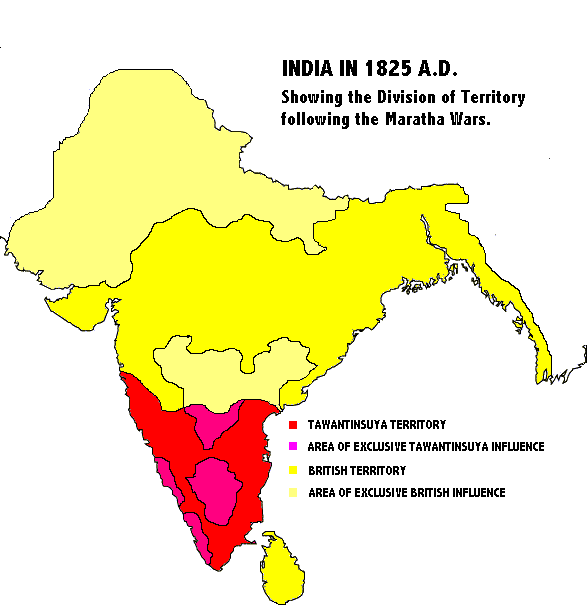
A.D. 1825--Russian military officers, who had been exposed to the Enlightenment during Russia's occupation of France, attempt to replace authoritarian rule with a representative democracy. Their coup, called the Decembrist Rising, fails and they are crushed. The first completely American-built locomotive is constructed in New York.
The first rail line linking Tawantinsuyu with the Quilombo opens for business.
A.D. 1825 onward--Tawantinsuya exploration of the interior of the Australian continent has been proceeding slowly, but by 1825, most of what is in OTL the state of Queensland has been explored. In addition to the two major settlements at New Cuzco and at Pacamayo, there are now small settlements along the few rivers which penetrate inland from the coast. The Tawantinsuya have also set up small posts in various places in the Outback where they conduct trade with the native aborigines...since the establishment of Tawantinsuya settlements in Australia, there has been a growing demand among the Tawantinsuya upper classes for shoes, belts, and other leather items made from kangaroo skin (for example, the height of fashion is for a Tawantinsuya nobleman to carry his coca leaves in a pouch fashioned from a kangaroo scrotum, suspended from his kangaroo skin belt), and the aborigines trade these skins to the Tawantinsuya for iron tools, beads, blankets, and other cheap trinkets, as well as for alcohol. However, despite the increased settlement brought by the Tawantinsuya government’s subsidy plan, British settlement of Australia is still greatly outpacing Tawantinsuya settlement of the continent. In some regions, disputes are beginning to arise with regard to the ownership of certain areas as Tawantinsuya and British settlers vie for control of scarce water resources. This development is worrisome to Auqui Amaru Inca II, who instructs his ambassador in London to open negotiations to establish the boundaries of British and Tawantinsuya territory in Australia. These negotiations will drag on for some time.
A.D. 1825 onward--The position of the still-independent Indian tribes in the southeastern United States (Cherokee, Creek, Chickasaw, and Choctaw, collectively known as the Four Civilized Tribes) are protected by treaty, but white settlers are encroaching on their lands nonetheless. In 1825, representatives of the Four Civilized Tribes petition Queen Mary for redress. Mary is sympathetic to the tribes, and after much negotiation, grants them a form of semi-independence. The tribes will be allowed to rule their reservations, make their own laws, and in general, conduct their own local affairs. American troops will be stationed on the reservations to protect the Indians from troublesome whites. In exchange, they agree to recognize the monarch of the United States as their sovereign, to allow the United States to conduct their foreign affairs, and to furnish troops when needed if the United States goes to war. The tribes agree to the terms, and U.S. Army units take up station at forts built on the reservations shortly thereafter. The problems the tribes were having with encroaching whites are resolved when the soldiers escort them off the reservations. The tribes are cemented even firmer in loyalty to the United States.
A.D. 1827--Britain, Russia, France break with Austria regarding the Greek war of independence-Austria still feeling threatened by any revolt against empire while the Russians want to protect their fellow Orthodox Christians. Egypt, a part of the Ottoman Empire, is helping the Turks, but a combined British, French and Russian fleet sink an Egyptian and Turkish fleet at Navarino Bay, on the west coast of the Peloponnesian Peninsula. This weakens Ottoman power in Greece and in Arabia. In Vienna, Austria, over 10,000 mourners attend the burial of Beethoven. In London, parliament extends tolerance, passing the Catholic Emancipation Bill, making it possible for Catholics to hold public office. The third major Tawantinsuya settlement in Australia, called Mayomarca, is founded on the site of the OTL town of Bundaberg.
A.D. 1828-1829--Hongi Hiki’s Rebellion: Chief Hongi Hiki of the Ngapuhi has secretly formed an alliance with the other tribes of the north island of New Zealand, all of whom are angry over the policies of Governor Apo-Mayta and his attempts to enforce Tawantinsuya law on the native tribesmen (Hongi Hiki has had no success with the tribes of the south island, who remain neutral during the conflict). At dawn on September 21, 1828, the tribesmen rise up in rebellion, and launch surprise attacks on Tawantinsuya communities throughout the north island. Hundreds of Tawantinsuya are killed, and many prisoners are taken (many of these are later eaten by the Maori during victory celebrations later that day). The Maori temporarily throw off Tawantinsuya control of the island, capturing many muskets from Tawantinsuya military stores in the process. Governor Apo-Mayta himself barely escapes with his life, fleeing by ship to the south island.
But the Maori victory is to be short-lived. The division of the captured muskets soon creates a rift between the allied tribes, and fighting breaks out between them. Governor Apo-Mayta is able to raise a force of Tawantinsuya troops from the garrisons on the south island, supplemented by troops sent from Tawantinsuyu itself and by Maori auxilliaries from the loyal south island tribes, and in late November 1828, he returns to the north island. Finding the formerly allied tribes disunited and at each other’s throats, he methodically subdues them, one by one, until, by January 1829, the entire north island is back under Tawantinsuya control. Hongi Hiki and the leaders of the other rebel tribes are captured and executed, and most of the muskets are recovered (some few will remain in Maori hands, despite the best efforts of the Tawantinsuya to locate them). The power of the northern tribes is effectively destroyed, and from then on, the enforcement of Tawantinsuya law on the north island proceeds relatively unimpeded.
c. 1829 onward--The Tawantinsuya presence on the south island of New Zealand is much smaller than that on the north island, and it will be some time before an effort to enforce Tawantinsuya law is made there. But, seeing the fate of the tribes of the north island, most of the tribes of the south island decide to voluntarily end the practices found abhorrent by the Tawantinsuya, especially cannibalism. Inter-tribal warfare goes on for quite some time, however, until the Tawantinsuya are sufficiently strong to finally put a stop to it.
A.D. 1829--The Treaty of Adrianople ends the war between Russia and the Ottoman Empire. The Ottoman Empire grants Greece independence. Russian authority in Georgia is recognized. The Russians are allowed access through the narrow straits from the Black Sea to the Aegean Sea. Autonomy is extended to Serbia and to the Romanians of Moldavia and Walachia, under Russian protection. Scotch tape is invented. The British under Captain James Stirling establish the colony of Western Australia, with it’s first settlement at Perth. The Treaty of London between the British and Tawantinsuyu Empires establishes the borders of British and Tawantinsuya territories in Australia. The border begins on the Barwop River, then runs due west until it reaches the point where Cooper Creek joins Lake Eyre. A second line runs due north from the northernmost tip of Lake Eyre to the northern coastline of the continent. Everything to the north and east of those lines is assigned to Tawantinsuyu. The remainder of the continent is recognized as being British territory. Also in this year, the U.S. Army finally locates and subdues the last of the free bands of the Seminole tribe in the Florida Everglades, ending the Seminole War.
A.D. 1829: The Treaty of Columbia--Gold has been mined in the north Georgia mountains since the early 1600s, when Spanish settlers conducted small-scale mining operations there. In 1828, major veins of gold ore are discovered on lands within the Cherokee Indian Reservation (in what, in OTL, would be White, Lumpkin, Union, and Cherokee Counties, Georgia). This leads to a major influx of whites onto the Cherokee reservation...despite the recent treaty between the Four Civilized Tribes and the United States concluded in 1825. U.S. Army troops, under orders from Queen Mary, attempt to stem the flow, but cannot be everywhere at once, and clashes between white "squatters" and the Cherokee become more and more common, with whites frequently murdering Cherokee officials who dare to interfere with them as they pan for gold in the mountain creeks. The government of the State of Georgia, siding with the miners, begins petitioning the Royal Government for the removal of the Cherokees from the disputed lands. The Cherokees, likewise, petition for the enforcement of the government’s obligations under the Treaty of 1825 and the complete removal of white "invaders" from Cherokee territory.
In early 1829, dismayed by the deteriorating situation, Queen Mary calls representatives from both sides to Columbia in an attempt to work out of compromise. Queen Mary and her able Prime Minister, Henry Clay of Virginia...renowned for his negotiating skills...are able to persuade the two sides to accept a compromise that protects the interests of both. The terms of the agreement are as follows...
--The Georgians are given the right to settle on Cherokee lands and mine the gold there. The Georgians must pay rent to the Cherokees for lands they settle...the whites will not be permitted to own Cherokee land, and "squatting" will not be permitted...and white settlers will be subject to Cherokee taxation while living on the Cherokee Reservation. The Cherokee may not tax whites at a rate greater than that which they impose on their own population.
--The whites agree to abide by Cherokee law while on the reservations, and the U.S. Army will enforce these laws, arresting accused violators and presenting them for trial. A special U.S. Circuit Court, to be composed of a panel of six judges...three whites and three Cherokees...will be created which will have jurisdiction over all cases involving a white accused of violating Cherokee law. In cases where there is a deadlock, the case will be submitted to the U.S. Supreme Court for a final decision. If found guilty, the white criminal will suffer whatever penalties are prescribed by Cherokee Law.
--The Georgians agree to pay a 3 percent tax on all gold mined on Cherokee Territory. The Royal Government agrees to establish a mint at the Cherokee town of Dahlonega, where the gold mined will be coined. The mint will handle the process of transferring the Cherokee tax proceeds to the Cherokees...by turning three out of every one hundred dollars worth of coins minted there to the Cherokees.
Neither side is completely happy with the agreement, but both can see that it is a relatively fair and equitable solution, and a treaty is signed in July 1829. The Treaty of Columbia will be the model for future relations between the Indian tribes and whites within the United States in the years to come....by 1840, all of the remaining tribes will have signed similar treaties.
A.D. 1830--With China's great population growth, unemployment has risen and there has been a shortage of land, creating peasant unrest. China is still the leader in manufacturing output (real rather than per capita), but its share is slipping from 32.8 percent in 1750 to 29.8 percent. India's share since 1750 has fallen from 24.5 percent to 17.6 percent. Britain, with a fraction of the population of either China or India, has increased its share in this period from 1.9 to 4.3 percent. The U.S. share is 2.4 percent.
Meanwhile, France has reneged in paying its bill for wheat bought from Algeria. A new era of European imperialism begins with King Charles X sending an invasion force of 36,000 troops to Algeria, claiming that he was responding to an insult to his ambassador. The invasion is described as a civilizing mission and a mission to abolish slavery and piracy-a response to Algeria's reputation in France for having attacked the ships of Christian nations during past centuries and for an estimated 25,000 European slaves in Algeria, including women in the harems.
Businessmen and common people loath Charles X, who has returned to absolutism, including dissolving parliament. The barricades go up in the streets of Paris. Charles X is frightened and rather than fight goes into exile, back to Britain. Parliament returns, creates a constitutional monarchy and elects a new king, Louis-Philippe.
The revolution in France sparks violence across Germany. Rent, tax and military records are burned. People who want bread or are annoyed by higher prices for food, military conscription and in places by feudal dues, rise up against their rulers. In Brunswick, Grand Duke Karl flees and a liberal constitution is created. The king of Saxony grants his subjects a liberal constitution. In Hesse-Kassel a constitution and a unicameral legislature are created. However, these developments will be short-lived, as intervention by the reactionary regimes in Prussia and Austria will soon put an end to the hopes of the revolutionaries.
In Spain, King Ferdinand VII issues the Pragmatic Sanction, ratifying a decree of King Charles IV which had been approved by the Cortes in 1789, but never promulgated. Since the accession of the Bourbon dynasty to the throne of Spain in 1700, the Spanish succession has followed Salic Law...i.e., only a male heir may inherit the throne. The Pragmatic Sanction restores the rules of succession to the laws existing before the Bourbons came to power, and allows females to inherit the throne. This at first does not cause much disturbance to public opinion, as Ferdinand is, at that point, childless. But later that same year, Ferdinand’s wife bears him a healthy baby daughter, who they name Isabella. Now the conservative elements of the population...already upset with Ferdinand because he has allowed the liberals who control the government to dissolve the religious orders and confiscate the property of the orders including the Jesuits...are outraged at the prospect that a female will inherit the throne. These conservatives begin rallying around Carlos Luis...the exiled son of King Charles V...as the "legitimate" heir to the throne.
A.D. 1831--Various uprisings are taking place onthe Italian peninsula, including the papal states. Pope Gregory XVI is opposed to democracy at any level and calls for help from Austria. Austria's army marches across the peninsula, crushing revolts and revolutionary movements. In Warsaw, Polish soldiers revolt against Russian rule. Crowds take control of the city. Austria and Prussia want the revolt crushed, while Britain and France are vocal in support of the rebels...but give little tangible support. The Russians are not so timid, and Nicholas I, who considers himself both the Tsar of Russia and King of Poland, sends troops that overwhelm the rebellion. Spanish troops force the Russians to abandon their settlement at Fort Ross in northern California. Up until now they have tolerated the Russian trading post, but recent worsening of relations between the two countries since King Ferdinand restored the liberal constitution of 1812 (which the reactionary Russian Tsar vehemently opposes) have lead the Spanish to reconsider this position.
Meanwhile, in England, parliament's lower body, the House of Commons, passes a reform bill. Britain's new Prime Minister, Earl Grey, wants to end undue representation of the "rotten boroughs" (towns or other parliamentary constituencies whose small populations allowed them to be effectively controlled by a rich landowner or other wealthy person of influence, thus giving said "patron" an undue and unfair influence in Parliament) and to give Britain's growing industrial towns representation in the House of Commons. The bill is defeated in the House of Lords, dominated by aristocratic conservatives. Rioting erupts in various cities, most seriously in Bristol from April 15 to May 4.
Also in this year, Charles Darwin, 22, has completed his B.A. at Cambridge and sails as an unpaid naturalist on the H.M.S. Beagle to South America, New Zealand, and Australia.
A.D. 1832--Egypt takes advantage Russia's defeat of the Ottoman Turks and declares independence. In Britain, the Whigs acquire more power momentarily. They are largely aristocrats with liberal leanings. They want to make Britain's political system fairer and to placate working people without giving in to all their demands. The Great Reform Act, denied in 1831, is passed into law. Also in this year, Auqui Amaru Inca II decides to establish formal diplomatic relations with the United States. The Tawantinsuya Embassy opens in the American capital city of Columbia in November, 1832.
In Japan, too much rain produces crop failures and what is called the Tempo famine. Prosperity comes to a temporary end. The famine is to last three years and an estimated 300,000 are to die.
A.D. 1833--Port Arthur is established by the British as the first penal colony in Tasmania. Troublesome convicts and defiant Aborigines will be transported there to settlements so brutal that convicts could be flogged for simply having their hands in their pockets. Upper Canada reaches 500,000 residents, as documented by a special census taken this year. The territory applies for Statehood.
A.D. 1833-1836--The Carlist War. In Spain, King Ferdinand VII dies. Queen Maria Christina is declared Regent by the liberal Cortes in the name of her daughter, Isabella, Princess of Asturias, who is not yet of age to assume the throne. However, an alliance of powerful conservative aristocrats and clergymen soon issue a "pronunciamento" declaring the Pragmatic Sanction invalid, and declaring that the throne rightfully belongs to Carlos Luis, heir of the former King Charles V. Carlos Luis is, at this time, fifteen years old...barely old enough to assume the throne. Both sides begin marshaling their forces, fighting soon breaks out, and thus begins the First Carlist War.
The Carlists, as supporters of Carlos Luis are known, gather much of their support from the Basque provinces, where there is strong support for traditionalism and the Catholic Church, and from Valencia, Catalonia and Aragon, provinces which had supported the Habsburg contender for the throne during the War of the Spanish Succession and whose special rights had been taken away by King Philip V after the said war in retaliation. Carlos Luis has promised to restore these rights.
The war at first goes badly for the Carlists, since the Isabelistas (as supporters of the young Queen-to-be are called) control most of the major cities and the army. But in 1835, the Carlists capture the important port of Bilboa in northern Spain. This victory encourages Tsar Nicholas of Russia and King Wilhelm of Prussia, reactionary rulers with whom Carlos Luis has been negotiating, to extend financial aid to the Carlists, which allows them to recruit and train a much larger army, capable of meeting the Isabelistas in open battle. The Carlists, under their brilliant general Tomas de Zumalacárregui, defeat the main Isabelista army and capture Madrid in early 1836, and Regent Maria Christina is forced to flee the country with Princess Isabella. They take ship to the Kingdom of Nuevo Espana, where they are welcomed with much fanfare. Carlos Luis is crowned as King Charles VI of Spain on April 1, 1836.
A.D. 1834--In Britain, vaccination becomes mandatory. It has been mandatory in the Tawantinsuyu Empire for almost a century. Upper Canada is granted Statehood by Queen Mary, regent for Crown Prince Benedict of the United States.
A.D. 1835--Britain and Spain renew their agreement against the slave trade. British sea captains are authorized to arrest suspected Spanish slavers and bring them before mixed commissions established at Sierra Leone and Havana. Vessels carrying specified "equipment articles" (extra mess gear, lumber, foodstuffs) are declared prima-facie to be slavers. Samuel Colt of Connecticut receives a patent for his revolver in Europe. Also in this year, Crown Prince Benedict of the United States comes of age and officially succeeds to the throne. He is crowned as King Benedict III on his birthday, May 18, 1835. The settlement of Melbourne, Australia, is founded.
A.D. 1836--Sam Colt receives a patent for his revolver in the United States. When Britain took over the Cape Colony in south Africa from the Dutch, it did not immediately emancipate the slaves there, not wishing to alienate the Dutch colonists (Boers). But recently, under pressure from Abolitionist Societies at home, the British government has begun emancipating the slaves in Cape Colony. The Boers in the colony dislike it. From 10,000 to 14,000 Boers begin their Great Trek away from British rule, looking for new African lands to occupy. Pope Gregory XVI bans railways in his Papal States, calling them "ways of the devil." Britain invites the U.S., France, Tawantinsuyu and the Quilombo to participate in international patrols to interdict slave ships. All agree to participate. The British colony of South Australia is established, with capital at Adelaide.
A.D. 1836 Onward--The repression of liberalism in Spain by King Charles VI has lead to a mass exodus of Spanish liberals and their supporters from Spain to the Kingdom of Nuevo Espana, as those liberals who manage to avoid arrest (or worse) flee the country. In the end, over 100,000 people leave Spain, never to return, among them most of the most educated and capable people of the Spanish intelligentsia. Spain is left with a largely uneducated but extremely conservative population...just the sort of people King Charles VI wants in his society...and begins to slide ever deeper into irrelevance on the world scene. Nuevo Espana, however, will see a flowering of culture and science...supported by the wealth of the New World, which, of course, no longer will be diverted to Spain...and will become a major world power in the years to come.
A.D. 1836 onward--In Spain, the new King Charles VI, hating the liberals who imprisoned (and he feels murdered) his father, conducts a bloody crackdown on anyone who opposes his rule. He formally repudiates the Constitution of 1812, restores the religious orders, including the Jesuits, and reinstitutes the Inquisition. He purges the army of liberal officers, and dissolves the Cortes, declaring his intention to restore absolutism to Spain. Conservatives are happier than clams, but everyone else hates the new King. Unfortunately for them, Charles clearly has the upper hand...and will retain it for some time to come.
Meanwhile, Regent Maria Christina and Princess Isabella assume power in Nuevo Espana, and another cold war ensues between the mother country and it’s former colony in the New World. Neither is strong enough to attack the other, however, and the situation will continue for many years. Also in this year, Louis Napoleon Bonaparte, nephew of Emperor Napoleon I of France, returns to France and leads an attempted Bonapartist coup. The coup fails, and Louis Napoleon escapes the country. In the United States, the new King Benedict III marries Louisa Catherine Adams, the 25-year-old grand-daughter of the author of the Declaration of Independence, John Adams (in OTL Louisa, daughter of John Quincy Adams, died as an infant, but she has survived to adulthood in the ATL).A.D. 1837--Queen Louisa, wife of King Benedict III of the United States, gives birth to a healthy daughter. The young princess is named Charlotte Henrietta.
In wake of the famine in Japan, rebellion breaks out in the city of Osaka and fire destroys one-fourth of the city before it is crushed. At Edo a U.S. ship arrives to repatriate shipwrecked Japanese sailors, to establish trade and land missionaries. The ship is fired upon and driven away.
A.D. 1838--In Britain, conservatives kill another reform package, and there are riots in Wales and such cities as Glasgow, Newcastle and Birmingham. Building on a theory about geology by Charles Lyell, Charles Darwin develops a theory of evolutionary selection and specialization.
A.D. 1839--The British fear Russian influence in Afghanistan and want "a trustworthy ally" there-on India's western frontier. There they have sent a force of 12,000 British and Indian troops, with elephants, 38,000 camels and a horde of followers, including families, prostitutes, and sellers of opium, rum and tobacco. The Tawantinsuya East India Company provides some logistical support for the campaign, but otherwise takes no active part. Also in this year, after a decade of anti-opium campaigns, China's government creates tougher laws and seizes 20,000 chests of British opium. The party in power in London, the Whigs, did not want to be accused of failing to protect Britain's commercial interests. It sends a punitive expedition, starting the first Anglo-Chinese war. The Tawantinsuya East India Company, which also trades opium in China, supports the British effort. In the United States, Charles Goodyear invents vulcanization, for making rubber. The Egyptians defeat the Ottoman Turks at the battle of Nisibin, near the Turkish-Syrian border.
A.D. 1840--Europe's four big powers, including Britain, force Egypt to relinquish control over Syria. Britain occupies the port of Aden (in south Yemen) to protect itself from the Egyptians. Science applied to farming is described by Justus Liebig, in his published work "Chemistry in Its Application to Agriculture and Physiology." This is to transform agriculture, and agriculture is to make possible coming advances in industrialization. Lower Canada and Florida are found, during the national census conducted this year, to both have reached the required population of 500,000 people needed for Statehood. King Benedict III calls for plebiscites in both territories to determine if Statehood is desired by the majority of the people therein.
Also in this year, Louis Napoleon Bonaparte returns to France and makes a second attempt at a Bonapartist coup. The coup fails, once again, and this time he is captured and imprisoned. He will remain in prison for several years. Also in this year, Queen Louisa of the United States gives birth to a son, Crown Prince Benedict Oliver Charles Arnold (Some readers may question why the name Benedict keeps appearing, generation after generation, in this family. This actually is something that happened in OTL. The first Benedict Arnold was born in England in 1615, immigrated to America and served as Governor of Rhode Island in the late 1600s. General Benedict Arnold of Revolutionary War fame...who in this timeline became King Benedict I...was in fact the sixth descendant of Governor Benedict Arnold to be so named. And it is a fact that his own eldest son was also named Benedict. So it is completely logical to assume that this family tradition would continue).
A.D. 1840: The Division of the Oregon Country--The Oregon Country (the region comprising the OTL U.S. States of Oregon, Washington, and Idaho, along with parts of the States of Montana and Wyoming and most of the Canadian province of British Columbia) has been, since the 18th Century, disputed between Britain, Spain (and later the Kingdom of Nuevo Espana) and Russia. Russia gave up it’s tenuous claims to the region to Britain by treaty in 1825, but the dispute between Britain and Nuevo Espana has remained unresolved. Complicating matters is the rather nebulous and ill-defined border between Nuevo Espana and Rupert’s Land, the holdings of the British Hudson’s Bay Company to the north. The Company has established trading posts in many parts of Nuevo Espana, as far south as the Snake River (in OTL Idaho) , and Company fur trappers have ranged much further south in search of beaver, where they have not always received a warm welcome from officials of Nuevo Espana. Both sides have not been shy about turning the native American tribes of the region against each other, and indeed, this activity has created several international incidents between Britain and Nuevo Espana over the past few decades and at least a couple of war-scares. It is therefore clear to officials on both sides that something has to be done to resolve the dispute, and in 1840, a treaty is signed at Mexico City to divide the territories between the two powers. The new border begins at the mouth of the Columbia River, and then follows said river east to the headwaters of said river. It then follows a line due east to the Continental Divide, then follows the Continental Divide northwestward to the 49th Parallel, then proceeds due east until it meets the border with the United States of America. The government of Nuevo Espana agrees to allow the Hudson’s Bay Company to continue operating within it’s territory for 20 years, after which all Company posts outside British territory have to be surrendered to Nuevo Espana.
A.D. 1841--Britain's political resident at Kabul is hacked to death and an uprising in the city leaves 300 of a British detachment dead. Lower Canada and Florida hold their plebiscites on the issue of Statehood in the American Union. Both vote in the affirmative, and King Benedict III issues Statehood Charters to both of them before the end of the year. The American Union now consists of 18 States (what would have been the State of Maine in OTL is still held by Massachusetts).
A.D. 1842--The British are forced to withdraw from Afghanistan.
A.D. 1843--Britain and France announce their recognition of the Hawaiian Islands as an independent state.
A.D. 1844--In New Zealand the Maori of the south island rebel, but are defeated by the Tawantinsuya, who take advantage of their victory to begin enforcing laws against intertribal warfare. In British Australia, a "Protection of Children Act" allows Church missionaries to kidnap aboriginal children in order to "civilize" them- a policy that is to last for many decades. In the United States, Samuel Morse invents the telegraph.
A.D. 1845-1849--The Irish Potato Famine. The faster shipment of potatoes from the Americas across the Atlantic to Europe allows the survival of mold arriving with the potatoes. Beginning in 1845 and continuing through 1849, the mold creates potato crop failures across Europe and starvation in Ireland. Beginning of the Irish Potato Famine. It will eventually kill as many as a million people in Ireland, and force as many as two million to flee the country. Most of these settle in the United States, Britain, British North America (Nova Scotia, Newfoundland, and Rupert’s Land), and Australia. As many as 300,000 migrate to the Kingdom of Nuevo Espana, where they find their Catholic faith makes them more welcome than in the Protestant Anglophone nations.
A.D. 1846--Poles in Krakow revolt against Russian rule. Austrian and Russian troops enter Krakow and Austria annexes the city. Pope Gregory dies and is replaced by Pius IX, who deviates from his predecessor's policies by introducing street lights and railways to the Papal States. In India the British are appearing weak after their Afghanistan debacle. A coalition of Sikhs attack the British. In three months of fighting the British forces prevail and the Sikhs sign a treaty obliging them to disband most of their military. The Tawantinsuya East India Company does not take an active part in the conflict, being embroiled in putting down an uprising by the ruler of Mysore, one of the client states of the Tawantinsuya in south India. In Italy, Ascanio Soberero discovers how to make nitroglycerin.
Also in this year, Louis Napoleon Bonaparte escapes from prison in France and flees to the Britain. Soon after arriving in Britain he makes the acquaintance of the Tawantinsuya ambassador, Crown Prince Atahualpa, with whom he becomes good friends. Louis Napoleon has long been deeply fascinated by the Tawantinsuya system of government, especially such features as the "aristocracy by examination" system, which provides the dual benefits of increasing popular support for the regime and increasing the efficiency of the government bureaucracy. He has also taken note of the constitutional monarchy which has ruled in the United States since 1807, and admires the stability and popular support it enjoys. Over the next two years he spends much time discussing (over brandy and cigars, of course) these and other issues with Atahualpa. These discussions will influence both men.
A.D. 1847--Three years of fighting in Tahiti ends with the French crushing Tahitian resistance to French domination. Britain's parliament passes the "Ten Hours Bill," which limits to sixty-three the hours of work per week for women and children. Since his accession to the throne, King Charles VI of Spain, has been a confirmed bachelor, enjoying the pleasures of many of the ladies of the court (it’s good to be the King). There have been some attempts to negotiate a union between him and Princess Isabella of Nuevo Leon as a means of finally ending the split within the family and between the two Kingdoms, but these have all failed. His ministers have been fretting, because Carlos has no heir, and if he dies, Isabella could return to the throne again and bring the liberals back to power. In 1847, Charles finally agrees to his ministers’ demands that he settle down, and marries the Archduchess Beatrix of Austria-Este. The Tawantinsuya East India Company takes Mysore. The native ruler is dethroned and a Tawantinsuya Governor is installed.
A.D. 1848--The economies of Europe have been suffering from a recent economic downturn. In France and Germany there has been a longer range decline in income as measured by what income can buy (real wages). The economic downturn causes another round of revolutionary turmoil in Europe.
In Milan, sixty-one people are killed protesting against a rise in taxes by Austria's authorities. In Palermo, Sicily, people riot. In February, people in Paris go to the barricades. King Louis Phillipe quits and the Second Republic is born. In the first Presidential Elections held under the new constitution of the Second French Republic, adopted after the ouster of King Louis Phillipe earlier that year, Louis Napoleon Bonaparte wins in a landslide. Louis Napoleon's platform is the restoration of order after months of political turmoil, strong government, social consolidation, and national greatness, to which he appeals with all the credit of his name, that of France's national hero Napoleon I, who in popular memory is credited with bringing the nation to its pinnacle of military greatness and establishing social stability after the turmoil of the French Revolution. In the summer, economic recovery begins across Europe. Revolutionaries in Paris, upset by elections that did not go in their favor, stage another uprising, and they are crushed.
The revolution in Paris inspires uprisings in Germany and Austria. The middle class in Germany joins the aristocracy against disorder, however, and revolution there is crushed.
Meanwhile, the political left in Vienna has alienated the liberal center and reaction there replaces revolution. The Hungarians and Romanians demand independence. Austria crushes Czech and Italian nationalism. With help from Russia, Austria crushes Hungarian resistance to its rule. Switzerland's civil war ends. Federalism and unity win against the separatism wanted by the Catholic Church and Austria.
Also in this year, at a women's rights convention in Seneca Falls, New York, a call is made for equal treatment of women and men under the law and voting rights for women. Ownership of land in the Hawaiian Islands is individualized, seen by Hawaii's leaders as advantageous for Hawaiians as well as enabling foreigners to buy land. It is called the Great Mahele (land division). An ancient human-like skull is discovered in a quarry on the island of Gibraltar that in eight years will be identified as Neanderthal.
Also in this year, Princess Isabella of Nuevo Espana comes of age and ascends to the throne as Queen Isabella I. Isabella has been deeply influenced by the liberal movement in her new realm, one of the goals of which is the end of slavery in the kingdom. Therefore, one of her first official acts is to issue a decree abolishing slavery in her realm. This is met with some outrage by slaveholders in Cuba and other Caribbean island provinces of the kingdom, where slavery is still a very important part of the economy. In most of the kingdom, however, slaves are relatively thin on the ground, and the measure causes little controversy.
Also in this year, Prussia attempts to annex the provinces of Schleswig and Holstein, which are under Danish control, but is opposed by a coalition consisting of Austria, Sweden, Denmark, Saxony, and Hanover in the conflict which will become known as the First Schleswig War.
A.D. 1849--Karl Marx, who has used figures from the recent economic decline to theorize about capitalism making working people more and more miserable and about capitalism's decline and eventual overthrow, is ordered out of Paris and goes to London. The British have defeated a second Sikh rising. The British formally annex the Punjab and territory to Peshawar and the Khyber Pass. Poor sanitation in New York City creates a cholera epidemic, killing 5,000 poor people, most of them poor and Irish. Some believe the epidemic is God's punishment. A son is born to King Charles VI and Queen Beatrix of Spain. He is named Juan Carlos, Prince of Asturias.
Also in this year, President Louis Napoleon Bonaparte of France introduces a bill into the French Parliament to reform the civil service system in France, introducing an entrance examination (similar to that used by the Tawantinsuya) which must be passed in order to be hired for any government post. He also introduces legislation to create a publicly-funded education system for the common people (with the aim of increasing the potential pool of people who can pass the civil service exam). Both bills are defeated in Parliament, which is dominated by monarchists who seek a restoration of the Bourbon monarchy in France, and see the bills (since they will tend to force aristocrats seeking positions in the government to compete on a "level playing field" with commoners, and in general to elevate more commoners into positions of authority) as a threat to their plans.
A.D. 1849 onward--A particularly horrifying massacre by Cheyenne Indians at a Spanish mission settlement in what would be in OTL northern Colorado leads the new Queen Isabella of Nuevo Espana to issue an edict ordering the subjugation of the Plains tribes and their confinement on reservations under guard by government troops. The ensuing campaigns by the forces of Nuevo Espana against these tribes will consume most of the next 30 years, but in the end, the tribes are defeated, disarmed, and confined to reservations under the control of mission priests, where they are taught Christianity and farming. They also die like flies from disease and mistreatment, and by 1900, only a small number of survivors of these once-proud tribes will be left. The campaigns themselves will make a deep impact on the popular culture of Nuevo Espana (or as it will later come to be called, Aztlan) in the years to come, as they will become a favorite subject of books and films in the nation, and for many generations a favorite children’s game in the nation will be "Vaqueros (or Caballeros) y Indios."
A.D. 1850--The population of the mainland portion of Tawantinsuyu stands at approximately 28 million as of this date, while the population of the Kingdom of Nuevo Espana stands at approximately 15 million people and the population of the United States stands at approximately 20 million. The population of the Quilombo stands at approximately 6.5 million. There are approximately 275,000 Tawantinsuya living in Australia (as opposed to over 400,000 British colonists) and approximately 60,000 Tawantinsuya living in New Zealand (along with approximately 100,000 Maoris). A further 100,000 Tawantinsuya live in India.
Also in this year, a Chinese Christian sees himself as the son of God ordered to save the world. He has started a movement for sharing wealth, land distribution and the Ten Commandments. He favors chastity and an end to foot-binding for women and opposes opium smoking. He creates what is to be known as the Taiping Rebellion. It sweeps across central-eastern China, intending to drive away "Manchu demons" and rival faiths. In Prussia, new freedoms won by peasants are maintained, and a decree moves 640,000 peasants to free farming. The First Schleswig War ends in defeat for Prussia. By the Punctuation of Olmutz (known in Prussia as the Humiliation of Olmutz), signed later that year between Prussia and Austria, Prussia agrees to give up it’s claims for leadership of the German Confederation to Austria.c. A.D. 1850 onward--Within the Kingdom of Nuevo Espana, there is a growing segment of the population, and of the power structure, which supports the adoption of a separate national identity for the Kingdom, divorced from that of Spain. These people support the renaming of the country (various names have been proposed, but the name "Aztlan," after the mythical northern birthplace of the Aztec people...the largest native ethnic group within the kingdom....has the most proponents) and the renunciation of all claims to the Spanish throne by the monarch. Although Queen Isabella does not support the aims of these people, their influence will grow over the succeeding decades.
A.D. 1850 onward--The fact that the United States has never expanded west of the Mississippi means that, by 1850, the attitude of U.S. citizens toward immigration is beginning to change as space in the country begins to fill up at an increasing rate. Within a few years of 1850, nativist sentiment has taken firm hold, and the first major anti-immigration legislation will be passed, directed mainly at non-Protestant peoples coming from southern and eastern Europe (with no Pacific coastline, very few Asians will end up in the United States in the 19th century), while immigration from the primarily Protestant "Nordic countries" such as Britain, Ireland, Germany, Holland, and Scandinavia remains relatively unrestricted. Particularly impacted are the Italians, who find the gates of America closed to them when large numbers of them begin leaving Italy in the 1880s. Instead, these immigrants go to another burgeoning American nation...Nuevo Espana (later known as Aztlan)...where the industrialization of the economy and the construction of a railroad net connecting the far-flung cities of the kingdom during the reign of Queen Isabella is creating the need for hundreds of thousands of new workers, and where their Catholic faith is appreciated rather than scorned. They join the large Irish community in that nation, competing with them for many of the same jobs, and give that nation a major population boost. By 1900, Nuevo Espana/Aztlan will have exceeded the United States itself in population, with no end in sight.
GO TO PART SIX: A.D. 1850-1900

Copyright 2006 by Robert Perkins. All Rights Reserved. Last Updated on 7 May 2006.