THE GUNS OF THE TAWANTINSUYA
An Alternate History Timeline
by Robert Perkins
PART TWO: 1700-1750 A.D.
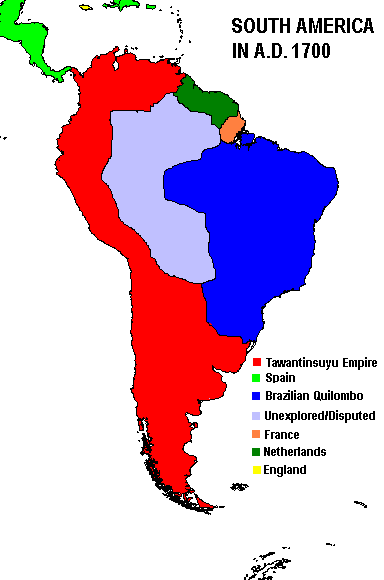
A.D. 1700 onward--Since the middle of the last century, Spanish emigration to the New World has been, due to the loss of Spain’s territories in South America to the Tawantinsuya, diverted to the Caribbean and North America. This has had some important impacts. Large areas of the American west are receiving a much larger settlement of Spanish immigrants than in OTL, and as a result, by 1700, the Spanish colonies in the regions which in OTL became New Mexico, Nevada, Texas, and California are much stronger and more robust than in OTL. In addition, Spain has reaped an additional benefit...the larger concentration of Spanish manpower in North America has allowed a much more thorough and complete exploration of the western region of said continent to be conducted, and by 1700 major gold and silver reserves have been discovered in northern California and Nevada especially, with other, smaller discoveries in New Mexico and what would, in OTL, become Arizona. This infusion of cash...which happens to coincide with the more dynamic leadership provided by the new Bourbon Dynasty, which replaced the old Habsburg Dynasty in 1700...has partially revitalized the power of Spain. This is, of course, a worrisome development for Spain’s old enemy, the Tawantinsuyu Empire.
c. 1700 onward--The effects of the abolition of slavery in the English colonies on the population of those colonies, particularly in the American South, continues to grow. The butterflies caused by this have meant that some important Southern figures of OTL, such as Thomas Jefferson, James Madison, and Patrick Henry, were never born. Others, such as George Washington, were born, but ended up in different careers (Washington continued to work as a surveyor throughout his life, never became wealthy, and never became an officer. He will later fight in the American Revolution...as a sergeant in the Virginia militia). Others, such as George Rogers Clark and Daniel Morgan, will go on to fulfill roles similar to those they played in OTL. There will be contributions made by people who did not exist in OTL but were created by the butterflies as well. But the impact of these changes will be strongly felt later on, particularly during the American Revolution.
A.D. 1700--Charles XII of Sweden starts the Great Northern War against Russia. King Charles II of Spain dies childless. End of the Habsburg line of Spanish Kings. King Louis XIV of France installs his grandon, Phillipe of Anjou, on the Spanish throne as King Philip V of Spain. Beginning of the Spanish Bourbon dynasty.
A.D. 1701--Antoine de la Mothe Cadillac (1658-1730) establishes a French colony at Detroit, Michigan. Frederick I of the House of Hohenzollern, Elector of Brandenburg, is crowned King of Prussia. Also in this year, Zumbi is assassinated by a rival chieftain. Within a short time, civil war breaks out in the Quilombo, as rival tribal groups, no longer held together by the charismatic personality of Zumbi, go for each other’s throats.
A.D. 1701-1713--War of the Spanish Succession (known in North America as Queen Anne’s War) breaks out as most of the other great powers of Europe, fearing the potential power of a Franco-Spanish combination, oppose the installation of Phillipe of Anjou on the Spanish throne. The Tawantinsuya, fully occupied wth the disturbances in the Quilombo, remain neutral.
A.D. 1702--Anne, last monarch of the Stuart line, becomes Queen of England.
A.D. 1702-1705--Huascar Inca, who is dismayed by the bloodletting which is going on in the Quilombo, sends in the Tawantinsuya military to restore order and prevent the European powers from getting any ideas about intervention of their own. After a hard-fought campaign lasting three years, the Tawantinsuya end the civil war in the Quilombo, and set about creating a stable government there. Eventually the Quilombo, under the guidance of the Tawantinsuya, will establish a government loosely patterned on that of England. Each tribal group is granted a territory within the Quilombo, and each territory elects a representative to a Great Assembly. The Great Assembly selects annually a Great Chief who will exercise the chief executive/magisterial function of government for one year. The system will eventually work well, but the road to that point is bumpy as the tribal hatreds brought over from the "old country" are slow to die. The Tawantinsuya therefore find themselves acting as peacekeepers in the Quilombo for quite some time to come.
A.D. 1702-1708--The old and new English East India companies reach a settlement. They unite into one body—The Union Company of Merchants of English Trading in the East Indies. Once again, the Tawantinsuya renew their partnership in the new company, which becomes the Union Company of English and Tawantinsuya Merchants Trading in the East Indies. Most people still refer to it simply as the English and Tawantinsuya East India Company.
A.D. 1703--St. Petersburg made capital of Russia.
A.D. 1704--Battle of Blenheim—Duke of Marlborough defeats French. Isaac Newton publishes OPTICKS, in which he proposes the particle theory of light. Deerfield, Massachusetts destroyed by French and Indian raiders from Canada in another horrible massacre of men, women and children.
A.D. 1705--Edmund Halley (1656-1742) predicts cyclic return of Halley's Comet.
A.D. 1707--Death of Aurangzeb, Emperor of Mughal India at its height. Act of Union unites the thrones of England and Scotland, creating the United Kingdom of Great Britain. Charlestown, South Carolina successfully defended against attack by French and Spanish fleets.
A.D. 1709--Russians rout Swedes at Battle of Poltava, ending Swedish dominance. Russia emerges on the European stage as a great power. In England, Abraham Darby uses coke to smelt iron ore, replacing wood and charcoal as fuel.
A.D. 1711--The South Sea Company is set up in England. It is granted a monopoly over English trade with the Quilombo, as well as trade with certain Tawantinsuya ports and with the South Sea Islands. The company profits handsomely by importing cacao, sugar, and coca leaves into England and exporting English-made textiles and other manufactures to the Quilombo and the Tawantinsuya.
A.D. 1712--Thomas Newcomen introduces the first commercially successful steam engine. It is sold to owners of coal mines, who use it to pump water from the mines, and fuel it with coal from the mines themselves, which allows the engine to be economically feasible despite being extremely inefficient in it’s fuel consumption. Also at this time, the independent state of Hyderabad is established, one of many Muslim and Hindu states to emerge amid the rapid decline of Mughal centralized authority and political chaos in India.
A.D. 1712-1713--Tuscarora Indian War in North and South Carolina. War partly caused by English slave raiding.
A.D. 1713--Treaty of Utrecht ends the War of the Spanish Succession. Frederick William I becomes next King of Prussia. Frederick William will spend most of his reign building up the Prussian army, which will be, by the end of his reign, possibly the finest in Europe and an instrument of which his son will make great use.
A.D. 1714--Gabriel Fahrenheit (1686-1736) invents mercury thermometer. In England, Queen Anne, last monarch of the Stuart line, dies. George, Elector of Hanover, becomes George I, King of England.
A.D. 1715--Death of King Louis XIV of France. Accession of Louis XV to the throne. The new King’s leadership skills are not anywhere near equal to those of his predecessor, and he has the additional liability of having inherited a treasury depleted by Louis XIV’s numerous wars. His reign will prove a disaster for France. Jacobite Rebellion in Scotland is defeated by the troops of King George I. Also in this year, Yamassee Indians kill several hundred settlers in South Carolina in retaliation for slave raiding.
A.D. 1716--First Freemason Grand Lodge established in Britain. South Carolina settlers and their Cherokee allies defeat the Yamassee. The Yamassee are virtually annihilated.
A.D. 1717--Jean Watteau (1684-1721), "Departure for the Island of Cythera." Scots-Irich immigration into North America begins. Most settle initially in Pennsylvania, from which they will begin spreading, via backwoods trails, throughout the South and mid-West.
A.D. 1718--French found New Orleans, in their Louisiana provinces. City of San Antonio founded by the Spanish in Texas.
A.D. 1719--Daniel Defoe writes "Robinson Crusoe" (first "real" novel). A second major discovery of gold is made in the Quilombo, in the region which in OTL would be called Mato Grosso. The South Sea Company offers to assume the entire national debt of England, offering it’s own stock in exchange for government bonds, by which it hopes to make a handsome profit. An incredible wave a speculation results, helped along by fraudulent and wildly inflated claims about the profitability of the company, which causes the price of South Sea Company stock to soar.
A.D. 1720--Collapse of "South Sea Bubble" trading empire. Confidence in the ability of the South Sea Company to pay it’s obligations leads to a collapse of the stock price. Banks fail when they can not collect loans on inflated stock, prices of stock fall, thousands are ruined (including many members of the government), and fraud in the South Sea Company is exposed. Robert Walpole becomes first lord of the treasury and chancellor of the exchequer and starts a series of measures to restore the credit of the company and to reorganize it (indeed, the company will survive the bursting of the bubble and continue in business for over another century). The bursting of the bubble ends the prevalent belief that prosperity can be achieved through unlimited expansion of credit. Legislation is soon after enacted that forbids unincorporated joint stock enterprise. Also in this year, Sir Edmund Halley becomes Astronomer Royal. The French build forts on the Mississippi, Niagra, and St. Lawrence Rivers.
A.D. 1720-1722--Spain occupies Texas.
A.D. 1721--South Carolina becomes English Colony. Peter the Great made Emperor of Russia. Russia takes Livonia and Estonia from Swedes at end of Great Northern War. Sir Robert Walpole becomes first British Prime Minister of Great Britain. In Boston, a smallpox epidemic prompts Cotton Mather and Zabdiel Boylston to experiment with inoculation against the disease. Mather had learned of the practice from one of his black indentured servants, who had himself been inoculated as a child and knew inoculation to be a widely accepted medical practice in Africa. A Tawantinsuya trader, having observed the effectiveness of this in Boston, brings the practice back to the Tawantinsuyu Empire, where smallpox epidemics are still a major problem. Deaths from smallpox dramatically decline in the Empire as a result.
A.D. 1722--Dutch are first Europeans to visit Easter Island.
A.D. 1725--Death of Peter the Great of Russia. Yet another major discovery of gold is made in the Quilombo, this time in the region which would be called Goias in OTL.
A.D. 1726--Jonathan Swift (1667–1745), "Gulliver's Travels." Also in this year, Huascar Inca dies, and is succeeded by his son, who reigns as Tupahualpa Inca.
A.D. 1727--Death of King George I of Great Britain. His son assumes the throne as King George II.
A.D. 1727-1728--Anglo-Spanish War; England's possession of Gibraltar confirmed, 1729.
A.D. 1728-1741--Voyages of Vitus Bering, a Danish officer serving in the Russian Navy, exploring the far northern reaches of the Pacific Ocean. The Aleutian Islands and Alaska are discovered in 1741, and claimed as a colony by Russia shortly thereafter.
A.D. 1729--North Carolina becomes English Colony. In France, Voltaire begins to preach ideas of political freedom...quite a controversial idea in that place and time.
A.D. 1732--Under the leadership of James Oglethorpe, Georgia is chartered as a colony for England’s debtors, who are given the choice between settling there or languishing in debtor’s prison. Benjamin Franklin (1706-1790) begins publication of "Poor Richard's Almanack."
A.D. 1733--Jethro Tull advances new agricultural practices.
A.D. 1734--Voltaire (1694-1778), "Lettres philosophiques." Jonathan Edwards begins preaching fiery sermons to crowds in Northampton, Massachusetts. This begins the religious revival movement known as the Great Awakening.
A.D. 1739--Persian army sacks Delhi and all but ends Mughal power.
A.D. 1739-1742--The War of Jenkins’ Ear between Britain and Spain.
A.D. 1740--Maria Theresa becomes Empress of Austria. Frederick II (the Great) becomes King of Prussia. Governor James Oglethorpe of the new British colony of Georgia leads an invasion of Spanish Florida. He attempts, but fails, to take St. Augustine.
A.D. 1740-1748--War of the Austrian Succession, begun by Frederick II (the Great)'s occupation of Silesia.
A.D. 1741--The Tawantinsuyu Empire enters the War of Jenkins’ Ear against Spain. Tawantinsuya participation will be mainly naval, and several battles between Tawantinsuya and Spanish fleets will take place off the Pacific coast of Mexico and in the Caribbean. Tawantinsuya marine infantry will also be landed along the coast of Mexico, where they will burn several coastal towns.
A.D. 1742--The Spanish invade Georgia from Florida, attacking Fort Frederica on St. Simon’s Island. They are defeated by James Oglethorpe’s English forces at the Battle of Bloody Marsh, and retreat back to Florida. This will be the last time Spain will contest England’s claim to Georgia and the Carolinas.
A.D. 1743--Battle of Dettingen. The English forces at the battle are commanded by none other than King George II, marking the last time that a British monarch will personally lead troops in battle. Also in this year, Tupahualpa Inca dies, and is succeeded by Sinchi Roca Inca II. Sinchi Roca enters negotiations with Spain to end the war between that country and the Tawantinsuyu Empire.
A.D. 1744--The Treaty of Cuzco ends the war between Spain and the Tawantinsuyu Empire. As the fighting between the two had been mainly inconclusive, the Treaty does not provide major gains to either side. The Tawantinsuya do gain the islands of Trinidad and Margarita, which had been occupied by Tawantinsuya marines during the war (Spanish naval vessels operating from these islands had been a nuisance to Tawantinsuya shipping for quite some time).
A.D. 1744-1745--Second Silesian war between Prussia and Austria.
A.D. 1745--Francis Stephen of Lorraine (spouse of Empress Maria Theresa) elected Holy Roman Emperor. Battle of Fontenoy, a French victory. British capture the French fortress of Louisbourg, on Cape Breton Island at the mouth of the St. Lawrence River. Prince Charles Stuart, known to history as "Bonnie Prince Charlie," lands in Scotland and calls the Highland clans to his banner. Beginning of the Scottish Jacobite Rebellion of 1745. French from Canada attack and burn Saratoga, New York.
A.D. 1746--French-British fighting in India intensifies when a French fleet seizes Madras in 1746, but hostilities end in stalemate and the French return Madras to the British in 1748. Also in this year, the Battle of Culloden ends the Jacobite rebellion of 1745. Beginning of great persecutions of the Scottish Highlanders and suppression of their culture. Foundation of The Presbyterian College of New Jersey, in 1896 renamed Princeton University.
A.D. 1748--Treaty of Aix-la-Chapelle ends War of Austrian Succession. A Tawantinsuya trading vessel, headed for the East Indies, is blown off course and discovers the Hawaiian Islands. The Tawantinsuya establish friendly relations with the natives, but leave behind a most unwelcome legacy...smallpox...which decimates the islanders over the next few decades.
c. A.D. 1750 onward--The Mughal Empire has disintegrated, after Delhi was plundered by the Muslim forces of Persian king Nadir Shah in 1739, and Delhi was again captured in 1756 by Ahmad Shah, emir of Afghanistan, who had previously seized the Punjab. A united of force of Marathas and Sikhs could not defeat the invaders, and the possibility of a reunification of Indian peoples into a strong national state dims. India thereafter comes increasingly under domination by the British and Tawantinsuya East India Company.
GO TO PART FOUR: 1750-1800 A.D.

Copyright 2005, 2006 by Robert Perkins. All Rights Reserved. Last Updated on 4 February 2006.