THE THIRD HITTITE EMPIRE
An Alternate History Timeline
by Robert Perkins
PART TWO: 800-700 BC
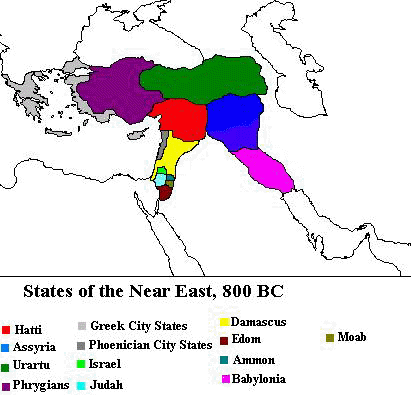
800 BC--Death of King Hattusili Tesub II of
Hatti. His son takes the throne as King
Telepinu II, and will become known as “Telepinu the Great” because of
his
accomplishments during his long reign. Also in this year, King Jehoahaz of
Israel dies,
and is succeeded by Jehoash.
c. 800 BC--The Etruscans arrive in Italy. Also at about this time, the Greek
version of the
Phoenician alphabet is first used, and the earliest iron age
societies...proto-Celtic
peoples...develop in Germany and Austria.
c. 800 BC onward--Greece is gradually emerging from the Dark Ages following
the fall
of the Mycenaean civilization. An increase in trade and the establishment of
governmental defense fortifications allows for the emergence of Greek
city-states (the
Polis) from tribal communities. These grow up around marketplaces and
include cities
such as Athens, Thebes, Sparta, Corinth and Megara on the Greek mainland.
For the most
part, the Greek city-states are similar in their political evolution, with
the exception of
Sparta's elite dictatorship. Most begin their political histories as
monarchies, evolve to
oligarchies, are overthrown during the age of the tyrants (c. 650-500 BC)
and eventually
establish democracies in the sixth and fifth centuries. Of the Greek
city-states, Athens
and Sparta will be the two most important.
798 BC--Death of King Joash of Judah. He is succeeded by Amaziah.
c. 795 BC--King Ben Hadad III is a weak ruler, and not at all in the mold of
his illustrious
forebears. The other Aramaean cities revolt against his rule, and the
powerful Damascene
state breaks up.
c. 794 BC--King Amaziah of Judah declares war against Israel, but is
defeated and
captured by King Jehoash of Israel. He will remain a prisoner of Jehoash
until the latter’s
death in 784 BC. His sixteen-year-old son, Azariah, is named King in his
stead.
790 BC--King Telepinu II of Hatti, seeing an opportunity for territorial
expansion, makes
an alliance with King Jehoash of Israel and King Azariah of Judah against
Damascus.
c. 790 BC--Greek colonists found the trading settlement of Al Mina in Syria,
where they trade
with the Hittites. Contact is established between the two civilizations for
the first time
since the fall of the Second Hittite Empire.
789-784 BC--Hatti, Israel, and Judah wage war on Damascus. The Kings of
Hatti have
adapted Assyrian siege technology (battering rams, siege towers), and
Damascus is taken
in 784 BC. King Ben Hadad III is captured and executed. Israel and Judah
recover all the
lands taken from them by Damascus, and Hatti absorbs Damascus itself, along
with the
other Aramaean city states (which, upon the surrender of Damascus, surrender
to King
Telepinu of Hatti).
785 BC--Death of King Menuas of Urartu. Argishtis I takes the throne.
Argishtis is even
more expansionist than his predecessors, and generally makes life miserable
for his
neighbors with incessant warfare.
784-750 BC--Israel and Judah expand. Israel re-takes Ammon and Moab, Judah
takes
Edom and Philistia. Both Kingdoms prosper mightily and maintain their
alliance with
Hatti.
784 BC--Death of King Jehoash of Israel. He is succeeded by Jeroboam II. It
is Jeroboam
II who recovers Ammon and Moab for Israel. Jeroboam releases King Amaziah of
Judah,
who returns to his own land, where he resumes the Kingship.
780 BC--Recognizing the common threat posed by the expansionist kings of
Urartu to
both of their kingdoms, King Telepinu II of Hatti and King Adad Nirari III
of Assyria
conclude a treaty of alliance against Urartu. When Adad Nirari III dies a
few years later,
Telepinu will renew the agreement with the new king, Shalmaneser IV, and
then again
with Shalmaneser’s successor, Ashur Dan III.
780-768 BC--King Telepinu II of Hatti and Kings Adad Nirari III, Shalmaneser
IV, and
Ashur Dan III wage war against Urartu. The combined armies of Assyria and
Hatti are
too powerful for the Urartians to resist, and the armies of Urartu are
gradually beaten
back and many of their fortress cities are taken by siege. However, the
Urartian capital of
Tushpa is not taken, and a treaty is finally signed in 768 BC which ends the
war. The
power of Urartu is effectively broken, and although it will continue as a
player in middle
eastern politics and warfare for over a century more, it will never again
threaten Hatti or
Assyria as it did previously. Hatti expands northward, and takes back the
old Hittite
homeland in the bend of the Halys River (which the Urartians had taken from
the
Phrygians in the previous century).
783 BC--Death of King Adad Nirari III of Assyria. Shalmaneser IV takes the
throne.
776 BC--First recorded Olympic Games are held at Olympia in Greece.
773 BC--Death of King Shalmaneser IV of Assyria. Ashur Dan III takes the
throne.
c. 770 BC--Carthage founds a colony at Gadir, on the coast of Iberia. The
city provides a
gateway to Spanish silver.
769 BC--King Amaziah of Judah, despite his successes against the Edomites
and
Philistines since the war with Damascus, has fallen into idolatry, and the
people revolt
against him. He flees to Lachish, where he is murdered. He is succeeded by
his son,
Azariah.
c. 765-745 BC onward--Assyria, despite it’s participation in the victory
over Urartu a few
years earlier, falls into a period of decline as local rebellions and plague
ravage the
kingdom.
765 BC--Death of King Telepinu II “the Great” of Hatti. He is succeeded
by his son, who
takes the throne as King Suppiluliuma III. Suppiluliuma begins rebuilding
the old Hittite
capital at Hattusas, which he plans to use as a northern administration
center.
763 BC--Death of King Argishtis I of Urartu. Sardur II takes the throne.
755 BC--Death of King Ashur Dan III of Assyria. Ashur Nirari V takes the
throne.
753 BC--Founding of Rome by Romulus and Remus (legendary).
750 BC--King Azariah of Judah is struck down with leprosy. His son Jotham
reigns as
regent from this time onward.
c. 750 BC onward--Greek colonization of the Black Sea and the western
Mediterranean
begins.
c. 750-650 BC--Hoplite phalanx adopted by cities of Greece. Previously
fighting was
carried out by a relatively few warriors with a shield, sword and spear with
no armor and
were not organized in a phalanx. Hoplites had defensive armor and fought in
close
formation, phalanx, a series of rows.
748 BC--Death of King Jeroboam II of Israel. He is succeeded by his son,
Zachariah.
However, Zachariah will rule for only six months before being murdered by
one of his
court officials, Shallum, who usurps the throne. Shallum does not enjoy his
ill-gotten
gains long, however, as he is, in turn, murdered by another official named
Menahem, who
also usurps the throne. Menahem will rule for ten years.
745 BC--Military coup in Assyria. King Ashur Nirari V is overthrown, and an
army
general takes the throne as King Tiglath Pileser III. Tiglath Pileser will
abandon the
alliance with Hatti, and will resume Assyria’s aggressively expansionist
policies, leading
to virtually continuous warfare throughout his reign.
746-744 BC--King Tiglath Pileser III of Assyria receives an appeal for aid
from King
Nabun-nasir of Babylon, who is beset by invading Aramaean tribes. Tiglath
Pileser
defeats the Aramaeans and reduces Babylonia to a tributary state.
743 BC--Elam has been in a disunified state since the defeat inflicted upon
it by King
Nebuchadnezzar I of Babylon over 300 years ago. In this year, a new dynasty
comes to
power at Susa which will re-unify the country. King Khumbanigash I takes the
throne as
the first king of a united Elam, which will become a major power in the
succeeding years.
743-741 BC--War between Assyria and Hatti. In 743 BC, Tiglath Pileser III of
Assyria
invades Hatti and tries to sieze the cities of Haran and Carchemish. The
cities strongly
resist, and Tiglath Pileser becomes involved in a protracted siege at both
cities. King
Suppiluliuma III of Hatti makes an alliance with King Sardur II of Urartu
and
Suppliluliuma’s vassal, King Menahem of Israel, against Assyria. The
allies meet
Tiglath Pileser’s army in battle outside of Carchemish in 742 BC. The
Assyrians are
victorious, but at huge cost, and have to abandon their sieges and return to
Assyria. The
following year, King Suppliluliuma leads the allied forces into Assyria,
where they meet
Tiglath Pileser again in battle, this time outside the city of Ashur. The
Assyrians this
time meet defeat, and Tiglath Pileser sues for peace. A treaty is agreed
upon later that
year. Urartu and Hatti both take some minor territory from Assyria. King
Tiglath Pileser
III plots revenge.
c. 740 BC--For many years, Egypt has been a fragmented land, with as many as
four rival
dynasties ruling at the same time from cities such as Tanis, Sais,
Leontopolis,
Herakleopolis, Hermopolis, Thebes, and Memphis. But in about 740 BC, this is
about to
change due to outside intervention. King Piankhi of Kush leads his army
northward, and
conquers Egypt as far north as Thebes. Within a few years he receives oaths
of loyalty
from the various rival kings of Egypt, effectively unifying the country for
the first time in
a century and a half. Under his dynasty, the 25th (Kushite) Dynasty, Egypt
will begin to
take an active role in the affairs of the middle east once more.
740 BC--Death of King Azariah of Judah. Regent Jotham succeeds to the
throne.
740-738 BC--Since c. 850 BC, the Medes, a group of Indo-Iranian tribes, have
been
settling in the region east of the Zagros Mountains, and their power has
been growing,
especially since they have often allied themselves with Urartu. However,
they have never
managed to unite, and the Assyrians have been able to keep these fierce
tribesmen in
check. Beginning with Shalmaneser II in 836 BC, Assyrian kings have
campaigned
against them. King Tiglath Pileser III continues this tradition, campaigning
against the
Medes from 740-738 BC. He is unable to conquer them, but devastates their
country and
carries away much booty. Median power is greatly reduced.
739 BC--King Sardur II of Urartu breaks the alliance with Hatti. Border
warfare between
the two kingdoms begins which will continue on for some time. Tiglath
Pileser III of
Assyria, of course, will take advantage of this.
738 BC--King Mita (Midas) III comes to the throne of Phrygia. He will war
against Hatti
in an unsuccessful attempt to regain the former Phrygian lands east of the
Halys River.
Mita will also be known for his fabulous wealth, giving rise to the legend
of “Midas of
the Golden Touch.” Also in this year, King Suppiluliuma III of Hatti dies.
He is
succeeded by his son, who takes the throne as King Ura-Tarhundas I. Also in
this year,
King Menahem of Israel dies, and is succeeded by his son, Pekahiah.
736 BC--King Pekahiah of Israel is assassinated by one of his generals,
Pekah, who
usurps the throne.
735 BC--Tiglath Pileser III of Assyria invades Urartu. No territory is
annexed by Assyria...this was more of a raid than an actual war of conquest.
His armies carry away a lot of booty, however, and Urartu is weakened.
c. 735-716 BC--First Messenian War. Sparta conquers the neighboring state of
Messenia.
The population of Messenia is enslaved and becomes the “helot” class in
Spartan society.
734 BC--Chaldeans take power in Babylonia. In the last century, Babylonia
was reunified
under a native dynasty. However, the state has remained weak, and has been
under the
domination (but not direct rule) of Assyria during most of this time. In
734, the
Chaldeans, a tribe related to the Aramaeans who had settled in the region
three centuries
before, sieze power in Babylon and found their own dynasty under a king
called
Ukin-zer. This dynasty will be much more aggressive, and will make Babylonia
a major
player in world politics again over the succeeding years. Also in this year,
King Sardur II
of Urartu dies. Rusas I takes the throne.
733 BC--King Tiglath Pileser III of Assyria lays siege to the Hittite border
city of Haran.
The city falls before King Ura-Tarhundas I of Hatti can intervene, and is
sacked. When
the King of Hatti does arrive with his army, he is defeated by Tiglath
Pileser’s Assyrian
host, but the cost to the Assyrians is so high that they accept an offer of
peace from the
Hittite King. Hatti cedes the city of Haran, along with the territories it
took from Assyria
in 741 BC, to Assyria.
732 BC--Death of King Jotham of Judah. His son, Ahaz, succeeds to the
throne. Ahaz
will fall into idolatry, and will be very unpopular in Judah. Also in this
year, King Pekah
of Israel is assassinated one of his generals, Hoshea, who usurps the
throne.
731-728 BC--King Ukin-zer of Babylon makes an alliance with King
Khumbanigash I of
Elam against Assyria. Tiglath Pileser III of Assyria invades Babylonia, and
in a campaign
which lasts for almost four years, finally defeats the allied Babylonian and
Elamite
armies and King Ukin-zer is captured and executed in 728 BC. King Tiglath
Pileser
declares himself King of Babylonia...the first Assyrian monarch to do so. He
reigns there
under the name King Pulu (and thus becomes known as Pul in the pages of the
Bible).
c. 728 BC--The Medes are united for the first time by King Deioces.
726 BC--King Tiglath Pileser III of Assyria dies, and is succeeded by his
son,
Shalmaneser V. Like his father, Shalmaneser rules Babylonia as well,
reigning under the
name of King Ululas.
c. 725 BC--The Cimmerians, a nomadic Indo-Iranian people living in the
region north of
the Black and Caspian Seas, are defeated by the Scythians and forced out of
their
homeland. The Cimmerians had been using war chariots, but quickly adopted
Scythian
light cavalry tactics after being defeated by said people. Some of them
settle in the
Crimea (giving that peninsula their name), but most will flee south through
the Caucasus
Mountains into Anatolia and Mesopotamia, where they will cause great
destruction.
722-721 BC--King Shalmaneser V of Assyria is assassinated in 722 BC, and
civil war
breaks out in Assyria. The final victor, Shalmaneser’s younger brother,
will take the
throne as King Sargon II in 721 BC.
721 BC--The assassination of King Shamaneser V of Assyria has lead to chaos
in
Babylonia. In Babylon, a Chaldean chieftain related to the former King
Ukin-zer
takes the throne, reigning as King Marduk-apal-iddina II (who will be known
as
Merodach Baladan in the Bible). The new king is not content to be an
Assyrian vassal,
and he will begin intriguing with the kings of other lands in an attempt to
form an alliance
aimed at the destruction of Assyria, and he quickly concludes an alliance
with King
Khumbanigash I of Elam against Assyria. King Sargon II of Assyria tries to
nip the
conspiracy in the bud with an invasion of Babylonia, but is defeated by the
combined
Babylonian and Elamite forces and forced to retreat to Assyria.
720 BC--The Cimmerians burst out of the Caucasus and invade the Kingdom of
Urartu.
King Rusas I attempts a pre-emptive attack, but is defeated. Urartu is
looted as far south
as Lake Urmia, but their fortified cities are not taken by the nomads, and
the kingdom
survives (albeit severely weakened). This proves to be a temporary incursion
by the
Cimmerians. They will return, however. Also in this year, King
Marduk-apal-iddina of
Babylon, who has been negotiating with King Ura-Tarhundas I of Hatti,
concludes a
treaty of alliance with Hatti. King Ura-Tarhundas had been impressed by the
victory of
Babylon and Elam over King Sargon of Assyria the previous year, and this is
what
persuades him to join the anti-Assyrian alliance.
720-710 BC--The alliance of Babylon, Elam, and Hatti declare war on Assyria
in 720 BC.
In a series of grinding campaigns which will consume the next decade, the
three powers
destroy Assyrian power forever. The great cities of Assyria are taken, one
by one, and
sacked, and the Assyrian armies are defeated. The final straw comes when
King Rusas I
of Urartu joins the anti-Assyrian alliance. King Sargon II is killed in
battle outside
Nineveh in 712 BC. His son, Sennacherib, is unable to recover the situation,
and is
himself killed when Nineveh itself falls to siege in 710 BC. Assyria
disappears from the
map as an independent state. The victorious allies divide the land between
them.
Ura-Tarhundas I of Hatti takes the region west of the Harbur River. King
Marduk-apal-iddina II of Babylon takes everything east of the Habur River
and south of
the junction of the Upper Zab and Tigris Rivers (including the cities of
Nuzi and Ashur).
King Argishtis II of Urartu (who had succeeded his father, Rusas I, in 714
BC) takes the
territory west of the Habur River and north of the junction of the Upper Zab
and Tigris
Rivers, including the cities of Nineveh, Calah, and Sargon’s capital at
Dur Sharrukin.
King Shutruk-Nahhunte II of Elam (who had succeeded his father, Khumbanigash
I, in
717 BC) is pretty much left out in the cold, and this, along with the
disputed nature of the
border between Babylon and Urartu (who have no obvious natural boundary
between
them, unlike the Hittites with their border on the Harbur River), will lead
to much warfare
in the succeeding decades.
717 BC--Death of King Khumbanigash I of Elam. He is succeeded by King
Shutruk-Nahhunte II.
715 BC--King Ahaz of Judah dies, and is succeeded by his son, Hezekiah.
714 BC--Death of King Rusas I of Urartu. Argishtis II takes the throne.
712 BC--Death of Pharaoh Piankhi of Egypt/Kush. He is succeeded by his son,
Shabaka.
Shabaka will, shortly after assuming the throne, attack the last remaining
native Egyptian
stronghold, the city-state of Sais, which is ruled by Pharaoh Bocchoris of
the 24th
Dynasty. The city falls, and Bocchoris is slain. But some of his family
survive, and will
eventually return to throne of Egypt as the 26th Dynasty.
709-705 BC--War between Babylon and Elam, as King Shutruk-Nahhunte II tries
to make
good his claim to some of the spoils from the recent war with Assyria. The
war is
inconclusive.
705-702 BC--Pharaoh Shabaka of Egypt, flush with his victory over Sais,
decides to
expand his empire into Asia. Accordingly, in the year 705 BC he invades
Judah and
Israel. While King Hoshea of Israel immediately submits to Shabaka and joins
him in the
assault on Judah, King Hezekiah of Judah calls on King Ura-Tarhundas I of
Hatti for aid.
King Ura-Tarhundas responds by leading an army southward against the
Egyptians. The
two forces meet in the Valley of Jezreel, near the town of Meggido. A bloody
battle is
fought in which the forces of Hatti and Judah emerge victorious. Shabaka
retreats to
Egypt, and abandons his ally, King Hoshea of Israel, to his fate. The kings
of Hatti and
Judah then invade Israel, and lay siege to Hoshea in his stronghold at
Samaria. The city
falls, after a siege lasting 2 years, in 702 BC. Hoshea is captured and
executed, and King
Ura-Tarhundas gives the land of Israel to King Hezekiah of Judah, in
exchange for a vow
of fealty from said monarch. For the first time in over 200 years, the
twelve tribes of
Israel are re-united under the rule of the House of David.
701 BC--Death of King Ura-Tarhundas I of Hatti. He is succeeded by his son,
who takes
the throne as King Suhis Tesub I.
Copyright 2004 by Robert Perkins. All rights reserved. Last updated on 15 September 2004.