THE THIRD HITTITE EMPIRE
An Alternate History Timeline
by Robert Perkins
PART ONE--THE EARLY YEARS (1200 BC to 800 BC)
c. 1200 BC--The Second Hittite Empire falls to attacks by invading Phrygian
and Kaska
tribesman. The capital at Hattusas is burned and abandoned. Many Hittites flee
south of
the Taurus mountains and take refuge in the city-states of Cilicia (at this
time called
Kizzuwanda) and northern Syria, many of which are inhabited by the Luwians, a
people
who are ethnically and culturally similar to the Hittites and speak a related
language.
c. 1200-1000 BC--Dark Ages in the aftermath of the barbarian invasions which
brought
down the Second Hittite Empire. During this period, sixteen powerful city
states arise in
Cilicia and northern Syria. These states are culturally Hittite, and speak a
mixture of
Hittite, Canaanite, and Luwian. Their rulers consider themselves to be the
heirs of the
Great Kings of Hatti (the old Hittite Empire), but they squabble among
themselves,
weakening all of them.
1168 BC--The Kassite Dynasty of Babylon is overthrown by the Elamite King
Shutruk-nahhunte. Babylon is captured and plundered (It is at this time that
the famous
stele of the Law Code of Hammurabi is taken to the Elamite capital at Susa).
The
Elamites rule Babylonia for the next 30 years.
1156 BC onward--The Second Dynasty of Isin comes to power in Babylonia. In the
aftermath of the overthrow of the Kassite dynasty by the Elamites, a new
dynasty arises in
the town of Isin under Marduk-kabit-ahheshu, (1156–1139 BC) who by the end
of his
reign will retake Babylon and re-establish the independence of Babylonia from
the
Elamites.
1125-1103 BC--Reign of King Nebuchadnezzar I of Babylon. He invades and
conquers
most of Elam.
1115-1077 BC--Reign of King Tiglath Pileser I of Assyria. Assyria invades the
region
inhabited by the Hittites and extracts tribute, but does not remove the
Hittite dynasties
ruling over the cities. In 1081 he defeats King Marduk-nadin-ahhe of Babylon
and
conquers Babylonia, ending the Second Dynasty of Isin.
c. 1100 BC--Over the past 3 centuries, Aramaean nomads have been infiltrating
the
Syrian region. By 1100 BC, they are powerful enough that they take control of
some of
the southern Hittite cities, such as Damascus. However, the twelve cities of
the north
remain under Hittite dynasties, albeit with the addition of Aramaean elements
to their
population.
1076-934 BC--Aramaean invasions of Mesopotamia. Incursions by Aramaean nomads
severely weaken Assyria. Assyria loses control over the Hittite cities of
Syria, and enters
a period of decline. Also during this time, Babylonia is invaded by Aramaeans
and
Chaldeans, and breaks up into small tribal states. It will be some time before
the country
is re-united.
c. 1000 BC--Most of the Hittite and Aramaean cities of Syria are temporarily
under the
sway of the United Hebrew Kingdom of Kings David and Solomon. The Hittite
cities of
Kizzuwanda (Cilicia) remain independent.
c.
1000 BC onward--Greek Colonization of the east coast of Asia Minor. Also at
about
this time, the alphabet is developed by the Phoenicians. Phoenician traders
and colonists
will spread it far and wide over the succeeding centuries, where it will be
adapted by
many peoples, including, eventually, the Greeks and Romans. Also at this time, the Sabaeans, a Semitic tribe living in southwestern Arabia, unite and form
the Kingdom of Sheba. Approximate time of the legendary visit of the Queen of Sheba to
the court of Hebrew King Solomon. The Sabaeans are traders in frankincense and myrrh,
precious resins obtained from trees which grow only in southern Arabia and which are
greatly prized for use in religious rituals.
965 BC--Death of King Solomon of Israel. The Hebrew Kingdom is divided in
twain,
with the ten northern tribes forming the Kingdom of Israel and the two
southern tribes
forming the Kingdom of Judah. The House of David continues to rule in Judah,
but Israel
will be ruled by a series of dynasties over the next two centuries. The two
Israelite
kingdoms will be often at war over the succeeding years. The Hittite and
Aramaean cities
of Syria regain their independence...indeed, Damascus gains independence even
before
Solomon’s death (c. 970 BC), when the Aramaean chieftain Hezion (Rezon from
the
Bible) seizes the city and establishes his dynasty there.
c. 950 onward--Growth of the power of the Aramaean city-state of Damascus.
Damascus
brings the other Aramaean cities under it’s control.
935-911 BC--Reign of King Ashur-Dan II, who begins to once again rebuild
Assyria’s
strength.
c. 930 BC--Death of King Hezion/Rezon of Damascus. He is succeeded by his son,
Tab-Rammon (Tabrimmon from the Bible).
c. 925 BC--Tuwanuwa I, the King of Azatiwataya (modern Karatepe, in
Kizzuwanda/Cilicia) unites the twelve Hittite cities under his rule. He claims
the title,
Great King of Hatti, and this is recognized by his vassal rulers in the other
Hittite cities.
Also at about this time, Pharaoh Shesonq of Egypt invades Judah and Israel and
sacks the
Temple at Jerusalem.
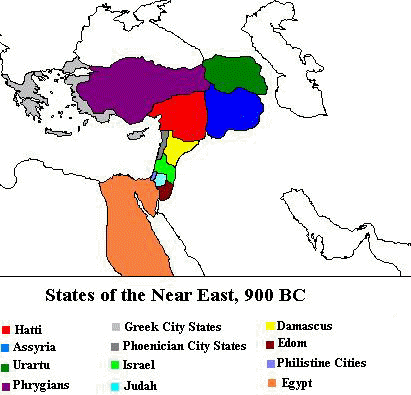
c. 900 BC--The various city-states and principalities around Lake Van are
united to form
the Kingdom of Urartu. Urartu, whose population is largely Hurrian in origin
(descendants of the people who once formed the powerful kingdom of Mitanni)
will be
one of the great enemies of Assyria, and sometime ally of Hatti.
c.
900 BC onward--Phoenician traders begin to found colonies overseas in north
Africa,
Spain, Sicily and Sardinia.
891 BC--King Tuwanuwa I of Hatti dies, and is succeeded by his son, who rules
as
Tuwanuwa II.
c. 890 BC--Death of King Tab-Rammon of Damascus. His son, Ben Hadad I, comes
to
the throne of the Aramaean city-state of Damascus.
c. 885 BC--War between the Kingdoms of Israel and Judah. King Asa of Judah
makes a
treaty with Ben Hadad I of Damascus, and King Baasha of Israel is defeated.
Both Israel
and Judah become tributaries of Damascus.
884-859 BC--Reign of King Ashurnasirpal II of Assyria. He fights several wars
with the
Hatti, but is unable to defeat it, in large part due to alliances made by the
Great Kings of
Hatti (Tuwanuwa II and Muwatalli III) with King Aramu of Urartu (in the
Armenian
mountains) and Kings Ben Hadad I and Ben Hadad II of Damascus.
881-870 BC--Reign of Omri of Israel. In 881 BC, Omri usurps the throne of
Israel. Since
King Ben Hadad I of Damascus is heavily engaged in warfare against Assyria,
Omri is
able to free Israel from its tributary status. Omri moves the capital to
Samaria, which is
heavily fortified, and extends Israelite control over Ammon and Moab to the
southeast of
Israel.
870-848 BC--Reign of King Ahab, son of Omri of Israel. Most of his reign will
be spent
warring, usually successfully, against the Kings of Damascus (except for one
notable
instance where he fought as the ally of King Ben Hadad II against Assyria).
However, in
the end, he will die in battle against the forces of Ben Hadad II at the
Battle of Ramoth
Gilead in 848 BC.
c. 860 BC--King Ben Hadad I of Damascus dies, and is succeeded by Ben Hadad
II.
860 BC--Aramu comes to the throne of Urartu. He makes an alliance with King
Tuwanuwa II of Hatti against Assyria.
859-853 BC--Reign of King Shalmaneser III of Assyria. He continues his
father’s wars
against Hatti and Urartu.
857 BC--Death of King Tuwanuwa II of Hatti. He is succeeded by his son, who
takes the
throne as King Muwatalli III (reckoning the line from the kings of the same
name who
had ruled the old Hittite Empire).
855 BC--Marduk-zakir-shumi I comes to the throne of Babylon, beginning a new
dynasty
which will re-unite the country.
853 BC--Battle of Qarqar. King Muwatalli III of Hatti allies himself with King
Ahab of
Israel and King Benhadad II of Damascus against King Shalmaneser III of
Assyria.
Shalmaneser is killed and his army is routed.
853-843 BC--Civil War in Assyria. The death of King Shalmaneser III at Qarqar
has left
a power vacuum in Assyria, as his oldest son, the crown prince Ashur-dain-apla,
is a boy
of fifteen years. Various claimants vie for power for the next decade, and
Assyrian
power is greatly diminished by this internecine warfare. Somehow, the youngest
son of
Shalmaneser survives the brutal infighting and comes to the throne as King
Shamshi-Adad V in 843 BC.
851 BC--Marduk-bel-usati rebels against his brother, King Marduk-zakir-shumi I
of
Babylon. Marduk-zakir-shumi (unable to call on Assyria as he did in OTL) is
overthrown, and his brother takes the throne. He will continue his brother’s
efforts to
unify Babylonia.
c. 850 BC--Following the victory against Shalmaneser III of Assyria, the
alliance of Hatti,
Damascus, and Israel breaks up as old animosities resurface.
849-845 BC--King Ahab of Israel makes an alliance with King Jehoshaphat of
Judah and
King Muwatalli III of Hatti against Damascus. King Ben Hadad II is hard
pressed
fighting a two front war, but manages to kill Ahab of Israel at the Battle of
Ramoth
Gilead in 848 BC, effectively taking Israel out of the war. Judah makes peace
with
Damascus shortly afterward. Ben Hadad then concentrates all of his forces
against Hatti.
Neither side is able to make much headway, however, and a peace treaty is
signed in 845
BC.
c. 845 BC--Mesha, king of the city of Dibon in Moab, revolts against Israel
and
re-establishes the independence of Moab. In commemoration of his victory, he
sets up a
stele (what in OTL will be known as the “Moabite Stone”). Ahab’s weak
successors as
kings of Israel, Ahaziah and Joram, are unable to restore Israelite control
over Moab.
843 BC--King Ben Hadad II of Damascus is murdered by Hazael, an influential
court
official, who usurps the throne. Also in this year, the civil war in Assyria
ends and King
Shamshi Adad V takes the throne. Shamshi-Adad once again begins building
Assyrian
strength. However, Assyria will not be strong enough to attack it’s
neighbors for some
time, and indeed will be hard-pressed to survive the onslaught of the Kings of
Urartu
over the next few decades.
842 BC--King Muwatalli III of Hatti dies, and is succeeded by Hattusili Tesub
I.
Recognizing the growing threat posed by Assyria, he forms an alliance with
King Aramu
of Urartu, King Hazael of Damascus, and King Mita of the Mushki (Midas of
Phrygia...Phrygia was apparently ruled by a line of Kings who all were called
either
Gordias or Midas) against Assyria. Also in this year, the House of Omri in
Israel (in the
person of King Joram) is overthrown by Jehu, one of the king’s generals.
Jehu assumes
the throne of Israel.
841 BC--Threatened with attack by Hazael of Damascus, King Jehu of Israel
formally
submits to King Shamshi Adad V of Assyria. However, Shamshi Adad is in no
position
to campaign against Hazael, and Jehu’s action succeeds only in enraging
Hazael against
him.
840 BC--Death of King Aramu of Urartu. His son, Sardur I, comes to the throne.
Sardur
breaks the alliance with Hatti and the Mushki, while maintaining an alliance
with Hazael
of Damascus.
840-800 BC--Period of Urartian expansion. Under the warrior kings Sardur I,
Ishpuinis,
and Menuas, the Kingdom of Urartu expands at the expense of Assyria, Phrygia,
and
Hatti. By the end of the period, the Mushki have been pushed back to the Halys
River,
and both Assyria and Hatti are virtual vassals of the Urartian king, paying
yearly tributes.
837 BC onward--Wars of Hazael of Damascus against Israel and Judah. King Jehu
of
Israel attempts to make an alliance with King Hattusili Tesub I of Hatti, but
with no
success (Hatti is embroiled in conflict with the Urartians by this time). By
the end of his
reign, Hazael will take all of Israel’s possessions east of the Jordan,
advance as far as
Gath in the Philistine Plain, and threaten Jerusalem itself. Israel and Judah
become
tributary states of Damascus.
823 BC--Death of King Hattusili Tesub I of Hatti. He is succeeded by his son,
Hattusili
Tesub II. The new king reorganizes the army, reducing the proportion of
chariots in favor
of light and medium cavalry (lancers and archers). The new military thus
created is quite
formidable.
818-812 BC--King Shamshi Adad V of Assyria wars with Babylon. He defeats King
Baba-aha-iddina in battle and pushes all the way south to the Persian Gulf,
but Babylon
itself is not taken, and Babylonia remains independent.
815 BC--King Hattusili Tesub II of Hatti, using his newly reorganized army,
defeats King
Ishpuinis of Urartu, who was besieging the city of Carchemish. The advance of
Urartu to
the west is halted, and no Hittite territory falls to the Urartians. However,
Hatti will pay
tribute to the King of Urartu in the succeeding years. Also in this year, King
Jehu of Israel
dies, and is succeeded by his son Jehoahaz. Hazael of Damascus continues his
war
against Israel, and the new King proves no more able to resist than his
father.
c.
815 BC--Carthage is founded by an expedition from the Phoenician city of Tyre.
811 BC--Death of King Shamshi-Adad V of Assyria. He is succeeded by his minor
son,
Adad Nirari III. Adad Nirari’s mother, Queen Sammuramat (Semiramis) rules as
regent
for the first few years of his reign.
808-783 BC--Reign of King Adad Nirari III of Assyria. Adad Nirari reaches
adulthood in
808 BC and assumes the throne of Assyria. His reign will be filled with
warfare,
primarily against Urartu. However, he will also war against Hatti and
Damascus, as well
as conduct campaigns in Babylonia to the south and against the Medes to the
east.
804 BC--King Adad Nirari III of Assyria attacks Hazael of Damascus. Hazael
allies
himself with King Hattusili Tesub II of Hatti, and the Assyrian army is
defeated in battle
outside the city of Kadesh. Adad Nirari retires to Assyria, and will not
trouble Syria
again for the rest of his reign.
801 BC--Death of King Hazael of Damascus. He is succeeded by his son, Ben
Hadad III.
800 BC--Death of King Hattusili Tesub II of Hatti. His son takes the throne as
King
Telepinu II. Also in this year, King Jehoahaz of Israel dies, and is succeeded
by Jehoash.
Copyright 2004 by Robert Perkins, all rights reserved. Last updated 15 September 2004.