Welcome to the Unofficial Web Site of the
Royal New Zealand Navy
A Brief History of the New Zealand Navy! |
The following article, written by Richard Jackson, appeared in the October 2003
issue of 'Navy Today', the official newsletter of the Royal New Zealand Navy.
(Richard is the Editor of the newsletter and he can be contacted at
[email protected])

How old is New Zealand's Navy?
This month, October 2003, it is 62 years since King George VI granted the title
of Royal New Zealand Navy to the New Zealand naval forces. While we justifiably
celebrate this 'birthday', 1 October 1941 was not the actual birth of the New
Zealand's national naval forces. Just how old, then, is our nation's navy?
The Naval Volunteers
Naval forces, funded by the settler's parliament, were an integral part of the
NZ militia and security forces in the 19th century.
 1858; The Militia Act authorised the formation of citizen militia units
for land and coastal duties.
1860; As part of the new militia, Volunteer Coastguard units were
embodied (in the re-organisation of 1862, the units were called the Naval
Volunteers and generally known as the "Navals"). Their function was
small boat work and supplementing the crews of Government vessels
on anti-smuggling patrols.
1858; The Militia Act authorised the formation of citizen militia units
for land and coastal duties.
1860; As part of the new militia, Volunteer Coastguard units were
embodied (in the re-organisation of 1862, the units were called the Naval
Volunteers and generally known as the "Navals"). Their function was
small boat work and supplementing the crews of Government vessels
on anti-smuggling patrols.
The Waikato Campaign, 1863-66
In addition to the RN ships and brigades involved, a river flotilla became the
first 'naval' force funded and equipped by the New Zealand Government. However
it was not a permanently established force.
1863-4; The Auckland and Onehunga Naval Volunteer units saw active
service in the Waikato campaign.
Coastal trading vessels were purchased by the NZ Government, refitted
and armed for the campaign.
3 shallow draught stern paddle-wheel gunboats were designed and built
in Sydney; manned by a mixture of personnel from the Royal Navy, the
Waikato Regiments and some civilians.
1864; A two-storied naval barracks was built at Sandspit (Devonport).
The Torpedo Corps
The Armed Constabulary Act of 1867 developed the Permanent Militia of 1862
into four corps - Artillery, Infantry, Engineers and a Torpedo Corps. The
New Zealand Torpedo Corps formed a part of Number 2 Company of the Permanent
Militia. The few photographs which exist show them wearing blue Navy-style
double breasted jackets with peaked caps.
1883; All Naval Volunteer units re-titled Naval Artillery Volunteers and
trained to help man the coastal gun batteries; some 20 units around
the country.
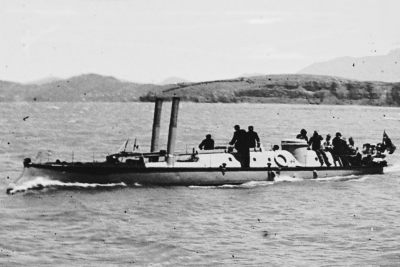
1884; Four Thorneycroft spar torpedo boats deployed to Auckland,
Wellington, Lyttelton and Dunedin, manned by both the Torpedo Corps and
the Naval Artillery Volunteers. The Auckland spar torpedo boat
initially operated from the Admiralty Reserve at Sandspit (today Windsor
Reserve) and by the early 1890s was at Torpedo Bay.
 1884; Permanent seaward defences for Auckland included an approved
minefield to stretch from North Head across to Rangitoto. The government
acquired land at North Head for defence purposes. When the minefield
was actually laid (around the turn of the century - operational in 1904)
it ran from Torpedo Bay to Orakei.
1885; The 'Russian Scare'; construction of a submarine mining station and
depot below the southwest face of North Head was approved - this became
known as Torpedo Bay.
The minefields were the responsibilty of the New Zealand Submarine
Mining Corps, a part of No.2 Company of the Permanent Militia. But
some Naval Artillery Volunteers also qualified as submarine miners.
The 'Navals' and the torpedo Corps existed until 1902, but in 1902 they were
transformed into the Garrison Artillery Volunteers, as part of the military
forces.
1884; Permanent seaward defences for Auckland included an approved
minefield to stretch from North Head across to Rangitoto. The government
acquired land at North Head for defence purposes. When the minefield
was actually laid (around the turn of the century - operational in 1904)
it ran from Torpedo Bay to Orakei.
1885; The 'Russian Scare'; construction of a submarine mining station and
depot below the southwest face of North Head was approved - this became
known as Torpedo Bay.
The minefields were the responsibilty of the New Zealand Submarine
Mining Corps, a part of No.2 Company of the Permanent Militia. But
some Naval Artillery Volunteers also qualified as submarine miners.
The 'Navals' and the torpedo Corps existed until 1902, but in 1902 they were
transformed into the Garrison Artillery Volunteers, as part of the military
forces.
The Australasian Auxiliary Squadron
The Imperial Conference on defence and the first Naval Agreement between Britain,
Australia and New Zealand, 1887.
The ships of the existing RN Australia Squadron would be supplemented
by a new combined naval force, of five cruisers and two torpedo gunboats.
These ships were built for Australasian service and based in Sydney,
forming the new Australasian Auxiliary Squadron.
Two ships, one from the Imperial squadron and one from the new
squadron, would be stationed in New Zealand waters.
The new ships were given Australasian names, among them, HMS Taurangu.
The NZ government agreed to pay a subsidy of �20,000, one sixth of
the cost of the new force. The Australian colonies paid the balance.
New Zealanders were eligible for service in the new naval squadron,
and Reserves would help man the three ships of the new squadron that
were not in full commission. This policy of subsidising the Imperial
naval in order to have a cruiser presence in New Zealand waters,
and to allow entry into the RN by New Zealanders, was followed by
Wellington for the next 20 years.
1888; The Auckland Harbour Board dry dock opened; the Admiralty
had rights of use.
The Naval Depot by now included a blacksmith shop and boatslip.
During the 1890s the Sandspit site was exchanged for land around the
dry dock.
1905; HMS Sparrow, renamed Amokura, was taken over to become a
training ship to prepare young New Zealanders for either naval or
merchant service.
The Naval Defence Act, 1913
The most important event in the development of our national navy was the passing
of the Naval Defence Act in 1913, which provided for permanent national naval
forces manned and funded by New Zealand.
15 July 1914, HMS Philomel commissioned into NZ service.
The CO was also appointed as Naval Adviser to the NZ Government.
August 1914, WW1; in accordance with the new Act, Philomel was
assigned to the Admiralty for operational control.
However, as research by the Naval Historian has found, throughout Philomel's
1915-17 deployment to the Mediterranean and Middle East, the CO still reported
to the NZ Government, ie. command remained with the New Zealand Government.
This was similar to arrangements for Australian warships, since the RAN operated
under a Naval Defence Act very similar to that of New Zealand.
1916; Conscription was introduced in NZ and the option for
Kiwis of volunteering for naval service in the RN was stopped.
1918; The German raider Wolf laid mines in NZ waters; the NZ government
had to hastily charter some trawlers and convert them for minesweeping.
The New Zealand Division of the Royal Navy
It was not until the 1920s that further progress was made.
1920; The first post-war recruits joined.
1921; HMS Chatham arrived; she had commissioned for New Zealand
use in 1920.
March 1921; Philomel was re-commissioned as a sea-going training and
depot ship; further recruits joined her.
By Order-in-Council of 14 March 1921, the New Zealand Naval Board was
constituted for the overall direction and administration of the Navy.
The Minister of Defence was Chairman of the Naval Board.
The Commodore Commanding the New Zealand Station became First Naval
Member and the Chief Staff Officer was Second Naval Member.
The senior cruiser Captain on station was appointed Commodore Commanding
the New Zealand Station.
Chatham came under the operational control of the new NZ Naval Board.
On 20 June 1921, in furtherance of Admiral Lord Jellicoe's vision for the wartime
role of New Zealand's Navy, the seagoing elements of the New Zealand Naval Forces
were designated 'The New Zealand Division of the Royal Navy'. That is, in the
event of war, the New Zealand ships would form a tactical division within a Royal
Navy fleet. As events transpired the actual composition of New Zealand's naval
force meant that only individual ships served in RN fleets, but a tactical
'division' never deployed. However the title "New Zealand Division of the
Royal Navy" often gives rise to confusion, because some assume it to mean
that NZ did not have a nationally-controlled naval force.
1921; Additional facilities; fuel storage tanks, a rifle range, and
sports facilities, were being built at Devonport.
Also on station during the 1920s were two Royal Navy sloops, war-built
Flower-Class escorts, HM ships Veronica and Laburnum. Although these
were British manned and funded ships they too came under the
operational control of the New Zealand Naval Board.
1926-28; Naval Reserve units were established in the four main ports.
New Zealand was part of a larger, multi-national, defence arrangement. Like
Australia, Canada, India and South Africa our Navy was seen as a contribution
to the defence of the whole Empire. The NZ Naval Station was an integral part
of a naval operational division of the world - after all the recent war against
German raiders and U-boats meant that Britain and the Dominions had just
learned some hard lessons in naval operations, defence of trade and control
of shipping. But this defence co-operation - logical and cost effective - did
not mean a loss of national control; it was New Zealand's government that
directed ships to Samoa, to the Hawke's Bay earthquake and during
sovereignty disputes over various islands in the central Pacific in the 1930s.
The New Zealand Division was a national naval force.
The Royal New Zealand Navy
The final step of Royal recognition for New Zealand's Navy came after the
debacle of the 1941 Greece and Crete campaigns. Our government was
determined that our forces be under clear national control and it was thought
that gaining Royal recognition would reinforce the New Zealand Naval Forces'
status to the RAN and RCN.
1941; more NZers were on loan to the RN from the NZ Naval Forces,
than there were RNers loaned to the NZ Division.
At the request of the NZ Government, the King was pleased to grant the title
of Royal New Zealand Navy to the NZ naval forces.
(Back To Top)
Part 1: NZ Government Ships - 1914 to 1921 
Back to Main Page