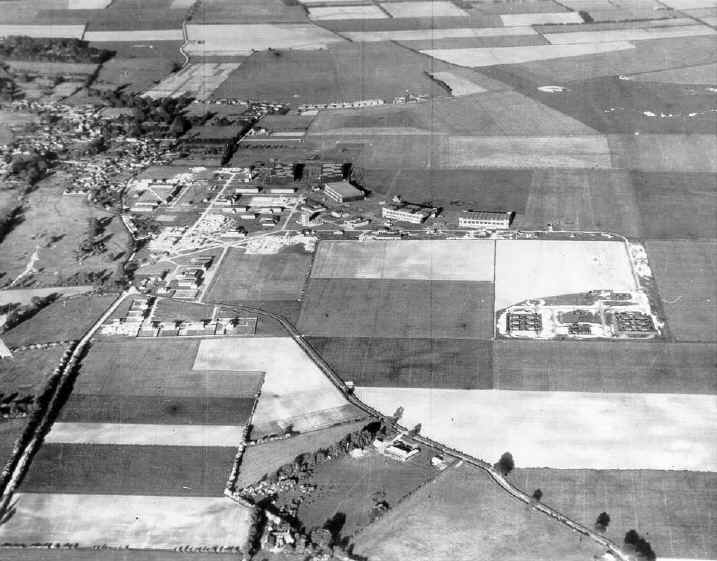
In February 1940, No. 214 Squadron moved to Stradishall and a New Zealand Squadron was formed at Feltwell. This became No. 75 (NZ) Squadron and remained on the Station until August 1942.
With the invasion of Norway, both Squadrons were making sorties three or four nights a week and the number of aircraft dispatched on each raid rose from six to an average of seventeen.
His Majesty King George VI presented DFC's to members of aircrew on the Station on 26th May 1940. In November 1940 No. 37 Squadron were moved to Malta and were replaced by No. 57 Squadron. Both 75 New Zealand Squadron and 57 Squadron continued night operations under 3 Group throughout 1941 and part of 1942 as part of the gradually increasing pressure on the Hun at home, which rose to the crescendo of the "Thousand" raids in May and June 19-2. It was during this period that Sgt. Ward, of No. 75 Squadron, was awarded the VC for climbing out on to the wing of a Wellington in mid-air in order to extinguish a fire in the wing petrol tank, the result of an enemy attack. This enabled the aircraft to return to base (Feltwell) without further mishap.
In August 1942 Feltwell and its satellite of Methwold were transferred to No. 2 Group, the light bomber tactical group. No. 75 (N.Z.) Squadron moved to Mildenhall and No. 57 Squadron to Scampton. They were replaced by No. 464 (R.A.A.F.) Squadron and No. 487 (N.Z.) Squadron, both armed with Venturas. In November 1942 a third squadron, No. 21, also with Venturas, was installed at Methwold. No. 3 Lancaster Finishing School started forming at Feltwell in November 1943. They had the job of adapting crews, who had done their operational training on Wellingtons, to working in Lancaster aircraft with which the operational squadrons of No. 3 Group were by this time equipped. They commenced training in mid-December and continued until the impending end of the war in Europe reduced the demand for crews. The Unit disbanded the 15th October 1945. |