Main Page For Hospitals
Downloads
Our Commercial Arm
Medical Informatics
IPTV
E Kutir
Our
contact address :
S.A.T.H.I.
28/31 Old Rajinder Nagar,
New Delhi -110 060 INDIA
Voice Phone : +91-11-25852291, 25853090
Fax +91-11-25860163
Cell +91-9810126883
VOIP Number (For Video Conferencing and
Telemedicine)+91-11-29603306
Our E Mail : sathi AT amlamed DOT com

Project on Low Cost Solution for High End Facility
Introduction
Most doctors in India are overworked. Not only are they seeing too many patients, but they are also called upon for performing the record keeping and related jobs of writing and rewriting patient records. Computers can make their job easier and more efficient.
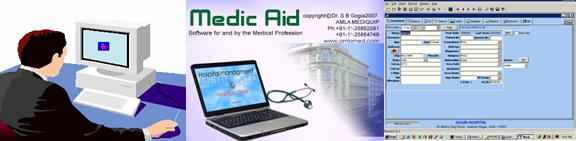
Doctors would be relieved if the non essential and repetitive part of their work like documentation, maintaining the register, filling up forms with the patients name, age, sex etc is taken over by secretarial staff. Ideally each form for a specialized test like X Ray or Biopsy (ie histopathology) needs to be accompanied by a detailed history and examination. However in practice, this is rarely done due to time constrains. A good and efficient EMR software e.g. Medic Aid can do that. But knowing what to click on and when, has to be learned for all the screens it provides. Knowledge of the exact functions is made all the more difficult as many of them are for use by a particular specialty or situation. Thus initial awareness of which screens one is using along with training and orientation to its use is required which again cannot be done by the doctors owing to paucity of time.
Thus the potential of IT in Healthcare has so far not been fully realized. One reason for this is the lack of suitable personnel who know both computers and usage of specialized medical software as well as are familiar with Medical terms and workflows.). SATHI has now taken the lead in bridging the gap through capacity building.
SATHI proposes to introduce vocational training for IT in Healthcare. The project is aimed at skill building of under privileged youth. Once the work force is ready in quantity and quality the growing gap will start filling.
The Situation
Many NGOs are working in urban slums and rehabilitation colonies to provide various types of vocational education to the local young crowd in an effort to make them employable. We have developed relationships with two such NGOs in Madanpur Khadar in South Delhi and in Raghubir Nagar in West Delhi.
Among other very impressive activities, both are already providing computer training to the youth in the localities at extremely low rates. We believe that this is an opportunity whereby we use the existing strengths of these organizations – in the form of availability of suitable facilities, staff and computers in a location team with youth from colonies which are yet to fully experience the fruits of development.
SATHI has a panel of staff who can train the students already undergoing computer training at the above facilities. Only some additional inputs towards acquiring Medical Software are required. Since the potential trainees are unable to pay for the additional training, SATHI is providing them the training at existing low rates. SATHI will take on the major responsibility of placing the trained youth at various medical facilities where such demand exists. As and when a job offer comes, SATHI shall charge a small service charge from the employer and provide them the trained personnel persons.
The Program
The first of these training centres is already operational in a centre run by Saksham Bharti in Shivaji Enclave in West Delhi See map
We have taken students who have already undergone three months training in the basic course at the same venue. We are not charging any extra fees from our side but shall be paying our own staff extra to provide the training. The charges shall be partly recouped by deducting from the first one or two salaries of the personnel as and when they get employment.
Certificates shall be provided at the end of the training program to successful candidates with the certificates being mandated by Indian Association for Medical Informatics or IAMI.
Training of the first batch of 10 students has already started on a thrice a week basis. More students are expected. However, our initial test to check their basic knowledge of computers showed some weakness which means that we shall have to work harder to get the desired output. Based on this the course plan is as follows:
First month – reinforce the basics so that they have an understanding and capability to use Medical databases. The emphasis here would be on knowledge of
- Networking and Internet
- Front End And Back End
- Medical Databases
- Basis of Client server and Web based Systems
- User logins and privileges
- Installing software
- Troubleshooting and hardware maintenance
- Upgrades
Second
Month – Introduction and use of Medic Aid
Third Month -means for better and faster data entry, understanding medical terms. Directed and one to one sessions will be given to working with the customized and special screens for a particular specialty say Ophthalmology for those who are desirous or already working with such facilities.Examples would be
- Taking and Editing Images
- Operation Notes
- ICD 10 Coding
- Special Forms
- Making your own form
- Charting
What do we need support for?
- Some funds to provide for
- More staff
- Internet facilities and better computers at the location
- Help in marketing the program through
- Advertisements
- Inform doctors that such a facility exists
- Reaching to other places in Delhi and later across other towns through sister organizations and NGOs
Persons in smaller towns can be additionally trained to work as Telemedicine Technicians