General Information:
Course Content:
Catalog Course Description:
|
MAT 0002
|
Basic Mathematics |
4 Credit Hours |
|
(College preparatory studies course)(This course does not
apply toward the associates degree.) This course is designed
for students who lack the basic skills necessary for success
in MAT 0024 Elementary Algebra. It provides instruction and
practice in computation involving whole numbers, fractions,
decimals, percent and signed numbers. Students must attain a
passing score on the exit test for satisfactory completion.
Laboratory activities (computer tutorials) are required for
this course. Four contact hours.
|
Course Outline:
- Operations with Whole Numbers
- Place Value
- Reading and Writing Number Statements
- Rounding Whole Numbers
- Number Properties
- Fundamental Operations
- Addition
- Subtraction
- Multiplication
- Division
- Exponents
- Order of Operations
- Applications
- Operating with Fractions
- Introduction
- LCD and Order Relations
- Equivalence and Simplification
- Fundamental Operations
- Addition
- Subtraction
- Multiplication
- Division
- Applications
- Operating with Decimals
- Place Value
- Reading and Writing Number Statements
- Rounding Decimals
- Decimals to Fractions
- Comparing Decimals
- Fundamental Operations
- Addition
- Subtraction
- Multiplication
- Division
- Applications
- Ratios and Proportions
- Simplification of Ratios and Rates
- Unit Rates
- Solving Proportions
- Applications
- Percents
- Percents to Fractions and Decimals
- Three Types of Percent Problems
- Percent of a Number when Base and
Percentage are Known
- Base When Amount and Percentage
are Known
- Compute Percentage when Base and
Rate Are Known
- Applications to Percent
- Introduction to Signed Numbers
- Fundamental Operations with Integers
- Fundamental Operations with Rational
Numbers
- Order of Operations
- Introduction to Algebra
- Combining Similar Terms and Order of
Operations
- Evaluating Algebraic Expressions and
Formulas
- Solving Simple Linear Equations in One
Unknown
- Geometry (To be discussed with whole numbers,
fractions, and decimals)
- Perimeter of Rectangles, Squares, and
Triangles
- Areas of Rectangles, Squares, and
Triangles
Course Materials:
Required Materials:
- Textbook
-
|
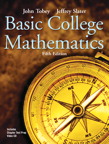
Basic College Mathematics: 5th Edition
by John Tobey and Jeffrey Slater, published by Pearson
Education, Inc, Upper Saddle River, NJ, copyright 2005,
ISBN#: 0-13-167971-6.
|
|
- MyMathLab
Needed Materials:
- Notebook
-
3-ring binder with paper and pockets (preferred).
- Notebook paper
-
College or wide ruled with size between 10.5 by 8
inches and 11 by 8.5 inches (preferred).
- Pencils or mechanical pencils
-
Bring at least two to class everyday (preferred).
- Internet Access
-
Available through:
- Home
- Computer Labs
- Learning Center
- Library
- Email Account
-
Available through:
- Home account
- FCCJ
- Free email accounts such as Yahoo! or Hotmail
Helpful Materials:
- Straight Edge
- Protractor
- Compass
- Graph Paper
-
Either:
- Quartile - 4 squares per inch
- Quadrille - 5 squares per inch
- Calculator (calculators will not be allowed on tests)
- Each student must have his or her own calculator.
- Cell phones may not be used as calculators.
-
Tips on Calculator Selection:
- Find a calculator that will work for all the
mathematics courses that you plan to take.
- For this class, any scientific or graphing
calculator will do.
- For many FCCJ classes, Texas Instruments TI-83,
or TI-83 Plus. (preferred)
Course Grading System:
Grading Scale:
| Grade |
Percent |
Points |
| A |
90% - 100% |
1350 - 1500 |
| B |
80% - 89% |
1200 - 1349 |
| C |
70% - 79% |
1050 - 1199 |
| D |
60% - 69% |
900 - 1049 |
| F |
Fail |
| W |
Withdrawal |
W, FN, and I Grade Policy:
- W Grade (Withdraw):
- A student may withdraw without academic penalty at Florida
Community College from any course up to the last withdrawal
date published for each session
The student will be
permitted only two withdrawals or "NP" grades per course.
Upon the third attempt, the student will not be permitted to
withdraw and will receive an "A," "B," "C," "D," or "F" grade
for the course.
- If you must withdraw, do so officially and save your
paperwork.
- FN Grade (Failure due to non-attendance):
- Students who fail to remain active in the course and who
do not withdraw will receive the FN, failure due to
non-attendance, grade. For this
course, failure to remain active is defined as any
student that meets either of the following criteria:
- absent for two or more consecutive weeks
- absent for more than
class sessions) of the course and failing the course
This grade may affect financial aid.
- I Grade (Incomplete):
- The grade of "incomplete" is given at the discretion of the
instructor when the student has completed at least 75% of the
course. The student must have a valid excuse with
documentation and consult with the instructor before an "I"
grade will be assigned. The instructor shall prescribe in a
written agreement with the student the remaining course work
required and a time limit for completion and removal of the
"I" grade. All work must be completed within the first eight
weeks of the subsequent term, unless the instructor agrees to
a longer timeframe (not to exceed one year). Failure to
complete the course within the time limit will result in an
automatic F. The instructor may choose not to grant the
request.
Weighting of the components of the course:
Grade Weights:
| Homework Assignments |
100 |
| Chapter Assignments |
100 |
| Quizzes |
100 |
| Notebook |
100 |
| Practice Test 1 |
100 |
| Practice Test 2 |
100 |
| Test 1 |
200 |
| Test 2 |
200 |
| Final |
500 |
| Bonus |
|
| Total |
1500 |
Grade Calculation:
- For the homework assignments, I will add the number of
points that the student has gained and divide this by
the total number of homework points. This value
(0% to 100%) will count as the homework score (0 to
100).
- For the chapter assignments, I will add the number of
points that the student has gained and divide this by
the total number of points from chapter assignments.
This value (0% to 100%) will count as the chapter
assignment score (0 to 100).
- For the quiz grade, I will take an average of all the
quizzes. This average (0% to 100%) will count as the
quiz score (0 to 100).
- For the notebook, the grade on the notebook will
count as the notebook grade (0 to 100).
- For the practice tests, each practice test is worth 100
points. The number of points the student gets on
the practice test will count as the practice test
score (0 to 100).
- For the tests, each test is worth 200 points. The
number of points the student gets on the test will
count as the test score (0 to 200).
- For the final, the final exam is worth 500 points. The
number of points the student gets on the final exam
will count as the final exam score (0 to 500).
- For the bonus, the number of bonus points the student
gains during the sememster will count as the bonus
score.
I will add up all of the above scores and divide the total by
fifteen. The result is then rounded to the nearest whole
number.
State Mandate:
- Students have only three attempts per college credit course
(all grades count as an attempt, including audit, IW, AW,
W, NP, F and D).
- A student will be permitted a maximum of two withdrawals per
college credit course.
- The third time a student enrolls in a course he/she must pay
the full cost of instruction, which is equivalent to the
out-of-state tuition (approximately four times the regular
tuition).
- A student cannot repeat a course when a grade of A, B or C has
been earned.
Academic Dishonesty:
Students found cheating on quizzes, tests, or exams will receive a
grade of F in the course and procedures for expulsion from the college
will be followed. Cheating includes (among other things) copying
another individual's work (or allowing someone to copy your work),
using unauthorized references (cheat sheets or programmed information)
on a quiz, test, or exam, or allowing another individual to take a
quiz, test, or exam for you. For the full college policy, visit:
http://www.fccj.edu/resources/catalogs/2005_2006/rights/expectations.html#dishonesty
Course Requirements:
Homework:
Homework will be assigned at the end of every section in the textbook
and is available in
MyMathLab. Homework is due at the beginning of the next class
session. The grade for an assignment will consist of the number of
correct homework problems. Students may re-submit homework assignments.
Students are strongly encouraged to work the odd numbered problems
from the textbook. The final homework grade will be calculated
by adding the number of points the student has gained on the
homework assignments and dividing this by the total number of
homework points. This value (0% to 100%) will count as the
homework score (0 to 100).
Chapter Assignments:
A chapter assignments will be given at the end of every chapter
in the textbook and is available in
MyMathLab. After a chapter has been completed, the
chapter assignment is due at the beginning of the next class
session. The grade for a chapter assignment will consist of the
number of correct problems. Students may re-submit chapter assignments.
The final chapter assignment grade will be calculated
by adding the number of points the student has gained on the
chapter assignments and dividing this by the total number of
points on the chapter assignments. This value (0% to 100%)
will count as the chapter assignment score (0 to 100).
Quizzes:
There will be quizzes periodically during the semester.
Quizzes will be online and in class so be prepared everyday.
Students can expect to see questions on definitions and homework
problems. Partial credit may be given. The average of all
the quizzes will count as the course quiz score.
Notebook:
Students will be required to keep notes in a notebook for this
course. The notebooks will be handed in on the days of the test.
Late notebooks will not be graded. The notebooks will be graded
on neatness, readability, and content. The notebooks will be
graded during the test and handed back after the test is completed.
Use the following guidelines for the notebook.
- Name clearly written on the cover
- Name clearly written on the first page in the notebook
- Put the following entries on the first page under your name.
- Notebook grade 1:
- Notebook grade 2:
- Notebook grade 3:
- Notebook grade 4:
Practice Tests:
There will be two practice tests worth 100 points each. Each practice
test is a take-home assignment. Partial credit will be given for work
shown.
Tests:
There will be two tests and a final exam. Each of the two
tests is comprehensive and worth 200 points each. The final
exam is comprehensive and worth 500 points. Partial credit will be
given for work shown.
Final Exam:
The final exam is comprehensive and is worth 500 points. Partial
credit will be given for work shown.
Bonus Assignments:
Homework:
Homework is assigned at the end of every section in the textbook (see the
assignment sheet ). Students are to work the
odd numbered problems from the textbook. Each section is a separate bonus
assignment. Each assignment is worth one point. Use the following guidelines
for turning in these bonus assignments. Assignments that do not follow these
guidelines will not receive credit.
- Put your name in the upper right hand corner.
- Under your name put the course
- Under the course put the campus
- Under the campus put the class time
- Under the class time put the class dates
- Each section should be on its own sheet.
- Put the section on the top line in the center.
- Label the problems clearly.
- Circle your answer.
Journal:
Students may choose to keep a journal of their educational
experience. The student needs to make a journal entry every
day or two. The journal will be turned in on the last day
of class
.
For every class session the student needs to
comment on the following:
- Date of Journal Entry
- Date of the class session
- What material and sections were covered
- What did you understand
- What did you not understand
- What did you like about that day's presentation
- What did you not like about that day's presentation
- How can the material be used in your field of study
- Any other comments the student wishes to make
Use the following guidelines for the journal.
- Name clearly written on the cover
- Name clearly written on the first page in the journal
- Put a place on the first page for your journal grade
The Journal will be graded and the first page (with the grade)
will be returned to the student.
Online Discussion:
Students who take an active part in online discussions will
receive bonus points.
Make-up Tests:
I will only give make-up exams in extreme cases, which must be
documented. Make-up exams must be completed prior to the next test.
Only one make-up will be allowed.
Guidelines for Tests:
For the test, you can have pencil, paper, graph paper,
straight edge, and an eraser. You can show your work on the test or
on your own paper. Use the following guidelines for turning in the
test and scratch paper.
- Your name in the upper right hand corner of every page,
including scratch paper and the test.
- Put you answer on the Test.
- Circle your answer on the scratch paper.
- Turn in all scratch paper.
- Each problem on the scratch paper must be clearly labeled.
- Draw a line between each problem on the scratch paper.
- Do not scribble out your work.
Either erase or put a big X through it.
Incorrect problems that do not follow these guidelines
might
not receive partial credit.
Re-Tests:
To be eligible to take the Exit Exam, the student must score
70% or better on all of the tests. If a student scores below
a 70% on a test, he or she will be allowed one Re-test per
test. The Re-test will replace the original score and must
be completed prior to the next exam.
Exit Exam:
The Exit Exam is a 50 question multiple choice scantron test
(no partial credit given) that the students must pass in order
to successfully complete MAT 0002. To be eligible to take the
Exit Exam, the student must score 70% or better on all of the
tests and have a C (70%) or better average on all work
(homework included).
Course Policies:
Electronic Devices:
All cellular or digital phones and pagers are to be turned
off during the class.
Class Structure:
Since class time is valuable, I try to be as efficient as I
can so that the students can get the maximum possible
benefit. Therefore most of the classes will be structured as
follows:
- Roll is taken.
- Papers handed back.
- Answer questions (priority given on most recent
material) 5 to 15 minutes.
- New material.
If you are late and missed the roll call or
did not get your papers back, wait until after class to:
- turn in homework.
- notify me of your attendance.
If you do not notify me of your attendance, then you
will be counted as absent.
- get homework back.
I encourage questions and will answer as many as class time
permits, but I also expect the students to refrain from
excess talking during the class.
Attendance:
Students are expected to attend every class, to be on time, and to
stay for the entire class session. If a student is absent, it is
his or her responsibility to:
- get the class notes from a fellow student.
- complete the required homework which will be due.
- get any needed help on the missed information from either
- the Learning Center
- the instructor (outside of class time).
Students who miss more than two consecutive weeks or who miss
more than
classes) may recieve a grade of FN (failure for non-attendance),
which may affect your financial aid.
If you are late and missed the roll call then get with the instructor
after class so that your attendance can be recorded, else it will
count as an absence. Three tardies and/or early departures will
count as one absence.
If you must leave early, please sit in a location that will not
disrupt class when you leave.
Excused Absence:
I will excuse (not count for the purposes of grades) any student
absences for the following reasons:
- student illness requiring hospitalization.
- death in the family.
- jury duty.
- military duty.
Additional Information:
Instructor Contact Information:
You may contact me by:
- Stopping by my office during my posted office hours.
- Calling me in my office.
If I am not in, leave a message. I will try to
return your call as quickly as I can. Please include
the following information:
- Name,
- Time and Date,
- Course, Campus, and Class meeting time/days,
- Phone number where you can be reached.
- Email.
I will try to respond within 24 hours during the week
or no later than Monday if email is sent on the
week-end. Please include the following information:
- Name,
- Course, Campus, and Class meeting time/days,
- Please use page and problem numbers if requesting
help.
- Catching me in the Learning Center, FCCJ Library, UNF
Library, or other campus locations.
- Yahoo! messenger.
If I do not reply, assume that I am away from the
computer.
Resources at South Campus:
Library (G-300) / 646-2174
The Library is located in G 300 and has resources that may be helpful
for FCCJ math students (such as CD's videos and telecourses).
For more information call, visit or follow this link:
www.fccj.org/library/
Hours of Operation:
| Monday - Thursday |
7:30am - 9:00pm |
| Friday |
7:30am - 5:00pm |
| Saturday |
9:00am - 5:00pm |
| Sunday |
1:00pm - 9:00pm |
|
(hours vary on holidays, breaks, and between terms)
|
Math Lab (G 200) / 646-2083
The Math Lab is located in the Learning Center (G 200) and has many
resources for FCCJ math students. They offer tutoring for courses
from Basic Math to Calculus III, useful handouts, textbooks, and
solution manuals. For more information call, visit or follow this
link:
www.fccj.org/campuses/south/learning_cent/math_lab.htm
Hours of Operation:
| Monday - Thursday |
7:30am - 10:00pm |
| Friday |
7:30am - 5:00pm |
| Saturday |
9:00am - 5:00pm |
| Sunday |
1:00pm - 9:00pm |
|
(hours vary on holidays, breaks, and between terms)
|
Assessment and Certification Center (U 120) / 646-2040
The Assessment and Certification Center is located in U 120. They
provide a variety of testing including the CLAST, CLEP, certification
tests, and make-up tests. For more information call, visit or follow
this link:
http://www.fccj.org/assessment/
- A photo-identification with signature is required.
- All testing must be completed prior to closing.
Hours of Operation:
| Monday |
8:00am - 7:00pm |
Tuesday |
8:00am - 8:00pm |
Wednesday |
8:00am - 8:00pm |
Thursday |
8:00am - 7:00pm | |
Friday |
8:00am - 5:00pm |
Student Services
- Career Development Center
- U 104 / 646-2283
- Disabled Student Services
- U 114 / 646-2191
- Counseling & Advising
- U 110 / 646-2424
- Enrollment Services
- U 169 / 646-2304
- Financial Aid & Scholarships
- U 166 / 646-2020
- Student Activities
- U 209 / 646-2276
Math and Science Resource Room (C 103)
The Math and Science Resource Room is located in the Math and
Science Department in room C 103. It has textbooks, video tapes,
and a couple of solution manuals.
Children on Campus Policy
No children under age 16 will be allowed in instructional areas and
no unsupervised children in non-instructional areas during scheduled
classes or while testing.
Ronald H. Moore
Professor of Mathmatics
Florida Community College at Jacksonville
[email protected]
