|
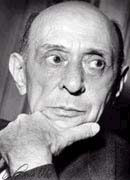
"I am quite conscious of the fact that a full understanding of
my works cannot be expected before some decades. The minds of the musicians,
and of the audiences, have to mature before they can comprehend my music.
I know this, I have personally renounced an early success, and I know
that-success or not-it is my historic duty to write what my destiny orders
me to write" - Arnold Schoenberg (1947)
Biographical Information:
Born in Vienna, Austria on September 13, 1874
Began violin lessons when he was eight and started composing
Schoenberg was born a Jew, but converted to Lutheranism
in 1898
There are believed to be three periods in Schoenberg's
life:
| |
Early Period (from birth until 1908)-characterized
by extended tonality
Middle Period (1908-1921)-characterized by
atonality, without a tonal center
Last Period (1921-death in 1951)-characterized
by 12-tone composition
|
He received formal training from a man named Zemlinksy
when he was a teenager, and in 1910 Schoenberg married Zemlinsky's sister
His first known works were from circa 1900 and include
"Verklarte Nacht"
He was influenced by the composers Wagner, Brahms, and
Wolf
In 1913 he was in Berlin working as a cabaret musician
and a teacher
He wrote the symphonic poem "Pelleas und Melisande"
there in 1903
He then returned to Vienna and starting taking private
students; Berg and Webern were among his first
Schoenberg gradually started writing longer instrumental
structures in his 12-note method
In the 1920's he returned to standard forms and genres
Schoenberg founded the Society for Private Musical Performances
(1919-1921)
In 1923, his wife died; he remarried in 1924
In 1925 he moved to Berlin to take a master class at
the Prussian Academy of Arts
While in Berlin, he wrote most of his piece "Moses
und Aron"
In 1933 he had to leave Berlin because he was a Jew (Hitler
was taking control in Germany). He went to Paris, and formally converted
back to Judaism
In late 1933, Schoenberg moved to the United States,
and settled in L.A. in 1934
He returned to tonal composition while in the US
In 1936 he started teaching at UCLA, and his musical
output decreased
Schoenberg became and American citizen in 1941
He suffered a heart attack in 1945, and after that, he
gave up teaching and made some return to expressionism,
He wrote "A Survivor From Warsaw" (1947) and
"String Trio", as well as some religious choruses
Schoenberg died in Los Angeles on July 13, 1951
|