


 R. Manasseh Papers
 R. Manasseh Home
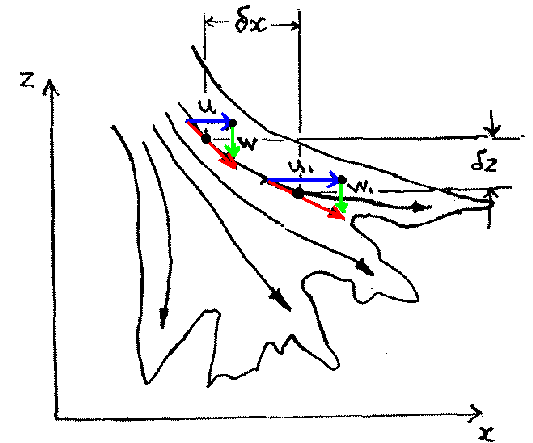
Figure 1: A snapshot of a fluid in motion.
For our ocean system, the first equation from physics is also an equation used by all fluid-dynamical systems. It is Newton's Second Law,
where the vector F is the force applied to a
particle,
 is its mass and the vector
  is its
acceleration. In fluid
dynamics, the forces and masses are usually given to us
by nature and
Newton's Second Law is usually written,
is its
acceleration. In fluid
dynamics, the forces and masses are usually given to us
by nature and
Newton's Second Law is usually written,
so
that the known quantities are on the right-hand side. We
have to work out the
acceleration of the fluid - where and how the
fluid is moving.
A distinguishing feature of a fluid is its acceleration, which can be very different to that of a solid. Acceleration is the rate of change of velocity with time, which for a `splash' like in figure1 can be written,
The rate of change of the horizontal ( -direction)
velocity
-direction)
velocity  is
is
 and the rate of change of the vertical
velocity
and the rate of change of the vertical
velocity  is
is
 . (We'll only worry about motion in the
horizontal for now as
things are much the same in the vertical.) The use of the
capital
. (We'll only worry about motion in the
horizontal for now as
things are much the same in the vertical.) The use of the
capital  in
the derivative means that all the ways in which a
fluid can accelerate
are being included. A fluid can certainly accelerate
simply by having a
different velocity at a later time - this is the sort of
acceleration that
solids undergo, and is written
in
the derivative means that all the ways in which a
fluid can accelerate
are being included. A fluid can certainly accelerate
simply by having a
different velocity at a later time - this is the sort of
acceleration that
solids undergo, and is written  . (The curly
`partial derivative' symbols mean ``differentiate
just with respect
to time''; they are used to remind us that the fluid's
velocity depends on
space as well as time.) A fluid particle can also change
its velocity by
changing its position within the flowing mass. As a
fluid particle moves
to a new point in the evolving `splash', it finds itself
in a region with a
different velocity.
. (The curly
`partial derivative' symbols mean ``differentiate
just with respect
to time''; they are used to remind us that the fluid's
velocity depends on
space as well as time.) A fluid particle can also change
its velocity by
changing its position within the flowing mass. As a
fluid particle moves
to a new point in the evolving `splash', it finds itself
in a region with a
different velocity.
The fluid particle gains an extra horizontal velocity

by moving  at speed and
  at speed
. This means that
the horizontal component of a fluid's acceleration is
at speed
. This means that
the horizontal component of a fluid's acceleration is
where the last two terms on the right-hand side express that very special property of a fluid particle - its ability to accelerate by moving to a different region within the flowing mass, where the velocity is different.
To complete the Newton's Second Law equation,  must be worked
out, so now think about forces specific to the example of
the ocean surface.
The basic force is that of gravity, which is transmitted
to a fluid particle
below the ocean surface by pressure. From physics, the
pressure
must be worked
out, so now think about forces specific to the example of
the ocean surface.
The basic force is that of gravity, which is transmitted
to a fluid particle
below the ocean surface by pressure. From physics, the
pressure  at depth
 is given by
where  is the density of the seawater,
  is the acceleration due to gravity and is the local
height of the ocean
surface above its normal sea level, as shown in figure 2.
(As we only wrote
down the horizontal acceleration, we'll only write down
the force acting
horizontally.) The net pressure force acting on the tiny
`block' of fluid in
figure 2 is given by
is the acceleration due to gravity and is the local
height of the ocean
surface above its normal sea level, as shown in figure 2.
(As we only wrote
down the horizontal acceleration, we'll only write down
the force acting
horizontally.) The net pressure force acting on the tiny
`block' of fluid in
figure 2 is given by

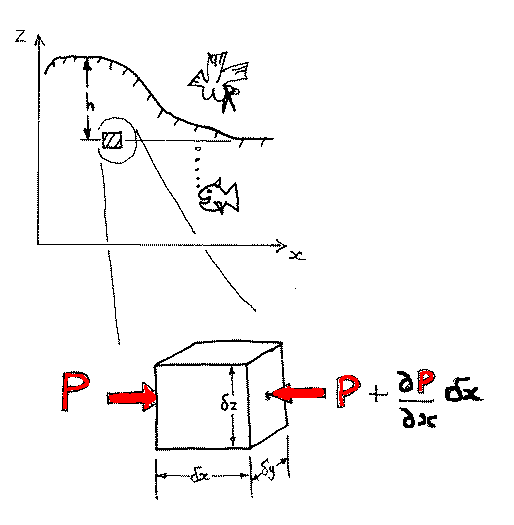
Figure 2: Horizontal force on a block of fluid in the ocean.
All that is needed now is the in the Newton's Second
Law equation, which is
given by

so
dividing  by gives
when (1.6) is used.
There is a second equation from physics for the fluid dynamics of the ocean surface. This says that `what goes in, must come out', as shown in figure 3.
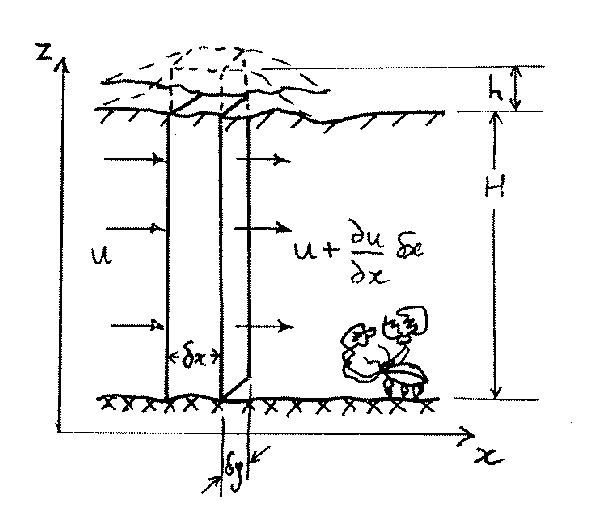
Figure 3: What goes in must come out.
The net amount of fluid flowing into a column of water is equal to the amount going in the left-hand side, minus the amount coming out the right-hand side. This inflow must be equal to the rate at which the column is growing (owing to the rate of increase in the local height of the ocean surface), giving
Our two equations are now
It
is worth pausing for a moment to note that these are
differential equations - equations involving
derivatives - and that they are nonlinear
differential equations. `Nonlinear' means that they
contain terms where a
dependent variable is multiplied by a derivative (like
the  and
and  terms that make
the Newton's Second Law equation (1.10) nonlinear)
or
where a dependent variable
or a derivative appears to some power other than one.
Nonlinear differential
equations are generally very hard to solve;
unfortunately, it's the nonlinear solutions that describe most of the real
physics and exciting
complexity of our world, including, as we shall see,
surf !
terms that make
the Newton's Second Law equation (1.10) nonlinear)
or
where a dependent variable
or a derivative appears to some power other than one.
Nonlinear differential
equations are generally very hard to solve;
unfortunately, it's the nonlinear solutions that describe most of the real
physics and exciting
complexity of our world, including, as we shall see,
surf !
R. Manasseh Papers
R. Manasseh Home








