13/11/07
So it turns out that nearly melted chocolate is still quite nice and an ordinary household microwave can be used to measure the speed of light to within a few hundred thousand meters per second....Merry Christmas!
It was early. We discussed the photoelectric effect.
Always write down Einstein's photoelectric equation before attempting any question on this subject.
Here is a table of stuff on wave particle duality.
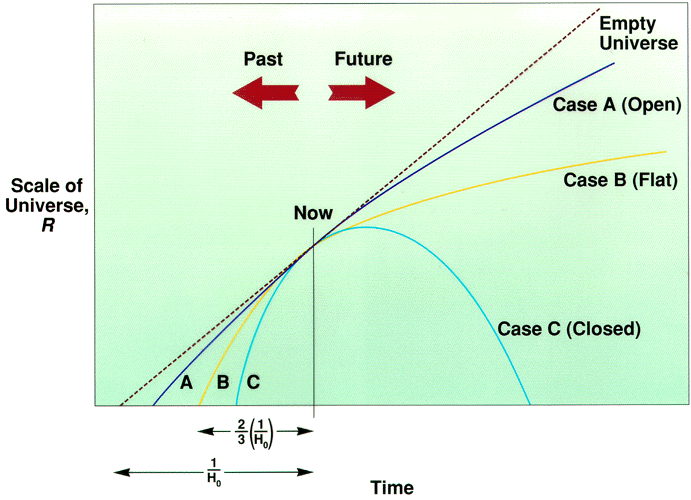
Here is some stuff on cosmology.
Oh my word. None of you know anything at all! Except how to do calculations.
So it was apparently an easy paper, 46 for an A. No circular motion though.
You must be totally precise with your explanations of phenomena or you will fail.
Another one next time, perhaps we'll do 2, taking the hard questions (non calculations).
Topical joke courtesy of Olly Keers:
I bought a teddy bear on e-bay for �10. I named it "Mohammed" and sold it again the next week for �20.
Question is, did I make a prophet?
PHY4 Jan 2007 was sat as a mock. Gone through next time. Apart from Blake, who was in Oxford for a gruelling 3 week interview. Or something.
The history of the universe apparently.
Green video with Michio "ancient Japanese proverb" Kaku about time and cosmology. It was really rather good I thought.
We also discussed that you need to answer questions as though
is true, whereas
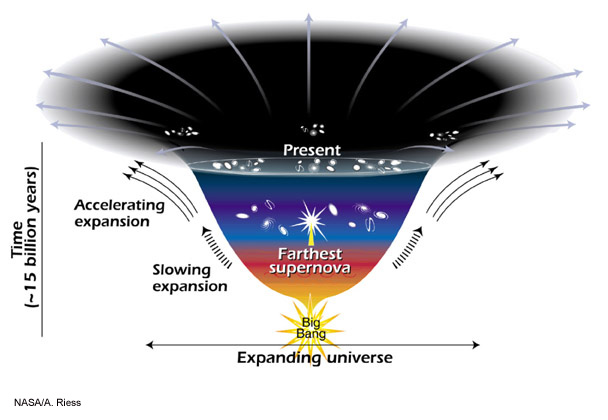
is more likely.
HW PHY4 Jan 2007 will be sat tomorrow - you can prepare for it if you like.
More cosmology - only 4 in though so random discussion really. Was Flatland by ex CLS dude Abott a social satire or a serious mathematical work?
The maths department recommends this "sequel" which may well have more Physics in it.
And apparently, the lead singer of "Eels" has a dad who was a theoretical physicist. So get good at Physics and then your children can become alternative rock stars. I wonder if I can find a nice video for us to watch tomorrow?
We talked cosmology. Particularly we looked at the 2 types of calculation that you might be expected to do.
You need to be able to do calculations using the Doppler shift formula to work out the radial velocity (away or towards us) of objects.

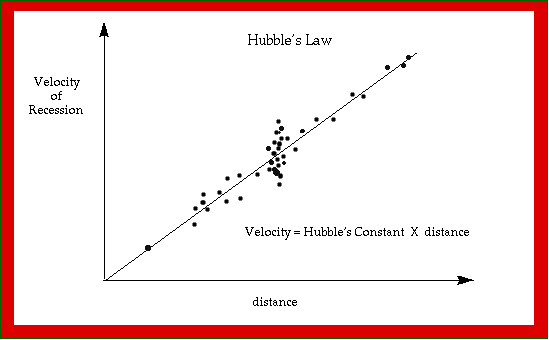
Hubble used several ways to measure the distance to stars in other galaxies and he also measured their Doppler shift.
He found most galaxies to be receding at a rate proportional to their distance from us.
v = H0d
This is the origin of the Big bang theory and also gives us a rough estimate of the age of the universe.
The methods of distance measurement such as parallax and standard candles were covered in astrophysics last year here
This gave rise to the idea of all matter in the universe starting out very much closer together than it is now (if the current expansion is simply time reversed).
More complicatedly, the idea is that not only all matter has got further apart , but that this is because space itself is expanding.
We tried the 2D "balloon universe analogy"
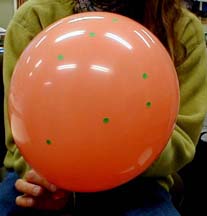
I am master of the ballooniverse.
As the skin of the balloon stretches, the dots on the balloon become further apart, faster the further they are away.
Movie link here
The universe is thought to be something along the lines of a 4 dimensional hypersphere, such that all points in the universe will observe Hubble's law to be true (the curvature which we cannot detect is in a 4th dimension unknown to us).
No test yet. Maybe eventually.
RM = sleep.
We chatted about absorption spectra and the atomic orbitals that cause them to come about, due to the wave nature of electrons.
The pattern of jumps between orbitals is a unique "fingerprint" of the chemicals present. Observing starlight, one finds the abosrption lines for hydrogen (which is present in all stars) tend to show up in the wrong place. This is due to the Doppler effect stretching or compressing the wavelength of light due to relative motion between the source and the obsever.
We'll do Doppler effect calculations next time.....
We "sat" the test except George who was absent today, and Ed who was absent yesterday and talked incessantly about crack instead.
The idea in the quantum section about emission and absorption spectra is vital for the understanding of some of the methods used in cosmology, so I wittered about that for a bit. Electrons can only exist at certain "distances" from their nuclei due to their wavelike behaviour (The probability wave would interfere with itself otherwise.....) If you give the electron some energy by heating, it may well jump up to a higher "energy level" and get a bit further aweay from the nucleus. If it does this, it will fall down again, emitting a photon of a specific frequency.
This site has some funky stuff about allowable electron transitions.
In fact it's got spectral lines too.....
Seriously, follow the links to the above site. It's totally awesome for making complex ideas appear simple.
HW Ed and George - revise for an SHM test
I summarised SHM delightfully on the board. Then I had to rub it off again. I should have that savey thingy like Mr Jones.
This link has some revision stuff on SHM, there will be a test tomorrow.
Another period of RM absence lasting eons has been spent mostly practising SHM exam questions. We'll get a shift on and do an SHM test soon so we can move on to the cosmology section of the course.
I have been away for several years, but now I can walk again.
We made resonance curves.
You used a vibrator to drive the oscillations of a mass-spring system.
In fact it was very much like this...
The mass-spring system vibrated very strongly when the driving frequency was equal to its natural oscillating frequency. (Which is just the SHM vibrating frequency that can be calulated from m and k.)
The amplitude of these "forced" vibrations is very dependent on the frequency of the driving force.
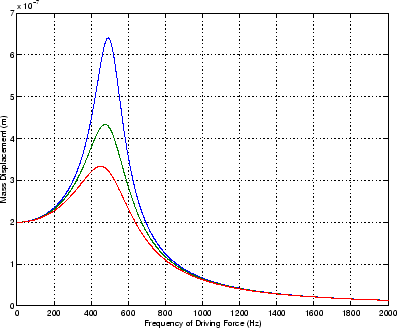
If the system is damped more (there is more friction slowing down the SHM) then the peak becomes less pronounced.
HW Was there?
We started to look at resonance by watching a rather entertaining video on vibrations.
RM = so kaput he stayed at home.
08/10/07
RM = kaput
We started a set of questions on SHM nicked from Emanuel school. We'll carry on next time.
We sat the little circular motion test except KK and PF.
Kieran has the same initials as Dr Khand!
Who knows? Ed is really annoying.
In fact we tried to measure the spring constant of the same types of springs we used in the last experiment.
We performed an experiment to test the oscillation of a mass hanging on a spring. We assumed that it was undergoing shm (reasonable as we know that a spring obeys Hooke's law). We measured the period T, for various masses. Analysis of the shm formulae allowed us to plot a straight line graph using the angular frequency and sqrt(1/m) which allowed us to make a measurement of k, the spring constant of the spring. We then directly measured the spring constant using a force vs extension graph.
Those who got there found results which were similar, certainly not bad for results obtained from 2 error prone experiments.
Energy in SHM.
The total energy of the system is made up of the total of KE and PE. When KE is max, PE is zero and visa versa.
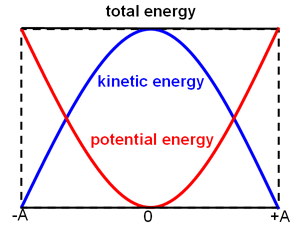
The above graph shows how the energy stored varies with displacement. You should also be familiar with how KE and PE vary with time.
You can get the maximum speed achieved during SHM directly out of the motion formulae (the amplitude of the velocity function), and therefore the maximum KE too.

So: maximum speed = Amplitude * angular speed
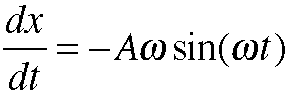
The maximum KE is then easily calculated if you know the mass.
The maximum acceleration is also easily calculated (amplitude of the acceleration function).
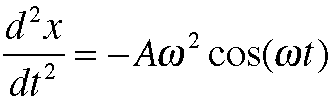
Another link to that really good SHM flash animation.
Check out this little shm self test thing. Pretty ace.
HW Revise for a little circular motion test next time.
More SHM - eventually. There will be a circular motion test on Thursday.
HW Finish Chapter 5 practice questions.
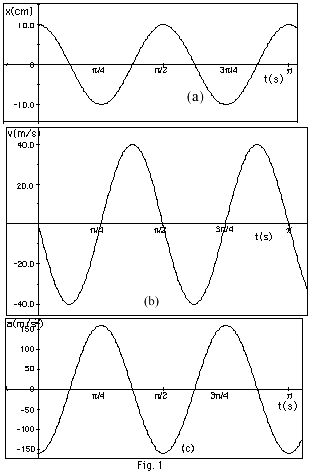
We looked at the mathematics behind SHM - showing how the sine wave shaped motion vs time graphs are solutions of differential equations that can be formed using simple Physics.
You can get the maximum speed achieved during SHM directly out of the motion formulae (the amplitude of the velocity function)
The maximum acceleration is also easily calculated (amplitude of the acceleration function).
Another really good SHM flash animation.
A slide show covering circular motion ideas and then SHM, how convenient.
HW None I believe unless you owe me some chapter 2 and 3 gubbins.
We began to look at oscillatory motion. We did experiments using pendulums. They oscillate about a central point with a frequency which does not change if the amplitude is varied.
For a mass on a spring, the period of oscillation is proportional to the square root of mass. The period of a pendulum is proportional to the square root of the length of the pendulum (the mass is irrelevant).
Do the experiment here if you want.
I derived a formula which showed that the acceleration of a pendulum is proportional to the displacement from the central position but always in the opposite direction (back towards the central position). The same is true for a mass-spring system. I wrote it on my back board but failed to show it you. Next time then.
HW Practice questions 4.1 and 4.5 please.
We began SHM.
We began to look at oscillatory motion.
We looked at the displacement against time graph and figured out the shape of the velocity and acceleration graphs too.
This link shows excellently the link between SHM and circular motion.
We started some assesment questions on circular motion.
HW Finish Assessment Qs 1-3
As it turns out, we did have another lesson before the CCF trip.
We did more on angular speed and the reasons why it is measured in radians per second.
HW I gave you Chp 2 and Chp 3 practice questions to do for the double lesson I am missing.
Vertical circular motion today.
We also looked at vertical circular motion under gravity. The weight of an object at the top of a circle can make up part or all of the centripetal force required to keep it moving in a circle.
For a mass on a string, the tension in the string is at a minimum at the top of the circle as the objects weight contributes to the centripetal force. The tension has to provide the centripetal force and support the object's weight at the bottom of the circle, so is at a maximum.
Then we moved onto angular speed.
Here is what wikipedia says about it.....
It is a measure of the rate of rotation of an object. However, rather than this being measured in degrees per second, the angles are measured in radians. One complete circle is 2Pi radians. This gets rid of a factor of 2Pi in many equations as it cancels out making life much easier.
I'll miss the next lesson due to the CCF trip, but will set some work for you to pick up.
Hooray, the 8 coolest of you are back for A2...
We're going to do circular motion for now and I started to wave around a mass on a string.
Qualitatively: An object uniformly moving in a circle is constantly changing direction so has a constantly changing velocity. This means that it is accelerating. This acceleration is called the centripetal acceleration. The force causing this acceleration is called the centripetal force. It can be provided by tension in a string, friction, gravity, magnetism etc. depending upon the situation.
This is an animation of a thing going in a circle. Marvellous.
Think about which modules you need/want to resit in January and let me know soon.
We looked at quantifying the acceleration and forces involved in circular motion.
A proof was shown that the acceration is v2/r
So the centripetal force is: mv2/r