Past papers (centre number 10512)
21/03/09
Um. You finished that PHY5.
Prastical. Easter papers went out.
Mass has energy and energy has mass. Radioactive decay, nuclear fission and fusion all exhibit an imbalance in the mass of the ingredients of a reaction and the products. Mass is converted into energy in the process, making the resultant nuclei more stable than the initial ones.
This is a cool little summary.
These calculations are the only ones where you must use all the sig. figs from your calculator. Masses of individual nucleons and the like can be quoted in kg or in Atomic mass units. The energy released can then be found by using the famous e=mc2 NB: The Nagasaki bomb (21kT) was reckoned to convert 1g of mass to energy...
You said,"What's the difference between a cyclotron and a synchotron?"
I said,"A synchotron varies the frequency of its accelerating metal plates to take into account relativistic effects."
You said,"Oh really?"
I said, "Yes"
The detectors used in particle accelerators were also discussed.
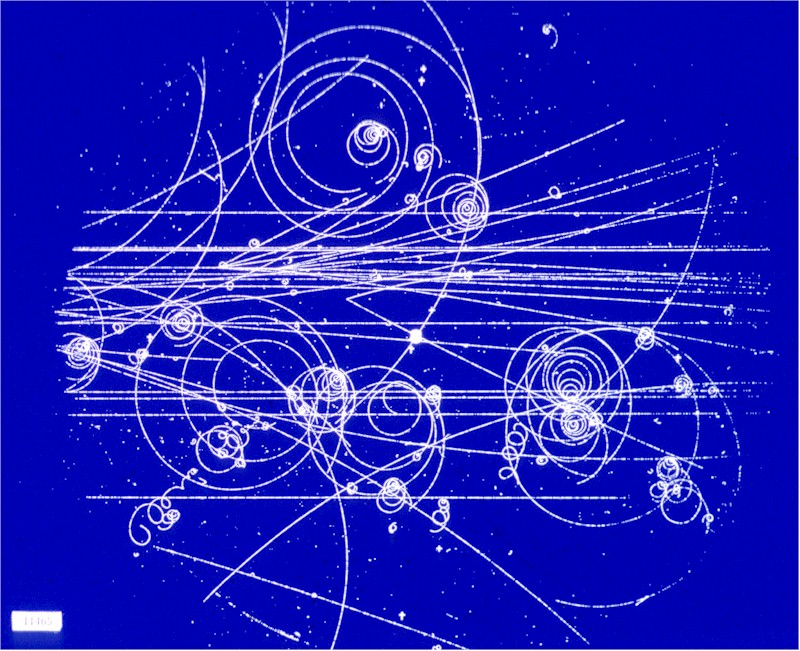
These included cloud chambers ( build your own, perhaps we can look at it in lessons), bubble chambers (all the best inventions are somehow based on or inspired by beer), spark chambers and their more advanced cousins drift or wire chambers.
You need to be able to explain the path of a particle within one of these detectors when subjected to a magnetic field. The circular motion and magnetic force formulae can be equated just like in cyclotron calculations.
Working out what the hell is going on is not straightforward... The particles gradually lose momentum and so spiral inwards.
Simple lab cloud chamber above (no magnetic field here).
A bit like what happened at CERN?
HW PHY5 Summer 2005
We do need to cover accelerators and the like. So we started.
The most basic accelerator is an electron gun, the humble cathode ray tube . You must be able to calcuate the Ke and hence velocity of an individual electron in one of these.
We also covered linacs and cyclotrons.
HW Calculations on Ch 21 and 22.
We went through the second question of the practical attempted last week. RTFQ.
We will clear up the final bits of PHY5 and 6 theory on Thursday, no praccy due to the J6 CW.
There will be extra sessions on Wednesday after school for you guys (to cover both resits and current stuff.) They won't start this week (CCF inspection.)
No lesson yesterday - today I went through the practical Q2A with you. You really must read questions....
Still not many in the way of practical papers in. Thursday's lesson is likely to be out, many of you are going to the science museum - nice. Probably bettter than Ipswich.
Good link for reading around the subject.
We looked at a few electromagnetic induction questions, we'll move on to chapter 21 next time.
No. You were either having your pictures taken or forgetting to have your pictures taken, one or the other. Still - some people will owe me a completed practical paper on Monday.
"Prastical".
HW Finish the written part?
We talked about the design of a simple motor/generator and how they are basically the same thing, and use the same basic physical phenomenon, the magnetic force on a moving charged particle to operate.
We also started to talk about transformers, which you don't appear to know in any more detail than GCSE.
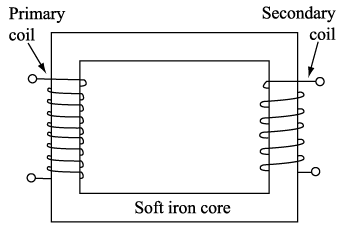
N1/N2=V1/V2
Faraday's law.
More on electromagnetic induction.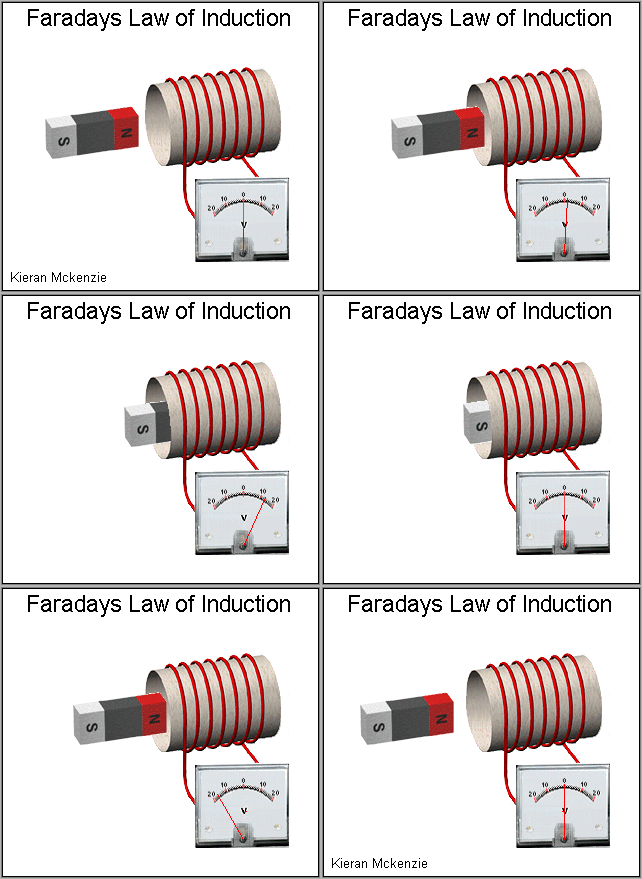
Any relative movement between a conductor and a magnetic field will induced a voltage. An increased speed of movement, or an increased magnetic field will increase the induced voltage. Reversing the direction of the movement reverses the direction of the voltage induced.
In fact the size of the induced voltage can be calculated as the change in flux linkage.
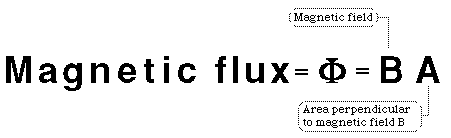
"Linkage" means the area of the magnetic field that is affecting a conductor. So a change in the area affected or in the magnetic field will induce a voltage.
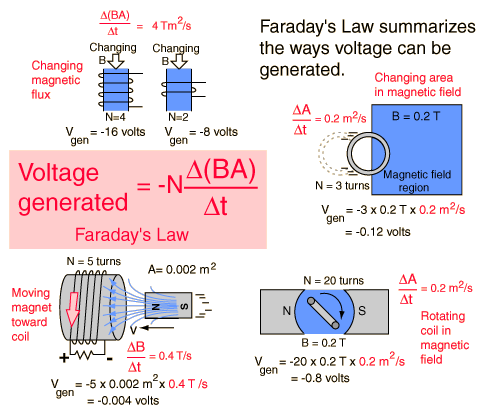
This can be done in a number of different ways as above.
A single long straight conductor passing perpendicularly through a magnetic field will move a distance v in one second. (d=st).
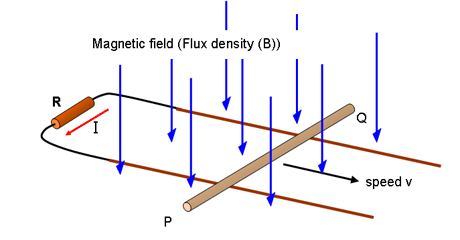
The area swept out by the wire per second is therefore lv. The magnetic field is constant, so the voltage across the wire can be calculated:
emf = Blv
We looked at the way to measure magnetic fields created by an alternating current. A "search coil" is used rather than a Hall probe, an alternating voltage is induced in the coil due to the changing magnetic field created by an alternating current.
The size of the magnetic field produced by a solenoid carrying a.c. can be calculated still by the same formula as before (B=mu0nI), and the search coil could then be calibrated in a similar way to the Hall probes to give a link between the induced voltage and the magnetic field size.
HW 21.3,4,5
Electromagnetic induction.
I introduced electromagnetic induction just with a wire, magnet and an microammeter. It is precisely the same effect as causes all magnetic forces (magnetic force on a moving charged particle) but is just expressed differently.
We saw a demonstration of electromagnetic induction. We already know that moving charges experience a force in a magnetic field. If a conductor is physically moved through a magnetic field, the free charge carriers inside the conductor experience a force. This force pushes them through the conductor, it is an induced voltage. An induced voltage can cause an induced current if the conductor is connected as part of a complete circuit.
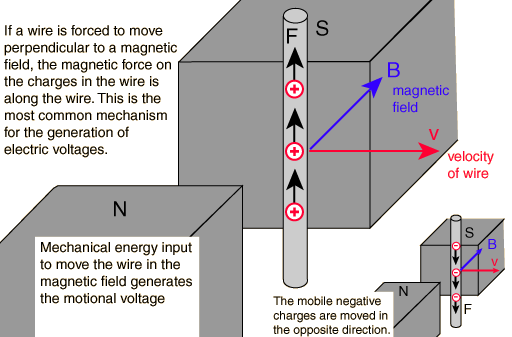
Both positive and negative charges within the wire feel a force (in opposite directions), but only the free electrons are able to move.
The induced voltage is reversed if the wire is moved the other way. The induced voltage is made stronger by moving the wire faster, or having a stronger magnetic field.
More on electromagnetic induction. We saw an example of a motor/generator. Put a voltage in and you get movement out. Put movement in and you get an induced voltage out. The induced voltage is often referred to as an emf (electromotive force.)
Any relative movement between a conductor and a magnetic field will induced a voltage. An increased speed of movement, or an increased magnetic field will increase the induced voltage. Reversing the direction of the movement reverses the direction of the voltage induced.
We looked at various examples of Lenz's law, showing that any induced current caused by an induced emf due to a change in magnetic flux on a conductor will cause a magnetic field which acts to help stop the change which created it.
Of course, if the conductor has no resistance, the induced current will produce a magnetic field large enough to completely cancel the change that is causing it.
Hence, superconducting levitation.
Induction Caltech vid Part 2 and 3 link on to it.
HW 19.1, 20.1, 20.2
We looked into the theory behind the strength of magnetic fields produced by a solenoid, again explained in excessive detail here.
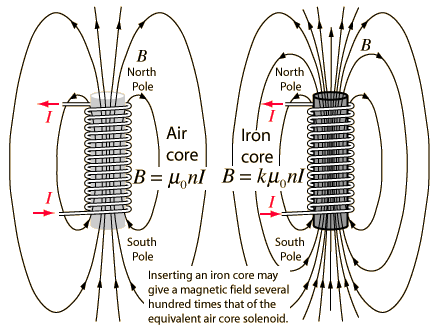
The number of turns per m (n) , and the current (I) are the 2 variables which affect the strength of the field within the coil. mu0 is a fundamental constant, the magnetic permeability of free space.
More here on the solenoid formula, here on the effect of a ferromagnetic core, and here about the field around a current carrying wire, the formula for which we derived by just being clever.
HW Yep 18.2,4,5
We looked at Hall probes.
They are explained in some detail here.
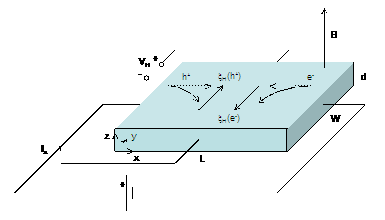
A current is passed through a wafer of semiconducting material. A microvoltmeter measures the size of the magnetic force on the moving charge carriers due to an external magnetic field perpendicular to the current. The microvoltmeter is position perpendicular to the flow of current and in no way measures the emf which causes the steady current to pass through the probe.
Hall probes must be calibrated so that the reading from the voltmeter can be converted into a magnetic field strength in Tesla.
We used Hall probes to show that the magnetic field produced by a solenoid (coil of wire) varied linearly with the current in the solenoid, as you'd expect.
We defined the Amp.
One ampere is defined to be the constant current which will produce an attractive force of 2�10�7 newton per metre of length between two straight, parallel conductors of infinite length and negligible circular cross section placed one metre apart in free space. The definition is based on Amp�re's force law. The ampere is a base unit, along with the metre, kelvin, second, mole, candela and the kilogram: it is defined without reference to the quantity of electric charge.
The SI unit of charge, the coulomb, "is the quantity of electricity carried in 1 second by a current of 1 ampere.".[5] Conversely, a current of one ampere is one coulomb of charge going past a given point per second.
And the did some F = Bil calculations.
HW Do CH17 Q4 and CH18 Q3.
I just introduced the basic difficulty really which is that magnetism is not a "real" radial field like gravity and electrostatics but comes about due to moving charge. A magentic field is a region in space where a moving charge or permanent magnet will feel a magnetic force.
Permanent magnets only have a magnetic field due to the overall internal structure and movement of the charge which is held within them. ("Spin" a fundamental quantum property of particles is apparently largely responsible for the magnetic field, but personally I like to picture little electrons going in circles.)
Any how, you need to remember a few thing from GCSE about the shapes of magnetic fields.
Important points:
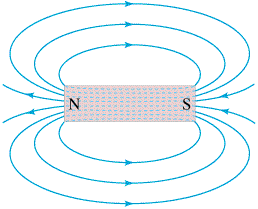
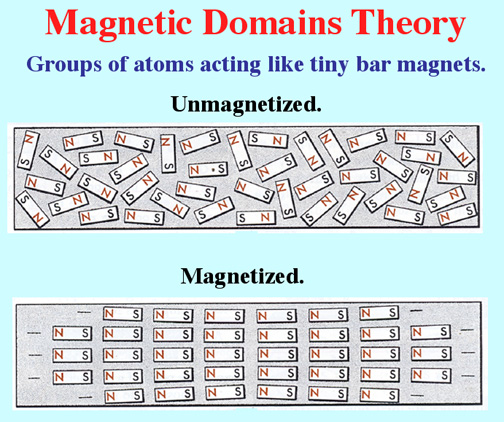
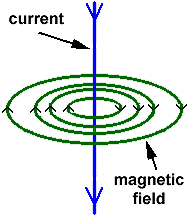
The direction of the force can be determined by Fleming's left hand law.
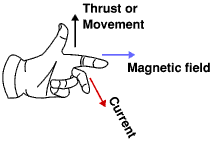
The physical reason for this force is due to the combining of the magnetic field from the the wire and the external magnets. The fields agree on one side of the wire, but cancel each other out on the other. This is known as the catapult field effect.
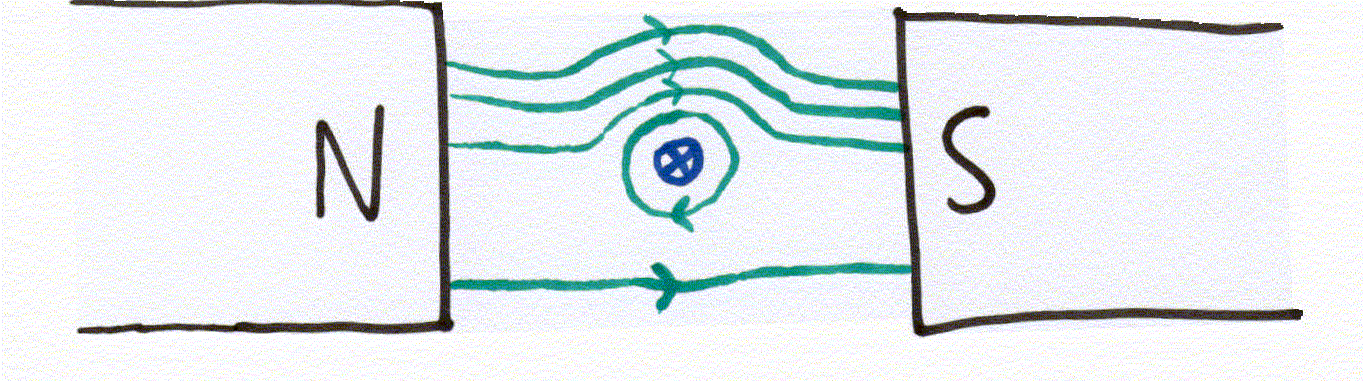
A force is always felt from areas of strong magnetic field to areas of weak magnetic field. Strong fields are shown by the field lines being closer together.
The direction of the force will be reversed if either the current is reversed or the magnetic field is reversed (but not both). The force is made stronger by increasing the current (more moving charge to experience a force) or making the external magnetic field stronger.
We looked at some more magnetic fields.
We performed an experiment to see how the force on an current carrying wire perpendicular to an external magnetic field varied with the current in it.
These are the results we got, showing that the force is clearly proportional to the current (I). It is also proportional to the size of the external magnetic field (B) and the length of wire inside the field (l).
From these 3 factors we get the equation for the force on a perpendicular current carrying wire in an external magnetic field:
Force = B * I * l
The above equation only works for the wire being totally perpendicular to the field, if it isn't you can resolve the current (it is a vector) into perpendicular and parallel components.
In fact, magnetic field strength is defined by the above equation, measured in Tesla (or N/Am). 1 Tesla would be a field sufficiently strong to produce a force of 1 Newton on 1m of wire with 1A flowing in it.
HW Get the gradient of your graph (or mine) to make a calculation of the magnetic field strength in between the magnets (l was 0.06m)
Magnetism was started properly.
It is by far the most complicated of the forces we deal with at A level due to it's tricky reliance on relative movement of charge. Of course this brings in the idea that magnetism is just a relativistic effect and is in fact just like an electrostatic force in reality.
We loooked at some simple magnetic field shapes.
More next time, when we will try and quantify magnetic field strength.