02/12/08
We went through some of the Jan 08 paper. We'll do the rest next time and perhaps have a go at Gabriel's 07 paper.
No marked PHY4 yet. PHY5 books came out - magnetism, is just electrostatics in a moving froame of reference discussion was started, but not finished. More after marking!
Look at this, and this to keep you going for now.
Mock sat. 25/11/08
Reviseville Arizona. Jan and June 2005. Mock is next lesson.
Revisetastic. Jan and June 2005.
Revisetastic. Jan and June 2005.
Revisaroooney. Jan and June 2002.
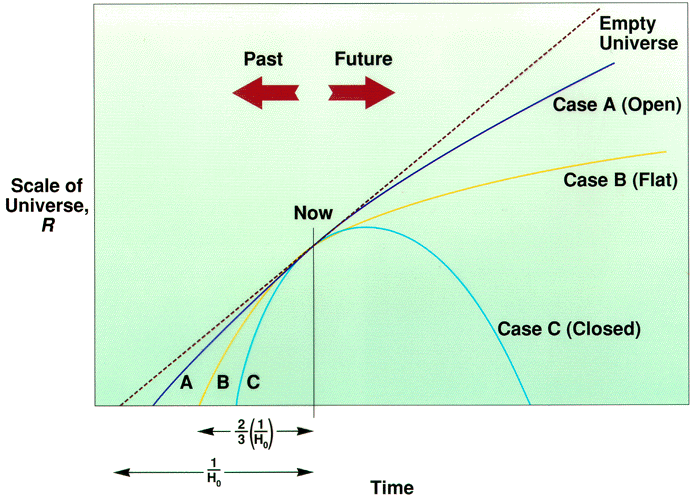
We underwent a "Big crunch" as cosmology came to an end.
I'm missing for both other lessons this week so I suggested that you might want to do something about the electromagnetic spectrum chapter in terms of making a few of those key facts a bit easier to learn.
I'll throw a PHY4 past paper your way too to finish for next week too.
We discussed that you need to answer questions as though
is true, whereas
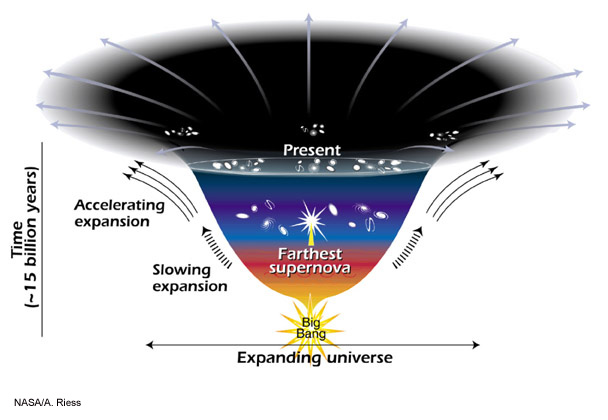
is more likely.
The deciding factor on the fate of the universe is the density of mass-energy within it.
Visible matter is likely to make up only a tiny proportion of the total matter in the universe. Evidence for this is seen in galaxy rotation curves.
Possible candidates for dark matter were discussed.
HW 24.4, 25.3, 25.4
We talked cosmology. Particularly we looked at the 2 types of calculation that you might be expected to do.
You need to be able to do calculations using the Doppler shift formula to work out the radial velocity (away or towards us) of objects.

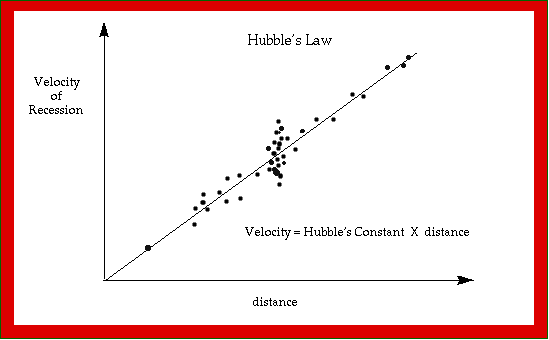
Hubble used several ways to measure the distance to stars in other galaxies and he also measured their Doppler shift.
He found most galaxies to be receding at a rate proportional to their distance from us.
v = H0d
This is the origin of the Big bang theory and also gives us a rough estimate of the age of the universe.
The methods of distance measurement such as parallax and standard candles were covered in astrophysics last year here
This gave rise to the idea of all matter in the universe starting out very much closer together than it is now (if the current expansion is simply time reversed).
More complicatedly, the idea is that not only all matter has got further apart , but that this is because space itself is expanding.
We tried the 2D "balloon universe analogy"
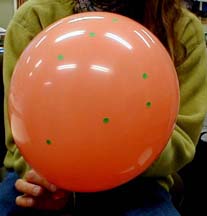
I am master of the ballooniverse.
As the skin of the balloon stretches, the dots on the balloon become further apart, faster the further they are away.
Movie link here
The universe is thought to be something along the lines of a 4 dimensional hypersphere, such that all points in the universe will observe Hubble's law to be true (the curvature which we cannot detect is in a 4th dimension unknown to us).
Video with Michio "ancient Japanese proverb" Kaku about time and cosmology. It was really rather good I thought.
HW Ass Q 27 on Hubble and the like.
This animation might help you picture the idea. It only applies to sound, however as the source here can exceed the emitted wavespeed.
HW E99, 102, 105 (Muncaster.)
Some exam questions on spectral lines - we must get onto Doppler next time.
A double lesson in which we took some time out to discuss the Millenium bridge and its problems with resonance. (classic interview topic.)
We did some calculations on spectral lines and photons.
Essentially in the week before half Term we had about one single lesson. In this lesson, we discussed emission spectra and looked at some.
Then I went to China with little else achieved.
Test marked - loads of marks given away, lots to work on re: exam technique etc.
We will have continued with matter waves by looking at De Broglie wavelengths of electrons and relating it to the Young's double slits formula.
We were able to make a pretty good estimate of the separation of layers of atoms in graphite using the electron diffraction tube.
, HW Have a go at a few De Broglie wavelength calculations 23.2,3,5
Look at this site. it's great.
No marked test. We started to look at matter waves instead.
The above film was discussed.
Testy testy testy.
We revose for a test on waves which will be held tomorrow.
Remember that you can dig out past papers and answers from the student are of the school network.
HW Revise!
We're going to hang fire on new stuff for a week and consolidate on waves. We looked at some simple waves Qs today, we'll move on to exam questions next time.
This isn't a standing wave in the way we have been looking at them. But it looks quite cool.
HW Finish off the Qs we started today, we're heading for a test on Friday.
Yet more on standing waves. They are handy for making a measurement of the speed of waves which might otherwise be a hassle.
We used a sig gen and speaker to feed sound waves into a closed plastic tube with a piston like end so that its length could be varied.
As the length was slowly increased, at certain points the tube was the correct length for a stable standing wave to be set up (resonances of the tube.)
The first such resonance represented the point where the length of the tube was equal to one half of the wavelength of the sound wave.
Knowing the frequency and having measured the wavelength, it was then possible to work out the speed of the sound.
This is approx. the experiment we did, but we had a node at both ends....
HW Still Chapter 17 Practice for Tues (Noah Monday)
More on standing waves. We made a standing microwave and showed how it could be used to find the wavelength of the waves by measuring the distance between antinodes.
Then you started to annoy me a bit so I showed you a video on the interfeerence of light.
HW Chapter 17 practice Qs (for Tuesday) or Monday for Noah.
We moved onto standing waves.
Isao and I made several versions using a slinky. Look at the American teacher - he doesn't get as many as me.... He didn't break his slinky though. The idea is similar to that of wave superposition producing interference patterns. However, standing waves are generally caused when a wave source interferes with reflections of itself in a constrained system.
Waves on a slinky undergo a 180 degree phase change when reflected.
The reflected wave then interferes with the incoming wave as set out by the principle of superposition.
This generally produces a mess, with each section of the slinky (or string or whatever) constantly changing in displacement. However, if the frequency of the incoming wave is just right (a la resonance) a stable standing wave can be set up, with nodes (of zero displacement) and anti-nodes (areas of maximum displacement) set up.
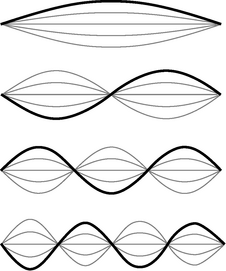
Several "modes" of standing waves can be set up, as the frequency of the wave is increased.
The distance between nodes is always half the wavelength.
The first 5 modes of vibration on a fixed string.
Standing waves can also be set up in constrained systems with open ends.
A fixed end forces a node to be present at that point. A "flappy" end means that an anti-node must be present at that point in order to have a stable standing wave.
Much more on this next time, including Josh (guitar), Mr Mackrell (sax), Tim (trumpet).
HW None about this, but lots of you didn't hand me ass. 10
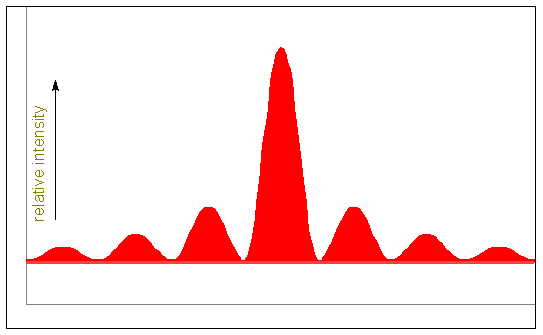
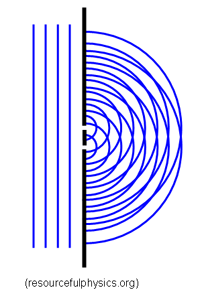
As promised, a go through of practice Qs from chapter 15. I also talked you through the interference pattern caused by a single slit. The single slit diffraction pattern can be explained by thinking of every point along a wavefront as a tiny point source of waves.
Destructive interference everywhere else due to path difference from all of these tiny sources leads to plane waves propagating in straight lines usually.
However, the slit takes away all but a few of these tiny wave sources. At points where there is a path difference of half a wavelength from the near side of the slit and the middle of the slit, waves from these 2 ponts will undergo destructive interference. At this point, there will also be a path difference of half a wavelength between the middle of the slit and the far side. Hence these sets of waves will also interfere destructively as they will be in anti-phase. Hence a minima will occur here.
HW We didn't get ass. 10 done. Do it for next time and hand in the exam questions I gave you if you failed to do so today.
We saw an interference pattern created by shooting 3cm microwaves through 2 slits. The detector didn't work very well so we didn't take any measurements off it.
We could not have used the Young's double slit formula as the distance from the slits to the detector was small compared to the slit separation. Hence the small angle approximation would not hold.
However, we also looked at a laser being shone through a diffraction grating. In this case the slit-screen distance was large compared to the slit separation. We could use the double slit formula to estimate the wavelength of the laser light and got it right to within 1%. Not too shabby.
However, a diffraction grating is not a double slit, but a whole shed load of them. In fact the separation of the bright fringes does not change with the number of slits, they just become more well defined as the number slits is increased.
Even a single slit will produce an interference pattern of sorts.
Add another slit and the maxima and the maxima become better defined.
HW Only (for HDK's sake) the 2 A level interference questions given out. We'll do ass. 10 etc. tomorrow.
We listened to the interference pattern created by 2 speakers playing the same note, in phase from a signal generator.
Areas of constructive and destructive interference could be clearly heard. We also used a microphone and oscilloscope to show them too.
For constructive interference, the path difference (difference in distance travelled) from each source must be equal to a whole number of wavelengths. Wave from both points will arrive at such a point in phase with each other.
We derived a formula using small angle approximations to show where the areas of constructive interference would appear.
HW I can't remember - more on this next time.
Principle of superposition: When 2 waves of the same type meet, the total displacement of the medium at that point is the vector sum of the displacements associated with each wave.
HW 14.2,3 and 4
Qualitative waves stuff. Diffraction, relection and refraction.
The 3 main properties of waves, reflection, refraction and diffraction.
Here is the website with the cracking animations giving examples of all of these effects
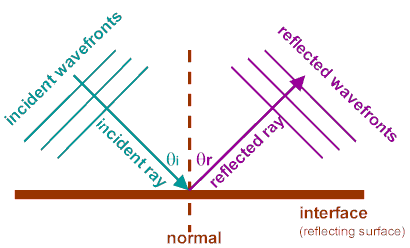
Reflection: Waves reflect off plane surfaces at an angle which is equal to their angle of incidence.
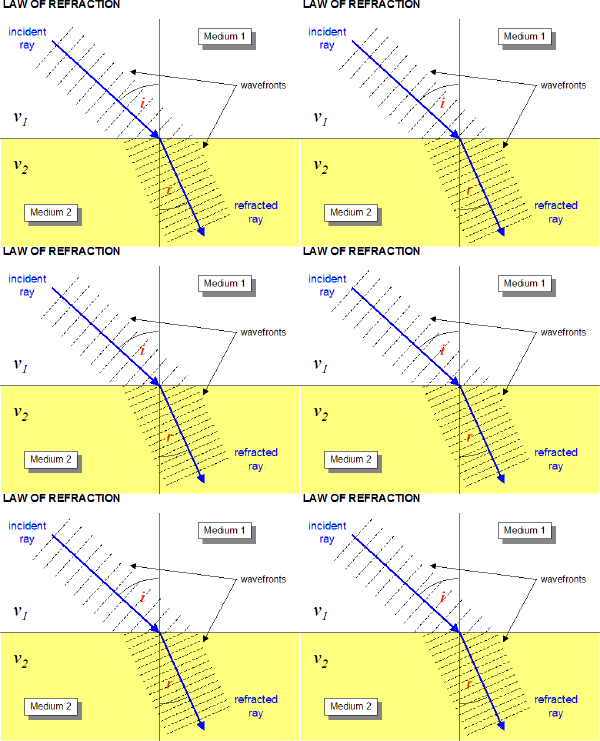
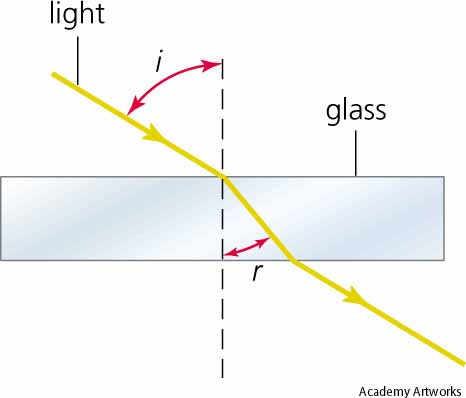
Refraction: Waves change direction when they enter a medium which slows them down. The wavelength is reduced, not the frequency.
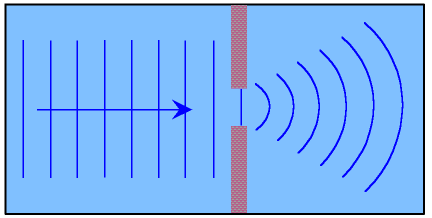
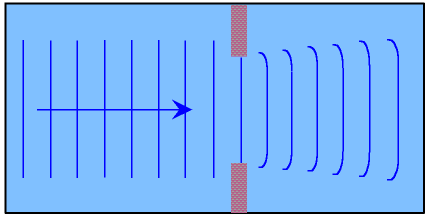
Diffraction: Waves spread out when passing through a gap. The smaller the gap, the more spread out the waves become. If the gap is much larger than the wavelength, then diffraction less unnoticeable.
You guys really don't like some of this polarisation stuff.
Try not to think about electromagnetic waves as mechanical waves, the field strength is what is varying, there is no magic piece of string in space doing some oscillations.
Check this out to confuse you some more.
We attempted some (old) book questions on polarisation, they are a lot more straight forward than the questions you were asking me...
I am tasked to explain "why" large e-m wavelengths are not able to penetrate a fine wire mesh for example.
This example based on diffraction of sound goes some way to help...
HW Try old assessment Qs 8 and 9
I went into polarisation in far too much detail, so much so that we forgot to put down any notes about it. Never mind, at the beginning of next lesson instead.
Only transverse waves can be polarised.
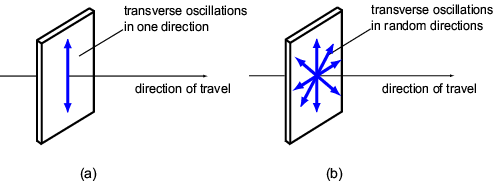
We saw how polarised microwaves can be be blocked by a metal grill held in one orientation, but unaffected if it is held at 90 degrees to this.
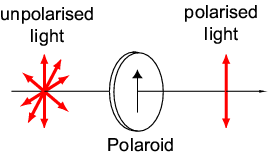
A polaroid works in a similar way on light, only allowing one orientation of electric field vibration to pass through.
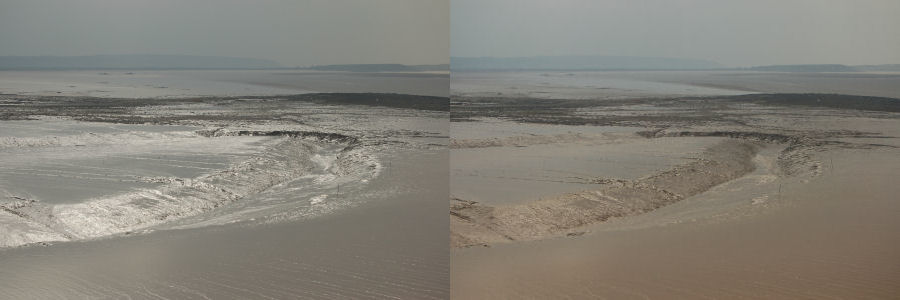
Light reflected at a glancing angle from water, glass, snow etc. tends to be polarised. Polaroid sunglasses take advantage of this by reducing the glare from reflections.
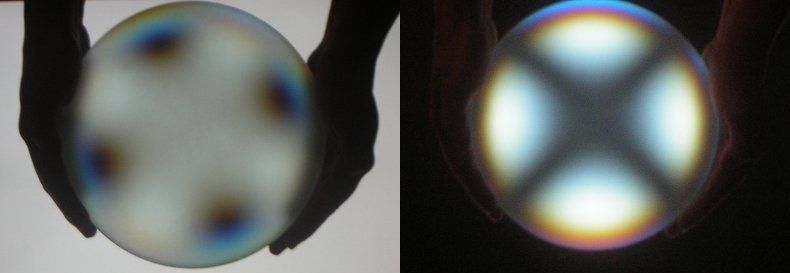
There are several other uses of polarised light, e.g. identifying chemical isomers and in stress analysis.
It was delightful to see you all again. Shame about TB, lets hope that he's allowed to build a Tesla coil wherever he's gone...
You should look at you individual module results if neccessary to decide what retakes may be required.
We will carry on with waves, HRSJ covering circular motion and SHM for now.
I recapped longitudinal and transverse waves, amplitude, wavelength, period and the wavespeed formula.
Waves transport energy from one place to another with no overall movement of matter. The energy is transported as vibrations (a combination of KE and PE) through some medium.
Waves come in 2 major types, transverse and longitudunal.
In transverse waves, vibrations occur which are perpendicular to the direction in which the wave is travelling. e.g. water waves, light.
Longitudunal waves have vibrations which are parallel to the direction of wave travel.
This site has excellent animations of the various types of waves.
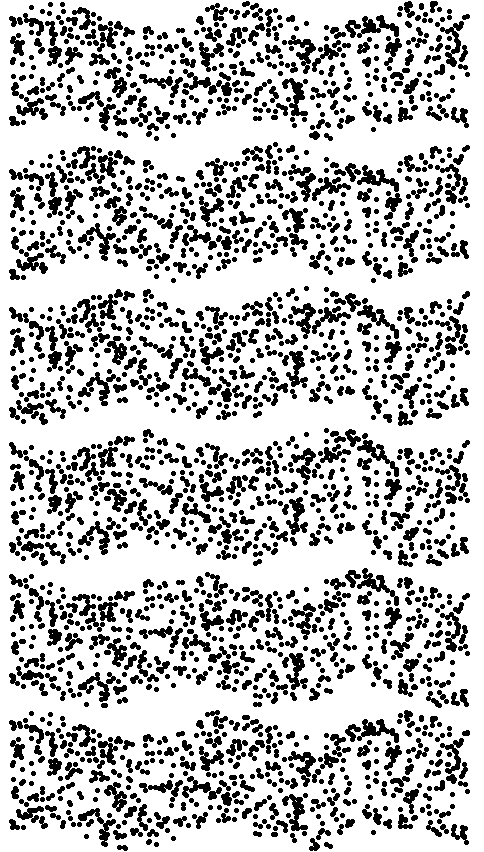
transverse above
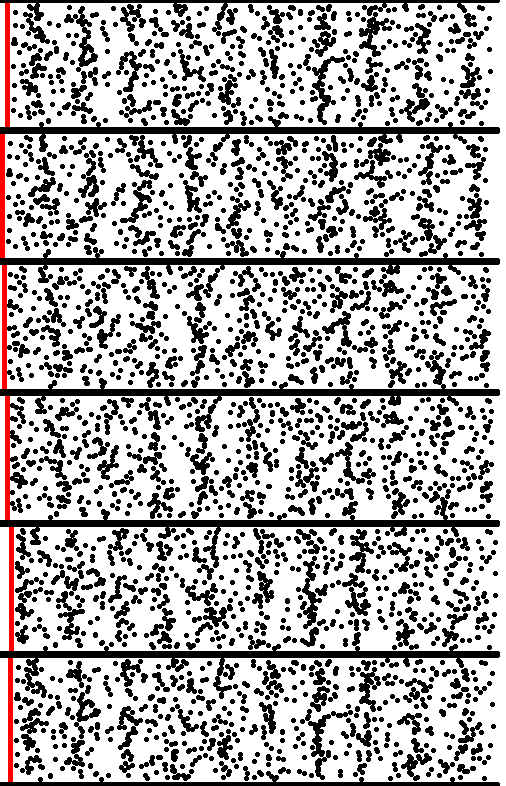
and longitudinal
Important quantities that you need to remind yourself of are:
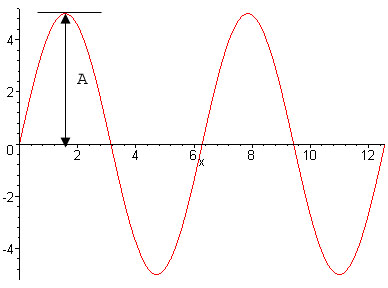
1. Amplitude - the maximum "height" of the vibration. Easy to see in a transverse wave, not so easy in a longitudunal.
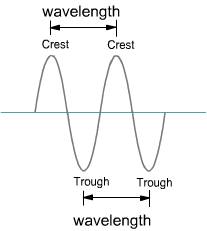
2. Wavelength - The distance from the peak of one wave, to the peak of the next. It can really be measured from any point on the wave, to the next equivalent point.
3. Frequency - the number of waves which happen per second (measured in Hz)
Related to the frequency is the Period (T) which is the time taken for one wave to happen.