19/03/09
We measured the speed of sound across the Thames, mainly for the benefit of TC. (and it was a nice day.) We took a "plot and look" approach to the recorded data and discussed the random uncertainty and the systematic error involved.
We then started to discuss mechanics, particularly Newton's 2nd law and how it was originally conceived using momentum.
We introduced the concept of momentum.
Momentum(kgm/s)= Mass(kg) * Velocity(m/s)
It is a vector quantity (has direction). A force is required to change the momentum of any object.
The unbalanced force acting on an object is equal to the rate of change of momentum that it causes. (Newton 2)
When a force is exerted by body A on body B, body B exerts an equal and opposite force of the same type on body A.(Newton 3)
So they must cause an equal and opposite change in momentum on one another, implying that momentum is always conserved. Which it is, for any type of interaction at all.
These animations show momentum conservation in collisions.
Apart from some small errors due to friction, the total momentum of bodies before a collision was always the same as the total momentum after a collision.
Momentum = Mass * velocity
Momentum is always conserved in collisions. To solve problems...
1. Draw both objects and mark in their mass and velocity.
2. Calculate the combined total momentum (add them together remembering that only one direction is positive.)
3. Draw a new diagram showing what has happened after the collision.
4. The total momentum afterwards must equal the total momentum before the collision. Use this fact to work out any unknowns.
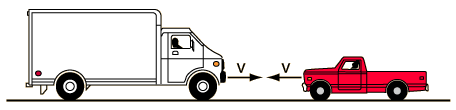
The force between 2 vehicles is equal and opposite during the crash. They experience equal and opposite changes in momentum during the crash (so total momentum must stay the same). The same change in momentum requires less change in velocity for a heavier object.
Occupants of a heavier truck experience less force during a head on crash. This is because the big truck experiences less deceleration, (or negative acceleration). The force on the people in the truck is: F = ma , where m is the mass of the person. People inside the truck must decelerate at the same rate as the truck (unless they go flying out through the windscreen). A large force is what will hurt people in a crash.
When a force acts on a body, it causes a change in momentum. The larger the force, the larger the change in momentum. The longer the force acts on the body, the larger the change in momentum it causes.
Force * time = Change in momentum
Ft = mv - mu
This is a rearrangement of Newton's 2nd law which can help explain why certain safety measures are used. Crumple zones are used in cars to increase the time it takes for the car to slow down and stop as it crashes. A smaller force acts on the car for a longer time - this reduces the chance of occupants injuring themselves.
In a car accident the larger mass vehicle is less likely to change velocity by so much. Both vehicles involved in the crash will experience equal and opposite forces when they collide, and so equal and opposite changes in momentum. However, a lighter vehicle has to change its velocity more to exhibit the same change in momentum as a heavier vehicle. That means the people inside the smaller veicle experince a greater deceleration and so a greater force during the crash and are more likely to die.
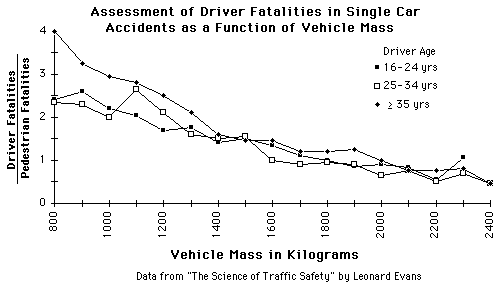
This graph shows the trend of fewer deaths in heavier vehicles.
HW You are on maximum coursework write up hand in tomorrow alert.
and again.... hand is Friday for HRSJ
Coursework.....
Courseworktastic.
Random uncertainty and systematic error are the key things for you to get sorted with this, I feel.
02/03/09
The little test was gone through. JLB and AA did it in the library, but to little effect.
The little test was sat. (only 8 in.)
Following this we moved on to some more mechanics, this time linking force with motion.
HW P208 Qs?
Lots of x,u,v,a and t type qs.
We also looked briefly at the seperation of horizontal and vertical motion. Horizontal motion carries on unaffected by any vertical acceleration that is going on.
A bullet fired horizontally from a gun on a flat plain will hit the ground at the same time as a bullet which is simply dropped simultaneously.
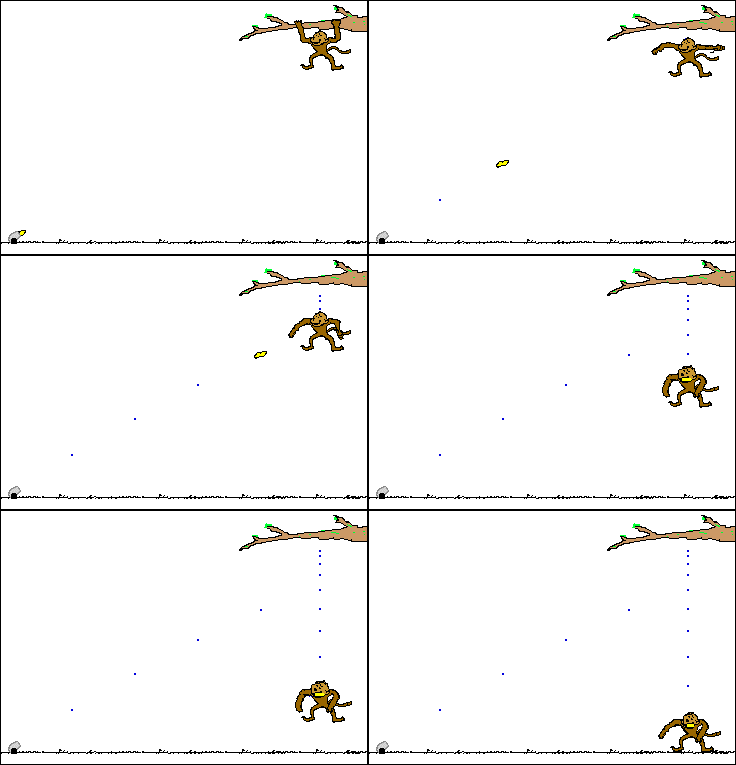
A monkey is doomed if it lets go at the same time as the gun is fired (if you are clever, try to prove that this is true for any angle that the gun shoots at the monkey, not just horizontally as we talked about in the lesson.)
So you can resolve vectors into 2 orthogonal (perpendicular) directions and then use seperate x,u,v,a,t equations for each direction.
Also note that if the force on an object changes, then x,u,v,a,t equations become invalid, as the acceleration will change.
HW Revise for a test full of calulations on all we have covered on vectors and the uniform acceleration equations.
Relative velocity was finished off.
We derived the equations of motion for constant acceleration. They are all based upon 2 physical concepts.
Average velocity = Displacement / Time = x/t
Because acceleration is constant, average velocity is simply a mean value.
Average velocity = (u + v)/2
u = initial velocity
v = final velocity
So, (u+v)/2 = x/t or x = t(u+v)/2
Also, acceleration = rate of change of velocity = (v-u)/t
This can be re-arranged to: v = u + at
Substituting one equation into the other, firstly for v and then for t will give you the remaining 2 equations of motion.
x = ut +1/2at2
v2 = u2 + 2ax
You aren't required to derive these equations at will, but you should understand where they come from.
To successfully solve all motion problems you simply follow this recipe.
1. List all quantities x,u,v,t,a
2. Fill in all quantities given to you
3. Choose an equation which includes only one unknown, along with figures you do know
4.Solve it!
Here are the 4 equations you can use again:
x = t(v+u)/2
v = u +at
x = ut +1/2at2
v2 = u2 + 2ax
HW Qs from the book P193 on relative velocity.
We looked at relative velocity between 2 moving objects.
HW Complete the set of questions on velocity (which weren't actually on relative velocity.)
We looked at some more vector problems. This time we looked at "crossing a river" style problems where the desired resultant vector is known.
Use this link to help you if having trouble.
HW Finish all the Qs from the book P 186 and also the "Flying in a Crosswind" worksheet.
We went through the materials test, which was largely well done.
We looked more at resolving and adding vectors.
HW Q1 and 2 only from the resolving forces sheet which are a bit like the above vid.
Vectors and scalars were covered. Vector quantities have direction as well as magnitude.
Displacement and velocity are often better to use than speed and distance.
We looked at another way of measuring g, assuming constant acceleration and knowing the time taken to fall a certain distance.
HW Revise for a materials test.
I have now reviewed your tals and the paperwork. I need a bit more on the planning, use of resources, manipulation of data and overcoming difficulties side of things so will get you to write a supplementary sheet soon.
We continued to look at motion - firstly looking at the information that can be gleaned from a speed vs. time graph.
We then also looked at how assuming a constant acceleration can allow you to make more accurate measurements of "g" than we did using ticker tape timers last lesson.
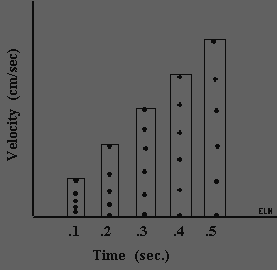
Using tickertape timers, you recorded the motion of a falling object. You used the resulting information to calculate a value for the acceleration due to gravity on Earth of an object. We discussed that the mass of the bject sed didn't matter.
HW Revise for a test on all o chapter 4 and 5. It will be exam Qs, calculations and definitions mainly I expect.
We started to look at mechanics, particularly representing motion and simple speed, distance and time calculations.
You used a ticker tape timer to make a measurement of the acceleration due to gravity.
HW Q sheet 20S Qs 1-4 only.
You guys did your talks and handed in the paperwork.