01/12/08
More talk prep.
Coursework preparation was undertaken on the laptops. The talks will be heard starting on Monday 8th of December.
Watch the above - any good?
Those "warm up" talks were seen. Too little in the way of diagrams, too much reading from slides and not enough Physics.....
Look here for some useful research links. Also look at the linked documents here which are of some use.
Many absent on the chemistry trip. We prepared some short "warm up" talks as practice for the coursework task.
We looked at polycrystalline, and semi-crystalline structures. We looked at how the behaviour of different polymers is determined by the way that they are bonded together. e.g. thermosets, which are hard and brittle due to cross linking of polymer chains, and other polymers which are ductile due to their semi-crystalline structure.
HW Notes on plastics from your book and the old PHY2 book.
We looked at the materials coursework task guidlines - you are going to choose a material to do your presentation on.
We then looked at dislocations in metals structures - how they can move through the structure when it is put under stress without the breaking of many bonds. This is the reason for the ductility of many metals. However, they tend to stop moving when they reach the edge of a crystal (grain boundary). Therefore materials with smaller crystals can often be less ductile.
We finished discussing semiconductors.
We looked at materials selection charts which were nice.
HW Do Q5 P122
We will have begun chapter 5! Looking at the variations in resistivity (and therefore conductivity) with temperature of various materials.
Metals gain resistivity with temperature due thermal vibrations slowing down the drift velocity of the free charge carriers.
Semi conductors are much poorer conductors than metals at any temperature. However, they gain free charge carriers when heated up and so increase in conductivity and decrease in resistivity when warmed.
We just started to look at doped semiconductors. We'll zoom on with more chapter 5 next time.
HW Data handling Qs on conductivity and resistivity.
Resistivity calculations. Your experimental figures turned out not to be half bad - your random uncertainty also seemed fairly small.
We did some sums on resistivity from the CD.
HW Sums on conductivity from the CD for next time.
We did an experiment to measure the resistance of several samples of wire. We also measured the cross sectional area and the length of the samples allowing us to calculate the resistivity of the metals.
This is a general property of a material, taking into account changes in shape.
HW Complete your calculations of resistivity for each of your samples and come with a justified estimate of the percentage uncertainity in your value.
No. RM in Brum. You did some comprehension work (worthwhile, as I learned...)
13/10/08
We went through the test.
We will have sat a test.
Following that, we will have recapped electrical resistance and how it varies with length of conductor.
HW Plot a graph of how the resistance of your wires varied with length. Calculate a value of resistance per unit length for each wire.
I think that we will have learned about logs.
HW Definitely - something hugely difficult I should imagine so I can give you guys a nice grade. Revise for a test maybe?
We built some bridges!
2 really excellent bridges were built, both of whch were essentially beam bridges, but wih ingenius methods of strengthening.
Lack of organisation and co-operation and over ambition were the main difficulties faced I think.... However, paper joints using only glue apeared to be a bit weak.
Here are some ideas about simple bridge designs which could have been utilised.
The cleverly designed winner made sure that there was no particular weak point where there was a major join using tubes within tubes of different lengths. 2.9kg was supporte at the centre.
Not as good as this though.....
HW There was none, so I'll have to set something a bit longer after the single.
We finally got around to looking at those samples of bone. Bone is a composite material.
They make use of the differing properties of 2 types of materials to give the combined substance desirable properties.
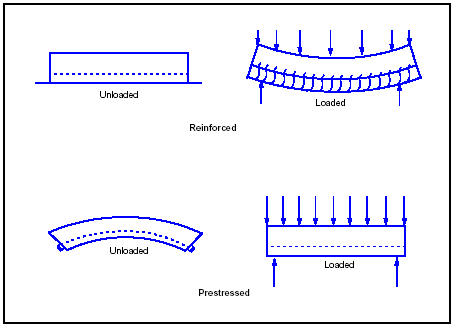
Concrete is very strong in compression, but very weak in tension indeed.
One way to make it less prone to failure is to incude steel cables, which are very strong in tension as part of the structure.
Still better, make sure that the entire material is in tension to begin with by using prestressed cables.
HW I think it was a "reading HW" P75 to 83 or so.....
Your values for the Young's modulus of copper at least were reasonable in an order of magnitude sense. (except for a couple of people who are still having unit conversion issues it seems.)
I showed you a much more accurate way of establishing the extension which was hung up in 502.
We tested some thin nylon and fishing wire samples to see how their ultimate tensile strength varied from sample to sample. The proper treatment of error uses the standard deviation of a sample, but a quick estimate using half the range of a set of results as the absolute error is often fine.
We started to discuss the meanings of some words associated with materials in terms of stress/strain graphs.
Stiffness - a stiff material will have a large Young's modulus, has a steep stress/strain graph.
Toughness - essentially the energy required to break a material, has a large area under the stress/strain graph.
Plastic - a material that yields and extends permanently when beyond it's elastic limit.
Brittle - a material that exhibits no plastic extension, and fails after the elastic region
HW An example set of Young's modulus data for you to answer questions with.
You spent rather a long time plotting your graphs of your results from last time. Be aware that there are 1 million square millimetres in a square metre.
HW Another set of stress strain and Young's modulus questions. Also, finish plotting both graphs and draw lines of best fit. Calculate the gradients of these lines which should be the Young's moduli of the wires you used.
We made an attempt to directly measure the Young's modulus of some materials.
This is hard in the lab due to the tiny strains that are exhibited in the elastic region of extension. Also the limited forces that we can safely apply in the lab.
We solved this by using very long and thin samples (wires) which showed (barely) measurable extensions under small forces.
Read the section on this experiment from your CD.
HW You need to produce a neat description of the experiment, including reasons for the design, and an estimate of the errors involved in the cross sectional area. Calculate and tabulate the stresses and strans ready for graph plotting on Monday.
Stress vs. strain was covered in some more detail. The area under a stress vs. strain graph tells you the energy stored per unit volume in a material.
We looked at some numerical questions relating to Young's modulus from the Edexcel book.
HW 8 Qs from the CD on Young's modulus.
We stretched polyethene to see what properties the plastic had under load.
It did not obey Hooke's law, and most of the extension that it exhibited was permanent. This is plastic, rather than elastic extension.
We learned about the generalisations of force and extension for a lump of material which is any size and shape.
Force becomes Stress (Force per unit area) to deal with a material of any thickness.
Extension becomes strain (extension per unit length) to deal with material of different lengths.
Stress/Strain is a generic measure of how stiff a material is. This is called its Young's modulus.
HW Finish your graph for the polyethene and calculate the energy required to stretch it.
The graphs which you drew for homework were analysed.
The slope of the force/extension graph tells you the "stiffness" of a material.
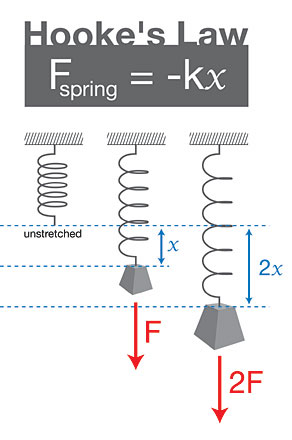
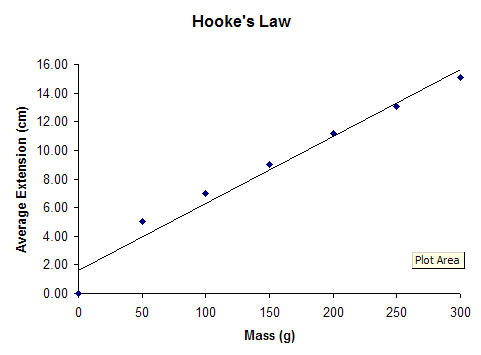
It was found that force was proportional to extension for the most part. The force divided by the extension gives us the spring constant, k of the spring which tells you how stiff it is.
Spring constant(N/m) = Force(N)/Extension(m)
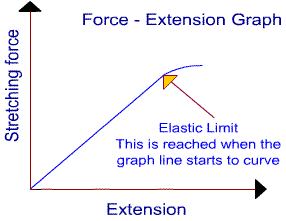
A very large force can permanently deform the spring meaning it has passed beyond its elastic limit. Hookes law no longer applies after the graph has started to curve.
We covered springs in series and parallel. By testing them.
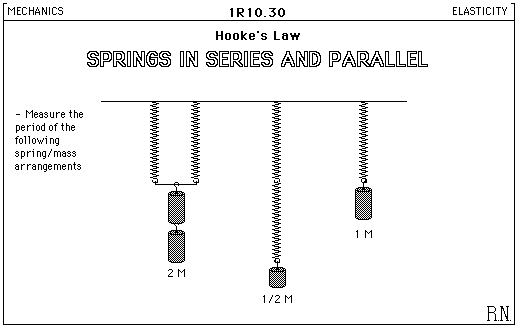
2 springs in parallel extend half as much as one on it's own (the spring constant is doubled). 2 in series extend twice as much (the spring constant is halved).
The Force/Extension graph for an elastic band is not a straight line, showing that it doesn't obey Hooke's law.
The elastic energy stored in a spring can be calulated by finding the area under its force/extension graph.

If the spring obeys Hooke's law, F = kx
and Energy stored = 1/2Fx (area of triangle)
So energy stored = 1/2kx2
This only works for springs below their elastic limit.
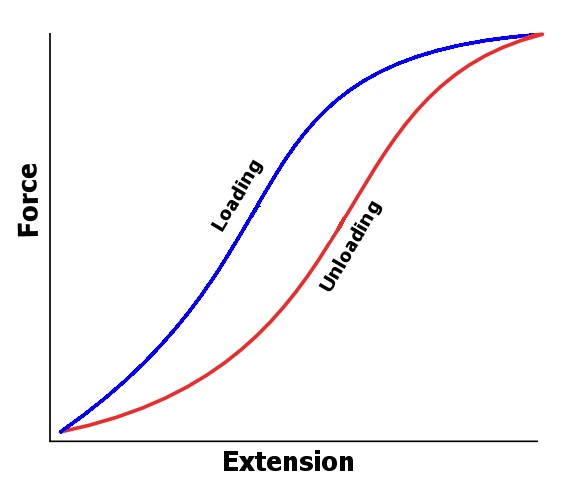
The hysteresis loop shown by the elastic band indicates that not all the energy used in stretching the band is returned when it is unloaded. The area between the 2 lines indicates the energy lost as heat.
HW Define all the words in bold in section 4.1 of the text book.
Welcome to "Advancing Physics". I'm finding it all a bit odd after having done the Edexcel course myself and then taught it for 4 years.
It turns out that we just have to fish the vital bits of Physics out of the book, which is filled with some nice extra interesting bits. The CD is filled with a staggering quantity of extra bits that cannot all be attempted. Then there's the website.....
Anyhow, we started off with something very familiar to most indeed. Hooke's law.
We are covering the materials section of the course, and will start by looking at the mechanical properties of some things.
You stretched a spring under different loads and recorded the extension produced on loading and unloading. You then tried 2 identical springs in series and in parallel. Finally, you tried an elastic band.
HW Plot one graph with the 3 sets of spring data on it. Plot a second graph with the rubber band data on it (ensuring loading and unloading is shown).
Results a bit like this?
Force proportional to extension for the spring.
Different results for loading and unloading with the rubber band. We'll talk through what this means next time.