We went through almost all of the 2002 past paper. SM owes me some revision notes on radioactivity.
27/05/05
We looked at some more work, energy and power GCSE questions. Syllabuses for the end of year exam were given out.
HW 2002 past paper must be completed to be marked (or gone through) during the week after half term.
25/05/05
Apparently you failed to get the correct questions done when I was absent as the message was not passed on. However, we carried on with energy, viewing some videos on different energy sources. Each has advantages and disadvantages that you need to be aware of. We then practised some GCSE questions on work, energy and power. We will not have time for a formal test on this topic, we'll just get straight into revision for the end of year exam.
You were given the 2002 past 4th form exam paper to help with revision over half term. Complete this for HW please. If you are in a Latin exam on Friday, then pick up a syllabus from my pigeon hole please. If not, get it on Friday.
20/05/05
RM absent. You did work, energy and power questions from P172.
18/05/05
There were a great many absences due to drama, music and cricket. We watched a video on work and power. We then did some problem sheets on the same. If you missed the lesson, the sheets are downloadable here and here
Power = Work done/time
It measures the rate at which something can convert energy from one form to another. Power is measured in Joules per second, or Watts.
HW Complete the work, energy and power problems sheet. Books will now be taken in on Friday when I hope the majority of people will actually be in the lesson. The efficiency questions from the AQA book should be there (P87 Qs 1,2,3)
13/05/05
We sat the radioactivity retest. 50% required by those who have yet to produce a decent mark on this topic. If not, more compulsory extra sessions beckon.
I forgot to take in the books, therefore will do so after next lesson.
11/05/05
We looked at the energy changes involved when a ball is dropped and bounces on the ground. (Basically GPE to KE to elastic PE to KE to GPE, and repeat). Losses on the way are sound and heat energy at bounce and also heat due to air resistance.
We performed an experiment to show that the bounce height of a ball is proportional to its drop height in general. But this rule doesn't quite apply if you drop the ball from higher heights. Air resistance comes into play and the efficiency of the bounce drops. This experiment may very well be our coursework topic.
HW Qs on efficiency from AQA book. P87 Qs 1,2,3
06/05/05
We went through the radioactivity test. Poor average leads us to the following action:
We will cover Rutherford's experiment again with everyone in lesson. There will be a compulsory recap session on Thursday lunchtime for all people who got under 55% (and anyone else who would like to show up.)
We will have a second short radioactivity test next Friday, to be completed by everyone.
We'll carry on with work, energy and power next time.
04/05/05
We sat the radioactivity test. Loads of you complained. If you are away, it is your responsibility to try and catch up. Admittedly, some of you wouldn't have had lots of time, but I am entirely unsympathetic to your futile whimperings if you have been absent and not made any attempt to see me and catch up.
We started work, energy and power. Energy cannot be created or destroyed, but when it is converted from one form to another, things happen.
We used an electrical motor to convert chemical potential stored energy in a battery into electrical energy, then kinetic energy which finally lifted a mass up, giving it gravitational potential energy.
A joulemeter recorded the total amount of electrical energy taken from the battery. We calculated the amount of gravitational potential energy that was given to the mass.
GPE = Mass * height * g
Where g is the gravitational field strength (10N/kg on Earth)
We found that there was a discrepancy, some energy must have been wasted in the process.
HW Work out the efficiency of each of the 3 lifts we did. The electrical energy we supplied to the motor was the total energy put into the system. The gravitational potential energy gained by the mass was the total "useful" energy taken out of the system.
29/04/05
We finished off notes on nuclear fission/fusion. Radioactivity is finished, we practised doing some exam questions.
HW Revise for a radioactivity test next Wednesday.
27/04/05
Rutherford's alpha particle scattering experiment.
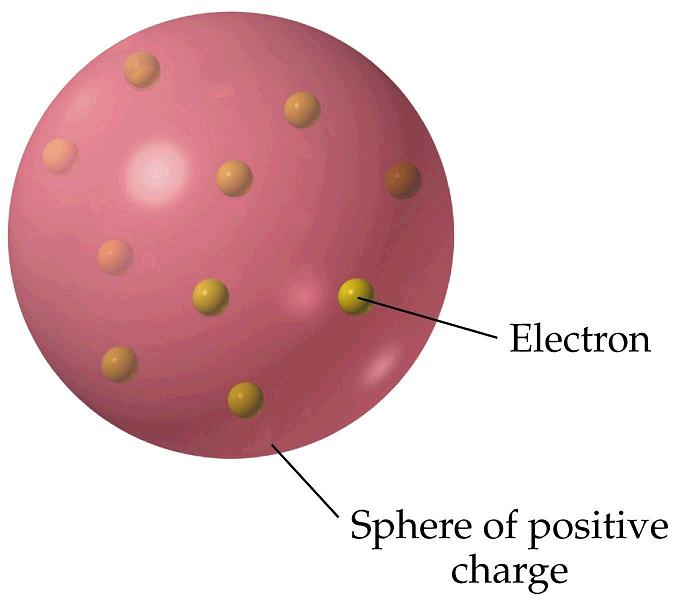
In 1900 or so, it was thought that the atom was made up of negative particles which were uniformly distributed throughout a positively charged sphere.
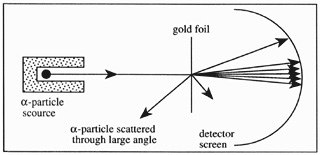
Rutherford fired fast moving alpha particles at a very thin gold foil and found that some particles were deflected by a large amount. This proved that the positive charge in an atom must be concentrated at one particular point. We call this the nucleus of the atom. Electrons "orbit" the nucleus at a distance. Most of the alpha particles pass straight through the gold foil as they pass directly through the empty space which makes up most of the atom.
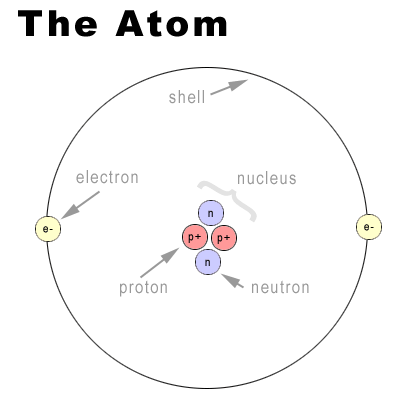
Some are slightly deflected by passing near the positive charge in the nucleus.
Nuclear fission and fusion.
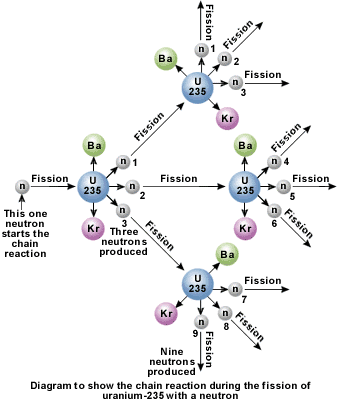
A neutron is absorbed by a large nucleus causing it to become unstable and split into two. The daughter nuclei are more stable than the original one, so energy is released. (They have less mass, E=mc2, so mass has been converted into energy.)
If enough fissile material (uranium-235 or plutonium-239) is present, the neutrons released in one fission will hit other nuclei, causing them to split.
The energy can be released catastrophically as in an A bomb, or in a more controlled manner in a reactor. Control rods are used to absorb some of the neutrons in this case.
The daughter nuclei are radioactive with a long half life which causes problems as what to do with the spent fuel.
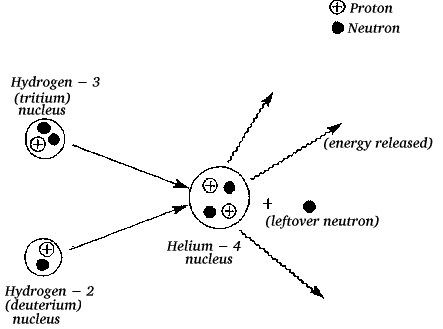
2 small nuclei are slammed together at very high temperatures. They become more stable as a result, turning into Helium. This releases energy. Fusion is the reaction that powers stars, the above reaction is one that humans are trying to harness in order to have an almost inexhaustible supply of energy. (The fuel can be derived from seawater.
Fusion does not leave radioactive waste and is much more efficient than fusion in terms of the amount of energy released per gram of fuel.
Humanity must harness this power effectively if it is to have any long term hopes of survival.
HW Physics Matters P271 Qs 1,2,4
22/04/05
We saw a real time decay of a radioactive sample. Radon gas was blown into a gas chamber with a voltage across it. An ammeter was conected across the chamber. The radon gas is radioactive, producing alpha particles. The alpha particles ionised the gas in the chamber which allowed a current to flow. The more ionisation there was, the more current flowed.
We plotted a graph showing how the current dropped over time. It was the same shape as the "decay curve" we saw in the dice analogy. We were able to calculate the half life of the radon. It was about 80 seconds or so. (2 readings were taken from the graph for greater accuracy). So half of the radon atoms present would decay every 80 seconds. Radon is itself a decay product of thorium, which has a very long half life. A continual supply of radon is therefore released around radioactive thorium deposits.
Radon gas is released around granite rock and is heavier than air. This can increase the natural dose of radiation recieved if a person lives in a granite based area (e.g. Cornwall.)

An example of a decay curve showing several half lives.
Radioactivity Qs 1-8 from handout are required in from several people on Monday, 10 were submitted.
Kyle needs to sit his retest on Monday breaktime.
Kyle, Nat and Sandro will write me letters of apology for next lesson or get detentions.
20/04/05
We learned about the various uses of radioactive materials.
A radioactive isotope of an element is one that has unstable nuclei which will decay by producing one of the three different types of radioactive emissions. (eg. carbon-14) Most common isotopes of elements have stable nuclei and so are not radioactive (eg. carbon-12).
Alpha particles have uses in smoke detectors, ionising air within the detector to allow a current to flow. Smoke particles absorb more alpha particles so the current drops when smoke gets in to the detector.
Beta particles are often used to help control the thickness of milled paper or metal. Put a source on one side and a detector on the other. If the material being produced is too thick, more beta particles are absorbed, the count rate goes down and so an adjustment must be made and similarly the count rate goes up if the material is too thin. Carbon dating uses the beta decay of carbon 14 to nitrogen to tell how old organic material is.
Gamma rays are used to sterilise food and medical equipment. They can also be used as medical tracers. Inject a dissolved gamma ray source into someone's blood stream and the gamma rays will be able to pass out through their skin. Using a radiation detector you can tell where most blood flow is going on. They can also be used to test for hairline cracks in machines or to trace the movement of materials within sea currents etc. Gamma rays can also be used to kill cancerous cells within the body.
A radioactive isotope must be chosen with a sensible half life must be chosen for each application. For internal medical use, the half life must be very short. For longer lasting industrial applications it has to be longer.
This file contains basic notes plus the HW questions.
HW Complete questions 1-8 of the radioactivity handout. All 50% and below are joining me for an electromagnetism retest at 1.30pm tomorrow.
15/04/05
We went through the electromagnetism test which was done poorly as a whole. Those who got 50% or less are required for a retest which will be sat at the start of Thursday lunchtime. Detentions for those who don't show up. 60% will be the minimum requirement for this retest or you will continue to lose lunchtimes.
We looked at a few radioactive sources. There are 3 types of nuclear radiation. They are all potentially dangerous as they can smash into cells within the body, causing damage, cell death and sometimes mutations which can lead to cancer.
Alpha particles are small lumps which come flying off a larger, unstable nucleus and consist of 2 neutrons and 2 protons. They are easily absorbed by a small distance of air or a piece of paper. They are very dangerous if ingested, however.
Beta particles are electrons which come zooming out of the nucleus at high speeds. They appear when a neutron within the nucleus turns into a proton. They can be stopped by a thinish layer of aluminium but can penetrate the skin and some distance through air.
Gamma rays are not particles, but short bursts of high energy electromagnetic radiation. Gamma rays are also produced by unstable nuclei, but they do not change the composition of the nucleus in terms of the particles present when they are produced. Gamma rays are the most penetrative type of nuclear radiation and require several inches of lead to absorb most of them.
We will look in much more detail at the different types of radiation, and their possible uses next week.
13/04/05
We sat the electromagnetism test.
Then we began looking at radioactive decay. Some nuclei are not stable and occasionally "decay" into more stable nuclei. This decay is a chance event, which has a certain probability of happening within a given amount of time.
We used dice to simulate a sample of radioactive nuclei decaying. Each time a die was thrown, there was a probability of 1/6 of it decaying.
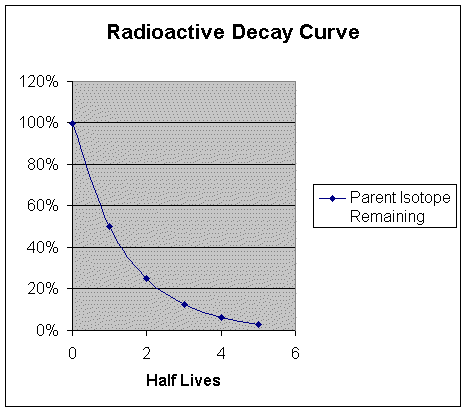
The exponential decay curve is followed by all radiactive samples.
The half life of a sample is the amount of time taken for half of the nuclei present to decay, or the time taken for the radioactive count rate to drop to half of its present value.
HW Qs 1-3 P131 of AQA.