3H 25/05/06
We calculated how much longer the Millenium bridge gets in a hot summer compared to a cold winter due to thermal expansion. About 17cm it seems.
We then looked at what happens if you heat a fixed volume of gas. The hot gas cannot expand, but the particles are moving faster so they bang into the walls of the container faster and more often exerting a larger force.
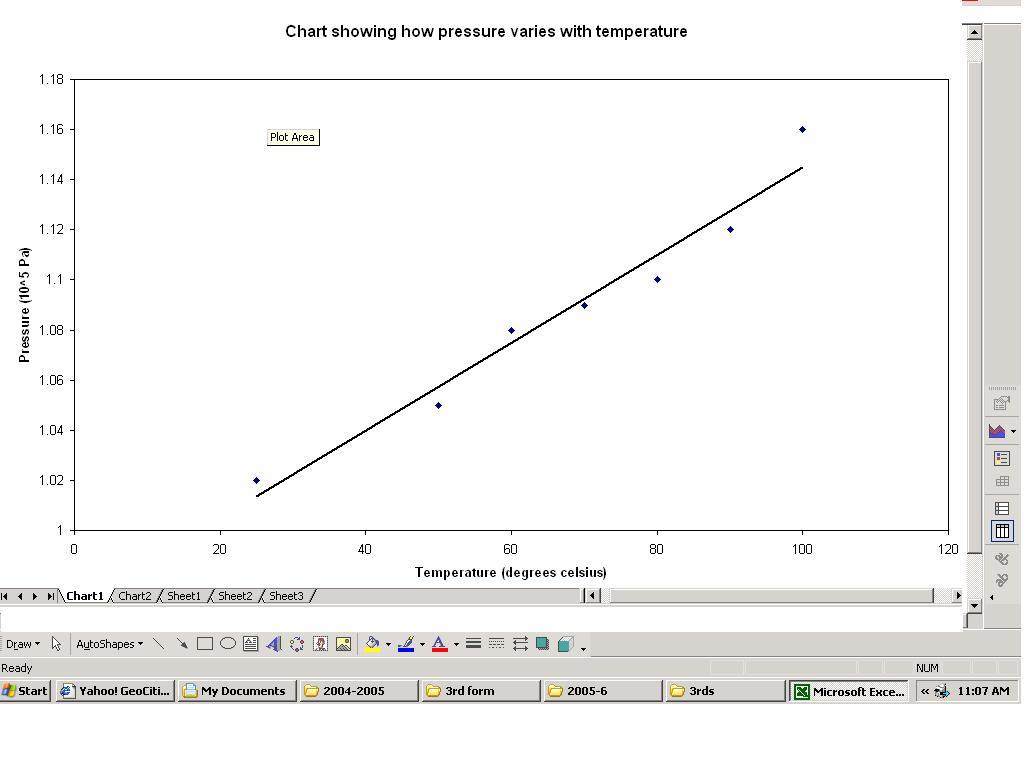
This file shows the results that we got.
If a heated gas is not able to expand, it will exert a larger pressure. The pressure rises proportionally with the temperature.
HW Revision obviously, but do the 2004 past paper in near to test conditions please and it will be marked. 2003 is for you to practise with.
3H 20/05/06
We did some calculations on thermal expansion. Thermal expansion of solids happens because the particles vibrate more when heated and so the average distance between particles rises, making the material slightly bigger.
We also looked at a demonstration of Brownian motion.
How do we know that materials are made up of individual atoms? We saw some evidence for this. Looking at illuminated smoke particles (very small lumps of carbon) through a microscope, we saw them jiggling around at random. This motion cannot be explained unless the particles are being hit by individual gas molecules from around them, knocking them this way and that.
It is called Brownian motion, first spotted by a biologist looking at pollen grains suspended in water.
3B 19/05/06
The cooling a cup of coffee conundrum was experimentally modelled and solved. If you are forced to leave your coffee for a period of time, it is better to put the milk in prior to leaving it, rather than afterwards.
This is because the black coffee will have a higher temperature than the white coffee to begin with. This means that the difference in temperature between the black coffee and the surrounding atmosphere is larger. This means that more heat energy is transferred from the black coffee to the atmosphere during the time you leave it. You then have to add the milk anyway, which will cool it further.
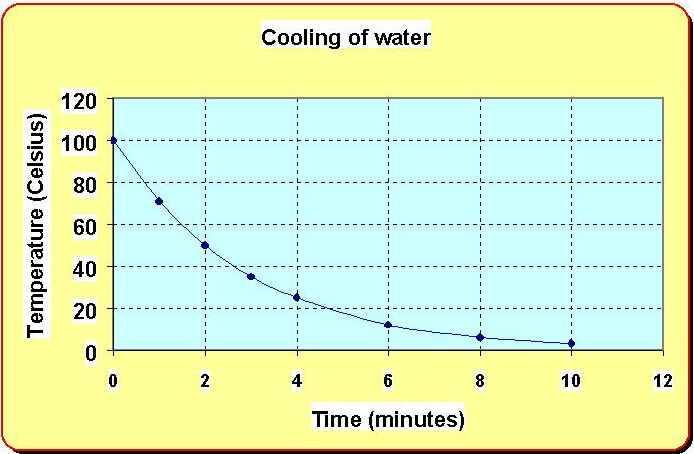
The cooling curve of an object starts off steep and gets less steep as the object gets nearer to the temperature of the atmosphere around it. The rate of cooling is proportional to the difference in temperature between an object and its surroundings.
3H 18/05/06
We saw demos that demostrated that solid objects expand when heated. In the first, a steel bar expanded with enough force to break a smaller iron peg which was holding it in.
We also saw various other demos which are detailed quite well here.
We then carried out an experiment to see how far various metal rods expanded when heated using Bunsens.
We'll look at calculations involving this idea on Tuesday.
HW Finish all the calculations and questions on the handout sheet for the experiment.
3H 16/05/06
The cooling a cup of coffee conundrum was experimentally modelled and solved. If you are forced to leave your coffee for a period of time, it is better to put the milk in prior to leaving it, rather than afterwards.
This is because the black coffee will have a higher temperature than the white coffee to begin with. This means that the difference in temperature between the black coffee and the surrounding atmosphere is larger. This means that more heat energy is transferred from the black coffee to the atmosphere during the time you leave it. You then have to add the milk anyway, which will cool it further.
The cooling curve of an object starts off steep and gets less steep as the object gets nearer to the temperature of the atmosphere around it.
3B 16/05/06
Black objects absorb heat radiation best (as they do light) and so warm up the most when infra red is shone on them. White or silver objects reflect most heat radiation and heat up less.
Black objects emit heat radiation best too, so if a hot object is black, it will emit more radiation than a white or silver object at the same temperature.
3B 10/05/06
Conduction of heat: When one part of a substance is heated, the particles begin to move faster. They pass on their energy to their neighbouring particles by collisions, thereby heat energy is passed through the material.
Solids conduct better than liquids or gases (particles closer together). Metals conduct best (free electrons can carry heat energy through the structure).
Keep your notes made on the printed handout so you can add radiation and convection stuff to them on Tuesday.
3H 11/05/06
Solids conduct better than liquids or gases (particles closer together). Metals conduct best (free electrons can carry heat energy through the structure).
Black objects absorb heat radiation best (as they do light) and so warm up the most when infra red is shone on them. White or silver objects reflect most heat radiation and heat up less.
Black objects emit heat radiation best too, so if a hot object is black, it will emit more radiation than a white or silver object at the same temperature.
3H 09/05/06
We went through the waves and sounds test.
Then we just touched upon the topic for next lesson. Methods that heat can transfer energy from one place to another, conduction, convection and radiation.
Books were taken in.
3B 09/05/06
We went through the waves and sounds test.
We heated 3 samples of metals using an electrical heater. We calculated the specific heat capacity of each one. That is the energy needed to heat 1kg of a substance up by 1 degree Kelvin (or Celsius - it's the same thing)
1kg of Aluminium required much more energy to heat it up by 1 degree than 1kg Copper. This difference is due to the microscopic atomic structure of the metals.
Here is a nice link which explains it all.
HW Do specific heat capactiy (shc) questions on the sheet. I seem to have all of your books!
3B 05/05/06
We didn't go through the test due to being a bit lazy.
We started looking at the new topic - heat energy and temperature.
We talked about heat energy and temperature. Heat energy is the energy something has due to the internal movement of its particles. When you heat something up, you are making its particles move faster, in a solid they vibrate, in a liquid and a gas they are able to move around each other.
The temperature of a body is a measure of the average kinetic energy of its particles. It is often measured in degrees Kelvin in science. They are the same as Celsius except that O Kelvin is the temperature at which particles would completely stop moving, and so things cannot possible be any colder than that. It is at -273 degrees celsius - absolute zero.
A large object at a low temperature will carry more heat energy with it than a small object at a higher temperature.
When you give an object some heat energy, it will warm up. The amount that it warms up by depends on its heat capacity.
The heat capacity of an object is the amount of energy required to heat it up by 1 degree.
The specific heat capacity of a material is the amount of energy required to heat up 1kg of the substance by 1 degree.
3H 04/05/06
We heated 3 samples of metals using an electrical heater. We calculated the specific heat capacity of each one. That is the energy needed to heat 1kg of a substance up by 1 degree Kelvin (or Celsius - it's the same thing)
1kg of Aluminium required much more energy to heat it up by 1 degree than 1kg Copper. This difference is due to the microscopic atomic structure of the metals.
Here is a nice link which explains it all.
HW 2nd set of questions on specific heat capacity done in your books. I still need to mark your sound tests......
3B 28/04/06
We sat the waves and sounds test.
3H 27/04/06
We sat the waves and sounds test. Then onto the new topic - heat energy.
We talked about heat energy and temperature. Heat energy is the energy something has due to the internal movement of its particles. When you heat something up, you are making its particles move faster, in a solid they vibrate, in a liquid and a gas they are able to move around each other.
The temperature of a body is a measure of the average kinetic energy of its particles. It is often measured in degrees Kelvin in science. They are the same as Celsius except that O Kelvin is the temperature at which particles would completely stop moving, and so things cannot possible be any colder than that. It is at -273 degrees celsius - absolute zero.
A large object at a low temperature will carry more heat energy with it than a small object at a higher temperature.
When you give an object some heat energy, it will warm up. The amount that it warms up by depends on its heat capacity.
The heat capacity of an object is the amount of energy required to heat it up by 1 degree.
The specific heat capacity of a material is the amount of energy required to heat up 1kg of the substance by 1 degree.
HW Couple of questions based upon water having a specific heat capacity of 4200J/kg/degree
3H 25/04/06
We prepared for a test on waves and sounds which will be on Thursday.
HW Revise and make sure that set of questions on the speed of sound. is done.
3B 25/04/06
We prepared for a test on waves and sounds which will be on Friday.
HW Revise and make sure that set of questions on the speed of sound is done.