
3H 13/12/07
Merry Christmas!
Building an electronic thermometer.
We made a circuit which acted as an electronic thermometer. This was achieved by putting a thermistor in series with a fixed resistor. As the temperature rose, the resistance of the thermistor fell, this meant that the share of the battery voltage taken by the thermistor also fell. The voltage across the fixed resistor therefore increased as the temperature rose. We used ice and boiling water to calibrate the device.
Books are in.
We learned all about diodes
They only allow charge to flow through them in one direction, rather like electrical valves.
LEDS

A diode that emits light when a current passes through it.
thermistors
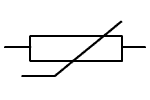
Loses resistance as it gets hotter, the opposite of a filament bulb. This happens because it gains many free charge carriers the hotter it gets, outweighing the "crowded party" effect.
and LDRs.

Loses resistance as the light levels increase, again due to an increase in free charge carriers.
We learned all about diodes
They only allow charge to flow through them in one direction, rather like electrical valves.
LEDS
A diode that emits light when a current passes through it.
thermistors
Loses resistance as it gets hotter, the opposite of a filament bulb. This happens because it gains many free charge carriers the hotter it gets, outweighing the "crowded party" effect.
and LDRs.
Loses resistance as the light levels increase, again due to an increase in free charge carriers.
We did an experiment to test how the voltage across and current through a filament light bulb varied.
It was found that for the light bulb the voltage and current were not proportional to each other. The line on the V/I graph was a curve. This means that the bulb does not obey Ohm's law. (Resistance = Voltage / Current).
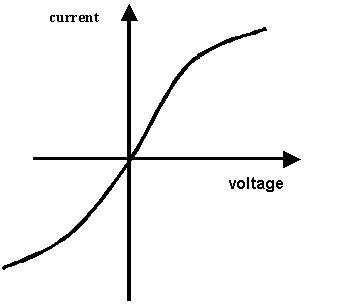
This graph has opposite axes to the one you plotted. Don't worry about this, the important point is that the hotter the bulb gets, the greater the voltage increase required to push more current through the filament.
Hotter objects have an increased resistance
The reason for this is because a hotter electrical conductor will have greater vibrations in its particles. These will impede the flow of electrons through the substance, increasing its resistance. c.f. the crowded party.
HW Research non-filament light sources (e.g. fluorescent strip lights, LEDs etc.) and write down in simple terms how they work and find out how efficient they are. Complete all the questions from the board, including the table of resistances and stick your graph in if not done in the lesson.
We did an experiment to test how the voltage across and current through a filament light bulb varied.
It was found that for the light bulb the voltage and current were not proportional to each other. The line on the V/I graph was a curve. This means that the bulb does not obey Ohm's law. (Resistance = Voltage / Current).
This graph has opposite axes to the one you plotted. Don't worry about this, the important point is that the hotter the bulb gets, the greater the voltage increase required to push more current through the filament.
Hotter objects have an increased resistance
The reason for this is because a hotter electrical conductor will have greater vibrations in its particles. These will impede the flow of electrons through the substance, increasing its resistance. c.f. the crowded party.
HW Research non-filament light sources (e.g. fluorescent strip lights, LEDs etc.) and write down in simple terms how they work and find out how efficient they are. Complete all the questions from the board, including the table of resistances and stick your graph in if not done in the lesson.
We did a little set of problems using Ohm's Law. (V=IR)
Although metals have electrons which are free to move, they don't pass through the material in straight lines when a voltage is applied.
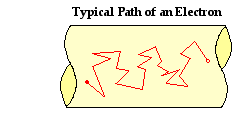
They tend to collide with each other and with the positive ions jostling around within the metal this animation shows the effect more clearly.
The collisions tend to slow the motion of the electrons rather like a kind of electrical "friction". The harder it is for electrons to pass through a metal, the higher its electrical resistance.
An experiment to test how voltage applied across a component effects the current flowing through it was done.
The resistor showed a proportional relationship between the voltage and the current. It is said to obey Ohm's law.
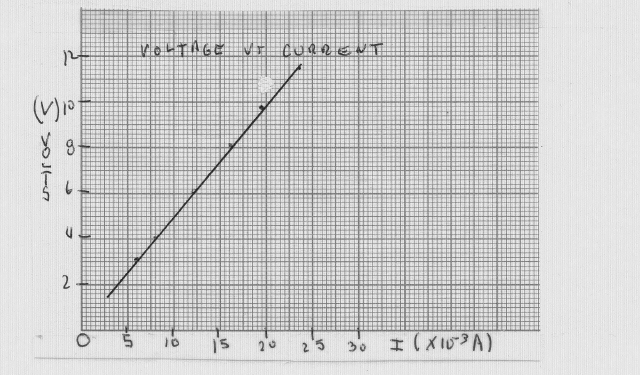
The gradient of line gives the resistance of the component.
Voltage = Current times Resistance, or V = IR, R = V/I
The larger the resistance, the larger steeper the line on the graph.
HW Finish off the experimental write up by plotting both graphs, finding their gradients and answering the questions on the handout using the Ohm's law formula.
Although metals have electrons which are free to move, they don't pass through the material in straight lines when a voltage is applied.
They tend to collide with each other and with the positive ions jostling around within the metal this animation shows the effect more clearly.
The collisions tend to slow the motion of the electrons rather like a kind of electrical "friction". The harder it is for electrons to pass through a metal, the higher its electrical resistance.
An experiment to test how voltage applied across a component effects the current flowing through it was done.
The resistor showed a proportional relationship between the voltage and the current. It is said to obey Ohm's law.
The gradient of line gives the resistance of the component.
Voltage = Current times Resistance, or V = IR, R = V/I
The larger the resistance, the larger steeper the line on the graph.
HW Finish off the experimental write up by plotting both graphs, finding their gradients and answering the questions on the handout using the Ohm's law formula.
We did a litte quiz based on the rules you have learned for current and voltage in series and parallel circuits. They can be summarised thus:
In series, the current is the same at all points.
In series, the battery voltage is shared between all the components in the circuit.
In parallel, each parallel path recieves the full battery voltage.
In parallel, the total current is found by the addition of the currents in each of the parallel paths.
No - slavery day or some such. We'll carry on with Ohm's law next time then.
RM practically unconcious with fatigue.
Electron structure in metals was discussed, among other things.
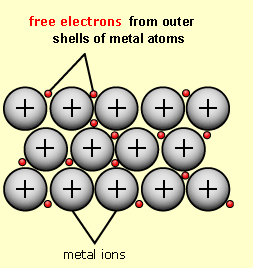
Although metals have electrons which are free to move, they don't pass through the material in straight lines when a voltage is applied.
They tend to collide with each other and with the positive ions jostling around within the metal this animation shows the effect more clearly.
Electricity we started.
Electric current is a word describing moving electrical charges. It is the rate of flow of electrical charge. The unit which is used to measure charge is called the Coulomb. (The numbers of individual electrons moving would be very large indeed.)
Current is therefore measured in Coulombs per second. Another word for 1 Coulomb per second is an Ampere
. Electrical conductors are materials that allow the passage of electric current. In order to do this they must have charge carriers (usually electrons) which are free to move.
Metals have free electrons as part of their structure which can conduct electricity.
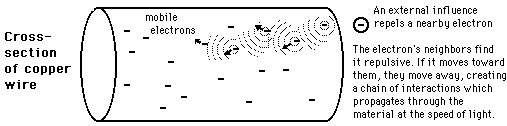
Although electrons move slowly through metal wires, each electron repels its neighbour causing a knock on effect which means that electrical energy is transferred at the speed of light.
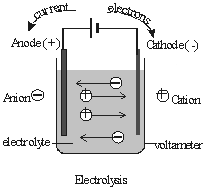
The dissolved ions in a solution are also free charge carriers and so can be used to conduct electricity.
We tested some simple circuits with light bulbs in and came up with the following rules:
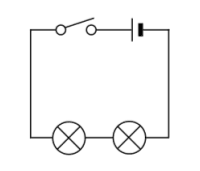
1. The current in a series circuit is the same at all points.
2. The bulbs lit up at less than normal brightness in series; less current was flowing through them than in a single bulb.
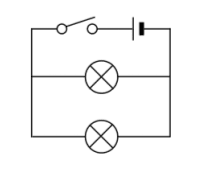
1. The total current in a series circuit is equal to the sum of the currents in each parallel path.
2. The bulbs in parallel lit up at normal brightness; they had the same current flowing through each of them as flows through a single bulb.
HW Draw diagrams and explain the following terms in your books.:
Series circuit
Parallel circuit
Then write down the rules we figured out for the current in the seres circuits and parallel circuits.
Electricity we started.
Electric current is a word describing moving electrical charges. It is the rate of flow of electrical charge. The unit which is used to measure charge is called the Coulomb. (The numbers of individual electrons moving would be very large indeed.)
Current is therefore measured in Coulombs per second. Another word for 1 Coulomb per second is an Ampere
. Electrical conductors are materials that allow the passage of electric current. In order to do this they must have charge carriers (usually electrons) which are free to move.
Metals have free electrons as part of their structure which can conduct electricity.
Although electrons move slowly through metal wires, each electron repels its neighbour causing a knock on effect which means that electrical energy is transferred at the speed of light.
The dissolved ions in a solution are also free charge carriers and so can be used to conduct electricity.
We tested some simple circuits with light bulbs in and came up with the following rules:
1. The current in a series circuit is the same at all points.
2. The bulbs lit up at less than normal brightness in series; less current was flowing through them than in a single bulb.
1. The total current in a series circuit is equal to the sum of the currents in each parallel path.
2. The bulbs in parallel lit up at normal brightness; they had the same current flowing through each of them as flows through a single bulb.
HW Draw diagrams and explain the following terms in your books.:
Series circuit
Parallel circuit
Then write down the rules we figured out for the current in the seres circuits and parallel circuits.
Rm present yet again!
You did a bunch of questions on energy to finish off the toopic. We'll start some electricity next time.
RM expectedly absent. You did a bunch of questions on energy.
RM unexpectedly present!
We looked at some ways of calculating the amount of energy involved in energy transfers.
Energy be created or destroyed - only changed from one form to another. When this happens - work is done and a physical change of some sort takes place.
Kinetic energy - due to the movement of a mass. KE = 1/2mv2
Gravitational potential energy - lift something up and it has the potential to fall down again. GPE = mgh
Heat energy - due to the internal movement of particles.
Light energy - carried via an electromagnetic wave.
Electrical energy - carried as the movement of charge through a conductor.
Chemical PE - stored in fuels which are yet to be reacted to release their energy into a more useful form.
Elastic PE - stored when materials stretch or squash (e.g. springs)
This file has the calculations done in the lesson.
We learned about efficiency.
A device which transfers energy from one form to another is called a transducer. Often, there is more than one energy transfer involved in the operation of a single transducer.
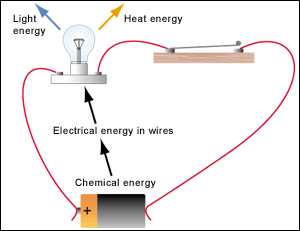
2 energy transfers are involved in a simple light bulb.
Some transducers do not change all of the energy into the required form. Some energy is changed into an unusable form which is wasted (although not destroyed).
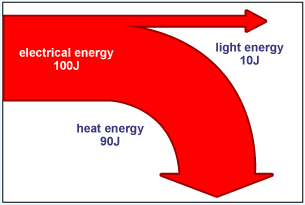
The bulb only converts 10% of the input electrical energy into the useful form, light. It is said to be 10% efficient.
We did some calculations on efficiency. It is defined as the useful energy obtained from a device as a percentage of the total energy going into the device.
Efficiency = Useful energy/Total energy * 100%
This file has the calulations we tried.
HW
RM unexpectedly present!
We looked at some ways of calculating the amount of energy involved in energy transfers.
Energy be created or destroyed - only changed from one form to another. When this happens - work is done and a physical change of some sort takes place.
Kinetic energy - due to the movement of a mass. KE = 1/2mv2
Gravitational potential energy - lift something up and it has the potential to fall down again. GPE = mgh
Heat energy - due to the internal movement of particles.
Light energy - carried via an electromagnetic wave.
Electrical energy - carried as the movement of charge through a conductor.
Chemical PE - stored in fuels which are yet to be reacted to release their energy into a more useful form.
Elastic PE - stored when materials stretch or squash (e.g. springs)
We learned about efficiency.
A device which transfers energy from one form to another is called a transducer. Often, there is more than one energy transfer involved in the operation of a single transducer.
2 energy transfers are involved in a simple light bulb.
Some transducers do not change all of the energy into the required form. Some energy is changed into an unusable form which is wasted (although not destroyed).
The bulb only converts 10% of the input electrical energy into the useful form, light. It is said to be 10% efficient.
We did some calculations on efficiency. It is defined as the useful energy obtained from a device as a percentage of the total energy going into the device.
Efficiency = Useful energy/Total energy * 100%
This file has the calulations we tried.
HW
I was away for absolutely donkey's years.
We went through the forces and motion test and I established what you had got done while I was away. You had begun some ideas on energy.
I demonstrated some devices which transferred energy from one form to another.
A device which transfers energy from one form to another is called a transducer. Often, there is more than one energy transfer involved in the operation of a single transducer.
2 energy transfers are involved in a simple light bulb.
Books came in.
HW 4 or 5 sentences explaining why it is such a bad idea to insert energy collecting rollers connected to generators in the roads around the country on paper.
I was away for absolutely donkey's years.
We went through the forces and motion test and I established what you had got done while I was away. You had begun some ideas on energy.
I demonstrated some devices which transferred energy from one form to another.
A device which transfers energy from one form to another is called a transducer. Often, there is more than one energy transfer involved in the operation of a single transducer.
2 energy transfers are involved in a simple light bulb.
HW Complete energy flow diagrams for oil, gas, wind, wave, tidal, solar, geothermal and nuclear electricity generation on paper.
You sat the forces and motion test which you had prepared for so well.
RM absent with dead leg. You started the new topic, "Energy" by doing some work from the text book.
RM absent with dead leg. You did some forces and motion test preparation.
We sat the forces and motion test.
We saw a video on freefall, the idea of apparent weightlessness and drag forces.
We then went on to discuss free fall. Without air resistance, all objects fall at the same rate with an acceleration of about 10m/s/s (on Earth). However, air resistance changes the way that some objects fall.
We looked at drag forces.
A speed/time graph of the motion of a skydiver would look like this:
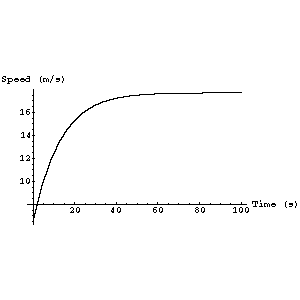
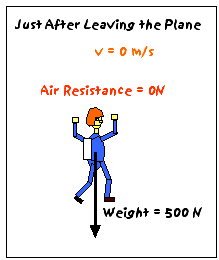
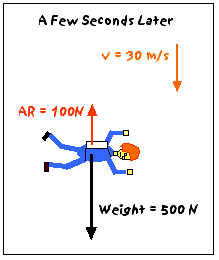
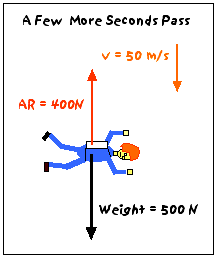
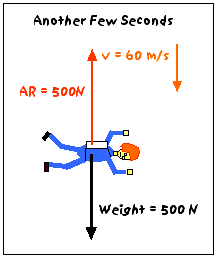
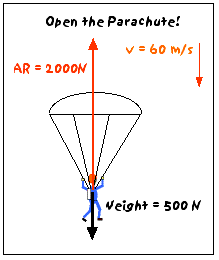
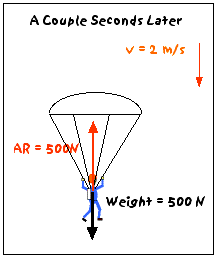
The above shows how a parachutist first accelerates until the air resistance force on him is equal to his weight. He then travels at terminal velocity, a constant speed with balanced forces acting on him. He then artificially increases his air resistance by opening his parachute, so he slows down until air resistance once again equals his weight at a much slower (and safer) speed.
Terminal velocity occurs when the air resistance (sometimes called "drag") force equals the weight iof the falling object. This means that:
heavy, compact, objects will have a higher terminal velocity than light, spread out objects. Therefore, heavy objects will fall faster in air than light objects
Horizontal and vertical motion are entirely seperate. We talked about the monkey and the hunter example. If the monkey lets go as the hunter fires at it it is doomed.(whatever angle the gun is fired at the monkey from).
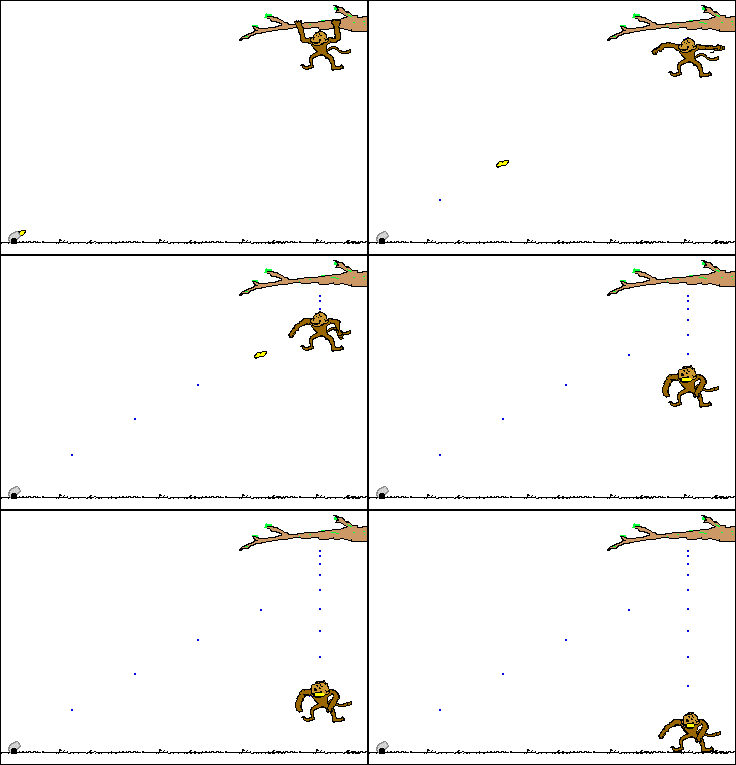
We saw some lab demos of horizontal motion being unrelated to vertical motion and of acceleration due to gravity being the same for all objects in a vacuum.
Then we started to prepare for a test next lesson by answering many questions on the topic.
HW Revise for a test on forces and motion next time.
More ticker tapes. This time, we measured the motion of a falling object. You produced another ticker tape "graph" and calculated the acceleration of the trolley.
Remember: Acceleration = Change in speed / time
a = (v-u)/t
To work out acceleration you must first work out the fastest speed ( s = d/t ) from the longest ticker. Then work out the slowest speed ( s = d/t ) again from the shortest ticker. Then calculate how long the time was between the 2 speeds you have just worked out (You can do this by counting the number of gaps between dots which have happened between your 2 speeds). Finally stick all 3 numbers into the formula for acceleration.
HW Read P119 and 120 of your text book and answer Qs 1-7 not 1-12, that's probably too many!
We saw a video on freefall, the idea of apparent weightlessness and drag forces.
We then went on to discuss free fall. Without air resistance, all objects fall at the same rate with an acceleration of about 10m/s/s (on Earth). However, air resistance changes the way that some objects fall.
We looked at drag forces.
A speed/time graph of the motion of a skydiver would look like this:
The above shows how a parachutist first accelerates until the air resistance force on him is equal to his weight. He then travels at terminal velocity, a constant speed with balanced forces acting on him. He then artificially increases his air resistance by opening his parachute, so he slows down until air resistance once again equals his weight at a much slower (and safer) speed.
Terminal velocity occurs when the air resistance (sometimes called "drag") force equals the weight iof the falling object. This means that:
heavy, compact, objects will have a higher terminal velocity than light, spread out objects. Therefore, heavy objects will fall faster in air than light objects
Horizontal and vertical motion are entirely seperate. We talked about the monkey and the hunter example. If the monkey lets go as the hunter fires at it it is doomed.(whatever angle the gun is fired at the monkey from).
We learned about acceleration.
We looked at calculating acceleration.
Acceleration is the rate of change of speed (as long as no change of direction is involved)
Acceleration (m/s2) = Change in speed / time
In symbols : a = (v-u)/t
v = final speed (m/s)
u = initial speed (m/s)
t = time to go between the 2 speeds
Remember: Acceleration = Change in speed / time
a = (v-u)/t
To work out acceleration you must first work out the fastest speed ( s = d/t ) from the longest ticker. Then work out the slowest speed ( s = d/t ) again from the shortest ticker. Then calculate how long the time was between the 2 speeds you have just worked out (You can do this by counting the number of gaps between dots which have happened between your 2 speeds). Finally stick all 3 numbers into the formula for acceleration.
More ticker tapes. This time, we measured the motion of a falling object. You produced another ticker tape "graph" and calculated the acceleration of the trolley.
Remember: Acceleration = Change in speed / time
a = (v-u)/t
To work out acceleration you must first work out the fastest speed ( s = d/t ) from the longest ticker. Then work out the slowest speed ( s = d/t ) again from the shortest ticker. Then calculate how long the time was between the 2 speeds you have just worked out (You can do this by counting the number of gaps between dots which have happened between your 2 speeds). Finally stick all 3 numbers into the formula for acceleration.
HW Read P119 and 120 of your text book and answer Qs 1-7 on paper
We looked at ticker tape timers.
Average speed = Distance / Time
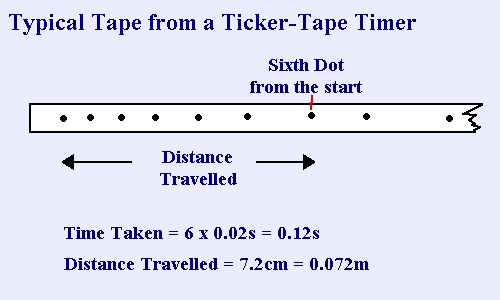
A ttt produces one dot every 1/50th of a second.
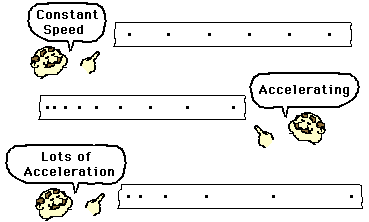
The distance between the dots varies if the speed is changing.
You produced a ticker tape "graph" for a constant speed and a trolley accelerating down a slope.
HW Finish off both graphs. Books were kept in.
We looked at a pre-prepared tickertape and used it to calculate an acceleration due to gravity. We'll do the practical for this next time.
We had another lesson!
To work out the speed of an object you need to know how far it has travelled and how long it has taken.
This can be done using a stopwatch and a ruler. We tried this to measure the average speed of falling objects but found it quite difficult.
We observed a light gate attached to an air track. The light gate times how long a beam of light is cut off for. If you know the length of the object, you can than calculate its speed.
Speed (m/s) = Distance (m) / Time (s)
HW No.
More ticker tapes. You produced a ticker tape "graph" and calculated the acceleration of a trolley going down a slope.
We learned about acceleration.
We looked at calculating acceleration.
Acceleration is the rate of change of speed (as long as no change of direction is involved)
Acceleration (m/s2) = Change in speed / time
In symbols : a = (v-u)/t
v = final speed (m/s)
u = initial speed (m/s)
t = time to go between the 2 speeds
Remember: Acceleration = Change in speed / time
a = (v-u)/t
To work out acceleration you must first work out the fastest speed ( s = d/t ) from the longest ticker. Then work out the slowest speed ( s = d/t ) again from the shortest ticker. Then calculate how long the time was between the 2 speeds you have just worked out (You can do this by counting the number of gaps between dots which have happened between your 2 speeds). Finally stick all 3 numbers into the formula for acceleration.
HW Finish off both graphs, stick them into your book and calulate all the speeds and the accelration required by the handout.
No. CCF. I gave you some cover work to do from a GCSE book.
The last lesson of the day. What happened?
We practised calculating speeds using a ticker tape timer.
HW I don't think so.
We did an experiment investigating friction. The larger the weight of an object, the larger the frictional force it can produce in contact with a surface. We discovered this because it took a larger force to start moving a block when it had masses piled on top.
Once an object has started sliding, the frictional force on it decreases. It took less force to keep the block sliding at a constant speed than it did to start it moving in the first place. Static friction is larger than dynamic friction.
HW I'll miss the next lesson too! Research antilock brakes in cars and write a paragraph or 2 to explain how they work and why they are better than ordinary ones (with reference to static and dynamic friction).
We looked at three methods of measuring speed.
Firstly, to work out the speed of an object you need to know how far it has travelled and how long it has taken.
This can be done using a stopwatch and a ruler. We tried this to measure the average speed of falling objects but found it quite difficult.
We observed a light gate attached to an air track. The light gate times how long a beam of light is cut off for. If you know the length of the object, you can than calculate its speed.
Speed (m/s) = Distance (m) / Time (s)
We looked at ticker tape timers.
Average speed = Distance / Time
A ttt produces one dot every 1/50th of a second.
The distance between the dots varies if the speed is changing.
HW Research and record how speed cameras operate.
No. Stubbers. You did a bunch af cover work for me.
No. Stubbers. You did a bunch af cover work for me.
Books were issued to all. Numbers were taken in.
Forces can be mechanical or act at a distance (e.g. gravity). When an object has unbalanced forces acting on it, it will accelerate in the direction of the overall force acting on it. If a body has balanced forces on it, it will remain at a constant speed or at rest.
An object sitting on a table has 2 equal and opposite forces acting on it. Its own weight acts downwards and is counteracted by the reaction force that the table puts onto the object.
I won't see you next lesson as I'm on a trip with my form. Cover work will be set.
Books were issued to all. Numbers were taken in.
Forces can be mechanical or act at a distance (e.g. gravity). When an object has unbalanced forces acting on it, it will accelerate in the direction of the overall force acting on it. If a body has balanced forces on it, it will remain at a constant speed, or at rest.
An object sitting on a table has 2 equal and opposite forces acting on it. Its own weight acts downwards and is counteracted by the reaction force that the table puts onto the object.
We did an experiment investigating friction. The larger the weight of an object, the larger the frictional force it can produce in contact with a surface. We discovered this because it took a larger force to start moving a block when it had masses piled on top.
Once an object has started sliding, the frictional force on it decreases. It took less force to keep the block sliding at a constant speed than it did to start it moving in the first place. Static friction is larger than dynamic friction.
HW Finish off the write up of the sliding block experiment including the graph with best fit lines and the questions 7-10 from the sheet.