18/05/09 3B
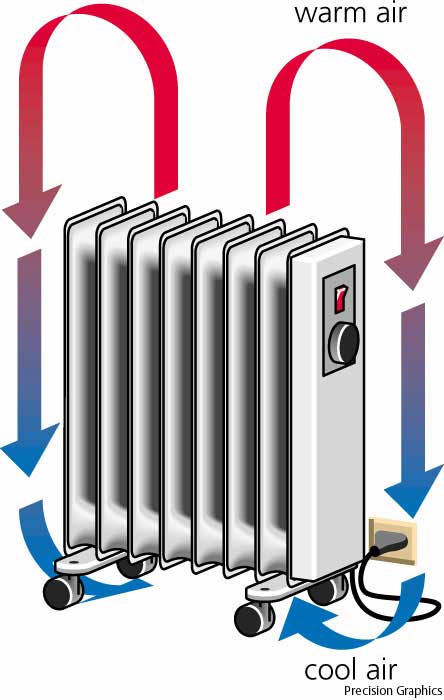
Convection: Happens in liquids and gases (fluids) that are in a gravitational field. One part of the fluid is heated and the particles begin to move faster and in doing so, get further apart. This reduces the density of the warm part of the fluid. The warm part of the fluid therefore starts to "float" up above the cooler less dense fluid surrounding it. Cooler fluid then moves in from the side to replace the warm, less dense, rising fluid. This fluid then starts to be heated, and so rises itself. Once the warm fluid has risen, it may cool and start to drop back down past the warmer fluid being heated beneath it. This causes a circular convection current to be created.
We saw a hot air balloon rising above a lit Bunsen.
"Radiators" actually heat rooms by causing convection currents, hence it doesn't matter what colour they are painted really (although black would be a more efficient emitter of heat radiation).
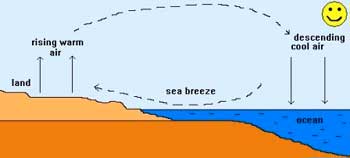
We learned about sea breezes, which occur because the sea has a large heat capacity than the land.
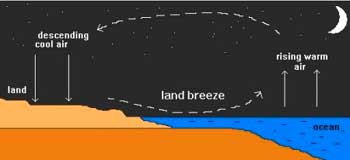
At night, the opposite happens..
HW ? Lost, confused, can't sope with room displacement.
Another method of heat transfer is:
Black objects absorb heat radiation best (as they do light) and so warm up the most when infra red is shone on them. White or silver objects reflect most heat radiation and heat up less.
Black objects emit heat radiation best too, so if a hot object is black, it will emit more radiation than a white or silver object at the same temperature.
More on heat transfer. We looked at the remaining 2 methods.
Black objects absorb heat radiation best (as they do light) and so warm up the most when infra red is shone on them. White or silver objects reflect most heat radiation and heat up less.
Black objects emit heat radiation best too, so if a hot object is black, it will emit more radiation than a white or silver object at the same temperature.
Convection: Happens in liquids and gases (fluids) that are in a gravitational field. One part of the fluid is heated and the particles begin to move faster and in doing so, get further apart. This reduces the density of the warm part of the fluid. The warm part of the fluid therefore starts to "float" up above the cooler less dense fluid surrounding it. Cooler fluid then moves in from the side to replace the warm, less dense, rising fluid. This fluid then starts to be heated, and so rises itself. Once the warm fluid has risen, it may cool and start to drop back down past the warmer fluid being heated beneath it. This causes a circular convection current to be created.
We saw a hot air balloon rising above a lit Bunsen.
"Radiators" actually heat rooms by causing convection currents, hence it doesn't matter what colour they are painted really (although black would be a more efficient emitter of heat radiation).
We learned about sea breezes, which occur because the sea has a large heat capacity than the land.
At night, the opposite happens..
HW Complete your notes on radiation and convection of heat energy into your exercise books. Also complete the questions from the book for the radiation and convection sections.
We sat the waves test.
Then onto heat and temperature.
Heat energy is the energy something has due to the internal movement of its particles. When you heat something up, you are making its particles move faster, in a solid they vibrate, in a liquid and a gas they are able to move around each other.
The temperature of a body is a measure of the average kinetic energy of its particles. It is often measured in degrees Kelvin in science. They are the same as Celsius except that O Kelvin is the temperature at which particles would completely stop moving, and so things cannot possible be any colder than that. It is at -273 degrees celsius - absolute zero.
A large object at a low temperature will carry more heat energy with it than a small object at a higher temperature.

A further test on waves, with a little more on light (reflection, refraction, total internal reflection etc.) than the first one was sat.
We did a practice test on waves and sound, in preparation for the real thing which will be held on Monday. Perhaps I'll leave out diffraction....
Go through of the test, before moving on to the conduction of heat energy.
Max B, Jonah U, Alex P, Ben L Isaac P, Tiago D, Naveed M, Kamil h and Hugh G are bad and owe me stuff.
The physics of musical instruments and the speed of sound.
We managed to use the Tate modern to bounce sound across the Thames. We were able to make a measurement of the speed of sound, finding the distance the sound had travelled from a map. Remember, with echo location type methods, the sound has to travel the distance there and back, so a doubling up of the distance or halving of the time is often needed.
Watch this for extra speed of sound gubbins including more maths.
We looked at the Physics of musical instruments. All sounds are produced by an initial vibration. Musical instruments use reeds (woodwind), lips (brass), strings etc. to start the vibration. The vibration must then be amplified by a sound box or tube. The air inside the tube in a saxophone, for instance, vibrates up and down forced by the reed. This creates a much louder sound which can be made even louder by blowing harder. By changing the length of the column of air (putting keys down), the note can be changed. The larger column of air vibrates at a slower frequency and so plays a lower note.
Remember - sound is a longitudunal wave. In order to see the shape of the wave we transfer it to an electrical signal with a microphone. We can look at the shape of the electrical signal and find out things about the sound. A louder sound has a higher amplitude, a higher pitched sound has a higher frequency and a smaller wavelength.
2 different instruments can play the same basic frequency of sound and still not sound the same. This is due to the subtle shape of the sound wave produced and is called the timbre.
You can make a sound by blowing over the top of a bottle. The more water in the bottle, the higher the note produced (as there is less air inside to vibrate.)
The vibration in them is started in a similar way to a flute.

Big instrument make low sounds in general due to a very long column of air vibrating.
HW Write notes on P97-100 including how 3 different instruments work, as detailed on the board.
We looked at how sound can be a nuisance - noise pollution and did some echo location calculations. Books came in for me to look at cover work etc.
I asked some people to bring musical instruments next time.
Heat and temperature.
Heat energy is the energy something has due to the internal movement of its particles. When you heat something up, you are making its particles move faster, in a solid they vibrate, in a liquid and a gas they are able to move around each other.
The temperature of a body is a measure of the average kinetic energy of its particles. It is often measured in degrees Kelvin in science. They are the same as Celsius except that O Kelvin is the temperature at which particles would completely stop moving, and so things cannot possible be any colder than that. It is at -273 degrees celsius - absolute zero.
A large object at a low temperature will carry more heat energy with it than a small object at a higher temperature.
When you give an object some heat energy, it will warm up. The amount that it warms up by depends on its heat capacity.
The heat capacity of an object is the amount of energy required to heat it up by 1 degree.
The specific heat capacity of a material is the amount of energy required to heat up 1kg of the substance by 1 degree.
We performed an experiment, electrically heating some samples of aluminium and copper in order to measure their specific heat capacities.
HW Revise for a test on all of waves.
No RM - you did some work on sound from various books.
We looked at the Physics of musical instruments. All sounds are produced by an initial vibration. Musical instruments use reeds (woodwind), lips (brass), strings etc. to start the vibration. The vibration must then be amplified by a sound box or tube. The air inside the tube in a saxophone, for instance, vibrates up and down forced by the reed. This creates a much louder sound which can be made even louder by blowing harder. By changing the length of the column of air (putting keys down), the note can be changed. The larger column of air vibrates at a slower frequency and so plays a lower note.
Remember - sound is a longitudunal wave. In order to see the shape of the wave we transfer it to an electrical signal with a microphone. We can look at the shape of the electrical signal and find out things about the sound. A louder sound has a higher amplitude, a higher pitched sound has a higher frequency and a smaller wavelength.
2 different instruments can play the same basic frequency of sound and still not sound the same. This is due to the subtle shape of the sound wave produced and is called the timbre.
We made some test tube pan pipes by filling them with various amounts of water. The vibration in them was started in a similar way to a flute.
HW No, books came in with speed of sound Qs in. Also, Easter revision papers should have come in.
We saw several demonstrations relating to sound.
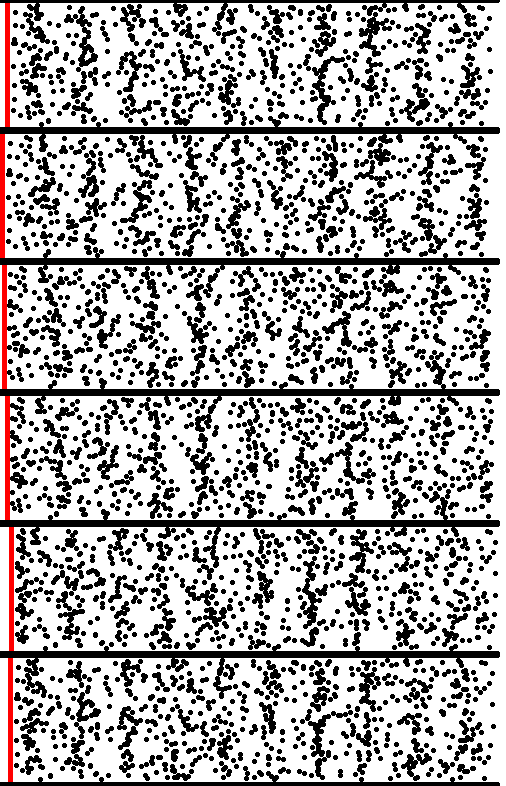
Sound is a longitudunal wave (as above) where the vibrations in the medium take place in the same direction as the wave is travelling.
We saw how a loudspeaker vibrates in order to cause sound and the vibrations travel through the air.
We also tested the range of frequencies that humans can hear using a signal generator and a loudspeaker. Most of you could hear sound between 20Hz and about 20kHz. I could only hear up to about 14kHz because I am old and rubbish.
Bell jar in a vacuum demonstration.
We looked at a bell ringing in a glass jar. The air was sucked out of the jar and we could no longer hear the bell. Sound requires a medium to travel, in a vacuum sound cannot propagate. Light, however, travels easily through a vacuum. This is because it is a wave of oscillating electric and magnetic fields.
Light is an electromagnetic wave. Radiowaves, microwaves, infrared waves (those that carry heat), ultraviolet light, X rays and gamma rays are all also part of the electromagnetic spectrum and can move through a vacuum. They all move at the speed of light, which is 300 million metres a second.
We played some sounds into a microphone connected to an oscilloscope. This makes it much easier to see things like amplitude and wavelength. The sound is converted into an electrical signal by the microphone and can then be represented as a transverse wave.
Important quantities that you know are:
1. Amplitude - the maximum "height" of the vibration. Easy to see in a transverse wave, not so easy in a longitudunal.
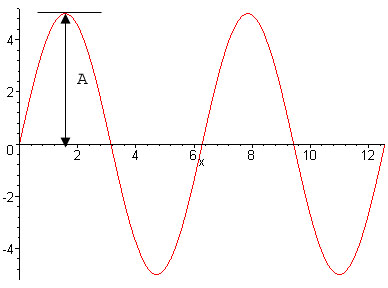
2. Frequency - the number of vibrations a second, measured in Hertz (Hz)
HW I am missing on Monday, make sure that all past papers are in by Friday. Complete the write up of the bell in a vacuum for handing in next week.
We looked at sound.
We saw several demonstrations relating to sound.
Sound is a longitudunal wave (as above) where the vibrations in the medium take place in the same direction as the wave is travelling.
We saw how a loudspeaker vibrates in order to cause sound and the vibrations travel through the air.
We also tested the range of frequencies that humans can hear using a signal generator and a loudspeaker. Most of you could hear sound between 20Hz and about 20kHz. I could only hear up to about 14kHz because I am old and rubbish.
Bell jar in a vacuum demonstration.
We looked at a bell ringing in a glass jar. The air was sucked out of the jar and we could no longer hear the bell. Sound requires a medium to travel, in a vacuum sound cannot propagate. Light, however, travels easily through a vacuum. This is because it is a wave of oscillating electric and magnetic fields.
Light is an electromagnetic wave. Radiowaves, microwaves, infrared waves (those that carry heat), ultraviolet light, X rays and gamma rays are all also part of the electromagnetic spectrum and can move through a vacuum. They all move at the speed of light, which is 300 million metres a second.
We played some sounds into a microphone connected to an oscilloscope. This makes it much easier to see things like amplitude and wavelength. The sound is converted into an electrical signal by the microphone and can then be represented as a transverse wave.
Important quantities that you know are:
1. Amplitude - the maximum "height" of the vibration. Easy to see in a transverse wave, not so easy in a longitudunal.
2. Frequency - the number of vibrations a second, measured in Hertz (Hz)
We then managed to use the Tate modern to bounce sound across the Thames. We were able to make a measurement of the speed of sound, finding the distance the sound had travelled from a map.
HW Finish write up of bell in a vacuum demo. (Q8 and 9 are extension.)
Qs 1,2,3,5,6 on the speed of sound.