Welcome to 2nd form Physics. This page will contain invaluable information which will help you through the year. Make sure that you bookmark it!
2R 09/12/05
As 2L in every detail except for somes lines issued for Michael extraction.
HW P38 Qs 1,2,3
2L 08/12/05
We concluded our ideas about upthrust. Upthrust gets bigger the larger the amount of object immersed in a fluid. A solid object pushes or "displaces" the liquid higher than it was before. The liquid therefore tries to fall back down, resulting in an upward force on the object.
Upthrust = Weight of displaced fluid
Take the amount of fluid which has been displaced and weigh it in Newtons and you have the size of the upthrust force.
An object can push a maximum of its own volume of fluid out the way. If it weighs more than an identical volume of water (i.e. it is more dense), the object will sink.
We tested various materials to see if they would float or sink. Some interesting things were seen. An iron pin can be made to float on water due to surface tension (not like ordinary upthrust floating). A boat shaped piece of plasticine will also float.
In fact steel, iron or aluminium boats float because the water displaced by the shape of the hull equals the weight of the metal hull and whatever is aboard. If you squeezed a baking pan into a cube of metal it would sink because it does not displace it own weight in the water. Left in the pans original shape, it would not only float but would float if a brick was added to the pan because the weight of the two objects would still be less than the maximum displacement of the pan.


HW P38 Qs 1,2,3 Books in next week.
2R 02/12/05
We did an experiment on upthrust as 2L below.
HW Finish of the graphs of your results and answer questions in your book.
2L 01/12/05
We sat the brief magnetism and electrostatics test.
We then went on to do an experiment on upthrust (the floating force that objects experience when they are wholly or partly underwater).
The more of a wooden block that was immersed in water, the lower its weight seemed to be as measured by a Newton meter. An electronic balance beneath the beaker of water registered an increasing force at the same time as the force on the Newton meter was decreasing.
HW Finish graphs of change in force against distance and electronic balance reading against distance. Answer the questions from the board in your book.
2R 25/11/05
We sat the little 2nd form test on magnetism and electrostatics.
We then recapped ideas of weight and mass (mass is the amount of matter measured in kg, weight is the force which gravity exerts on that mass in Newtons). We looked at finding the volume of regular and then irregular objects. This page shows what my 1st form did last year on the matter.
Density is a measure of how tightly the matter in a material is packed together. It is calculated by the formula:
Density = Mass/Volume
Books were handed in, they will be marked along with tests for next time with luck.
2R 18/11/05
RM absent, cover work attempted.
HW Revise for a short test on magnetism and electrostatics.
2L 17/11/05
Just before CCF we had a lesson. 1st form ideas of finding the volume of regular and irregular shaped objects were covered. Also the difference between mass and weight moving onto the idea of density.
HW Revise for a short test on magnetism and electrostatics.
2R 11/11/05
RM absent, you attempted many questions on electrostatics from the text book.
2L 10/11/05
We looked at induced dipoles in electrostatics.
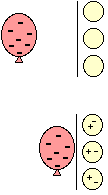
We charged a balloon by rubbing it with a furry cloth and found that we could stick it to the ceiling.
As the charged balloon is brought close to the ceiling, it causes electrons in the ceiling to move creating a small patch of the opposite charge near the balloon. Hence the balloon sticks even though the ceiling is neutral overall.
A long period of somewhat boring textbook work was your reward for shouting out too much.
Books were taken in to mark last 2 sets of HW. Kirtiman took his home to finish! JL has lines.
2R 04/11/05
Very similar to 2L, except our Van der Graff sparks were twice as big. Woohoo!
2L 03/11/05
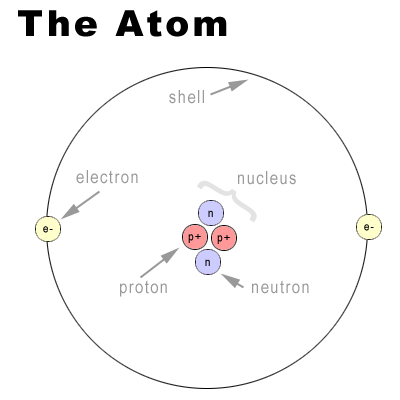
We looked at electrostatic forces. There are 2 types of charge, positive and negative. Negative charge is carried by electrons. Positive charge is carried by protons which live in the nucleus of atoms. Electrons whizz around the outside of atoms and are much lighter and more mobile.
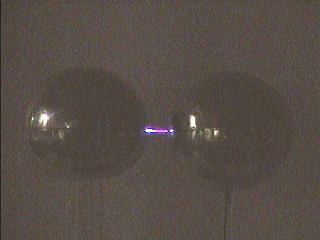
A Van der Graff generator deposits charge (electrons) on a metal bell by friction (Electrons are literally "scraped" from a belt onto the bell. This means that there are more electrons in the metal bell than there are protons, and so it has an overall negative charge.
Like charges repel, so the electrons have an electrostatic force on them trying to leave the dome of the Van der Graff. The force gets so large that eventually the air itself becomes a viable conducting medium by ionising (turning into charged particles). At this point, a spark is formed and jumps from the dome to the nearest earthed point.
HW Finish the questions from the electrostatics handout. Answer Qs 1-5 from page 105-106
Max and Jonathan have extra work on particle accelerators, the whole class will do a session of silent work next week.
2R 21/10/05
As 2L in almost every detail.
Alex Brown has gained lines.
2L 20/10/05
We went through the test which was generally done reasonably.
We then investigated how the size of a magnetic force between 2 magnets varies as the distance between them is changed using some weighing scales.
HW Finish the graph of your results and answer the questions that you copied from the board.
2R 14/10/05
We sat the test and then looked at some more magnetism. A strong electromagnet (made of a coil of wire with electrical current flowing through it) can also be used to magnetise pieces of steel permanently. Another name for this is a solenoid.
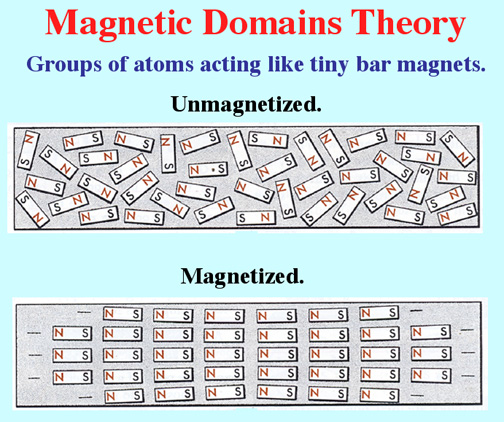
We magnetised Bolaji's scissors in a solenoid and then unmagnetised them again by putting them into a Bunsen flame. The heat causes them atoms to shake about more, which makes all the tiny magnetic domains line up randomly again.
Soft iron is attracted to a permanent magnet, but cannot be permanently magnetised itself as the magnetic domains always become jumbled as soon as the magnet is taken away.
HW Finish off the magnetism fill in the gaps sheet.
2L 13/10/05
We sat the test and then looked at a film on magnetism.
We looked very briefly at the experiment we will do next week. We will test how the strength of a bar magnet's field varies with distance away.
HW Answer the question you copied into your books about the force changing on the lump of iron.
2R 06/10/05
Very much as 2L again.
HW Revise for the test on everything so far next week.
Those who didn't get moment HW sheets have picked them up now and are going to give them to me on Monday.
2L 06/10/05
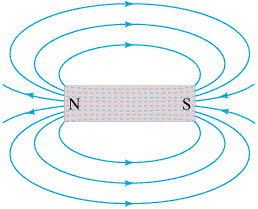
Magnetism was covered. We tested the shape of magnetic fields using plotting compasses.
HW Revise for a test on everything that has been covered so far.
2R 30/09/05
Same as 2L again!
There are several people who are going to give me the balanced forces sheet in on Monday. You know who you are!
2L 29/09/05
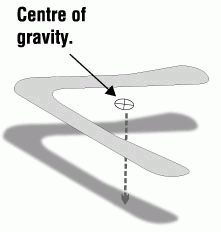
The centre of mass (centre of gravity) of an irregularly shaped piece of card was found.
The centre of mass is the point at which the weight of an object appears to be acting through. (e.g. it will balance if held from this point. If you slice an object in 2 through it's centre of mass, there will be an equal mass both sides.
The centre of gravity needn't actually be inside the object.
HW Finish off Qs 1-6 in your book complete with diagrams and in full sentences.
2R 23/09/05
Same as 2L again!
For both groups: both the powerpoint shows on moments can be found here and here
And here is the adding forces HW sheet from last week in case you missed it.
2L 22/09/05
We looked at turning forces. This is all based around the idea of balancing seesaws. All the turning forces trying to make an object turn clockwise must be balanced by the forces trying to make it rotate anti-clockwise if it is in equilibrium.
The name for a turning force is a moment
Moment = Distance from pivot times Force
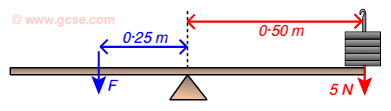
If the system is balanced, the anticlockwise turning effect of force F must equal the clockwise turning effect:
clockwise moment = anticlockwise moment
Clockwise moment = 5 N � 0�50 m = 2�50 Nm.
Anticlockwise moment = F � 0�25 m = 2�50 Nm
Force F = 2�50 Nm � 0�25 m = 10 N
In order to balance the 5 N force acting at 0�5 m from the pivot, we require 10 N acting in the opposite direction but at 0�25 m.
HW Sheet of calculations involving turning forces.
2R 16/09/05
Same as 2L again!
2L 15/09/05
We investigated frictional force. It takes a certain force to get a wooden block sliding across the surface of a desk. The force resisting motion is called friction. If weights are added to the block, the frictional force can become higher, so it takes more force to start it sliding across the desk.
HW Books were handed in, you must finish the balanced forces printed sheet (answers on the sheet) to be handed in for next time. People who forgot their books must get them to me pigeonhole by tomorrow.
.........................................................
2 parrots on a perch. One says the other "Can you smell fish?"
2L 08/09/05
Books were issued and we began the first topic - forces.
Forces can be mechanical or act at a distance (e.g. gravity). When an object has unbalanced forces acting on it, it will accelerate in the direction of the overall force acting on it. If a body has balanced forces on it, it will remain at a constant speed, or at rest.
An object sitting on a table has 2 equal and opposite forces acting on it. Its own weight acts downwards and is counteracted by the reaction force that the table puts onto the object.
HW Finish off the diagrams and questions for the first 3 sections of the handout sheet given to you.
...............................................
Q: How does the barber cut the Sun's hair? A: Eclipse it.
2R 09/09/05
The same as 2L!(see above)
....................................................
A neutron walks into a bar; he asks the bartender, 'How much for a beer?' The bartender looks at him, and says 'For you, no charge.'