Happy New Year all.
12/03/8
Mr Richardson took you and taught you about the difference between a bar chart and a line graph.
You plotted the growth of a foetus throughout pregnancy.
Mr Richardson took you for "gestation".
You saw how the fertilised egg develops first as an embryo and then a foetus.
You made a cut and paste foetus type thing.
HW Finish the sheet with you baby on it.
Yes. We finished off the reproduction topic, onto pregnancy next time.
No. RM = CCF. You did some bookwork.
We had a small test (testicle) on the testes, amongst other body parts. Then we finished the "coming together" video. You wrote down some notes which described the journey of the sperm from the testis and the egg from the ovary to when they meet and fertilise.
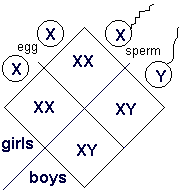
We talked a little about the determination of the sex of the baby in terms of x and y chromosones.
HW Finish the questions on the handout on the "Coming together" video.
We took some time out from watching the dodgy videos to label the parts of the male and female reproductive system and make a note of the changes which take place during puberty.
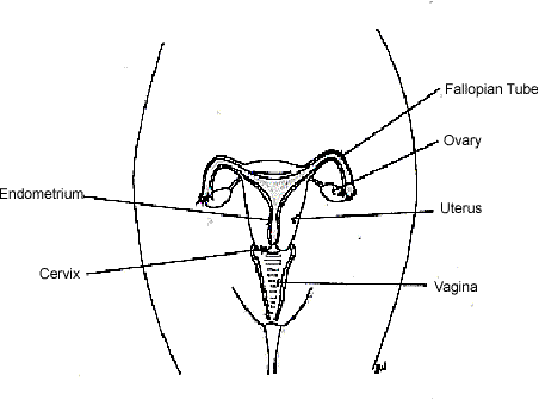
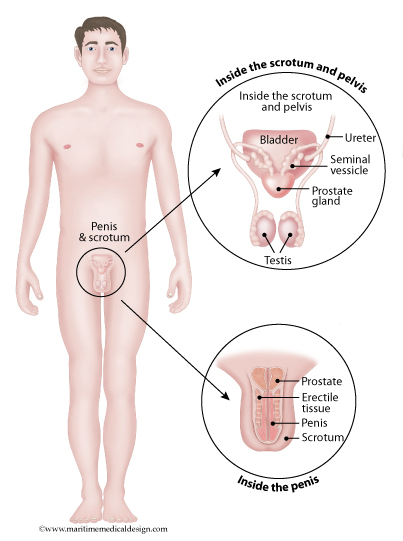
Then, 12 mins into video 2!
More sex videos - we got 4 mins into the 2nd one. More next time!
We wrote down some summary notes on each of the main human body systems. These are important and must be completed if they weren't in the lessons.

We then began the new topic - reproduction.
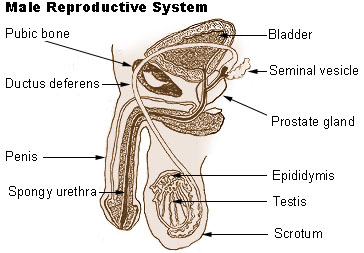
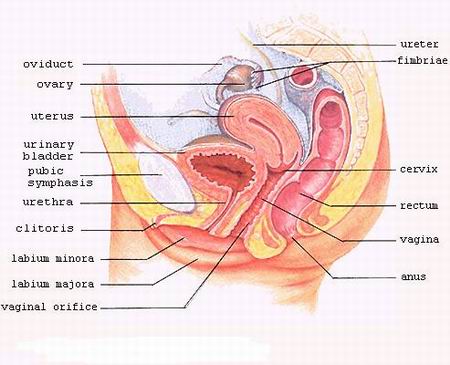
We'll learn about the functions of both of the above in the next couple of weeks.
HW Finish body systems notes.
We delved into Berthold the body's organs and took them out one by one, trying to work out which body system they were involved with.
Here they all are in some detail.
We'll need to summarise the different systems and their functions next time.
The little skeleton test was indeed sat. We then looked more at the film on the systems of the body.
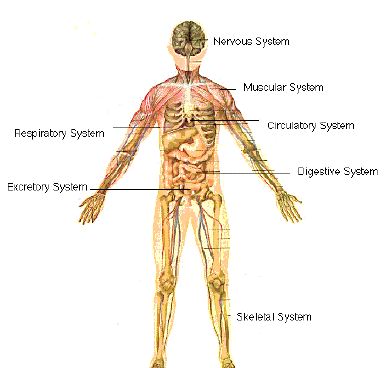
We need to learn about the functions of all of the above.
The torso will have to be looked at next time...
We looked at systems of the body.
Specialised cells group together into organs which co-operate in the various systems of the body. These systems do all the things that the body needs to survive.
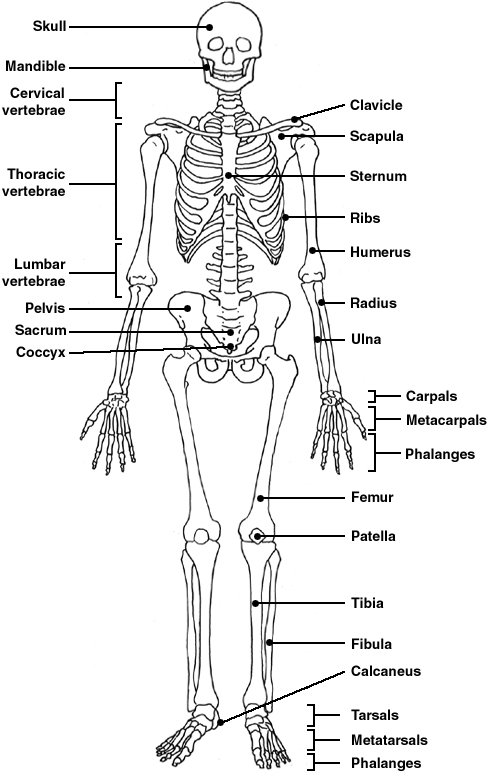
The skelton (and muscles) provide the body's important organs with protection and allow the body to move.
The muscles tend to work in antagonistic pairs (e.g. biceps and triceps) to bend and straighten joints. Muscles can only pull by shortening, not push.
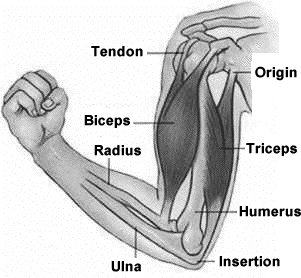
Ball and socket joints allow movement in all directions (shoulder and hip) but hinge joints just allow bending (knee and elbow).
We got half way through the 2nd video, the human machine. More next time.
HW Learn the bones of the skeleton for a test next time.
We continued the work on the discovery of the cell in the PC room.
We looked at some specialised cells and their adaptations to their tasks.
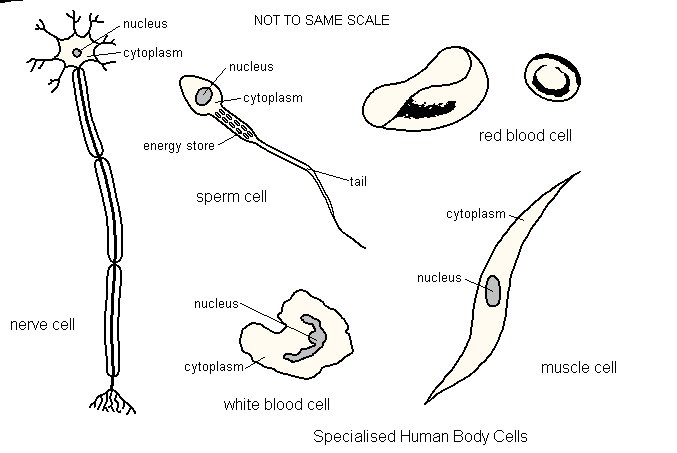
In humans, above.
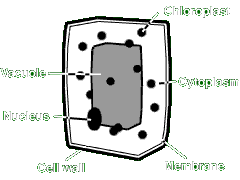
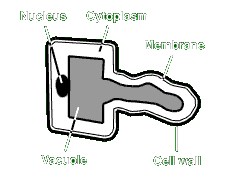
and in plants, above.
We removed some of our own cells and looked at them through a microscope.
We looked at our own skin cells. They were a tad broken up in general. However, they looked a little like this...
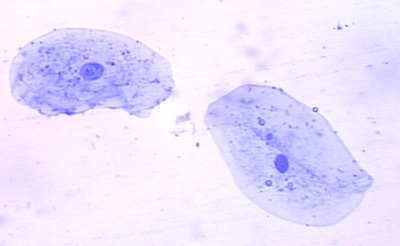
You could see the nucleus stained and the fact that these cells were smaller and less ordered than the onion cells. Animals cells have no cell wall, no large vacuole (they have several small ones) and no chloroplasts.
HW Qs from your text book
We started a new "historical" little bit of work in the computer room.
Instructions are:
The Discovery of the Cell
� Who discovered it and how?
� (Robert Hooke)
� What did people think living things were made of before the discovery of the cell?
� Date � what device did he use?
� Who else worked on the idea of cell?
� What are the main features of cells?
� Differences between animal and plant cells
� What function do the different parts of the cell have?
� What about the future of cell biology � how does cloning, gene therapy etc work?
� What different types of cells are there?
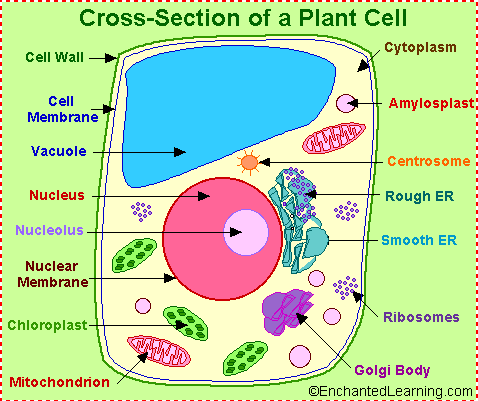
We looked at the features of a plant cell and their purpose.
We covered: Cytoplasm, the nucleus , chloroplasts , chlorophyll , cell membrane , cell wall , photosynthesis , vacuoles and more.
We looked at some powders and other little things through microscopes and practised drawing what we had seen. We then got started on looking at a very thin layer of an onion called an epithelium. This layer is in fact not more than a few cells thick. This allowed us to see the shapes of individual cells and even some of the bodies inside the cell. Onions are plants and so their cells have a cell wall (unlike animals).
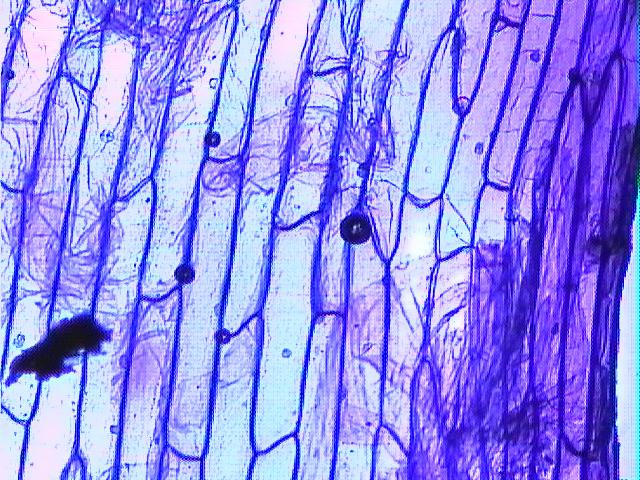
We will go into more detail about the structures inside a cell later. Next week - human cells!
HW Finish off your labelled cell drawing, stick your sheet in and answer all the questions in full sentences in your book.
More on keys. Biologists have to use well defined characteristics in their keys to avoid confusion.
HW Key for bicycle, bus, car, train, aeroplane (make it nice for comm.)
We looked at using keys to identify specific objects from a group.
A key is a series of yes or no questions which splits objects into a series of groups, and which eventually will allow you to find which object you are talking about. This echoes the biologists way of dividing up animals and plants. They are split into various groups and sub groups, based on how closely they are related to each other.
A double lesson at last!
We introduced the microscope. You learned the rules regarding their use and the parts.
You also practised drawing the images you saw by viewing some powdered or crystal substances.
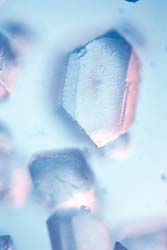
Sugar
HW Learn all the parts of the microscope for a little test next time.
Darwin talks again. Increase the quantity of scientific theory for higher marks... Good talk by Joel, although this may be of interest.....
Darwin talks again.
We listened to some Darwin talks. Very good in general I thought, well done. More tomorrow.
Darwin talks are due this week! Make sure they are ready for the 2 single lessons this week.
Here and here are some good clips explaining evolution.