
12/12/07
"Last" lesson - nothing much useful. Hand in the HW tomorrow.
You guys have a couple of misconceptions (i.e. are wrong) about a couple of things....
1. Respiration does not mean breathing. It is the reaction of chemicals to produce energy; oxygen with food in our case.
2. Excretion does not mean "pooing". excretion means getting rid of the products of respiration from your body. We breathe out carbon dioxide and get rid of water and nitrogenous waste in a number of ways.
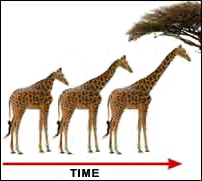
3. It doesn't matter what an individual member of a species does, (i.e. giraffes stretching necks) that animal will still pass the same set of genes down to its offspring. Evolution by natural selection occurs when members of a species are born by chance with features that favour their survival.
We started to look at how living things are classified into groups.
The idea is that each species of life is put into a group with other species which are closely related to it (so they shared a recent common ancestor). There is a long list of groups and sub groups which can be applied to every creature, starting off with the basic type of cell it is made from, then the Kingdom (animal, plant or fungus) and narrowing down from there.
We looked at the ways in which animals are classified. Firstly, all animals are spilt into Phyla. These are then split into sub groups called classes. One Phylum is the chordates, more commonly known as the vertebrates. We learned about the five different classes of vertebrates and classified some examples, we then went on to look at some examples of invertebrates which we put into their respective Phyla.
We tried to identify the classes of some different vertebrates (animals with a backbone.)
We then tried to identify the phylum of some different invertebrates (animals without a backbone)
HW Complete the worksheet on classification.
We started our next little "project" which will be a mini presentation on some aspect of Charles Darwin's life
This file contains the talk topics and instructions.
The noble badger is also related to weasels
A MRS GREN problem (cars) was attempted. Then we attempted to explain how a giraffe's long neck has evolved by natural selection.
P.S. The weasel and the stoat are superficially similar, with similar prey and habitats. However, the stoat is a slightly larger creature, weighing more which can bring down animals as large as a hare. Legend has it that a stoat can hypontise its prey.
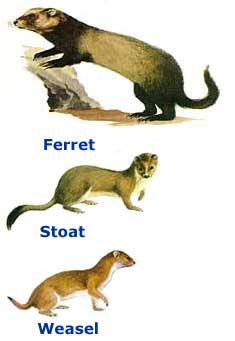
Ferrets are much larger.
Cheeky extra lesson stolen from PSHE....
We saw a nice video on survival. Many foxes.
The important points were that life is all descended from an initial outbreak of simple bacterial orgaisms which occurred about 3.85 billion years ago. Over a very long period of time, differing sorts of organisms came to exist in the different enviroments available on Earth. Natural selection ensured that they became adapted to their enviroments, and more complex creatures started to evolve. Evolution initially relied on random mutations (errors) when creatures copied themselves for any changes which occured to organisms genes. However, once organisms started to reproduce sexually, faster change was possible.
We saw a whole bunch of objects which you guys classified as living or non living.
We also answered some controversial questions about the beginnings of life and evolution.
HW Finish all the questions in your book and ensure you have stuck in your sheet of questions .
We started biology, the study of all living things by trying to answer the difficult question, "What is life?".
You saw a rather good video on the formation of life, evolution and the characteristics which define life.
We talked about how there are so many diverse species in the world. Living things reproduce, and they pass on their characteristics to their offspring. Offspring which have poor characteristics for survival will die and therefore won't produce offspring of their own. Therefore, good survival characteristics tend to get become more common. Sometimes offspring have characteristics that do not belong to either of their parents, due to a random error in the reproduction process. If this characterisitc is good, it may survive for future generations. Over very long periods of time, this process can make entirely new species arise. Different enviromental features all over the Earth have created millions of different species which have evolved to suit the conditions around them.
M ovement
R eproduction
S ensing
G rowing
R espiration
E xcretion
N utrition
If something exhibits all of these attributes, it is classed as alive. MRS GREN is a method of remembering all of these.
HW Think of a non-living object which fits as many as possible of the criteria for life, and describe how it does so. Also point out why it isn't actually alive.
We looked at some thermal expansion of metals, and in general.
When heated,particles in a solid vibrate faster and further. They get further apart on average, increasing the size of the material in every dimension. We saw that this expansion is very strong, enough to snap a metal bar in 2 when we heated a steel rod. Engineers need to take this into account when they build things.
Liquids and gases expand much more than solds when heated.
HW Revise for a test on everything done so far this year!
We attempted some questions on density.
In science:
1. Always use a calculator - brains are too unreliable....
2. Always shop all your working, including the formula you are using.
3. Make sure you write in the units of your answer.
Carrying on from your volume measurement practical last week, we looked at measuring the density of objects. This was pretty easy.
Density = Mass/Volume
It is a measure of how tightly the matter is packed into a substance. Once you have found out the volume of an object (regular or irregular) using last week's methods you simply measure it's mass by placing it on an electronic balance.

A larger object can have less mass, and so feel less heavy if it is less dense.
Lead was the densest substance we measured, with a density of about 11 g/cm3 or so, which is 11 times the density of water.
HW Find out information about one liquid which is more dense than water, one which is less dense than water and find out the density of water itself. Try to find out the importance of the density of a liquid in determining whther an object will float in i t or not.
RM was away..... You did a practical session on measuring the volume of regular and irregular objects.
It is hard to find the volume of irregularly shaped objects by calculation. However, if they are immersed in water, they push exactly their own volume of water out of their way. This causes a rise in the water level, which can be measured if the water is held in a measuring cylinder.
RM back walking again. Woohoo!
We looked at the results of our experiment on cooling palmitic acid.
As you heat a solid, the heat energy you give to the particles goes into the movement (kinetic) energy of the particles. However, when the solid melts, the particles need to take some extra energy to escape the attraction between them. This means that even though you continue to give the solid energy by heating, the particles don�t get any faster they just get further apart.
The heating (or cooling) curve of water.
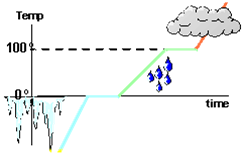
No temperature change in the flat sections due to latent heat.
The same thing happens when you heat a liquid up to its boiling point and it turns to a gas. This extra energy needed is called �latent heat.�
I took in the books to figure out what went on while I was away.
We started work on a task called the "History of Atoms".
Write a project, which describes the history of the discovery of the atom. From the very first ideas of the Greeks through to our most modern ideas today. You should talk about all of the relevant scientists involved. Starting with Democritus. Others include :Dalton, JJ Thompson, Rutherford
RM run over.
8/10/07
We looked at what happen to the temperature of a material as it changes state. We used palmitic (or stearic) acid, which has a melting point of about 60 degree Celsius to demonstrate. We heated the acid using a water bath until it melted. We then recorded the temperature of the acid once every minute to see how it varied.
You found that the liquid acid cooled quite quickly, but once it started to solidify, the cooling stopped.
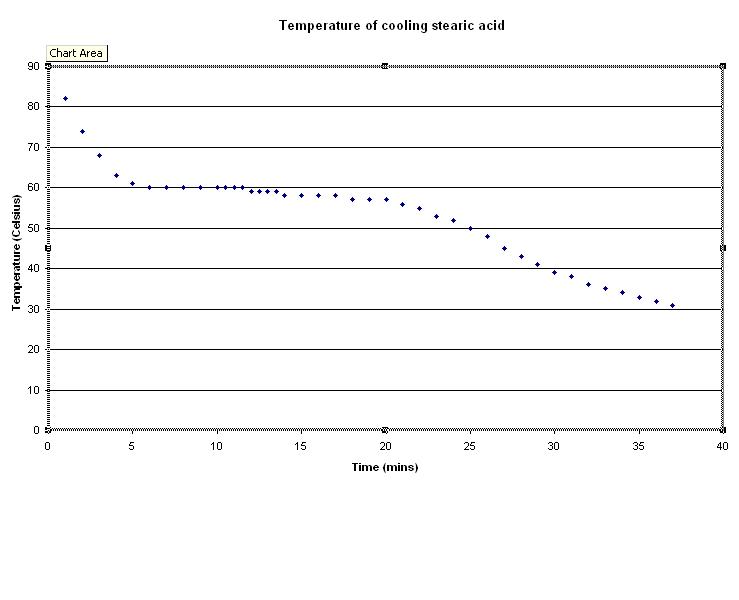
The long time spent at 60 degrees shows that the temperature does not change as the liquid solidifies. Once all the liquid had solidified, it begins to cool again. It will eventually reach the same temperature as the surroundings.
HW Plot graph of your results and answer all the questions from the sheet in your book to complete the write up.
04/10/07
Having claimed that all matter is made of tiny particles approximately 1 ten billionth of a metre wide, you demanded proof, damnit.
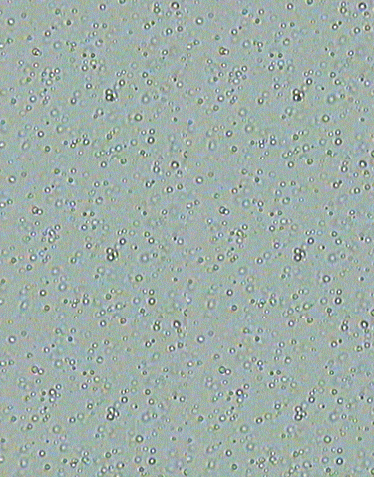
We looked at a demonstration of Brownian motion.
How do we know that materials are made up of individual atoms? We saw some evidence for this. Looking at illuminated smoke particles (very small lumps of carbon) through a microscope, we saw them jiggling around at random. This motion cannot be explained unless the particles are being hit by individual gas molecules from around them, knocking them this way and that.
It is called Brownian motion, first spotted by a biologist looking at pollen grains suspended in water.
HW Robert Bunsen work was taken in.
We looked at the particle structure of solids, liquids and gases.
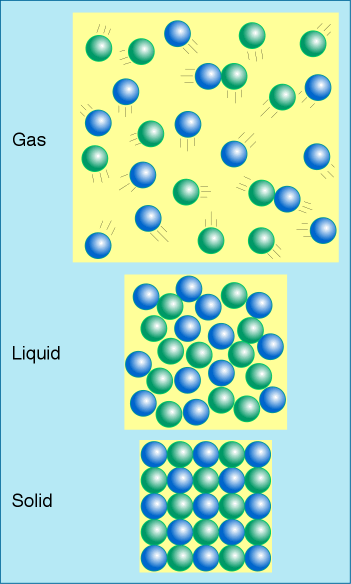
This powerpoint presentation contains the explanations.
HW Finish the task from the lesson, copying the particle diagrams and explaining the properties of the types of matter.
We made an aborted attempt to use the data logger to record how the temperature of palmitic acid varied as it froze solid. (It has a melting point of 60 degrees Celsius or so.)
Never mind, we'll be much better prepared for next week.
HW Start the written record of the experiment by drawing a large, labelled diagram in your book, writing a method and copying the results table so you will be ready to start the experiment right away next double lesson.
More work in 306 on the life and work of Robert Bunsen.
HW If you didn't finish it in the lesson, it must be printed and handed in to me by next Thursday.
We looked at thermometers and how various types work.
I started showing you how a data logging temperature probe works - we'll use these with luck next week.
Books were taken in with HW in. If you haven't handed it in - it must come in tomorrow!
We cooked some ice using Bunsen burners and charted how the temperature varied over time. This was mainly to learn techniques for heating liquids using Bunsens, but also related to the next topic.
HW Finish up the writing up of the experiment as detailed on the handout and answer Qs 1-3 from P4 of your text book.
We started a report on the life of Robert Bunsen in the PC room.
NB - This is not HW yet - although it may be next week.
There was a test on the Bunsen burner parts.
We played with Bunsen burners. When the collar is open, air is drawn in and the flame burns hot and blue. The hottest area of the flame is at the top of the blue cone. The yellow flame is less hot and contains soot (unburned bits of carbon.)
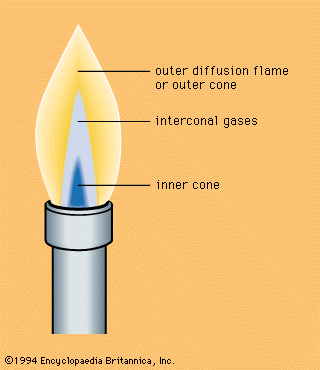
HW Write up the Bunsen experiments into your books neatly, so that they make sense as a stand alone piece of work (not just answers to questions.) and revbise for a test on the parts of a Bunsen.
Yep, finally.
We completed our lab safety rules and then looked at an example of a real live accident. We did a "Spot the hazard" competition. Those away, read this document.
Yes, but there was a fire alarm, so pretty much no. We started making some Normal Safety Precautions (NSP) for all experiments.
No, Stubbers.
No, MIDYS test.
Hello all! I promised you a joke.
Q: What do you call a pig with three eyes?
A: A Piiig
Books were handed out and text book numbers taken. We need one more Absolute Science book.