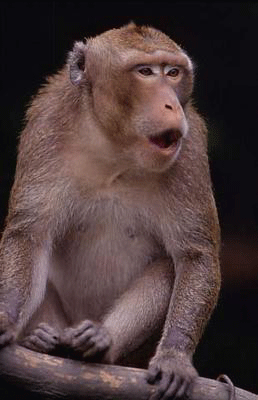
| Crab-eating / Long-tailed Macaque |
| M.fascicularis belong to the fascicularis species group of macaque which comprises four species: M. fascicularis, M. mulatta, M. cyclopis and M. fuscata. The geographic ranges of all the four species are non-overlapping. These group of macaque are the most successful and widespread. M. mulatta inhabit South and South East Asia and is the most widespread and adaptive of all macaques M. fascicularis is close behind spreading all over South Asia mainly the Island nations and parts of South Asia too. |
 |
| Generic Name Macaca fascicularis Common Name Crab-eating macaque Long-tailed macaque Habitat Tropical forests and Islands in South and South East Asia. Social Structure Multimale-multifemale Group Size 8 - 72 Adult Sex-Ratio male to female 1 : 1.8 Breeding Season Whole year with birthpeak in March-May Menstural Cycle 24 - 52 Days Gestation 160 - 170 Days Behavioural and Ecological Data on Indian subspesies are Inadequate |

|
 |
| These are medium sized monkeys. Face is pinkish-brown and hairs are backwardly directed. Head and body length of males ranges from 41-65 cm which is comparatively larger than females of 35.5-50 cm. Back is olive bown to dark gray ventral side is grayish. They are widely disributed in South and South-East Asia. Nicobar Islands (India), Myanmar, Thailand, South Vietnam, Indonesia (except the Celebes) and north to Philippines. 21 subspecies are recognized (Napier and Napier, 1967). Of these two occur in South Asia: M.f.aurea in southern Myanmar and Thailand M.f.umbrosa in Nicobar Island India. No published Data except some surveys of population. M.f.aurea sp. is Critically endangered and M.f.umbrosa is Near Threatened ( I.U.C.N). Though long-tailed macaque is omnivorous it usually subsist on vegitation and eats crustaceans and molluscs opportunistically. Primary food is fruits but it also eats leaves, flower, insects and rice and potatoes whenever available. Home Ranges Varies from 600m to 1,600m They coexist four other species of primates - M. nemesttrina, Presbytes.obscurus, P.melalophos, Hylabates lar. These five coexist in all combinations and their encounters are noncompetitive and peaceful. They live in riverine forests, coastal areas and islands of South and South East Asia. The main predator species are python, monitor lizard, small cats, leopards, bear and raptorial birds. |
| DISTRIBUTION OF M. fascicularis |
 |
| HOME / PRIMATES / CLASSIFICATION / MACAQUES |
 |