|
[Dragon
Stone Index]
Below
are descriptions of some of the things that may have inspired dragon
myths.
Alligators
See Crocodiles.
Birds
Some dragons have very bird-like attributes, such as feathers. Also,
some dragon myths have alternate versions, in which the dragon is a type
of bird, showing how similar they are in some instances, e.g. Tiamat is
sometimes depicted as a lion-headed storm-bird, as oppose to a dragon.
It is possible that in the past exotic birds were mistaken for dragons.
As people had not seen such creatures before, they could well be
misinterpreted as some some kind of mystical creature. For example, a
fair number of medieval dragons had roundals on them, like a peacock's
tail. Or, a familiar bird may be seen so briefly, that it is
misidentified. One possible origin of Toltec/Aztec feathered serpent
myths (such as Quetzalcoatl) is the Resplendent Quetzal (Pharomarchus
mocinno). This bird has extremely long tail covers, which can make it
look a bit like a flying serpent, especially combined with its striking
metallic green colour. To give an idea of the length of the tail covers,
an average bird is 35cm long, and its tail covers 60cm (note that the
tail covers are not part of the tail).
Other Pages:
Alchemy - Quetzalcoatl
| Dragon List - Quetzalcoatl;
Tiamat
Crocodiles
The crocodile's size and potential ferocity make it likely candidate for
inspiring dragon myths (of the dragon eating people variety). The most
dangerous types of crocodile are those that eat mammals in the wild. A
crocodile is about three meters long when it starts to hunt for larger
mammals. Usually, crocodiles don't cause too many problems, but in areas
where they are used to eating humans (such as prisoners being fed to
them, or dead bodies thrown in the water), they become far more likely
to attack and kill.
Alligators are
generally more passive than crocodiles. They rarely attack unless
provoked. Most modern attacks happen when an alligator mistakes a human
for prey, though the human often fights back, and the alligator
retreats.
It is possible
that the Biblical dragon Leviathan was suppose to look like a giant
crocodile (though the exact nature of Leviathan is not known). There are
various cases of the skin of a slain dragon being kept as a trophy,
which turn out to be crocodile skin.
Dinosaurs
 People
throughout the world use to believe that dinosaur bones were the bones
of a dragon. Although these people had no idea of the real truth behind
the bones, the connection to dragons is an appropriate one. Whether you
believe that dragons are ferocious carnivores or peaceful herbivores,
there is a dinosaur equivalent. However, dinosaurs are a bit lacking in
intelligence compared to most dragons. The large, dragon sized dinosaurs
had very little brain capacity. The more intelligent dinosaurs were far
smaller. Their bones were probably mistaken for the bones of large
mammals. Large dinosaurs also could not fly, which is something a good
number of dragons can do. People
throughout the world use to believe that dinosaur bones were the bones
of a dragon. Although these people had no idea of the real truth behind
the bones, the connection to dragons is an appropriate one. Whether you
believe that dragons are ferocious carnivores or peaceful herbivores,
there is a dinosaur equivalent. However, dinosaurs are a bit lacking in
intelligence compared to most dragons. The large, dragon sized dinosaurs
had very little brain capacity. The more intelligent dinosaurs were far
smaller. Their bones were probably mistaken for the bones of large
mammals. Large dinosaurs also could not fly, which is something a good
number of dragons can do.
There are
various modern stories about dinosaurs still being alive, such as the
loch ness monster of Scotland, or the mokele mbembe of Africa. If any
dinosaurs are still alive, and if people met them, they definitely would
have inspired dragon stories.
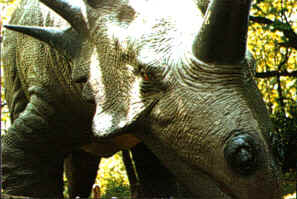
The dinosaur
photo is of a model tricerotops. See also: Pterosaurs.
Dragons
All of the real dragons out there must have caused quite a stir when
they were seen. A real dragon is the perfect template to design myths
around.
Pterosaurs
Pterosaurs were winged reptiles, existing in the late Triassic, and
Jurassic eras. Their wings consisted of wing membranes, attached to an
elongated fourth finger bone. The other fingers formed a hand at the
main wing joint. They had long necks, and many had teeth, and long
tails. Some pterosaurs with long tails has a extra bit of membrane at
the end (looking a little like a tail spade - a common feature in
dragons). Pterosaurs varied greatly in size. The largest had a wing span
of about 4 meters, and flew by gliding. These creatures have obvious
visual similarities to dragons, and fossilized remains could have been
the inspiration for some dragon myths.
Weather
There are many cases of weather being attributed to dragons. Lightning
strikes are sometimes considered to be produced by dragons. With the
dragon of Kinabalu in Borneo, the weather on the mountain top was taken
as an indication of the dragon's mood. In China, some dragons are though
to control the amount of rainfall. People in the past saw a complex
phenomena they could not explain (the weather) and came up with reasons
for it happening. In times when weather could not be described
scientifically, the idea that some sort of fabulous creature caused
weather effects would have seemed quite plausible.
Other Pages:
Types of Mythological Dragon - Dragon
Kings | Mythological Dragon List - Kinabalu,
the dragon of
|