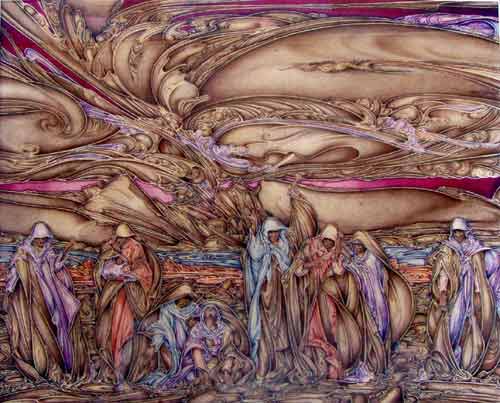
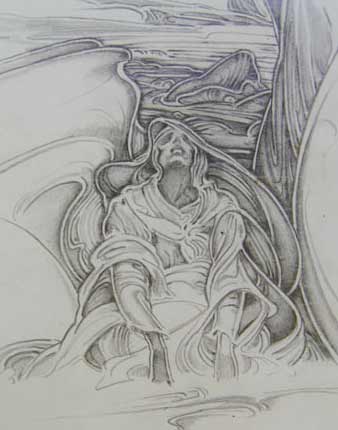
�The Daughters Of Jerusalem� represents a major development for me. In this piece I began applying techniques until then used only in the service of children�s� book and folk lore illustrations (with a conscious facetiousness and irony) to something as serious, as simple, as terrible as grief.
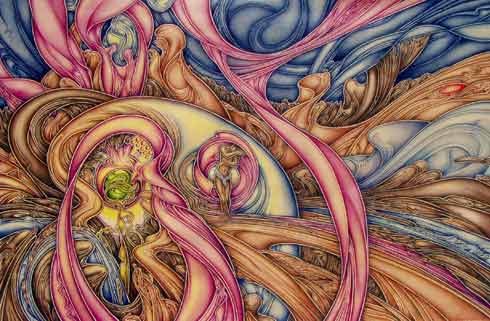
Until then, I had never had the self-confidence to do this. I had never been able to take myself seriously enough. No ink under-drawing, for a start, the staple of Rackam and co., and no escaping into caricature or grotesquely or sexual winking. The only indulgence I allowed myself was expressionistic licence - a sky as distraught as the mourners beneath it (originally conceived as if no particular sex - the name was appended to the piece long after it was actually finished, by a friend who was able to give it what I thought was a brilliantly appropriate name and context. I�d been reading The Book of Revelations and John Heresheys �Hiroshima�, and listening to Shostakovitch and Mahler. I guess, if you�ve not been made cognisant of apocalypse after that - even unhealthily so - you never will be!).
�The Nativity of the Fireflies�, finished immediately prior to �The Daughters of Jerusalem� was conceived in the same spirit as the illustrations for �Ti-Jean�, and was the last of its kind, a kind of farewell to all that. There was supposed to have been a series on the Childhood of Jesus, in the same style, but I don�t think it�s going to happen now.
The Daughters of Jerusalem concepts
After seeing the Cacoyannis� film �Trojan Women� a few times, the idea of the Chorus of Greek drama as an embodiment of grief and lamentation came to me, not so much as a revelation, but something I should have seen long ago for its obvious, direct simplicity. The desert seemed to be the only place to set this scene, to emphasize the sense of emptiness and desolation. Only in the sky (in an effort to convey a kind of embroiling conflagration) did I allow myself the luxury of expressionistic indulgence. Burne Jones� �Passing of Venus� - a bare unfinished masterpiece with much of the ochre and sienna underpainting still exposed - inspired my own colour scheme of browns and greys, deliberately held to a minimum of variation so as not to complicate the pallet and rob it of the kind of austerity I was striving for. The river, conceived purely as a compositional device, has been interpreted as the river of life, a symbol of life ever renewing itself, even out of devastation and disaster, in fact, in spite- and because - of it. The figures are the universal ones of Jung�s collective subconscious, clothed in the timeless garments of degradation and deprivation, the scraps of covering we find to wind about ourselves when all we have left to cover our despair are the bits and pieces of rags left after the cataclysm has passed. |