| a |
| a |
 |
|
|
 |
|
|
| The Bookmann | Richard Bolai All Rights | Reserved 2004-5 |
|
|
| The Bookmann online gallery |
|
|
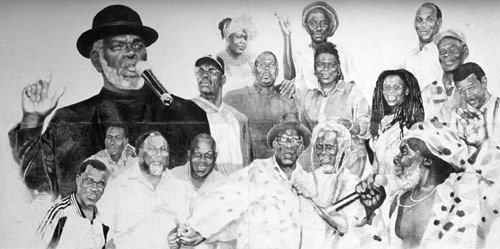
| Poster, Port of Spain, 2000 Trinidad, West Indies |
 |
 |
| Carnival is not necessarily colour. As imagery for Carnival goes, it is rare to come upon drawing such as this. I was very excited when I saw this large drawing, about 4 feet long by 3 to 3 1/2 feet high. It was produced for a calypso tent that was started at De Luxe theatre. This theatre no longer exists. In its place is a new night-club called Club Zen. The old theatre was one of those rare buildings that featured architecture from the period of Art Deco. What was particularly interesting about this old movie house was the bathrooms. They featured wrought iron details and geometric and floral tiles done in the delicate, quirky semi-restraint of the period. I miss the old place. There are so few symbols of pre World War II architecture, we seem to only save some of the cute ginger bread houses (amazingly the symbols of colonialism that we hated so much at one point. But we destroy the progressive architecture that came after colonialism) and I will write more on that at another time.
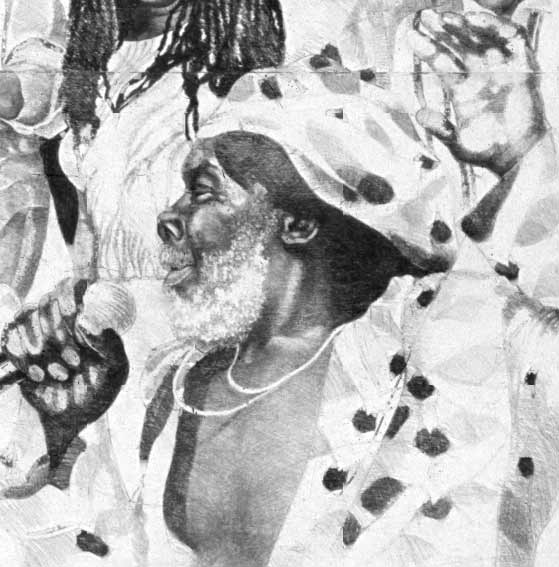
This beautiful. lifelike pencil drawing of calypsonians was rendered with love and respect for all of the musicians involved in that tent. Shadow is drawn the largest and is dressed in his symbolic black. (I believe that he and Stalin formed the calypso tent) Stalin is also a bit larger than the other members. He is featured in detail, and is represented on the bottom right of the poster, giving a strong diagonal and framing to the piece. Whether the artist used photographs of the musicians or drew them from life is unclear, and not a detail that really matters because there is definite skill in the work that is unquestioned. I was surprised when I saw this drawing that it was not treated in any way to suggest value. It was handled like a billboard, and if sprayed or painted over with a binding agent to secure it from fading, it was only just done. It had no adornment to raise it to the level of masterwork, no glass panel over it, no border of wood to claim it. It seemed simply drawn and placed, propped up on the staircase outside the building. Although it was clear that a lot of skill and attention was paid to making it known that it was a good work. After all it was advertising the tent. But it was so by the way, like so much of our best work in Trinidad and Tobago. I wondered to myself as I looked at it, how many people told their friends that they needed to come to this site to see this very good drawing. I know that I told everyone that I knew about it. I was so happy to see such good work in such an unlikely place. But there is something else about this piece. |
| Over the years in Trinidad and Tobago there has been a steady building of African identity that has been very aggressive. The argument being that Afro Trinidadians have suffered considerably more than other groups, and that culture in Trinidad and Tobago is predominantly of an African nature. This is a highly controversial issue. If I am off base I appreciate responses. This desire to see �culture� as predominantly �African� has lead to an uneasy truce by the non Afro-Trinbagonians of the island. No one wants to talk about or get into any argument about what culture is, and so the people who push the hardest for the funding of the cultural pie �win.� However most of us know deep down that culture is a constant, building and melding of cultures (plural) and not culture, (singular). We know that it is not fair to only see one type of music, art, dance etc as ours. But we seem unwilling or unable to say or do what we need to, to embrace everything and everyone. With that said, what this poster does is it raises the calypsonian to icon status, and this is one of its most appealing purposes. Yes it was designed to advertise. But it has done much more. It is something that in its use could have been utilized further. It could have branched out to tee-shirts and banners and other types of advertising because it was so sincere. When I looked at it I felt a pride about the drawing. The artist enjoys working with pencils and used the application of line in a myriad of ways. I stayed and observed the work for some time, and I was moved by the level of patient detail and special attention paid to every single person on the bill.
|
| Over the years in Trinidad and Tobago there has been a steady building of African identity that has been very aggressive. The argument being that Afro Trinidadians have The poster was part of a larger banner that held the names of all of the participants in the tent, and that was done in simple Sans Serif text on a green background, separate and apart from the drawing. This drawing to me said less about the whole �afro centric� question (or statement) and more about building up our icons for themselves. It reminded me as well about some paintings I had seen in Chaguanas on the main road. Someone has a group of very realistically rendered portraits of Mas man Peter Minshall among others. This too I shall write on in another posting) By its placement and care, the artist was talking about respect and regard for things Trinidadian. Not for things based on racial coin, and I think that that is where we have to go. There is nothing wrong with racial pride. It is important for self-esteem. What I am stating is that we live on an island, despite how big we feel, we are very small, and our wealth is within our diversity. Surely we can embrace everything we are, whole, whole, and develop what we know we can become without marginalizing other groups into feeling that only one kind of work is what our country is all about. Adele Todd 2005 |
| PublicArt |
| Billboard for a calypso tent at De Luxe theatre. Port of Spain, 2000 Trinidad, West Indies |