Near dusk, Pope John Paul emerged from the athletic Stadium. Catholic nuns, dressed in their earthy coloured habits, displayed a Carnival mentality never televised before. They were not unperturbed in prayer, genuflecting to his Holiness in a proper Church-Mass manner that would be expected of them � no, they bolted like a startled herd, galloping towards the stadium�s running track to see their JP2. A superstar circulating in his Pope-mobile. Orgasmic really. Gyrating their hips side to side and chipping to the calypso rhythms of a chorus sung in praise; �We Pope.�
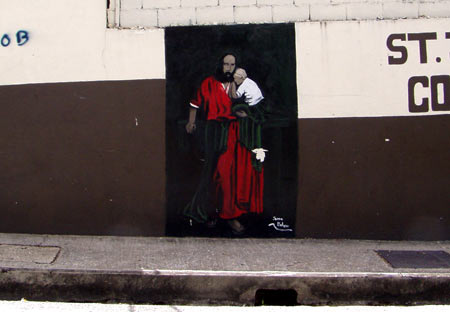
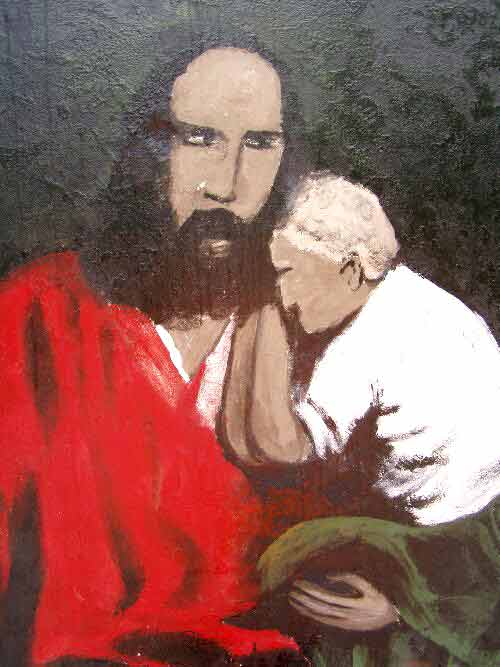
This is a nation of staunch Catholics, having iconography and lucky charms hanging in their prized possessions. It is in San Jose de Oruna, one of the oldest �New World� territories, that a wall mural displays not only the talent of a great painter (Trini standards) but also his Catholic religion, in a contemporary motif. A child is at rest, hands nestled in the regal beard of his father, (what a clever way not to paint hands) clothed in a white short sleeved �Polo� shirt and having an uncanny resemblance to a five-year-old Pope John Paul.
Rewriting the annals of biblical history
Jason Belaw is proud enough to sign his name to his newest testament, a life-size portrait of Joseph and the infant Jesus. Emanating from the darkened background of a four by seven foot frame, the dominant figure of Joseph in full roman scarlet-red is poised and seated, if you believe, on a throne draped with sea-moss green cloth. His left arm is placed gingerly on the armrest. His other arm cupped under the heavy strain of carrying this sixty-pound child. A unusually petite hand is visible.. At stance, his feet are well protected by a tanned hide �Clarks�. No Rembrandt composition here, but a painted subject illuminated under a 10-watt bulb. An untitled? A winner of the �Trinidad Aesthetic� Hall of Artistry..
Jason Belaw chose not to use emulsion for this painting, only the best he thought, and that would have to be the everlasting Berger low-sheen house oil paint. The German chemist Lewis Berger in 1760 developed a new formula for the pigments popularly known as Scarlet-red, Sea-moss green, Dominica brown and Pitch-lake black. The lacquer, applied layer by layer, gives the Berger high-gloss-house-paint a lustre of eternity. Joseph gesturing with a �cut-eye� holds whom appears not to be his child. Is the artist inadvertently trying to say something about himself?
|