(Megachasma pelagios)
 clip
art teken from http://www.animationfactory.com/
clip
art teken from http://www.animationfactory.com/
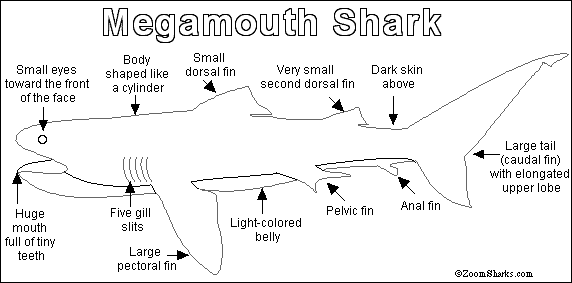 picture taken from
www.zoomsharks.com
picture taken from
www.zoomsharks.com
Megamouth Sharks are elusive and fascinating. There have been only 16 confirmed sightings of the Megamouth Shark and very little is known about this creature.
There are conflicting phylogenetic
hypotheses regarding the evolutionary relationships between the Megachasmidae
and other shark families. One theory suggests that the Megachasmidae is
evolutionary derived and form a monophyletic (they have one single common
evolutionary ancester) family with basking shark, Cetorhinidae. Others
disagree with this idea and suggest that the Megachasmidae is relatively
derived and forms a sister group to the Cetorhinidae, Lamnidae (mako, white
and porbeagle sharks) and Alopiidae (thresher sharks). Recent studies suggest
that Megachasma pelagios is the most primitive living species within the
order Lamniformes, which contains all the aforementioned families, and
has independently evolved the filter feeding mode, shared with the basking
shark, Cetorhinus maximus. Although only 16 sightings of megamouth shark
are reported, this species is now known from Indian, Pacific and Atlantic
Oceans. As with the two other filter-feeding sharks, the basking and whale
sharks, this species is wide-ranging. However, the megamouth is considered
to be less active and a poorer swimmer than the basking or whale sharks.
Poor mobility likely is a reflection of its flabby body, soft fins, asymmetrical
tail, lack of keels and weak calcification.
The sizes of all reported megamouth
sharks are maximum size is at least 550cm (17ft). Males mature by 400cm
(13ft) and female by 500cm (16ft).