On this page I will endeavour to go through the colours of Border Collies in Australia - I do appreciate the fact that the colours in most parts of the World are very extensive in comparison, but we at Rhonabwy have to go with the Australian Standard.....
As you can see from the photos below the Australian Colours are:
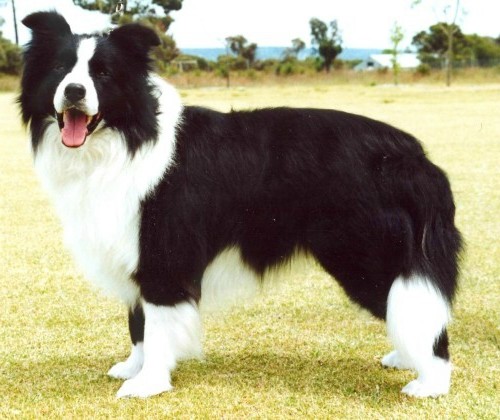
Black and White
The black and white colour is a combination of the dominant body colour black, and the recessive irish spotting colour creating the white markings. The black colour is coded for by the B gene, and is the dominant colour at that gene. Since black is a dominant colour, a black dog may be "carrying" alleles for other colours that are recessive to black, and "hidden" by the dominant black colour. For instance, a black dog might carry chocolate. This would be described genetically as "Bb" - showing that the dog has one dominant allele (the big B) at the B gene, and one recessive allele (the little b) at the B gene.
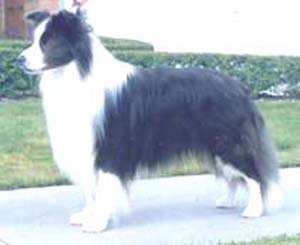
Blue and White
Blue is a recessive colour, a dilution of the black colour. The dilution effect is caused by improper packing of the pigment into the hair shaft, causing light to reflect differently. It is coded by the D gene, and since it is recessive, a dog must have two copies of the recessive
allele to actually be blue. It can be described as "dd".
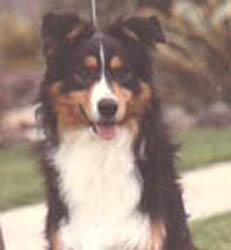
Black Tan and White (Tri)
Tricolour is a recessive colour coded by the A gene. A tricolour dog must have two copies of the recessive allele for tricolour, which can be described in genetic language as "at at". The
recessive colour causes the black or chocolate pigment not to be allowed into the coat in certain areas, usually around the legs, base of tail, muzzle and eyebrows - uncovering the yellow pigment always found underneath. Tricolour can be found in black and chocolate coloured dogs, and variations on those colours - blue and the merles, although Australia only recognises the black, tan and white.
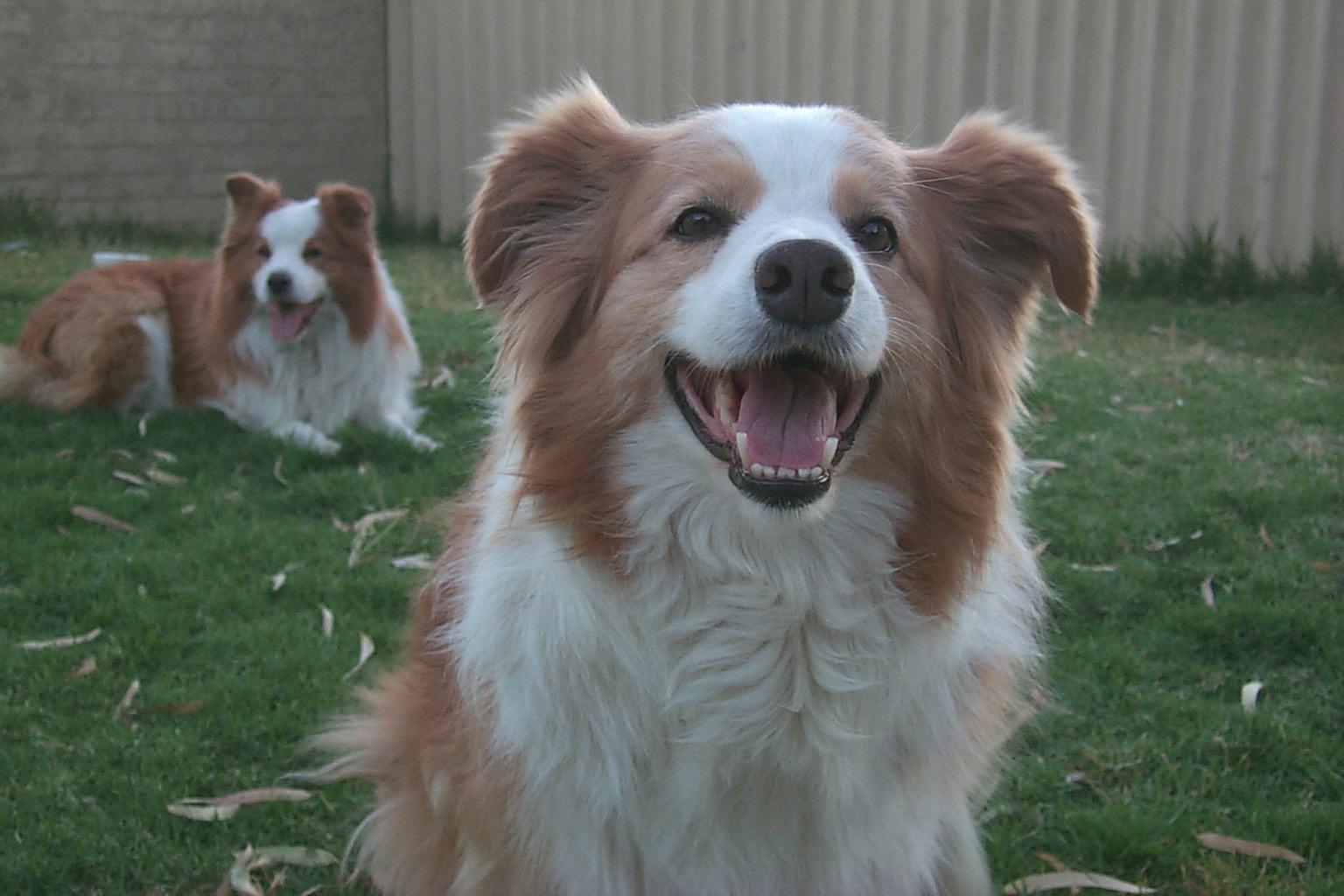
Red and White
Red is recessive colour coded on the E gene. If a dog has two recessive alleles at the E gene - if it is "ee" - then the dog will be red. This gene
causes the pigment specified at the B gene - either black or chocolate - not to be allowed into the coat, uncovering a yellow pigment which is always present underneath. The B pigment is still allowed into the eyes and nose and lips - therefore we see the striking black pigment which makes the red colour stand out like it does. This should explain why tricolour can't be seen on a red dog - *all* the yellow pigment is already uncovered on a red dog, so you wouldn't notice the partial uncovering of the yellow pigment caused by tricolour. I would have to say “Cody” is a classic example of this, especially with the number of Tri colours he has thrown.
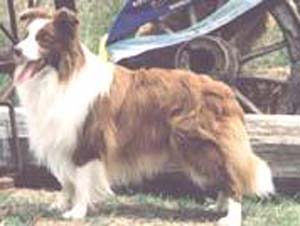
Chocolate and White
Chocolate and white is a recessive colour coded by the B gene - remember, black is a dominant colour, on the same gene. Chocolate is an alternative colour to black so a chocolate dog can be described as"bb". In order for a dog to actually be the chocolate colour, it must have *two* copies of the chocolate allele.
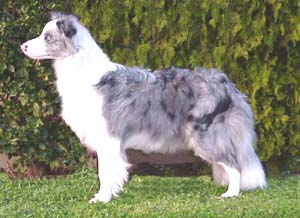
Finally Blue Merle
Merle is a dominant and is coded at the M gene. Since merle is dominant, only one dominant allele is necessary to create the mottled effect we know as merle. Almost all merles are carriers of the normal, recessive allele - and can be genetically described as "Mm". If two copies of the merle allele are present "MM", there is an extremely high risk that the dog will be deaf and have a condition called microphthalmia - small, damaged eyes, usually causing
blindness, as well as be depigmented - too much white. The merle gene acts by causing fading of the black colours in certain areas, allowing them at full strength in other areas (causing the patterning known as merle). It is important to point out that you should never breed a merle to a merle, or you will take the risk of creating "MM" pups which will suffer tremendously from the lethal effects of the gene. NOTE the Australian Blue Merle is just that and not a blue merle tri - having tan markings.
Big thank you to Tonya Levy for the picture of the merle
THE FOLLOWING ARE A COUPLE OF LINKS TO HELP WITH GENETICS:
Genetics 101: Not even sure you've got DNA and gene down? The Cold Spring Harbour Laboratory site has a comprehensive online tutorial DNA From the Beginning, with problems and examples.
The difference between molecular and classical genetics, or why pedigree-gazing is not enough.
The dilution and white-spotting and ticking loci
|