 The
year was 1920. It was the start of the decade, shortly after World War
One, and a time of great prosperity for the country. Women were called
dames, dolls, or the cat's meow. At the beginning of the decade, women
still wore long skirts but the "Roaring 20s" brought a new look of short
skirts and smartly coiffed shorter hair. Racial tensions were high and
quotas set for immigrants coming into America. The Klan was very active
during this period. The Harlem Renaissance was acknowledged as the first
important movement of black artists and writers in the US. On January
16, 1920, the Volstead Act became effective, heralding the start of
Prohibition and on August 18th of the same year, Tennessee delivered the
crucial 36th ratification necessary for the final adoption of the 19th
Amendment, giving women the right to vote. The worst and longest
economic recession to ever hit the United States would define the end of
the decade-the Great Depression.
The
year was 1920. It was the start of the decade, shortly after World War
One, and a time of great prosperity for the country. Women were called
dames, dolls, or the cat's meow. At the beginning of the decade, women
still wore long skirts but the "Roaring 20s" brought a new look of short
skirts and smartly coiffed shorter hair. Racial tensions were high and
quotas set for immigrants coming into America. The Klan was very active
during this period. The Harlem Renaissance was acknowledged as the first
important movement of black artists and writers in the US. On January
16, 1920, the Volstead Act became effective, heralding the start of
Prohibition and on August 18th of the same year, Tennessee delivered the
crucial 36th ratification necessary for the final adoption of the 19th
Amendment, giving women the right to vote. The worst and longest
economic recession to ever hit the United States would define the end of
the decade-the Great Depression.
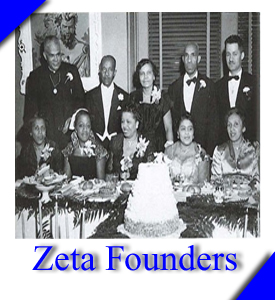
It was within this environment that Zeta Phi Beta Sorority was founded.
Zeta Phi Beta Sorority was founded on the simple belief that sorority
elitism and socializing should not overshadow the real mission for
progressive organizations - to address societal mores, ills, prejudices,
poverty, and health concerns of the day. Founded January 16,
1920, Zeta began as an idea conceived by five coeds at Howard University
in Washington D.C.: Arizona Tyler, Viola Tyler, Fannie Pettie and Pearl Neal. These five women, also known as our Five Pearls,
dared to depart from the traditional coalitions for black women and
sought to establish a new organization predicated on the precepts of
Scholarship, Service, Sisterly Love and Finer Womanhood. It was the
ideal of the Founders that the Sorority
would reach college women in all parts of the country who were sorority
minded and desired to follow the founding principles of the
organization. Founder Viola Tyler was oft quoted to say "[In the ideal
collegiate situation] there is a Zeta in a girl regardless of race,
creed, or color, who has high standards and principles, a good scholarly
average and an active interest in all things that she undertakes to
accomplish."
Since its inception, the Sorority has chronicled a number of firsts.
Zeta Phi Beta was the first Greek-letter organization to charter a
chapter in Africa (1948); to form adult and youth auxiliary groups; to
centralize its operations in a national headquarters; and to be
constitutionally bound to a fraternity, Phi Beta Sigma Fraternity,
Incorporated.
Zeta's national and local programs include endowment of its National
Educational Foundation, community outreach services and support of
multiple affiliate organizations. Zeta chapters and auxiliary groups
have given untotaled hours of voluntary service to educate the public,
assist youth, provide scholarships, support organized charities and
promote legislation for social and civic change.
A nonprofit organization, Zeta Phi Beta is incorporated in Washington,
D.C. and in the state of Illinois. The dues and gifts of its members
support the Sorority.
Over the years since the sorority's inception, Zeta Phi Beta has
chartered hundreds of chapters and initiated thousands of women around
the world. Zeta has continued to thrive and flourish while adapting to
the ever-changing needs of a new century. Despite the Great Depression,
discrimination and segregation and a host of other challenges, Zeta has
continued to hold true to its ideals and purpose, for, as stated by one
of the Sorority's founding members: "…I believe that no [other]
organization could have been founded upon principles that were so near
and dear to all of our hearts." (Founder Myrtle Tyler)