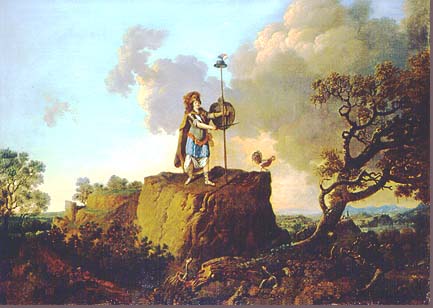
Virtue: The search to embody the ideal of Virtue led to the Ancient Civilisations of Rome and Greece. Art came to embody Virtue through the Heroes and Classical images as inspiration to ordinary citizens. As in the right-hand picture above, Liberty is dreessed as a Roman Gladiator. Philosophers extended this concept and chose to live in a certain degree of poverty and began to promote austerity as a natural extension of Virtue.
Art began to be exhibited at the then redundant Louvre Palace, and so Art was open to everyone and became more orientated towards everyday urban workers. Public art developed with a strong emphasis of directly relating to People.
In stylistic terms the end of the Nobility heralded the end of frippery in art and so clear lines and more defined shapes and objects become order of the day.
The Liberty aspect spread to women who were then more able to access the profession than previously. (see women) A famous example is Elisabeth Vigee-Lebrun. Who was a predominant female artist throughout the revolutionary period. Its of note that the Academy which was responsible for overseeing the Arts was reorganised on more egalitarian lines which gave greater opportunities to talents.
Clearly the Revolution brought immediate dramatic change. An end to the religious iconography of previous decades which was replaced by a predominantly Neo-Classical theme and stressed in general rationality and logic. Coupled with a move away from artifice was the celebration of youth to the extent that most of the subjects, apart from the most famous older classical heroes, were in their twenties. Uppermost was the concepot thyat artists previoulsy had been misunderstood and were 'Genius'' They ultimately painted images of and for the Revolution, often summing up aspects of the Revolution as a particular Virtue or ideal. |