| Women |
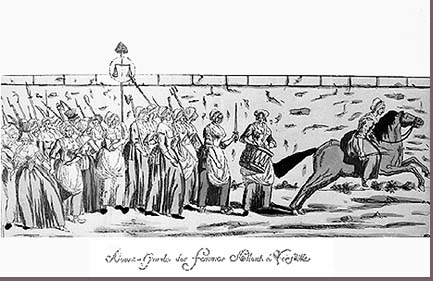 |
During the French Revolution women were about the only traditionally oppressed group who had not, at some time, realised strides towards liberty and equality. The Sans-Cullottes, Jews and even Blacks were at some time allowed to vote, women had never had the privilege. The enlightenment had led to a great deal of talk towards equality, racial, religious and economic. When it came to sexual equality even Jean-Jacques Rousseau, the man held as God-like to a generation of revolutionaries, firmly believed that woman�s place was in the home learning her opinions from her husband. The French Revolution saw two simultaneous fights. One to end feudal oppression and one for women�s rights. From the time of the first meeting of the Estates-General rights for women were being sought by pamphleteers. From the storming of the Bastille women contributed to the successes of the revolution. On the 5th October 1789 a few hundred women started to march from the Champs-Elysees to make demands for bread. Recruiting as they marched they numbered ten thousand by time they reached Versailles the following day. At Versailles the royal family was seized and escorted back to Paris. This significant action of the revolution became known as the �woman�s march on Versailles�. [See picture above.] The most famous individual of the women�s movement of the revolution was Olympe de Gouge. In response to the Declaration of the Rights of Man and Citizen she authored The Declaration of the rights of Woman in 1791. Her declaration called for the same rights for women to those granted to men, schooling for girls and more job opportunities for women, amongst other things. She also wrote plays and pamphlets advocating the abolishment of slavery, seeing equality in its fullest sense. At the same time in England Mary Wollstonecraft wrote The Vindication of the Rights of Women. A feminist work far ahead of its time in demanding universal suffrage, it was as important to twentieth century feminists as it was to women in the eighteenth and nineteenth centuries. (Feminism) |