
WHY RUM-ORTH-IVRI.NET?
OUR GOALS [CONTINUED FROM PAGE 2]
We are launching this website in English, considering that it is a kind of "Esperanto", i.e. an international medium, even within Israeli Society. But we intend to do our utmost in the very near future to post texts in many languages and to invite our readers on the web to contact us in their own language, whether it be English, Hebrew, Russian, Ukrainian, Serbian, Romanian, etc.
Our target in establishing this website is to enhance the quality of the spiritual life of the Faithful or of any other persons visiting our website and to address their inquiries, whatever these might be. It is a part of the present-day duty of the Orthodox Church of Jerusalem to accept and to face without shirking any issue concerned with the authentic Traditions of the Orthodox Church.
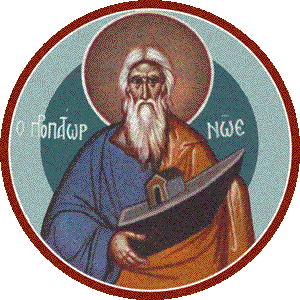
THE SIGN OF NOAH AND THE RICHNESS OF MULTICOLOURED LANGUAGES
We have chosen to launch this site on the eve of the Liturgical New Year of the Orthodox Church of Jerusalem, i.e. on September 14th, 2002 according to the Old Calendar. It usually corresponds to the Jewish holidays Rosh HaShanah [New Year], Yom HaKippurim [Day of Atonement] and Sukkot [the Eschatological Feast of the Booths]. Over this same period, the Orthodox Church also celebrates several Feasts, namely the Nativity of the Blessed Virgin Mary on September 8th [New calendar]/21st [Old calendar], and the Consecration of the Altar of the Holy Sepulchre on September 13th [New Calendar]/26th [Old Calendar] and the Exaltation of the Holy Cross on September 14th [New calendar]/27th [Old calendar]. Moreover, a new Feast, the Enthronement in 2001 of His Beatitude Irenaios I Patriarch of Jerusalem, All Palestine and Holy Sion is celebrated on September 2nd [New calendar]/ 15th [Old calendar] is now a part of the official calendar of the Church of Jerusalem..
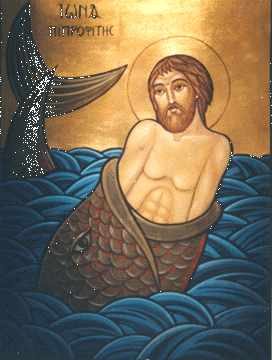
On the Jewish Day of Atonement [Yom HaKippurim], it is customary in the Jewish Community to read the Book of the Prophet Yonah [Jonah, Jonas]. Yonah did not want to undertake the task with which God had entrusted him. It is easier to go on vacation to a nice place than to preach and entreat sinners to repent. Finally Yonah acquiesced and accepted his mission, and as a believer in the One God, Creator of Heaven and Earth, he told the sailors on the ship in which he was traveling: "I am a Hebrew ["Ivri anokhi" in Hebrew] and I fear the Lord, the God of Heaven, Who has made the sea and the dry land" [Jonas 1:9]. The sailors, victimized by a terrible storm, cast Yonah out of the ship believing him to be the cause of their misfortune, and Yonah spent three days and three nights in the belly of a Big Fish ["Dag Gadol" in Hebrew] which is usually considered to be a whale [Jonas 1:15-17].
While inside the fish's belly, Yonah uttered a prayer of thanksgiving. He interceded on behalf of the sailors who had thrown him into the sea and thus they were saved from the storm. He was sheltered while on the waters, which are a symbol of sins [cf. Micah 8], but laid in the darkness of death before being vomited out by the Fish upon the dry land, a sign of Salvation.
Yonah's supplication is deeply moving: "I cried unto the Lord and He heard me; from the belly of Hell [i.e. the female fish, "HaDagah" in Hebrew] You heard my voice. For You had cast me into the deep . . . Then I said I am cast out of Your sight; yet I will look again toward Your Holy Temple" [Jonas 2:2-4].
It is recounted in the Gospels that certain people came to Jesus Christ looking for signs; and Jesus admonished them, saying: "An evil and adulterous generation seeks after a sign; and no sign shall be given to it save the sign of the Prophet Yonah, for as Yonah was three days and three nights in the whale's belly, so shall the Son of Man be three days and three nights in the heart of the earth . . . Behold, One greater than Yonah is here" [Matthew 12:38-42]. The same words of the Lord are mentioned as well in the Books of John 16:4 and Luke 12:54-56.
It seems that on the Day of Atonement the Jewish Community expects not only a sign but a miracle, which is represented by the same word in Hebrew and Aramaic and which is used in the Book of the Prophet Yonah, namely "oth" in Hebrew, or "atha" in the Peshitta Aramaic version of the Gospel. "Oth" is spelled in Hebrew "aleph-vav-tav", i.e. "aleph" [the first letter of the Hebrew alphabet] adjoining "vav" [meaning "and" in Hebrew] adjoining "tav" [the last letter of the Hebrew alphabet], i.e. that a sign is the miraculous intervention of God from the beginning of all things to the last events of History, introducing the Spirit of Prophecy as a dynamic action of God in our lives.
Therefore, we have chosen to open this website with the Prophet Yonah calling every human being to Atonement, Repentance, Forgiveness and Life despite all the trials and tribulations that may harm or imperil his life. Yonah is a sign of the hope beyond hope shown throughout history by the Jewish People, and the only sign that Jesus reveals: that we are to rise from Hell to Ressurection.
CONCLUSION
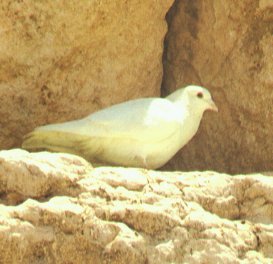
Finally, Father Alexander Winogradsky lives in the Holy Land where the Holy Spirit enlightened the Faithful. In Hebrew the word "yonah" also means "dove", which is the sign of the Holy Spirit ["Ruah HaQodesh" in Hebrew, "Rukha deQadishatha", "the Spirit of Holiness", in Aramaic].
May our Jerusalem dove reach you and many people on a regular basis through this website, and please tell your friends about us so that our dove will fly to visit them as well . . .

HOW to contact us?