
WEEK 4 - THE ORTHODOX READINGS - [Continued from page 2]
according to a ritual but a life-giving memory. Your computer has an active memory, it is not a storage, but as concerns God we are full of doubts. But Zechariah's wife is, by her name, a sign of the oath and the Hebrew text even suggests that God will not find any rest [lo yinakhem, not console Himself] until He will allow this couple to achieve an act of salvation.
When I go to Church do I really believe that the Presence of God is much more important to consider than the ritual and that the ritual is a living process and not a series of systematic and automatic pronunciations of sentences and acts to be performed? Do I consider family life, parental life as a living and repenting process? Do I accept the fact that God has sworn, taken an oath and will not change His mind? May I try to search for my own human balance and avoid any kind of versatility?
THE JEWISH READING
The Jewish portion of the Torah recalls the creation of the world. It would be very difficult to get into the explanation of most of the words because there is a high concentration of different aspects. A student learning Biblical Hebrew would have to know by heart the first sentence and, at least, three words "Bereshit / in the inception / Bara' /created / ElohiM / God the heaven and the earth". The problem is that BERESHIT does not mean "In the beginning", but "in the first...?" and a word is missing. In Greek "En arkhi" does mean: "In the very beginning", remote, archaic time. And then are listed the six days of creation. For each day, it is mentioned that "there was evening" [a time of darkness] and a morning [visit, visitation, light].
Of course we may not accept these words as a reality. Did God really create the whole of the universe in six days. We then focus on ourselves. Darwin's theory of a random evolution of human beings and the development of the world is still a real question. But many scientists were asked about how they consider the account of the Genesis. And some of them do consider that there would not be any other authentic possibility to describe such a process than as it is recounted in the first chapter of the Bible.
The creation of the earth is not limited as we would like it to be. In Hebrew, HA'ARETZ is not only the earth where we live. It includes a permanent expanding process and Divine Will to break forth and through time, space and history. We are often too stiff or cozy to consider any change, real changes in our personal lives but also human destiny, and suddenly are scared because of some threat [wars, fights, family quarrels, or simple changes... where is my teapot?].
We are really on the move and it may cause a lot of turbulences in our lives. In German, English, Dutch, Scandinavian languages "Wille, will, wil, vil[je]:" or in Latin languages "volunta, vonte, voluntad" may even be used for building future tenses. In Hebrew, RATZON is a developing extension of what was, is and will be in accordance with God's Will. The root RuTZ refers to "will", "run, race", earth placed in an extending space".
This action is even strengthened in the account of the creation of the world by the fact that God states a very unique situation, which we hardly cope with or can imagine. He created the human being in "His image and His Likeness". This means that every man can trace back to God Himself as the Initiator of Life and any inmate on the earth. Rabbi Akiva considered that the mitzvah "You shall love your neighbour as yourself" is the most important commandment, thus pronounced by a Jew when waking up according to many siddurim [prayer books]. But Rabbi Ben Azzai said that there was something higher, a commandment which is very difficult to accomplish or simply accept and respect: the fact that in every human being we do consider The Image and Likeness of God Himself.
The portion of the Torah has one positive commandment or mitzvah, common to any human being, man or woman: "Be fruitful and multiply, and replenish the earth, and conquer it" [Genesis 1:28] This life-giving commandment which shows evidence that we were created in His Image and Likeness is rejected when Kain kills his brother Abel. And the wickedness of man multiplies in such a way that God decides not to destroy the world, but to destroy all living beings, from mankind to animals.
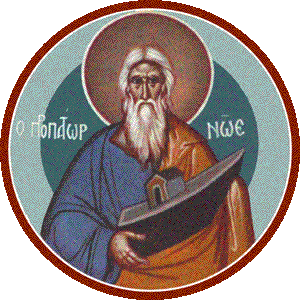
But God shall repent and save Noah, the righteous. This portion of the Torah is very similar to what the Orthodox celebrates. The conception, the birth, the service of the creation, of human welfare, well-being and enlightenment is a real challenge. The forerunner will be killed because of the wickedness and versatility of two women and a false king, Herod.
Therefore our hope is beyond every hope ane the Church knows that any development of life extends the creation and leads to its fulfuillment as the Apostle Saint Paul said [Ephesians 3:19]. And this is a huge challenge and thing to witness.

HOW to contact us?