
WEEK 3 - THE ORTHODOX READINGS - [Continued from page 1]
We are in the fourth century A.D. and the Jewish community has been scattered throughout the diasporas, most often accompanied by Christian believers and preachers. The Temple is a memorial and some remnants, like the Wall, the Cave of the Patriarchs in Hebron and other sites are kept alive in the daily prayers.
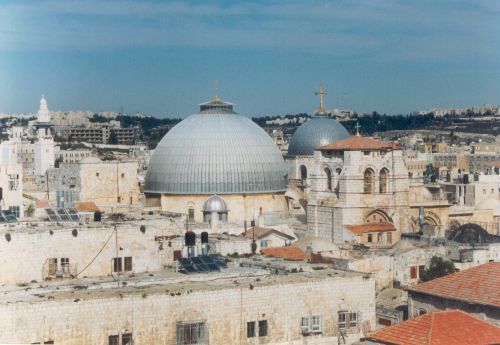
Saint Helena came to the Hill of the Crucifixion or Golgotha and she prayed in order to find the Holy Cross. Three pieces of wood are shown to her. In the Gospel, there are three Crosses: one for Jesus Christ and two others for the two thieves. But after three centuries, would it be possible to find out which is the authentic Cross? This is the mystery and action of prayer. Saint Helena rejects the two first pieces of wood and venerates the last one, as she profoundly feels that the last one is indeed the Life-giving Cross. This is a sign, a miracle. The faithful then begin to utter slowly, and then progressively more and more loudly the Greek words: "Kyrie eleison" [Lord, have mercy] which have been included and kept in most liturgical languages and Services. During the Procession with the Relics of the True Cross, the Patriarch Irenaios of Jerusalem, goes around the whole Anastasis, and at each major station [the Place of Discovery of the Holy Cross, Golgotha etc], he shows the Cross to the faithful and bows during the chanting of "Kyrie Eleison" forty times, bowing down and rising up again to show the Cross, the Tree of Life.
In Hebrew and still today in the Syrian Orthodox Church, the expression "Rakhem Aleynu" is comparable to this hallowing of the Cross: "Have mercy [O Lord]", and this week we can note with interest that both the Church and the Jewish Community share the same words of expectancy and hope: It is the recitation of Psalm 28:9: "Save [Hoshiyah], O Lord, Your people [et amekha] and bless your inheritance [uvarekh et nahalatekha]". The Church celebrates this year the Life-giving Cross on the Day of the Hoshana Rabba, the great supplication of God, that He may in His Favour save His Flock and all the creation. "Hoshaya", with a small pause, "save, have mercy" but most of all: "We give You thanks because we do trust that You will save". The Greek words are kept in the Byzantine Services as well as in the Latin, Coptic and Ethiopian Churches, and the Anglican and various Protestant movements at their origins. The Hebrew word "Hoshana, [Hosannah]" has also been maintained in for the coming of the Saviour: "Blessed be He [Barukh Haba] That comes in the name of the Lord [beShem Hashem], Hosannah in the Heights [Hoshana bamromim, cf. the Syriac Liturgy of Saint James]. Uttering this supplication "Rakhem Aleynu", we are acting as "lying carpets" in front of some unknown idols. We stay in the Presence of the Life-giving God and we raise ourselves to say: "Lord, give us Your impulse to live in Your forgiveness and loving care". "Rekhem" is the "life-giving womb" of a woman and similar to the launching of the creation of the world. "Hoshana" is related to God's creative "actions, deeds [AssaH]", a powerful impulse that we sometimes might consider too humbly, although there is a real challenge to expect any action of God in our lives.
IN THE BOOK OF APOCALYSIS OR REVELATION [1:9], the Lord says: "I am the Alpha and Omega, the beginning and the ending", and we confess that it is the Lord Jesus Christ in Person, now in the Glory of the Father. Jesus Christ did not speak the words of the Gospel in Greek. On the Cross, His title "Jesus of Nazareth, King of the Jews" is written in Hebrew, Greek and Roman [the Latin "pidgin" used throughout the Empire][John 19:19]. This error is quite frequent and still pending in Jerusalem. He certainly had said "Ani [Anokhi] HaAlef veHaTav", "I am the Alef and the Tav". The sign of the Tav became the TAU which Saint Francis of Assisi used when blessing Brothers, using the Priestly Blessing [Numbers 22:6]. TAV is a crook and in ancient Hebrew script it had the shape of a cross.
Different words are used, especially in Greek, to speak very commonly of the Cross: "Stavros" [Cross] which became a name, and "Xylos" [Wood]. In Russian, "Krest" is the Cross, and passing through It the faithful receive the seal of "Kreschenia", his baptism. The link is even stronger in Ukranian "Khrest/Khreschnia".
In Hebrew, "Alef" [alpha] is the first consonant and refers to God: "Ani HaShem Eloheykha" ["I am the Lord, Your God...", Genesis 15:7, Exodus 6:7, Leviticus 20:24]. To the contrary, "Tav" is the last consonant expressing the achievement [Tam, accomplished] as Jesus says on the Cross [John 19:30].
At first, this TAV was written in the shape of a cross, a crook. It is the "Tawah", the "mark" relating to the words of the Prophet Ezekiel 9:4: "And the Lord said to the Prophet, go through the midst of the city of Jerusalem and SET A MARK ["vehitwita taw"] upon the foreheads [cf. Apocalypsis 7:3, 9:4, 14:1] of the men that sigh and cry for all the abominations that be done in the midst thereof". In the Talmud Shabbat 55a referring to the Prophet Exekiel, it is written: "Go and make a prophetic sign [tav] on the foreheads of the righteous with ink". This "ark" is not an end, a condemnation. Just the contrary: a sign of Salvation and permanent renewal of life.
When Cain killed his brother Abel he was given a very specific measure of Divine protection toward him and his descendants, as we all are his great great grandchildren... The Lord said unto him: "Whosoever slays Cain, vengeance shall be taken over him sevenfold. And the Lord set a mark ["ot" = sign] upon Cain... who went to dwell East of Eden" [Genesis 4:16]. His grandson Lamekh sang these words to his wives: "Hearken for I [=my grandfather Cain] has slain a man to my wounding and a young man to my hurt. I, Cain, shall be avenged seven times, truly Lemekh seventy and seven times."
This sign is the mark of the miracle of life beyond death and slaughter, forgiveness beyond hatred and sorrow. Ant the Apostle Peter-Kaipha comes to Jesus and says to him: "Lord, how
TO CONTINUE TO PAGE 3 PLEASE PRESS HERE

HOW to contact us?