
WEEK 2 - THE JEWISH READINGS - [Continued from page 3]
First there is the palm tree or "lulav" which were originally from the Jericho Valley with the sweetest dates, then there are the three branches of myrtle or "hadas", then there are the two branches of willow or "aravah" - these three species to be held in the right hand. Then there is the "etrog" or citrin [a Yemenite specialty] to be held in the left hand, and altogether these comprise the four species or "arbaa minim". The palm tree is as stiff as the spine and symbolizes the man of faith. The willow is like a mouth that utters prayers and strengthens the weak. The citrus has a nice appearance and a good smell like righteous men who respect the Law and make good deeds. The myrtle smells nicely, but lacks flavour and represents ordinary people that don't really practice but may make good deeds. The willow has neither taste nor good smell and is like those who never study nor make good deeds.
The faithful wave these four species all together, and the unity of the entire Jewish Community as well as all mankind long after God and proclaim that God reigns over the whole world. Therefore they wave them to the East, West, North and South. And we should remember something very important. All these plants need a lot of water to survive and develop: "On the last day, the great day of the Feast, Jesus stood and cried, saying: If any man thirst, let him come unto Me and drink. He that believes on Me, as the Scripture has said, out of his belly shall flow rivers of living water [he was speaking of the Spirit that was to be given after His glorification]" [John 7:37-38].
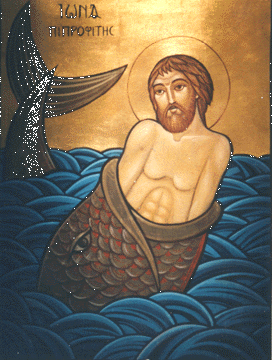
At each Feast, a special Book is read, usually pointing out the universal character of the proclamation of the Reign of God. On Kippur, the Day of Atonement, one reads the Book of the Prophet Yonah. On Sukkot it became customary to read the Book of Qohelet or Ecclesiastes - the Book of the Preacher, son of David. Of course, it should be noted that "Qohelet" as "Ecclesiastes" is derived from a word meaning "Great Assembly", and the entire human community is called to celebrate God's creations.
There might be some other and very specific reasons to read this small Book on that Feast. In the first two chapters the word "vanity" is mentioned 7 times [Ecclesiastes 1:2, 14, 2:11, 21, 26]. This is a sign of plentitude and fulfillment, not a negative one as is usually considered! To the contrary, the Hebrew word is "Hevel", a small breath, vapor or air, as the breath of sinless schoolchildren and babies [Talmud Shabbat 119b]. And on that specific day the Jewish Community, as well as the Christian Orthodox Church praying to the newborn Mother of God, are like babies uttering their first cries that will allow them to develop their lungs and breath. And all believers are going through such a state : babies called to grow up in the Face of God.

HOW to contact us?