
WEEK 1 - THE ORTHODOX READINGS - [Continued from page 2]
Jesus proclaims something new that is in fact "refreshing": Good News. It is called in theology a "kerygma", the special Good Tidings as the English word refers to a period "tid" in Scandinavian languages introduces to "times, periods". In Aramaic, the word is "Karozutha", in Hebrew it is "KaRuZ [public announcement]/ "KaRoZ" [public crier, especially as concerns the public crier who announced the morning in the Temple, cf. Jerusalem Talmud Tractate Sukkot 55a]. Jesus proclaims the dawn of a new era, a new morning. At the time of His death, the rooster will also crow, but Peter will reject Him three times.
The quotation from the Book of the Prophet Isaiah 61:1 also introduces a new time measure: "an acceptable year". The Greek and Aramaic version "Shanta meqavalta" corresponds to the usual expression of the Jewish prayer "Shanat Ratzon": "a year of favour, of expansion of God's Will". This is thus a time of uncovering not secret matters but the richness of our Salvation.
Jesus announces a favourable year to certain categories of beings and people. These are daily mentioned in the Morning Prayers [Shaharit] read in the synagogue from old. These are the Brakhot HaShahar [Blessings of the Dawn] in the following order:
a] Blessed are You, Lord, King of the Universe, Who gives to the rooster ["Khesvi" is ambiguous, i.e. both "rooster" and "my conscience"] the wisdom to distinguish between night and day. It is sometimes the most difficult thing to understand and the animal appears to have a natural ability to know when it is daytime! The reknown Jewish philosopher Emmanuel Levinas used to be very astonished that God gave such skills to a simple and rather proud animal. It does not reject its mission, but Peter will reject Jesus Christ three times [Matthew 26: 34-74] and still will be atoned [John 21:15-17].
b] Who gives sight to the blind. c] Who releases [delivers] prisoners.
THE JEWISH READINGS
The Jewish Community reads the Book fo the Prophet Yonah on the Day of Atonement. This is the rule in the Hebrew Tradition to read one of the five small Megilot [Scrolls] on each major Feast, for example the book of Ruth on the Feast of Tabernacles. It points out the outstretching of the Good News of Salvation to the whole of mankind.
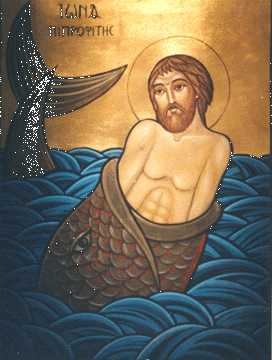
Yonah is a normal man. He would have preferred to go on vacation to Tarshish, the nice relaxing area of his time. Finally, he accepts God's proposition and goes to Niniveh, the sinful city. On the way, he has to explain that he is God's herald to the sailors , who out of fear cast him into the sea. A big Fish shelters the Prophet and vomits him out onto dry land after three days and nights. This is the sign-miracle of Yonah, which we explained as concerns the aim of our website.
PARALLELS BETWEEN CHRISTIAN ORTHODOX AND JEWISH TRADITIONS
At the beginning of this liturgical year, which implies the re-strengthening of our praying capacities, the problem is to know how we consider Jesus Christ. Yom Kippur Day is a specific proclamation of the Reign of God., In Matthew 16:16, Simon-Kaipha [Peter] gives THE answer saying: "You are the Messiah". On this particular day, the disciple proclaims in Jesus the 'Shem HaMeforash', the Unspeakable Name, the Name set apart of God, revealed in His Son.
Jesus says then to Peter: "Blessed are you, Simon Bar-Yona, for flesh and blood has not revealed it unto you, but My Father Who is in Heaven. And I say unto you: you are Kaipha [Stone in Aramaic, Petrus in Latin] and upon this rock I will build My Church and the Gates of Hell shall not prevail against it.
And I will give unto you the keys of the Kingdom of Heaven; and whatsoever you shall bind on earth shall be bound in Heaven; and whatsoever you shall loose on earth shall be loosed in Heaven".
Jesus said these words to Peter six days before the Feast [of Tabernacles] as shown in Matthew 17:1. Many theologians connect this confession by Peter with the proclamation of the Kingdom which concludes the Day of Atonement.
Moreover, Jesus introduces a new era, as at the time of the renewal of the celebration in the Temple under Ezra as mentioned in the Book of Ben Sirach the Wise 50:1: "This was Simon, Bar Onias [= Yona], the High Priest, who during his lifetime rebuilt the House [the Temple] and strengthened the Sanctuary."
In the time of Judgment two Kayphas are acting in the presence of God. The High Priest Kaipha who said to Jesus: "I adjure you by the Living God to tell us whether you are the Christ, the Son of the Living God. Jesus said to him; you have said that I say unto you; 'Hereafter you shall see the Son of Adam sitting on the right hand of power coming in the clouds of heaven' " [Matthew 26:63].
At the time of Judgment, both Kayphas, the High Priest and the Apostle Peter reject Jesus Christ.
TO CONTINUE TO PAGE 4 PLEASE PRESS HERE

HOW to contact us?