
SPECIAL SUPPLEMENT:
HANUKKAH, THE DEDICATION OF THE TEMPLE
THE FEAST OF THE LIGHTS: Friday, November 29th, 2002 - Kislev 24th, 5763
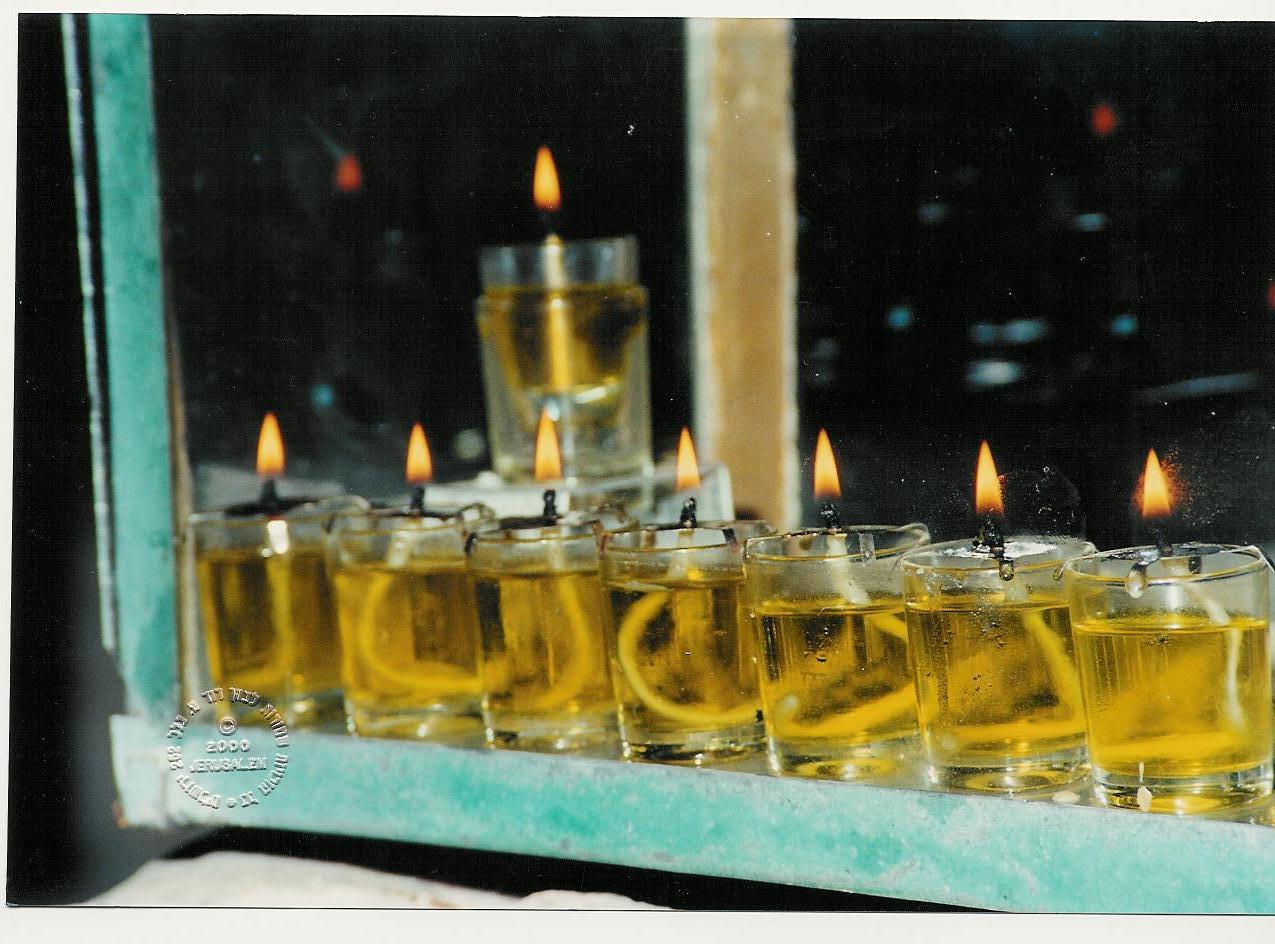
This week, i.e. from Friday evening Kislev 24th, the Shabbat itself Kislev 25th down to Tevet 2nd [December 7th, 2002], the Jewish Community will celebrate the Feast of Hanukkah, the feast of the dedication-purification of the Temple or the feast of the Lights.
Since the Greek Orthodox Patriarchate of Jerusalem is located in the State of Israel and that a large part of our Orthodox believers are Israeli citizens of whatever origin, it is important to link this festival to our spiritual care for local faithful.
It is a popular festival, somehow compared to Christian Christmas, a time of joy and presents made to children and the elderly, the needy, especially when all the inhabitants of the Holy Land are going through hard tribulations.
In 167 B.C. the Syrian-Greek Emperor Antiochus Epiphanes decided to destroy the Jewish way of living by imposing a ban on three major "mitzvot" [Commandments] of the Torah:
a] To cancel the sanctifying of the New Month [Rosh Hodesh];
b] To abolish the Brit-Milah [circumcision] the sign of the Covenant with Abraham; and
c] To suppress the celebration of the Shabbat, the day on which the Jewish Community recognizes that God is the Creator of the Universe and that He gave his Law [Torah] in order to comply with His Will.
The High Priest Matityahu ben Yohanan, from the town of Modi'in decided to fight Antiochus in order to preserve the values. He had no arms or supplies and was not a soldier, nor were his five sons: Yonathan, Shimeon, Yehudah, Elazar and Yohanan. They succeeded in gathering many fighters who joined them, the so-called Hasmoneans [Hashmona'im in Hebrew, maybe from "hashman", i.e. "exceptional leader], also named "Maccabee" which is usually considered as an acronym of the Hebrew verse repeated in many prayers: "Mi kamokha be'elim HaShem" [Who is like You among the gods, O Lord?, comp. with Psalm 86:8]. They evicted the oppressors after three years of harsh struggle but the victory was mainly a spiritual miracle. They took over the Temple of Jerusalem and needed to purify and to re-dedicate it. They found a single cruse of olive oil and could light the lamps of the menorah [candelabra, a "lamp" in Modern Hebrew], which burnt for eight days in a row.
The miracle of the light showed at that time the importance of spiritual struggle and resistance, which are still very much an up-to-date challange. We might often give up our religious forces and abandon the Word of God.
There are two ways in destroying a community of faithful and this concerns not only the Jewish Community but also the Christians:
a] Physical annihilation as the Jews were exterminated during World War II at the time of the Shoah [reduction to nothing] or Hurban [catastrophe] and prevously mentioned in the Bible in the small scroll of Esther. This is the Feast of Purim.
b] Cultural annihilation, which is often very subtle and not very clear to determine and the purifying of the Temple by the Hasmoneans shows this particular kind of spiritual behaviour giving to God the right and first place. In the Christian world this is very similar to the spiritual resistance of the saints and martyrs throughout history, especially over the 20th century.
The first step of the struggle conducted by the Maccabees ended on 25 Kislev and this is one of the explanations given for the name of the Feast: Hanukkah, i.e. "HaNUKH" = "the rested [on the KH: 25]".
In fact the word is mentioned in the Second Book of the Maccabees since Hannukah is "dedicatin, innauguration" as referred in the Talmudic Tractate Shabbat 21b. The original root in HaNaKH which means: a] to train, initiate, educate a child by "rubbing" the brain; b] to inaugurate.
Thus "KHUKH/KHOKH" means both "to rub, scratch" and as an onomatopoeia: "to laugh", the same laugh expressed by the name Itzhak-Isaac as a sign of the Redemption
TO CONTINUE TO PAGE 2 PLEASE PRESS HERE

HOW to contact us?