

READING 10 - THE ORTHODOX READINGS - CONTINUED FROM PAGE 2
apologize or even would not make an excuse, or they built up fences among themselves and thus between mankind and God, not to share a meal or they refuse others. Just before the beginning of this weekly pericope, Jesus said: "When you make a dinner or a supper, call not your friends, nor your brothers, nor your kinsmen, nor your rich neighbours; lest they also bind you again and recompense you... When you make a feast, call the poor, the maimed, the lame, the blind and you shall be blessed; for they cannot recompense you; for you shall be recompensed at the resurrection of the just". [Luke 14:12-14]
The essential purpose of the banquet is to show the transition from death to life and a huge number of people, having each a specific call and destiny, name, are called to witness for the resurrection of the only Just, the Son of Man, Our Lord Who rose from the dead.
It is a real challange today to nourish people not only by distributing food - which is vital - but to share and communicate at the same table the spiritual and physical, human gifts of God's Providence.
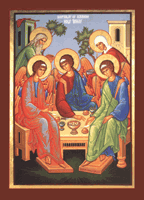
The Christian Orthodox tradition insists on the importance of the "trapeza" [Greek for "table"]. In the Christian speech the trapeza is not only a common table. It is the sharing of the most Holy Gifts that gathers together all believers who approach it, uttering their Names.
THE JEWISH READINGS
The Jewish Community begins to read this week the Second Book of the Five Books of Moses following the Book of Bereshit/Genesis, whose reading started at New Year [Rosh HaShanah, Jewish New Year in Spetember]. Interestingly enough, the name of the Book is completely different in Hebrew: Sh'mot [="Eleh haSh'mot...": these are the names of the children of Israel who came into Egypt...] and English and all Church denominations, i.e. "Exodus" [the "Way-out", "Exit"], the departure of the Sons of Israel from Egypt under the guidance of Moses.
The Jewish Community will point out some specific aspects of the long portion of the Torah, which shall be read this week.
a] The names of the eleven sons of Jacob-Israel who gathered with their father in Egypt ["Mitzrayim": double-fenced closed area, the first fence being human, the second spiritual]. From the very beginning, the Land of Egypt appears to be a trap.
b] The lack of memory and gratitude towards Joseph and his descendants who had saved the country. A new king came to power and wanted to exterminate and eradicate the Sons of Jacob-Israel, who did not know the Land of Canaan.
c] The exceptional circumstances of the birth and rescue of Moses, saved by the Pharoah's daughter who had the nerve to adopt ths child, knowing that he was a son of Israel.
d] The Sons of Israel are oppressed by Pharoah and "their cry came unto God Who had seen how the Egyptians oppress them". [Exodus 3:9]
e] Moses rebels and kills an Egyptian who persecuted the Sons of Israel in their slavery. He fled to the desert [Sinai], encounters Jethro, the Midianite priest and marries Zipporah who obliges him to circumcise their first-born son, Gershom.
f] God gives a special mission to Moses: to take the Sons of Israel out of Egypt and bring them to the desert "for a three day journey so that they may offer sacrifice to the Lord our Lord" [Exodus 3:18]. In fact, they could take with them gold and silver out of the country as a recompense for their 210-year labour in the country and they ask Moses' brother Aaron to make a Golden Calf.
The Jewish Community would basically draw the attention of the faithful to the fact that God rescues His people as Sons of the Patriarchs and the forefathers of the Twelve Tribes which are found in the Gospel in the persons of the twelve Disciples and Apostles and in the Book of Revelation [Apocalypses].
Thus, it is not clear whether Moses really promised to the Israelites that they will not return to Egypt and enter a new country, nor that explaining that to Pharoah he did commit a sin by lying to both Pharoah and the Sons of Israel. The main issue then is that it is a duly permitted to lie for the "shalom bayit" [peace of the house, family] for the delivery from slavery which was, par excellence a "mission impossible".
TO CONTINUE TO PAGE 4 PLEASE PRESS HERE



HOW to contact us?