The Original Homesteader
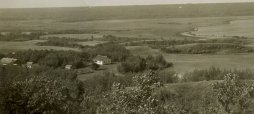
Alex Bodnaruk came to Manitoba in 1918 from Timmons Ontario with two small boys; Bill aged five and Nick aged three. Alex had been working in the Gold mines in Timmons, and after his wife passed away his health deteriorated from the quality of the air in that mining community. His doctor advised him to move away from the pollution and head for cleaner air. So he came to the Prairies and worked mostly as a farm laborer. Somehow, he found out that a dear friend of his was in the Roblin, Manitoba area and he moved there. At that time it was uncommon for a single man to keep small children. Often, such motherless children were given to another family. But Alex would not hear of it, and he kept his two small boys with him. The Scottish and English settlers in the area admired him for this, Alex warked and saved his money and for $10 Alex bought the quarter we are now on, through the Homestead Act. It was in a fertile valley with a small lake called Anderson Lake, named for an early pioneer to the area. The Assiniboine River fed the lake. Some of the family names of early settlers to the area were; Craig, Doll, Johnson, Case, Pitz, Pyott, Mitchell and Anderson.
Alex built the first house out of hand-hewn logs. It was a small structure with two tiny rooms - a kitchen and a living / sleeping area. Neighbors gave him money to put a roof on the house. He set about clearing the land; it was not treed the way it is now. Most of it was only scrub brush, as it was rather dry at that time. They got their drinking water from the creek. This was no easy feat, as it is a very steep approach to the creek. He had one milk cow and because there were no fences, he only got milk when the cow was close by and had not wandered too far away. Hard work and the pioneer spirit made his a viable little farm. He acquired four horses and more land in the valley. Although he was in poor health, he made the farm pay off.
Alex married Maria Fodoriuc in 1929. She had immigrated to Canada in 1928 leaving her former husband and only child in Romania. In 1935 her ex husband, sensing that war was imminent, sent their daughter Dora to live with her mother in Manitoba.
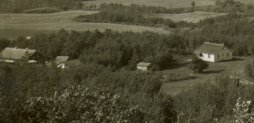
Alex, Maria and Dora slept in the little log house while the two boys slept in a granary. In 1937, they decided to build a better house (this is the house that is currently our home). Bill sent his two sons into the bush to bring back trees, and then they cut them into boards for the house. It is constructed using vertical logs spaced about 16 inches apart with horizontal logs making a ladder type look. It was then filled with straw and mud with some manure thrown in for for binding. There is a full one-inch shiplap on the exterior covered by wood siding. The walls are a good eight inches thick. The interior walls were then plastered to make them smooth. The house was very cool in the summer and in the wintertime, once the walls have warmed, up the house stayed remarkably warm for a long time. Even with no heat on in the house, it is cool but not too cold. The house had three bedrooms, a kitchen, living room and pantry. It had a dirt basement and there was no running water in the house.
In May of 1939 at 53 Alex passed away. Bill and Dora were married in November of the same year. They remained on the farm and settle into life on the farm. With time, their family grew to include one son and three daughters.
Bill had been digging holes all over the yard looking for water but could not find any. A friend who worked for the railroad at Russell, Manitoba was visiting one day in 1945 or 1946 and asked Bill what he was doing. He told him "looking for water". The friend went out and cut a willow branch, made a divining rod and proceeded to look for water with it. His diving rod pointed to the ground approximately 25 feet from the house. He told Bill to dig there, and so Bill began to do so. He ran out of money for cribbing and had only dug down eight feet by the time his friend next visited. Having an 8-foot hole in the yard was no end of problems for Bill. Time and time again, he had to rescue his cats, which would fall into the hole. His friend encouraged Bill to keep digging and offered to loan Bill money to purchase cribbing. Once again Bill began digging, this time down to 17 feet. Discouraged, Bill gave up on this dry hole. But one day he was walking from the barn to the house after checking on a cow ready to freshen. As he got near the hole in the ground, he heard a splashing sound and looked down. Low and behold, water was running in the side of the well. Bill made a mad dash to town for material for cribbing. At long last they had a well and it was right beside the house. They hand pumped water from this well until 1955. It caved-in sometime in the early 90's and was replaced with an 80 foot deep well. While the water from the deep well is usable it has a sulfur aroma and stains whites in the laundry. more farm history |