|
The
wolf is a carnivorous mammal of
the genus Canis in the dog family.
Once distributed over most of the
Northern Hemisphere,
wolves are now confined to the wilder
parts of a reduced range.
Three wolf species (the gray wolf, red
wolf, and coyote) are generally
recognized,
although there is much local variation
within them.

Other living members of the genus Canis
are the jackal and the dog.
All Canis species can interbreed,
producing fertile offspring;
the Eskimos have interbred wolves and
dogs to produce hardy animals for
pulling sleds.
The maned wolf, Chrysocyon
brachyurus,
found in wooded areas of central South
America, is not a true wolf,
although it is a canine (member of
the dog family).
It has extremely long, stiltlike
legs and an erectile mane on the neck.
Strand wolf is a name for the
brown hyena (not a canine) of Africa.
The aardwolf is also a member of
the hyena family.
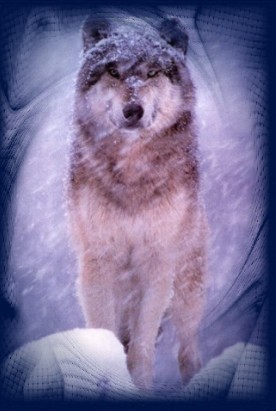
The most widespread is the gray wolf, C.
lupus, of circumpolar distribution;
it is also known as the timber
wolf in North America.
Extinct in W Europe except in a few
isolated pockets,
it is still found in SE Europe, Russia,
and much of Asia.
In the New World it is found in
wilderness forests and tundra from
Greenland and the shores and islands of
the Arctic Ocean to the extreme N United
States.
There is a healthy population in Alaska,
but it has endangered-species status
in the 48 contiguous United States
(except for Minnesota, where it has a
“threatened” status).
Thus protected, it is now steadily
increasing its range,
especially in the Great Lakes
region in Minnesota, Wisconsin, and
Michigan.
Despite the opposition of area
ranchers, small populations of
Canadian wolves were reintroduced
into Yellowstone National Park in 1995,
in the hope of restoring balance
to the Yellowstone ecosystem.
Canadian wolves were also introduced in
central Idaho in 1995 and 1996,
and natural reproduction has since
steadily increased the numbers of both
populations.
Wolves in these areas could be
reclassified from endangered
to threatened status if conservation
successes continue.
A comparable wolf recovery program for
the NE United States
was under consideration by federal
officials in the late 1990s.
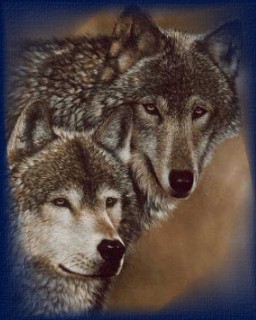
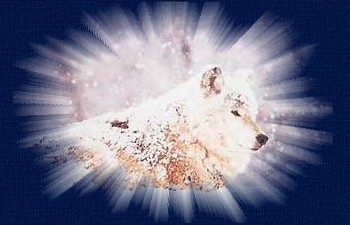
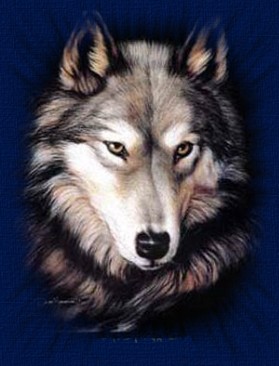
The gray wolf is similar in appearance
to a German shepherd dog, with a thick,
shaggy coat, erect ears, and a
bushy tail.
Its fur is usually gray mixed with black
and brown but may be nearly black or,
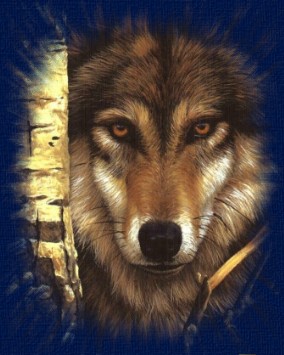
in the Arctic, nearly white.
An average-sized adult male is about 3
ft (90 cm) high at the shoulder and 4 ft
(120 cm) long,
excluding the tail, and weighs
about 100 lb (45 kg); some individuals
weigh twice as much.
Active mostly at night, gray wolves prey
on birds and small
mammals and on weak members of larger
species, such as deer;
they also eat vegetable matter and some
carrion.
They can run at speeds of up to 35
mi (56 km) per hour and can clear 16 ft
(4.9 m) in a single bound. While hunting
they can maintain a speed of about 20 mi
(32 km) per hr for many hours,
eventually wearing down even the
swiftest prey.
They roam over large areas and may
migrate in response to migrations by or

numerical fluctuations in their
prey species.
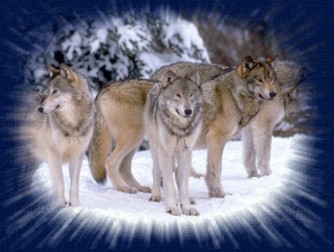
Gray wolves hunt singly and in family
groups,
called packs, which typically include
about five individuals.
Under severe conditions, especially in
winter, several families may join
together,
forming a pack of up to 30
individuals, rarely more.
During the mating season a wolf pair
establish a den, usually in a cave or
underground burrow,
in which they raise the young; both
parents bring home food.
A pair is believed to remain mated for
life.
Because of farmers' fears of raids on
livestock,
which wolves usually take only
when wild prey is unavailable,
gray wolves have been hunted
ruthlessly,
resulting in their extermination in all
but the most sparsely populated areas.
North American gray wolves have not been
known to attack humans without
provocation,
although Siberian gray wolves have
on occasion attacked riders of horses or
horse-drawn vehicles. There are many
stories of human children being raised
by gray wolves,
particularly in India, but none
has been authenticated.
The
red wolf, C. rufus, is a smaller species
that varies in color from reddish gray
to nearly black.
It has been nearly eradicated from
most of its range in the forest
and brush country of the S central
United States and is listed as
endangered.
However, captive breeding programs are
slowly increasing its numbers,
and some have been reintroduced to the
wild.
The red wolf is similar in behavior to,
and may be a hybrid of, the prairie
wolf,
C. latrans, better known as the coyote.
Smallest of the wolves, coyotes are
still widespread in W North America.

|