| Home | AboutMe | Paintings | DreamGirl | India | PhotoAlbum | Friends | Linux | Guestbook |
Position:- India, that is Bharat, lies in South Asia between latitudes 8 degree 4' and 37 degree 5' North and longitudes 68 degree 7' and 97 degree 25' East. It is bound on the South-West by Arabian Sea and on the South-East by the Bay of Bengal. On the North-East & North-West lie Himalayan ranges. The Southern tip, Kanyakumari is washed by the Indian Ocean.
Area:- It covers a total land area of 32,87,782 sq.
kms., measuring 3214 kms. from North to South and 2933 kms. from East to West.
It has a land frontier of 15200 kms and a coast line of about 6100 kms.
excluding Lakshdeep, Andaman & Nicobar islands.
Total number of States:- 29
Total number of Union Teritories:-
7
The
Constitution :- The Constitution was adopted by the Constituent
assembly on 26th Nov, 1949 and came into being on 26th January, 1950.
Facts :-
- The first President of Constituent assembly was Dr. Rajindra Prasad.
- The Chairman of the Constituent assembly was Dr. B.R.Ambedekar.
- The draft constitution contained 315 articles & 8 schedules.
- The final constitution came with 395 articles & 8 schedules.
PREAMBLE of the constitution reads as :-
WE THE PEOPLE OF INDIA, having resolved to contitute India into a SOVEREIGN SOCIALIST SECULAR DEMOCRATIC REPUBLIC and to secure to all its citizens
JUSTICE social, political and economical;
LIBERTY of thought, expression, faith, belief and worship;
EQUALITY of status & of opportunity; and to promote among them all
FRATERNITY assuring the dignity of the individual and the unity and integrity of nation.
Population:- One
Hundred Crore (approx. +50 per second)
Density :- 267 per sq.
kms
Literacy
Rate:- Males:- 63.86%, Females:- 90.5%
Its highest
in Kerala and lowest in Bihar
Among women, lowest literacy rate
is 20.84% in Rajasthan.
Sex Ratio:- 929 fair sex/1000 males
National Flag:-
 The flag is a horizontal tricolour in equal
proportion of deep saffron on the top, white in the middle and dark green at the
bottom. The ratio of the width to the length of the flag is two is to three. In
the centre of the white band, there is a wheel in navy blue to indicate the
Dharma Chakra, the wheel of law in the Sarnath Lion
Capital. Its diameter approximates the width of the white band and it has
24 spokes. The saffron stands for courage, sacrifice and the spirit of
renunciation; the white, for purity and truth; the green for faith and
fertility. The national flag was adopted by the constitutent assembly on 22nd
July 1947.
The flag is a horizontal tricolour in equal
proportion of deep saffron on the top, white in the middle and dark green at the
bottom. The ratio of the width to the length of the flag is two is to three. In
the centre of the white band, there is a wheel in navy blue to indicate the
Dharma Chakra, the wheel of law in the Sarnath Lion
Capital. Its diameter approximates the width of the white band and it has
24 spokes. The saffron stands for courage, sacrifice and the spirit of
renunciation; the white, for purity and truth; the green for faith and
fertility. The national flag was adopted by the constitutent assembly on 22nd
July 1947.
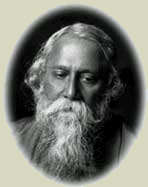
National Anthem:-The song 'Jana-gana-mana' composed by Rabinder Nath Tagore was adopted as National anthem of India on 24th, January 1950.
 Jana-gana-mana-adhinayaka, jaya he
Bharata-bhagya-vidhata
Punjab-sindhu-gujarata-maratha-
Dravida-utkala-banga
Vindhya-himachala-yamuna-ganga
Ucchhala-jaladhi
taranga
Tava subha name jaage
Tava subha ashisha
maange
Gaahe tava jaya gaatha.
Jana-gana-mangala dayaka, jaya
he
Bharata-bhagya-vidhaata,
Jaya he, Jaya he, Jaya he,
Jaya Jaya Jaya, Jaya he.
The playing time of the full version of the national anthem is approximately 52 seconds. A short version consisting of first and last lines of the stanza (playing time approximately 20 seconds) is also played on certain occasions.
The following is Tagore's English rendering of the anthem: Thou art the ruler of the minds of all people, dispenser of India's destiny. Thy name rouses the hearts of Punjab, Sind, Gujarat and Maratha, of the Dravida and Orissa and Bengal; It echoes in the hills of the Vindyas and Himalayas, mingles in the music of Jamuna and Ganges and is chanted by the waves of the Indian Sea. They pray for thy blessings and sing thy praise. The saving of all people waits in thy hand, thou dispenser of India's destiny. Victory, victory, victory to thee.
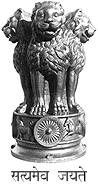 The National Symbol is an adaptation from the Sarnath Lion Capital of Emperor Ashoka, who ruled from 272 BC to 232 BC. In the original pillar, there are four lions, standing back to back, mounted on an abacus with a frieze carrying sculptures in high relief of an elephant, a galloping horse, a bull and a lion separated by intervening wheels over a bell-shaped lotus. Carved out of a single block of polished sandstone, the Capital is crowned by the Wheel of Law (Dharma Chakra).
In the State Emblem adopted by the Government of India on January 26 1950, only three lions are visible, while the fourth is hidden from view. The wheel appears in relief in the centre of the abacus with a bull on right and a horse on left, and the outlines of the other wheels on the extreme right and left.
The bell-shaped lotus has been omitted. The words Satyameva Jayate from Mundaka Upanishad, meaning 'Truth Alone Triumphs', are inscribed below the abacus in Devanagari script.
National Animal:- Tiger
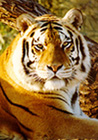 The magnificent tiger, Panthera tigris (Linnaeus), is a striped animal. It has a thick yellow coat of fur with dark stripes. The combination of grace, strength, agility and enormous power has earned the tiger its pride of place as the national animal of India.
Out of eight races of the species known, the Indian race - the Royal Bengal Tiger - is found throughout the country except in the north-western region, and also in the neighbouring countries, Nepal, Bhutan and Bangladesh. To check the dwindling population of tigers in India 'Project Tiger' was launched in April 1973.
So far, 23 tiger reserves have been established in the country under this project, covering an area of 33,126 sq.kms., where an estimated 3000 tigers now roam free.
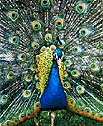 Male bird of species P.
cristatus, is a native of India, with striking plumage and upper tail
converts marked with iridescent ocelli, able to expand its tail erect like fan
as ostentatious display. Peacocks are related to
pheasants.
Male bird of species P.
cristatus, is a native of India, with striking plumage and upper tail
converts marked with iridescent ocelli, able to expand its tail erect like fan
as ostentatious display. Peacocks are related to
pheasants.
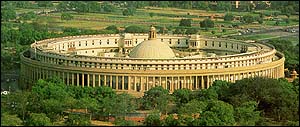 The Indian Parliament is the supreme legislative body of India. The first elected Parliament came into being in April 1952, after the first elections under the new Constitution of India. The Parliament comprises of the President, and the two Houses - the Lok Sabha (House of the People) and the Rajya Sabha (Council of States).
The Rajya Sabha or the Council of States consists of 250 members, of which 12 are nominated by the President from amongst persons having special knowledge or practical experience in the fields of literature, science, art and social service. Elections to the Rajya Sabha are indirect, and it is not subject to dissolution. One-third of its members retire on the expiry of every second year.
The Lok Sabha or House of the People is composed of representatives of the people chosen by direct election. The maximum strength of the House envisaged by the Constitution is 552. The term of the Lok Sabha, unless dissolved, is five years from the date appointed for its first meeting. However, while a proclamation of emergency is in operation, this period can be extended by the Parliament by law.