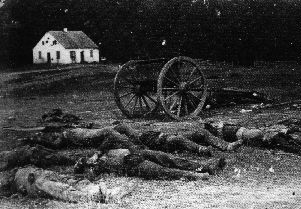
The 27th NC at Sharpsburg
A Brief History of the 27th NC at Sharpsburg taken from a manuscript by H.Z.Bogue III.
On September 28, 1861 by the direction of the govenor, ten companies of militia were organized at New Bern into a military organization officially designated the 27th North Carolina Troops.
The regiment first served as security forces, with companies located in several newly constructed fortifications along the south banks of the Neuse River, below New Bern and at
Fort Macon.
In August 1861 war came to North Carolina.
On August 27, as Federal General Ambrose E.Burnside captured Fort Hatteras on the Outer Banks, Confederate troops were reinforcing their defensive works at New Bern, bracing themselves for a fight that would determine who controlled the coastline north of Wilmington.
On March 14, Burnside landed thirteen seasoned regiments below New Bern and quickly engaged six poorly equipped North Carolina regiments. With support from artillery and naval gunboats, the Federals broke the Confederate line in the center and won a decisive victory.
The 27th NC had been located on the far left of the line, their flank resting on the Neuse River. When the center collapsed, it was reported that many in the regiment never fired a shot, but bolted to the rear in panic. The disorganized retreat did not stop until the spooked regiments reached the outskirts of Kinston. New Bern remained in Yankee hands until the end of the war.
The 27th had been humiliated in it's first action. The defeat had occured on native soil and frightfully close to the homes of many of the regiment's soldiers. The regiment was disgraced as was the Old North State.
By May 31, the Army of the Potomac had landed at Fort Monroe, Virginia and was pressing up the peninsula on the north side of the James River, within sight of the church spires of Richmond. Confederate President Jefferson Davis appealed to all governors for reinforcements. In response, the 27th boarded cars in Kinston and went to Richmond, where it was integrated into the Army of Northern Virginia.
The regiment saw this as an opportunity to avenge the result of their first battle. This was not to be. Now in a veteran army of great acclaim, the 27th was a regiment of poor reputation. Confederate generals , many of whom had never lost a battle, thought little of the men who had panicked at New Bern. Morale was again dashed when the men were turned away from the sound of battle and marched south toward Petersburg where they were relegated to picket duty along the James River.
Yet again on August 26th, the morale of the 27th was crashed when they were told that they would not be called upon, so they waited and only heard the glowing reports of the great victory at Second Manassas.
General Robert E.Lee was now beginning his movement to the northwest, the Maryland campaign was underway. A week of hard marching brought them to Fredrick, Maryland where they were assigned to Manning's Brigade, Walker's Division, of Longstreet's Corp.
On September 12th, the 27th marched to Harpers Ferry where it occupied Loudon Heights, supporting General Jackson's seige of the Federal garrison there. From there they were ordered to the town of Sharpsburg, Maryland.
I won't go into great detail setting up the battlefield, we all know the story. This narrative will focus only on the 27th and it's involvement in that the bloodiest single day in American history.
About 3:00am on September 17th, the regiment as a part of Walker's Division, was marched from just west of the town of Sharpsburg, in a light rain, southeast where they took up defensive positions close to Antietam Creek. They were postioned as the last regiment on the far right flank of the army.
At 9:00am, after the disaster of Miller's cornfield and the continued momentum of the Federal troops through the North and East Woods, General Lee gambled by stripping his right to save his left. He dispatched urgent orders for Walker's Division to displace from the right with all deliberate speed and move to Jackson's support.
In their haste to Jackson, Walker was informed, by a staff officer, that a gap existed in the army line between the southern point of the West Wood, near Dunker Church, and D.H. Hill's men.
Walker detached the 27th NC and the 3rd Arkansas of Mannings Brigade and placed them under the orders of Colonel John R. Cooke, of the 27th.
Colonel Cooke ordered his newly created light brigade, about 700 men, forward to fill the gap where S.D. Lee was withdrawing his artillery. He brought them to a halt, behind a wooden rail fence about 50 yards from the Hagerstown Pike which offered little protection from the musket and cannister fire from the pickets if the Union XII Corps.
To Cooke's left was the south point of the West Woods, which was held by Jackson, and Dunker Church. About 200 yards on his right were the regiments of D.H. Hill's Division that made up the center line of the army. In front lay more wooden fences and open ground that rose to a gentle crest.
Cooke's light brigade assisted Jackson against several charges made by Union Generals Tyndall, Sedgewick, and Greene who were assaulting Jackson's position in the West Woods.
During a lull in the fighting, Cooke moved his troops twenty paces to the rear, into a cornfield where they were ordered to lie down.
Hill's Division was heavily engaged in battle with with two fresh divisions of the Union II Corps from his position in the sunken road or what is known as "Bloody Lane" General Lee saw his army crumbling.
General Longstreet surveyed the the line and deduced that Cooke's command was strong enough to mount a charge at the Federal center, and sent the much awaited order for him to advance.
Around noon, Cooke pointed his sword and gave the order, "Forrr Warrrrd!" and with high pitched rebel yells, approximately 650 men scrambled over the rail fences and advanced toward the Federal center.
Clouds of smoke spread over the high ground as they endured volley after volley of musket fire from Tyndall's skirmshers. The Confederates advanced straight and true over pasture land littered with hundreds of bodies that had fallen earlier from both sides. Cooke's men never took time to realize that they were outnumbered and took four volleys for every one they delivered while on the move. The Yankee skirmishers were driven into their main line; then elements of the Federal brigade began to falter, and finally fragment into standing and retreating groups.
Cooke's charge carried over the crest and through two guns that had been brought up moments earlier. The attack wheeled to the right on the reverse slope and swept away the Union soldiers who remained. Tyndall tried twice to form a defensive line, but both crumbled as the Confederates pressed their advantage.
At one point Colonel Cooke called to 18 year old color bearer, Private William Campbell to slow the pace so the remainder of the command could keep up. With the 3rd Arkansas on the right, Campbell replied, "Colonel, I cant let that Arkansas fella get ahead a me."
General Walker observed the attack and commented. "The 27th North Carolina and 3rd Arkansas obeyed the order to charge in the face of such fire as troops have seldom encountered without running away, and with steadiness and unfaltering gallantry seldom equalled. Battery after battery, regiment after regiment, opened fire on them, hurling a torrent of missles through their ranks, but nothing could arrest there progress, and three times the enemy broke and fled before their impetuious charge."
Seven regiments of Tyndall's command were so battered they were withdrawn from action. Scores of Union soldiers who could not keep pace with the retreat ran to the adjacent field and hid behind haystacks, waving white handkercheifs. No one took time to organise those trying to surrender. The charge had assumed the character of a runaway locomotive, and now the Confederates were clearly getting too far into the Federal center.
To the right of the 3rd Arkansas stood the 1st Delaware. Now Cooke would be up against the II Corps infantry. At twenty paces the front rank of the Deleware delivered a volley. Then the regiment was ordered to attack. Their charge broke in confusion when their rear rank fired into the charging front rank. The inexperienced men lost their composure and stampeded from the field along with Battery G, 1st Rhode Island Artillery.
The valiant charge lost momentum after covering 850 yards. They had penetrated McClellan's line by 450 yards, an extroidinary accomplishment. Longstreet and Jackson had been hammering the federals all day - but only Cooke had broken through.
Click Here
For The Heroic
Conclusion.