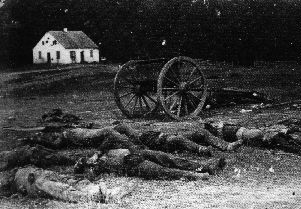
The charge had several profound effects on the events of the day. Among them 12,500 fresh troops of the Union VI Corps were sent in and 5 regiments under the command of William Irwin, about 2000 men were detached and ordered to drive Cooke from his advanced position and restore the Union center. Cooke's light brigade could muster about 550 effectives in a position that was clearly untenable. Colonel Cooke ordered a parting volley at Irwin's advance, and a rapid withdrawal toward the gap. Suddenly, the light brigade was subjected to galling fire. There was no cover for the men during the retreat, and no supporting regiments or artillery to retard Irwin's pursuit. Some of Tyndall's men who had been bypassed and tried to surrender now leveled muskets and were shooting the Confederates down as they ran past. Cooke's men were forced to go through a blistering crossfire that took a terrible toll. The movement soon lost all semblance of order and disintegrated into a desperate run to save life and limb. A dreadful semblance to the panic of New Bern. With Cooke's command streaming back in disorder, the prime question for all concerned was if the routed troops could be halted and reformed at the gap. To the observer's amazement, man by man, as if by heroic instinct, they quit their lively run at the same rail fence where it had begun. Here, fatigue and emotion forgotten. the soldiers stopped and faced about. Their practiced fingers snatched cartridges from the pouch, tore, rammed, capped and fired at the pursuing Yankees.Soon Cooke had his survivors, perhaps no more than 425, in line and delivering a disciplined fire. For fifteen minutes commencing at noon the gallantry of Cooke's small command had held the spectators of both armies spellbound. Now they were in a fierce struggle to hold their ground .......and keep their newly won pride. Irwin's five regiments began to falter at the Hagerstown Pike. They fell back to the reverse slope of the highground that Tyndall had defended earlier. General Longstreet determined that Cooke's position held the greatest jeopardy. He sent Cooke repeated dispatches telling him that his command held the key to the whole line and he must hold at all hazard. At about 1:00pm the 15th N.C. came upon the light brigade and their comander William McRae asked Cooke to share ammunition. It quickly became apparent that all cartridge boxes were empty! Disregaring this critical factor, Cooke invited McRae to stand with him at the gap. McRae accepted. No honor greater, no bond stronger than fighting men who willingly stand together with almost no hope of surviving the challenge. Another courier arrived from Longstreet telling Cooke to hold on. Cooke shouted back "Tell Longstreet to send ammunition. I have not a cartridge in my command, but will hold my position at the point of bayonet." The rider galloped off leaving Cooke little promise. Federal bullets took their deadly toll on the gray infantry. Soldier after soldier slumped to the ground clutching bleeding wounds. Nevertheless, the North Carolina and Arkansas soldiers, in the face of a greatly surperior force, obeyed Longstreet's order. Displaying their colors, they cooly remained in line armed only with empty, bayoneted guns. Longstreet, hearing of Cooke's predicament, saw two unmanned pieces of artillery of Miller's Louisiana Battery. He put his staff officers to the guns while he held the horses. It was easy to see that if the Federals broke through Cooke's line , the Confederate army would be cut to pieces and probably destroyed. He had the guns loaded and sent a rattle of hail into the Federals as they came over the crest of the hill. As the Federals would come up they would see the colors of the North Carolina regiment waving placidly and they would receive a shower of cannister fire. Once a regiment was out of ammunition, it was standard procedure for the regmient to be disengaged and replaced by a regiment from the reserve or second line. However there was not a single regiment available to relieve him. The Light Brigade stood well into the afternoon, costantly submitted to Irwin's volleys. All the defiant Southerners could do was wave their tattered flags and show the bayonet in a rash attempt to make the Union generals believe the troops in the gap were in strength and anxious to have another go. Union musket and cannon fire inflicted appalling losses on the regiment, but the North Carolinians vowed to hold the gap or go down together. For two painful hours, the troops stood to their line, empty cartridge boxes at their feet, and blood red battle flags flying defiantly above them. Around three o'clock, Captain James A. Graham, of the Orange Guards at the side of Colonel Cooke, beheld the terrible sacrifice of life. "The rail fence, which was our only protection, was riddled with bullets and torn with shot and shell and our men were falling fast, but still the 27th NC and the 3rd Arkansas flinched not. Endued with the courage of their commander, they stood firm to their post." Longstreet along with the two newly arrived 12 pounder guns of Captain M.O. Miller, continued to fire double cannister over the heads of the ragged Confederates and cruelly scored in the regiments from Maine and New York. Irwin found it a pointless waste to continue to expose his brigade to such fire. The hostilities ceased about 3pm as the two armies lay panting and licking their wounds. The 27th NC and the 3rd Arkansas had held Lee's left- center from the time they were committed, about 10 am,until all infantry action was completed. They had over- run Tyndall's reinforced brigade and penetrated deep into McClellan's center. This gallant Confederate assault, the most significant of the day, destroyed the momentun of II Corps which had shattered the Confederate center and nearly destroyed the Southern army. The regiment that had disgraced itself at New Bern; that was relegated to picket duty during the Peninsula Campaign; that was shunted to the rear guard during Second Manassas, had won unprecedented fame. Stephen Southall Douglas, in his second volume of Lee's Lieutenants refers to the 27th NC more than any other unit, describing them as "gallant", "great", "magnificent", "earned immortality at Sharpsburg"' and crowns their great success by naming them "the rock of Sharpsburg." Among the most gallant events in recorded military history is the stand made by a distinguished British regiment, the Coldstream Guards, at the Battle of Waterloo. They along with the famed Scots Guards held Wellington's right against determined attacks by superior French forces. in doing so they suffered a 27% loss. Their feat was eclipsed by the 27th NC at Sharpsburg. They held a vital position against a vastly superior enemy and refused to give ground despite a 61% loss. Read a letter by Captain Bart Johnson Jr. of the 3r d Arkansas , written about Sharpsburg after the war. Sponsored by the 3rd Arkansas/14th OVI web site. Back to Rebyll's Confederate Homepage.
Back to Rebyll's Confederate Homepage.