Dominican Republic

Antique Modern Time Line

 Antique 

Picture courtesy of
www.dominicana.com.do
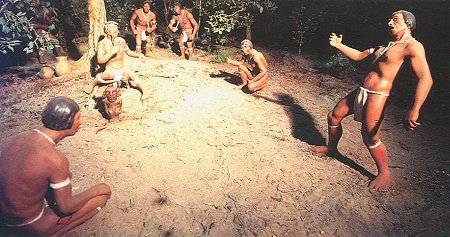
Before Christopher Columbus touched the coasts of the island in the year 1492, an unknown indigenous race called the ta�nos, which in the arawaca language means good or noble, inhabited the island from the year 800 A.D.

They were organized in tribal units that were governed daily, dedicated to a simple sedentary life, and rich in religious and agricultural traditions, the expression of their culture in this island was richest of the area of the Caribbean.
Agriculture
The Ta�nos left a great social inheritance to us, for example: several domesticated plants like yaut�a, tobacco, yam, the peanut, and corn; also yucca and the processing of game, a process that stays almost intact to the present time.

Art
The great development reached in the artistic activities and artisans was one of the features most characteristic of this society.
The preparation of an extraordinary ceramic for funeral and ritual use and the manufacture of an enormous amount of idols, amulets, and other articles of luxuries made in stone, wood, shell, bone and other materials have not survived as well as those of cotton and others (whose semi principal is in the Museum of Turin, Italy).
There have been samples of the ta�no rock art in different localities of the island such as in the caves of the Maravillas and the Pomier.
Two more important products of basketwork that are an inheritance of this pre-Columbian culture are the hammock and the knapsack.

Nevertheless, the discovery and methods of conquest exterminated this race in an approximated period of 50 years, which limited the impact of this indigenous culture on the Dominican one.

 Modern 

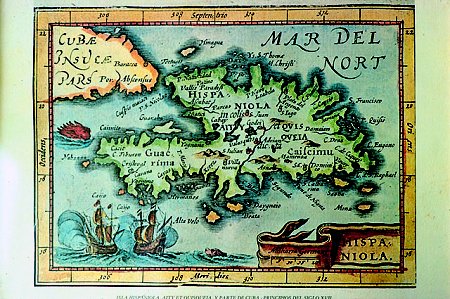
Mapa cortes�a de
www.dominicana.com.do
The Espa�ola island was the first European colony of the New World in 1492 and in its capital Santo Domingo, called the First City of America, the first colonial cultural and social institutions originated, the first forts, the first churches and the first cathedral, the first hospital, first monuments and the first university were constructed.
Until end of 16th century the Spanish island was the source of great benefits thanks to its mineral wealth and the system of the sugar plantations. Nevertheless, the auriferous mines were exhausted, which caused a wave emigration that considerably decreased the population of the colony. French buccaneers who used the island as a contraband bridge took advantage of this circumstance and they took possession of the western part where they founded the colony of Saint Domingue, based on the exploitation of plantations with African slaves.
This change in the economic system represented a variation in the social panels of the island, which, fundamentally due to the arrival of the slaves, produced a cultural fusion, that manifested immediately with the sprouting of different ethnic groups: mulattos, sambas, Latino blacks, and the mixed bloods, predominant in Latin America to the present day.
With the treaty of Ryswick in 1697, Spain tolerated France's occupation of the western part of the island.
Two nations are born sharing a same island, the western part colonized by the French, the Eastern part colonized by the Spaniards.
The division of the island caused constant wars between the colonialist powers for the predominance or the control of the island.
Toussaint Louverture invaded in 1801 the Eastern part of the island, to which France responded in 1802 by sending Leclerc, brother-in-law of Napole�n, in front of a powerful squad to demand the territory. The French governed Santo Domingo for a period of six years until being expelled by a group of Dominicans who, under the command of Juan Sanchez Ramirez, reincorporated the Eastern part to the domain of Spain.
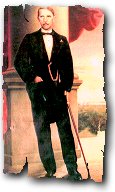
In 1822, after 12 years of relative tranquillity, Santo Domingo again was invaded by the Haitians, and it was not until 1844 that they were defeated by a group of patriotic Dominicans led by Juan Pablo Duarte, who proclaimed the independent State of the Dominican Republic. Internal differences prevented the development of the governmental institutions and a new annexation to Spain (1861-1863), caused what was called the War of the Restoration and the return to the Republic.

Juan Pablo Duarte
Picture courtesy of
www.dominicana.com.do
In 1916 and until 1924, troops of the North American infantry occupied the national territory, an occupation that returned to repeat itself in 1965 under the false pretext that the military coup of the 24 of April of that year, that it tried to replace to Juan Bosch like president, was communist. Bosch had gained the first democratic selection after the dictatorship of Rafael L. Trujillo, who had lasted 31 years.
In 1966 and until 1978 the democratic system was reinstated and the political stability manifested with elections that were celebrated every four years:
  • 1966-1978 governed Dr Joaqu�n Balaguer Ricardo, of the then Reformist Party, for three consecutive legislatures.
  • 1978-1982 governed Don Antonio Guzm�n Fernandez, of the Dominican Revolutionary Party.
  • 1982-1996 governed Dr. Salvador Jorge Blanco, of the Dominican Revolutionary Party
  • 1986-1996 governed Dr. Joaquin Balaguer again, of the Social Christian Reformist Party, during two and a half legislatures, due to the reform of the electoral system.
  • And in 1996 to present Dr Leonel Fernandez Reyna is elected. With his 43 years, and a vision of a modern government, President Leonel Fernandez has become a leader in the Caribbean, being a true promoter of investments and commerce.
Information courtesy of www.dominicana.com.do

 Time Line 
  • pre-1492 - The Arawak people inhabit Hispaniola
  • 1492 - Columbus "discovers" the island of Hispaniola and the first colony is established.
  • 1697 - The Peace of Ryswick formally cedes the portion of Hispaniola that had been occupied by French adventurers to France and it becomes known as Saint-Domingue (it is now Haiti). The remaining Spanish section was called Santo Domingo (it is now the Dominican Republic).
  • 1795 - Spain cedes Santo Domingo to France.
  • 1804 - Haiti ousts French but Santo Domingo remains under French occupation.
  • 1809 - French are expelled and nominal Spanish rule is restored.
  • 1814 - Spanish administration becomes increasingly tyrannical.
  • 1821 - Dominicans rise in revolt, proclaiming their independence.
  • 1822 - Haitian President Jean Pierre Boyer leads his troops into the country and annexes it to Haiti, thus bringing the entire island under his control.
  • 1844 - Boyer is overthrown by a revolution.
  • 1845 - Santo Domingo declares its independence, forming the Dominican Republic.
  • 1861 - The country, led by former President Santana, returns to Spanish rule.
  • 1863-1864 - A popular revolt, subsequent military reverses, and U.S. intervention forces the Spanish government to withdraw its forces and to annul the annexation.
  • 1865 - The second Dominican Republic is proclaimed in February.
  • 1906 - The Dominican government signs a 50-year treaty with the United States turning over to the United States the administration and control of its customs department. In exchange the United States undertakes to adjust the foreign financial obligations of the Dominican government.
  • 1916 - U.S. Marines occupy the country on November 29 and establish a military government.
  • 1924 - In March a constitutional government assumes control. Later that year the American occupation ends.
  • 1930 - Rafael Leonidas Trujillo Molina is elected to the presidency and presides over one of the tightest dictatorships in the world for the next 31 years.
  • 1935 - A boundary dispute with Haiti, going back to 1844, is settled.
  • 1941 - The U.S. government terminates the administration of the Dominican customs.
         - The Dominican Republic declares war on Japan, Germany, and Italy in December, shortly after the U.S. entered World War II, and subsequently becomes a charter member of the United Nations.
  • 1948 - The country becomes a charter member of the Organization of American States (OAS).
  • 1960 - OAS criticism of the Trujillo regime culminates in a resolution calling for severance of diplomatic relations with the Dominican Republic; the United States did so shortly afterward.
  • 1961 - Trujillo is assassinated on May 26.
  • 1962 - The OAS sanctions are revoked in January.
  • 1963 - Juan Bosch is elected by a wide margin and is inaugurated on February 27.
         - Bosch is deposed by a military coup on September 25 and the leaders install a three-man civilian junta.
  • 1965 - On April 24, a group within the army rebels against the government and Santo Domingo becomes the battleground of a civil war. Four days later, a contingent of U.S. Marines lands in Santo Domingo to protect U.S. interests.
         - In early May the OAS arranges a cease-fire and establishes an inter-American military force for peacekeeping duties.
  • 1966 - Balaguer, a conservative, wins the election in June. Under his administration, relative stability is restored to the country.
  • 1978 - The PRD candidate, Silvestre Antonio Guzm�n, wins the election.
  • 1979 - Two hurricanes leave more than 200,000 people homeless and cause $1 billion in damages.
  • 1986 - Balaguer is returned to the presidency after protest riots against President Salvador Jorge Blanco's attempts to rescue the country from its deepening economic crisis by raising prises on food and gasoline.
  • 1988 - Jorge Blanco is tried in absentia and found guilty of corruption during his presidential years.
  • 1996 - In a presidential runoff election held in June, Leonel Fern�ndez Reyna of the Dominican Liberation Party (PLD) defeated Jos� Francisco Pe�a G�mez of the PRD to win the presidency of the Dominican Republic.

Information courtesy of Microsoft Encarta 98

E N   E S P A � O L
Historia - La gente - Geograf�a - Cultura - Econom�a - Gobierno - Arquitectura
 
I N   E N G L I S H
History - People - Geography - Culture - Economy - Government - Architecture


Hosted by www.Geocities.ws

1