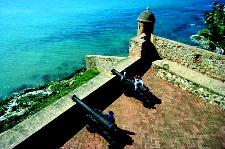
The Colonial Zone of the city of Santo Domingo is richest of the Caribbean in architecture
and memories of the colonial time: impressive monuments magnificently conserved, and fortresses and churches with the brick and
the stone changed into harmonious arcs and columns; stone alleys, streets, ruins, and impressive houses of important colonial
personages turn this zone into a wonderful vision of the past.
The Spanish heritage that subsists in the colony is in the architecture of coralline stone houses where the life revolves around
the so-called Spanish patio or central patio, complete with fountains, vegetation, and tiles that reflect the presence of the
Arabian culture in Spain at that time, and therefore in the colonial architecture of the Dominican Republic.
|

La Bas�lica de Nuestra Se�ora de la Encarnaci�n, Catedral Primada de Am�rica:
(The Basilica of Our Lady of the Incarnation, First Cathedral of America)
|
Picture courtesy of
www.dominicana.com.do
|
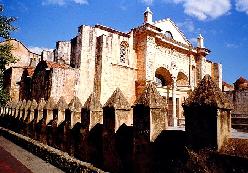
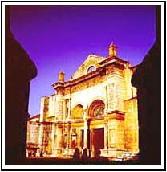
This is the most important colonial monument in Santo Domingo.
|
Picture courtesy of
www.dominicana.com.do
|
The Styles
The internal structure and the two oldest portals of this cathedral are late gothic, but with a regression to the romanesque. The mudejar style is present here, as well as Elizabethan ornamental details. The presence of the plateresque style, which dates from the Renaissance, is common and beautiful. This presence can be observed on the outer part of the cathedral, with its portal on the west side, and also in the decoration of some lateral chapels and in the choir stalls.
The Cathedral has three portals-- two portals are gothic and the third one is plateresque. The oldest portal is known by the name of Geraldini�s Portal. The style in the northern fa�ade is principally Herreriano.
Although the structure of the Cathedral is mostly gothic, the ornaments on the main fa�ade are principally plateresque.
|
General Information
The Cathedral is an unfinished monument.
The interior is 54.55 m. long and 23 m. wide. This temple has no transepts, only three naves.
|
The Chapels
The Cathedral has fourteen chapels, plus the high chapel and two altars at
the top of the lateral naves. These chapels were built gradually after the temple was finished. There are two retables at
the top of the lateral naves. One of them is the Altar of the Holy Relic and the other the Altar of Hail Mary.
|
|
El Alc�zar de Col�n:
(The Palace of Columbus)
|
Picture courtesy of
www.dominicana.com.do
|
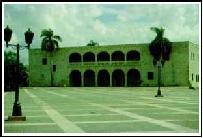
Don Diego Columbus� Alcazar, built in the second decade of the 16th century,
was the seat of the viceregal court. It was here where Maria de Toledo rendered her last will and testament in 1548. By
1770 the building had been completely abandoned and became a rubbish dump.
Unsuccessful attempts were then made to use the Alcazar as a prison. Two landslides in 1809 and 1835 left the building in
ruins. It has been restored twice--first in 1957 by specialized stonemasons, and again after 1965. As happens with almost
all of the Dominican Republics colonial monuments, lines and characters of differing styles blend in Don Diego Columbus�
Alcazar--from those pertaining to the neat and slender gothic and Renaissance periods to the most severe ones of the
classic orders. There you can find, side by side, the transparent ogive, the graceful and ornately crafted spires, coming
from the far east, and the horseshoe arch which, smoothed by the Arabs and roasted by the desert sun, also traveled to this
side of the Ocean�, says Joaquin Balaguer.
|
|
Las Ruinas del Hospital Nicol�s de Bari:
(The Ruins of the Nicholas de Bari Hospital)
|
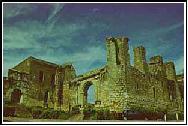
The San Nicolas de Bari hospital was a church and a health center at the
same time. This ancient construction has been completely restored.
The characteristics of the elevation and the fa�ade are known thanks to a 1783 plan. Do�a Mar�a Ugarte states:
"The transept was limited by extremely beautiful elliptical arches--one of which has been preserved--supported by strong
cylindrical buttresses with a denticulated capital. These columns raised on cubes with bevelled flutes. Gothic ribs closed
the transept ceiling."
She adds: "The central nave was used for religious cults, while the lateral naves and the section at the bottom of the
building, behind the transept, were intended for the patients."
|
Picture courtesy of
www.dominicana.com.do
|
|
La Casa del Cord�n:
(The House of Cord�n)
|
Picture courtesy of
www.dominicana.com.do
|
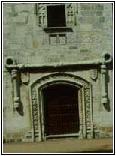
This structure is considered as the first Spanish-style house built in
America. It was built by the Conquistador Don Francisco de Garay. Tradition has it that the meetings of the Real Audiencia (the Royal Court)
were held in its large rooms for quite a long time; the Real Audiencia then moved into Las Casas Reales after 1516. The most
important feature of the house is its beautiful front door, decorated with a stone cord worn by the Franciscan order. Today
this house is a cultural center sponsored by Banco Popular Dominicano.
|
|

 Santo Domingo